2012 VOLKSWAGEN GOLF start
[x] Cancel search: startPage 295 of 516
conditions are
3. A manual transm iss ion vehic le must be in 1st
gear (1 ) i f headed up a or in Reverse (R ) if backing up a you must hold the clut ch down
and the foot brake must be depressed to keep
the vehic
le from moving.
' Rel
ease
the brake as you let the clutch out and gently depress the accelerator.
any requi rement lis ted in the tab le above is
no longer met (see 196 , ed automatically when the following conditions are all met at the same time.).
gine malfunctions .
Automatic transmission vehicles: the mission i s in Neutral (N).
Automatic transmission vehicles:
and
the foot brake must be depressed to keep the
vehic le from moving .
Relea
se the brake as you gently depress the accelerator.
cle in start situations (for example, if the surface icy or slippery).
down the
Page 322 of 516
Never open or close the engine hood if To reduce th e risk of electrica l shock and steam or coolant is escaping. Hot steam or personal injury
-Never touch ignition cables. Never ant escaping from the engine. touch other components of the high
Always the eng ine down com-age electronic ignition syste m .
opening the hood.
-Never touch the wiring of the Discharge (Xenon) headlights.
system burn skin on contact.
you are read y to open the hood: Moving parts in th e engine compartment can
- Firm ly apply the parking brake a nd shift cause serious personal injury on contact. the transmission into Park (P) (automatic)
vehicles with Keyless Access, make member that the radiator fan is temperature-
s
ure that the remote contro l vehicle key is controlled and can come on sudden ly even
out of range of th e vehicle and that the ve- when the engine
has been switched off for a
hicl e cannot be started by depres sing the 44. ignition.
-
Always keep children and others away you have to perform a check or repair from the engine compartment and never when the engine is runn ing, there are more leave them unsupervised. risks from the rotating parts, such as the
hair do not get caught in
ries. rotating engine
parts. B efore starting an y
- Turn
the cap
fluids onto hot parts of the engine o r exhaust system can
cause a fire. -
Always use
extreme caution if the ac-
ce lerato r pedal has to be depressed to perform a check. The vehicle will start to move even if the parking brake i s on.
Never leave any objects in the engine compartment, for examp le cleaning rags and tools. Objects left b ehind can cause malfunc-lions, engine damage, and even fires.
High voltage sy stems in the engine com part-ment can ca use electrica l shocks or even
electrocution, severe burns, other serious in-juries, and eve n deathl
Neve r short-circuit the electrica l syste m .
B e especially ca reful when using jumper ca-
Operating fluids and some materials in the engi ne compartment can catch fire easily, causing burns an d other serious personal in-juries
Do not smoke .
b les. The
vehicle 's battery could exp lode! Never work next to open flames or sparks .
223
Page 329 of 516
(continued)
qu ant ities ( n o mo re than 1 pint I liter).
11 . To av oid you mu st wait about 1 minute each tim e you add so that th e oil ca n n ow into the oil p an up to th e marking on the dips tick .
1 2 . Rea d the oil leve l o n th e dip s
tick aga in bef ore adding another amount , if necessary. N eve r
ad d to o muc h oi l
13 . After addin g the leve l mu st a t l ea st b e in the cent er of the 128@ ar ea, but neve r above
14 . Afte r addi ng se cu rely the cap on the eng in e oil ope ning . O th erwise , oil cou ld lea k out
w hil e the engine is run nin g .
1 5 .
the guide tube and p ush it
in Introd uct ion on page 222.
Engine oil
oil
R an ge @ You
may add oil (a bo u t 1 pint/ The oil leve l may go i nto the ran ge , b ut
no t ab ove the range .
R an ge @ You
mu
st ad d oil (abo ut 1 qu art Aft er add in g oil, make sur e th at th e oil le v-
e l is ab out in the middle of the @ ran ge.
Engin e can ignite when it touc h es hot en-
g in e parts. Thi s can caus e fires, burns, and
o th er se vere injuries.
spille d on a cold engine ca n also cau se a fire whe n th e engine warm s up.
op eni ng b ack o n tightly after adding oil and that th e dipstick
h as bee n pu sh ed
on p ag e 2 27.
Do not start the eng in e if the en gi ne oil leve l
i s abov e rang e@ . Contact an authorized
Volkswag en dealer or an authoriz ed V olkswa-gen F acility. the ca tal ytic converter and engi ne can be damage d
oil leve l sh ould neve r be abo ve
r a nge A . O th erwise oil can be draw n in by
the crankcase venti
lation sys tem and ent er t he at-
m osphe re v ia th e exha ust syste m .
Un der nor mal co
ndit ions , th e ra te o f oil consump
t io n d epe nds on o il qu alit y as as viscos ity, e n
gi ne speed (rpm) , o ut side tem pe ra tur e, road cond i
t io n s, th e amou nt of
oil d il u tio n ca used by co n
d ensed water or fuel res idu e, and ox idat ion of t he oil. co nsump tion may incre ase with engine
wea r over time , unt il replacement of wo rn en gin e
p arts m ay beco me nec essary .
terna l eng ine part s, in tern al co mbustion engines
u se so me o il. cons umpt ion var ies from engine
t o e ngine and m ay cha ng e ov er the li fe o f the en
g ine . En gin es ten d to use more o il d uring the
b re ak -in perio d than they do aft erwa rd, when oil
c on sumption has stabilized .
Volkswage n reco mm en ds that you t o ch ec k the en
gin e oil lev el a t r egul ar int erv als , p re fe rably e very tim e yo u the ta nk, and always be fo re a long
Care, c leaning, maintenance
Page 335 of 516
Checking engine coolant level and topping off
Fig. 13 1 Coolant expan sion tank in the engi ne
compartme nt.
Please first read and note the introductory Information and heed the WARN on page 233.
Park the vehicle on level ground .
Always let the engine down
the engine hood in Introduction on
page 222.
There is a sy mbol on the cap of the engine coolant expans ion tank 132 .
Checking engine coolant
When the engine is cold , check the engine
coolant level relative to the marking on the side of the expansion tank 13 1.
the coolant level in the tank is below the mini
mum mark ("min"), add coolant. When th e engi ne is warm, the engine coolant level may be slig htly
above the upper edge of the marked range.
Adding engine coolant
Always protect face, hands and arms from hot
escaping coolant or steam by covering the cap
with a large , thick rag.
Carefully unscrew the cap
Add only new engine coolant according to
The engine coolant level must be inside the
marks on the side of the reservoir 131. Do not
236 cleaning, maintenance Fig.
132 Coola nt expansion tank cap in the eng ine
compa rtment.
Screw the lid tightly .
Even in an emergency , do not use any other kind of coolant additive if engine coolant meeting
add distilled water only As
soon as possible , have the correct coolant ratio re
sto red using engine coolant that meet s
WARNING
Hot steam and hot engine coolant can cau se serious burns.
Neve r open the hood you see steam or coolant escaping from the engine compartment. Always w ai t until you no longer see or hea r steam or co olant escaping from the en
gine .
opening the hood. Hot components will burn skin on contact.
Park (P) (automatic) or Neutral (manua l only).
- Take the vehicle key
out of the ignition.
-
veh icles with Keyless Access, make
sure that the remote control vehicle key is out of range of the vehicle and that the vehicle cannot be sta rted by depressing the
starte r button 44.
-
Always keep children and others away
from the engine compartment and never
l eave them unsupervised.
Page 340 of 516
Charging,
on page 238.
Charging the vehicle battery
Vehicle batteries should be charged by an author
ized Volkswagen dealer or an authorized Volkswa
gen
because the factory -installed
battery requires a charger with overload protection
Replacing the vehicle battery
The battery in your vehicle is
batteries meet
ing standards TL 825
electrical system, note the following :
off
Unlock the vehicle before disconnecting the
battery; otherwise the alarm system
Fir st disconnect the negativ e cable(-) and then the positive
Connecting the vehicle battery
Pr ior to reconnecting the battery , switch off electrical sys tems and devices and the ignition .
Connect the posit ive cable(+) first and then the
negative cable (-)
After the battery is connected and the ignition is
sw itched on, different indicator light s may come on. They should go out after you drive a short distance
ice Facility and have the checked.
th e ign ition not start after reconnecting the vehicle battery , lock the vehic le from the outside
and unlock it again. Then try to start the ignition
again.
lhe ignition cannot be switched on, con
tact an authorized Volkswagen dealer, an author
ized Volkswagen
o r another quali
fied workshop for assistance.
Automatic electrical load deactivation
onboard electrical system management auto mati takes steps to help prevent battery drain.
The idle speed is increa sed so that the alterna
t o r provides more power.
Th e power to devices that consume a lot of electricity is cut back or switched off completely.
When the engine is started, the power supply to the 12
Long periods when the engine is not running,
especially when the ignition is on .
Using electr ical sys tems or devices when the
engine is swi tched off. Leaving the
The selecto r lever is left for a long period of time in any position other than P when the ignition
is swi tched off =>page 175.
Failure to use th e proper battery with proper mounting and connection s may cause short circu its, fires, and serious persona l injuries.
Always use only maintenance-free or cy-
cle-free, leak-proof batteries with the sa me
s p ec ifications and dimensions as the original
equipment b attery. Specifications are listed
on the battery housing.
Wh en the vehicle battery is ch arged, it produ-
ces highly explosive hydroge n gas.
th e engine compartment
Page 389 of 516
at the
143 and 144. Not using the
off the
Always make sure that the vehicle's as flat as possible and centered on the carrier plates of the floor jack.
Never start the engine when you have
raised the vehicle on the floor jack. The gine vibrations and vehicle movements knock the vehicle off the floor jack.
cle
Care , cleaning , m aint enance
To
add ition make sure the lifting arms have enough
The lifting arms should not touch side or other parts of the vehicle .
Page 395 of 516
As long as the indicator lights are on, expect engine malfunctions , increased
fuel consumption and loss of engine efficiency . <1
tory information and heed the on page 295.
T he
catalytic converter provides exhaust gas lrealmenll o help reduce pollutants in the exhaust
gas . To help ensure long service life of the exhaust
system and gasoline engine catalytic converter :
use unleaded fuel.
Neve r comple te ly empty the fuel la nk .
Do not exceed the corre ct oil level 227 .
Do not low the vehicle to start it, but use a
j u mp-start instead 327.
Care, cleaning, maintenance
you expe rience misfire s, loss of power or th e
Facili ty. Otherwise , gasoli n e
could reach the exhaust system and gel into the
atmosphere . The catalyt ic converter could also be
damaged
by overhea ting! <1
Page 403 of 516
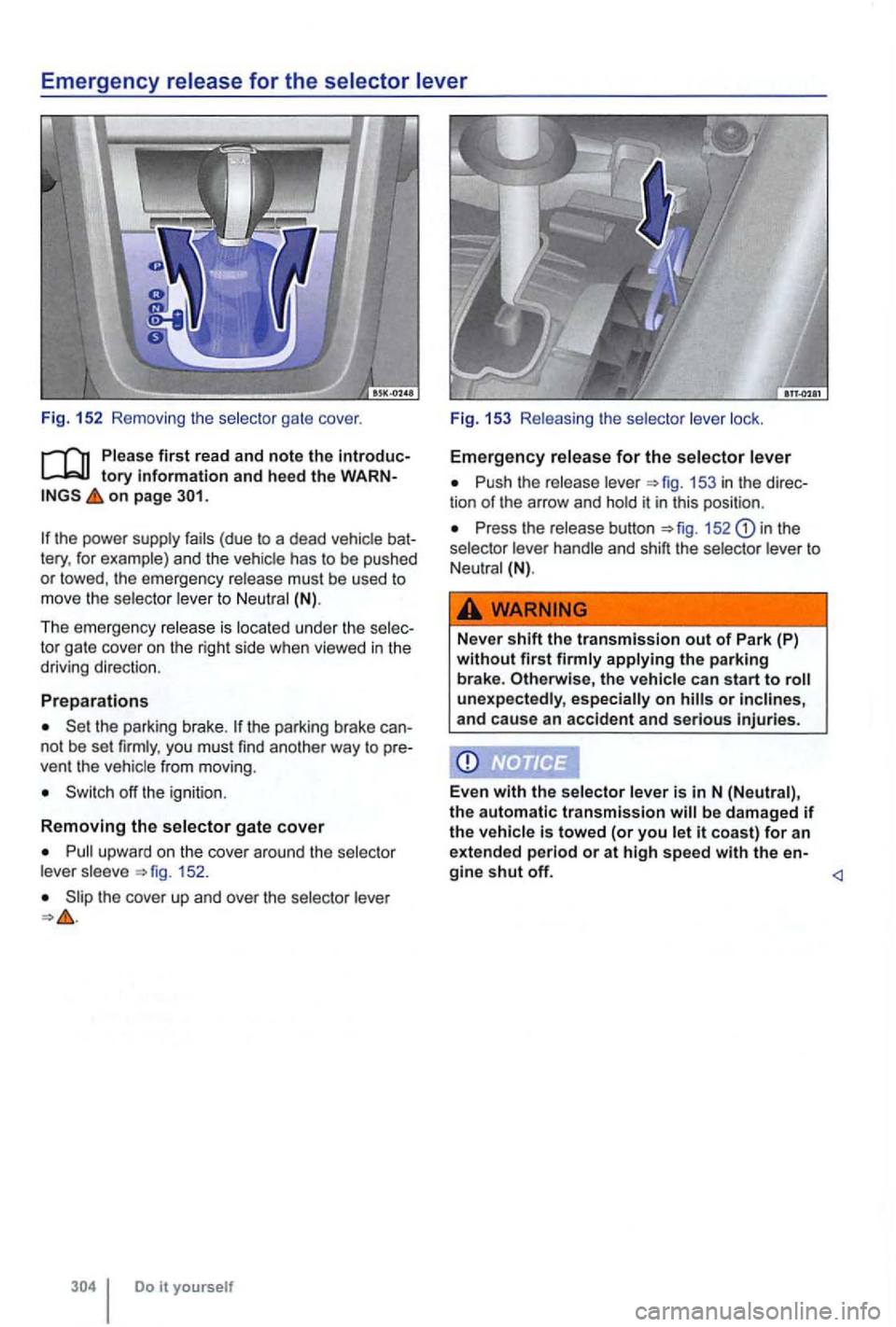
Emergency
on page
the power supply fails (due to a dead vehicle bat
tery , for example) and the vehicle has to be pushed or towed , the emergency release must be used to move the selecto r lever to N eutral (N).
Th e emerge n
cy release is located under the selec
tor gate cover on the right side when viewed in the
driving direction .
Preparations
Set the parking brake. the parking brake can
no t be set firmly , you must find another way to pre
vent the vehic le from moving .
Switch off the ignit ion.
Removing the selector gate cover
Pull upward on the cover aroun d the selec tor
lever sleeve fig. 152 .
Slip the cover up and over the selector lever
Push the release lever 153 in the direc
t ion of the arrow and hold it in this position .
Press the release button fig. 152 the
selector lever handle and shift the selector lever to Neu tral (N) .
WARNING
Never shift the tran smi ssion out of Park (P) without first firmly applying the parking
brake . the vehicle can start to roll unexp ectedly, especially on hills or inclines,
a nd cause an accident and serious injuries.
Ev en
with the selector lever is in N (Neutra l), the automatic transmission will b e damaged if the vehicle is towed (or you let it coast) for an extended period or at high speed with the en-
gine shut off.