2012 VOLKSWAGEN GOLF fuel
[x] Cancel search: fuelPage 235 of 516
you use the right outside mirror to judge distance s from vehicles behind you when
changing lanes, you could estimate incorrect
ly and cause a crash and serious injuries.
Whenever possible, use the inside mirror to more accurately judge distance and size of vehicles or other objects seen in the convex
mirror.
Always make sure you have a clear view to the rear of the vehicle.
136 Before driving Always
fold
in the outside mirrors when taking the vehicle through an automatic car wash.
To reduce fuel consumption , use outside mirror heating only when needed.
When first switched on, outside mirror heating works with maximum heat for about 2 mi
nutes .
outside mirrors can be adjusted by hand by
pressing on the edges of the mirror surface .
Page 245 of 516
Roof rack
Introduction
this sectio n find informa tion about:
Mo unt in g the roof rack base carrier and roof
rack
................................... 147
Securing a load on the roof rack . . . . . . . . . . . 148
The ro of o f your vehicle has been designed to
approv ed base carrie r mounts and roof racks can
be used .
When should the roof rack be removed?
When it is no longer needed .
Before driving through an automatic car was h.
When the vehic le wou ld otherwise be too high
t o ach ieve min imum clearanc e to enter, for
ple, a garage .
More information:
Lights
Transporting 137
Saving fuel and helping the envi ronment
Tires and wheels 258
283
Transporting heavy or bulky loads on the roof rack will change the way the vehicle handles by shifting the vehicle's center of gravity and
increasing the wind drag area.
146 Before driving
able and undam ag ed straps so that the load
have a negative effect on the vehicle's
aerodynamics , center of gravity and ove rall
Your vehicle is higher when the roof rack is installed , especially when it is loaded. Compare
the vehicl e he ight with existing clear ance
heights , such as underpasses and garage doors.
creases due to increased air resis ta nce.
Page 264 of 516
Explanatory notes in this section regarding tomatic transmissions Direct
an unauthorized vehicle key is used or the sys
tem mal functions , Immobilizer active! may
appear on the instrument
stead wh ile following proper and safe procedures.
More information:
Vehicle key set
Shifting gears
Braking , stopp ing and parking =>page 179
Steering 192
Startin g assistance systems
Refueling =>page 214
Emergen cy clo sing and opening
Jump-starting
Towing
off the engine while the vehicle is moving can make the vehicle harder to stop and result in loss of vehicle control, leading to collisions and severe perso nal injurie s.
To reduce the risk of serious personal injury when starting and running the vehicle's gine:
shifting, parking 165
Page 288 of 516
this section find info rmat ion about:
Effi cient driving sty le
....... . 189
Fue l-efficient driv in g . . . . . . . . . . . . . . . . . . . . .
Fuel consumpti on, envi ronme ntal impact, and wear
a nd tear on eng ine, brakes and tires depend main
l y on the
pe rsona l d riving style.
External conditions (weather , road condi tions).
Technical requir emen ts.
Efficient driving
on page 189.
Shifting faster
As a rule , th e app lies: The h igh er gear is
a lways the most e ffi cient gear . The rule of thumb
for mos t veh icles is to drive in 3rd gear at
mph
gears when upshifting also saves
Do not run the gea rs up to their lim it. Use 1st gear o nly to s tart movin g and then sm oot hly s hift into
2 n d gear. Avoid kick-do wns in vehicl es with auto
matic tra nsm issions.
Coasting
you take your foot off the accel erator, fuel de livery to the engine is interrupted , which lowers fuel consum ptio n.
Therefo re , whe n nearing a red stop for in
stance , the veh icle to coas t without usin g the
accelerator . Pre ss the peda l a nd release it
o nly if the vehicle mov ing too slowly or the coast
ing distance is too long. The engine
situa tions where the
swi tch off the eng in e.
conditions.
Freq uent braki ng and accelerat ion increase s fuel
cons umption significantly . Just by driving defen
s ive ly and keep ing a sufficiently large
distance
away fro m the
caused by taking your foot off the accelerator . Active braking and acceler
at ing is then not nece ssarily re qu ired .
Calm and smooth driving
Consistency is more important than speed. The
m ore smo oth ly you drive , the less fuel the vehic le
consumes.
Whe n driving
on the highw ay or free way, a co n
stant , m ode rate speed is more efficien t and eco
n omi ca l than constantly accelerating and brak ing.
you can reach your dest ination just as
quick ly by driv ing at a mod erate, but steady sp eed.
Th e crui se control syst
em can assist in mainta ining
a un iform dri vin g style.
Moderate use of extra electrical loads
Comfort in sid e the ve hicle is nic e and important ,
but it is importa nt to use the m in an envi ronm enta l
l y conscious manner.
Some devices can increase fuel consumptio n
whe n activated (exa mples):
Starting, shiftin g, parki ng 189
Page 289 of 516
Climate control system (air cond itioner): th e
trast ing temperatures , it requires a large amount of energy, which is genera ted by the engine. The
tempe ratu re in the shou ld therefore not be
ext remely different from that of the outside ature . may be to venti la te the veh icle fore driving and then to drive a short distance with
the windows open. After that, sw itch on the air
Keep the
windows increase fuel consumption.
off the rear window defroste r as soon as
t he windows are free of fog and ice.
14
miles
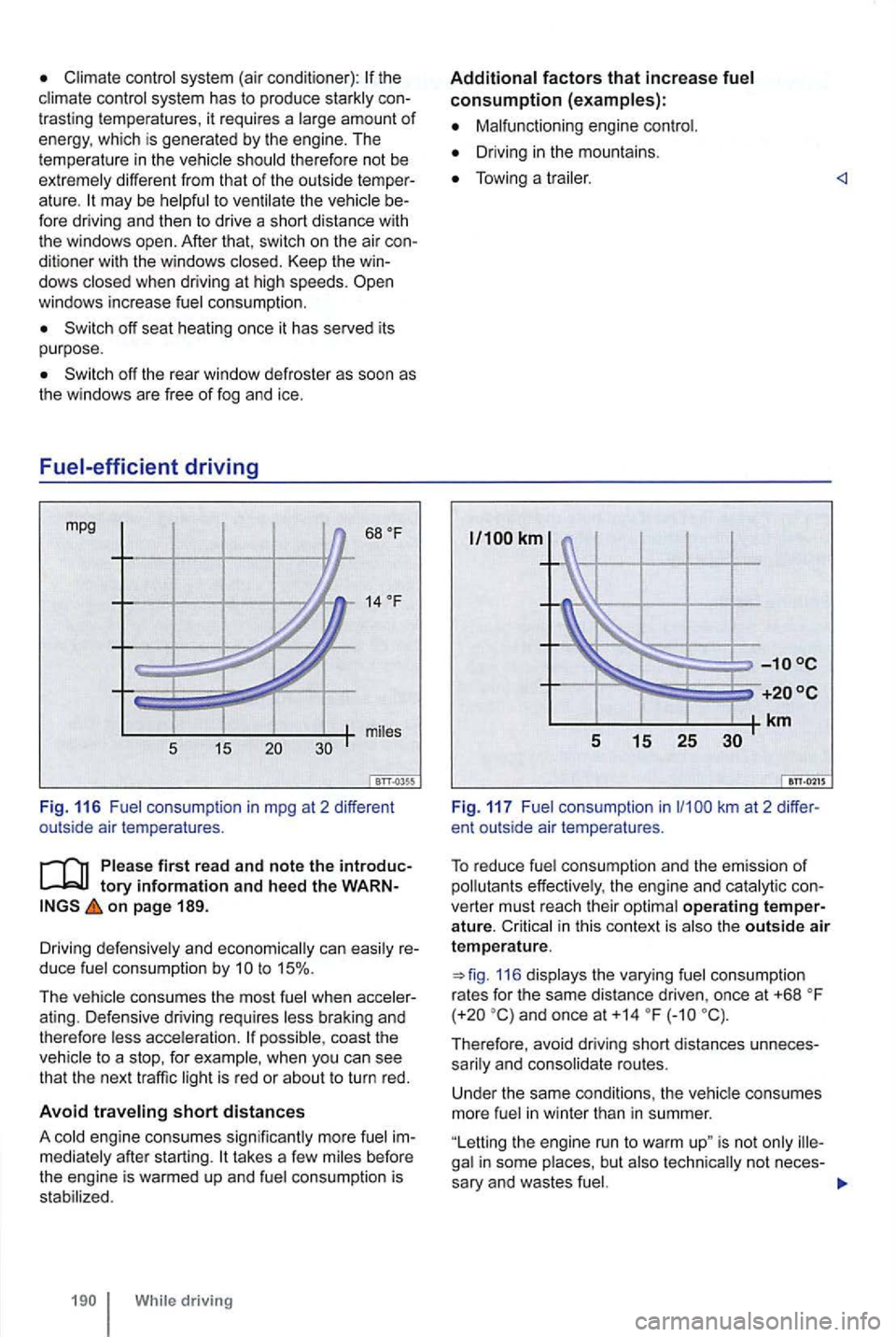
Fi g.
116 F uel consumption in mpg at 2 different
outside air temperatures .
on page 189.
D riving defensive
ly and economica lly can easily duce fuel cons umptio n by to 15%.
The veh icle consumes the most fuel when ating. Defensive driving requires less braking and
ther efore less acceleration. possibl e, coast the
vehicle to a stop , for example, when you can see that the next traffic light is red or about to turn red.
Avoid traveling short distances
A co ld engine consumes sign ificantly more fuel media tely after starting .
consumption (examples):
Malfunction ing eng ine control.
Drivi ng in the mountain s.
T owing a tra iler.
-1
Fig. 117 Fuel consumption in ent outside air temperatures .
To reduce fuel consumption and the emission of
ature. Criti cal in thi s con te xt is also the outside air temperature.
T herefo re , avoid driving short distances sarily and consolidate routes.
Un der the same conditions , the veh icle consumes
more fuel in winte r tha n in summer.
in some places, but also not neces -
Page 294 of 516
Driver assistance systems
Starting assistance systems
Volksw age n Informatio n pag e 24
pa ge 179
Vehicle batt ery
p age 2 58
Jump-s ta rting page 327
The
on p age 195 .
fo r examp le afte r
s topping at a traffic light. don't have to app ly
an d r elease th e park ing brake whil e depress ing the
accele ra tor . For
The dynam ic sta rting assistance feature s
cannot keep the vehicle from moving in all hill-start situations (for example, if the ground is slippery or icy).
Driving with too little fuel in the fuel tank in-
c rea se s th e risk of especially when driving up and down hills.
H old keeps th e bra ke a ppl ied for not quit e
2 seconds with the same force you u sed t o p reve nt the veh ic le f rom mov ing. This gives you time to
t ake your foot off the brake , let the clu tch out on a manual transm issio n veh ic le, a n d gently depress
the accele ra tor to get the veh icle m ovi ng agai n.
F urther more, if any requi remen t for engagi ng
Ho ld disengages and the brakes are automati no longer ho ld th e vehic le.
Driver ass is tance systems 195
Page 313 of 516
At the gas station
Refueling
Introduction
lights an d fuel gau ge . . . . . . . . . . . . . 215
Refu eling .............................. 216
F uel capac ities . . . . . . . . . . . . . . . . . . . .
. . . . . 217
R efueling checklist . . . . . . . . .
.. . . .. . . . . . . . 217
T he fuel
fl ap is loc ated on the rea r right side
o f the veh ic le.
More information:
E xterio r vie ws
Fu el
Prepa rations fo r w orking in the engi ne compart
ment 2 22
refueling or handling of
the way. This keep from out or evaporating.
the pump
refueling . The
electromagnetic radiation can cause sparks
that can ignite vapors and cause a fire.
in exceptional circumstances you must get back your vehicle refueling,
make certain that you the door and touch
helps avoid the
Even if empty , portable fuel containers can and cause a fire and serious personal in-juries, especially in a crash.
container in your vehicle.
container ,
container anywhere in or on the vehicle (for ex-
ic electricity can
a portable container on the ground before Never
vapors are
-
-a portable container made of the filler help prevent static electricity from discharging
and causing a fire .
-
and state or pro-vincial laws about the use, storage , and
transportation of portab le containers.
Page 315 of 516
the fuel and take the fuel cap back
on the
Afte r switc hing on the ignition , the light
may stay on or the text message may
however, the malfunction indi cato r light also
comes on, drive to your nearest authorized Volks
wagen deale r or a uthorized
Vol kswage n Facility and have the fuel system and the engine
checked .
Driving with a fu el tank that is almost empty can lead to and serious personal injuries.
Refueling
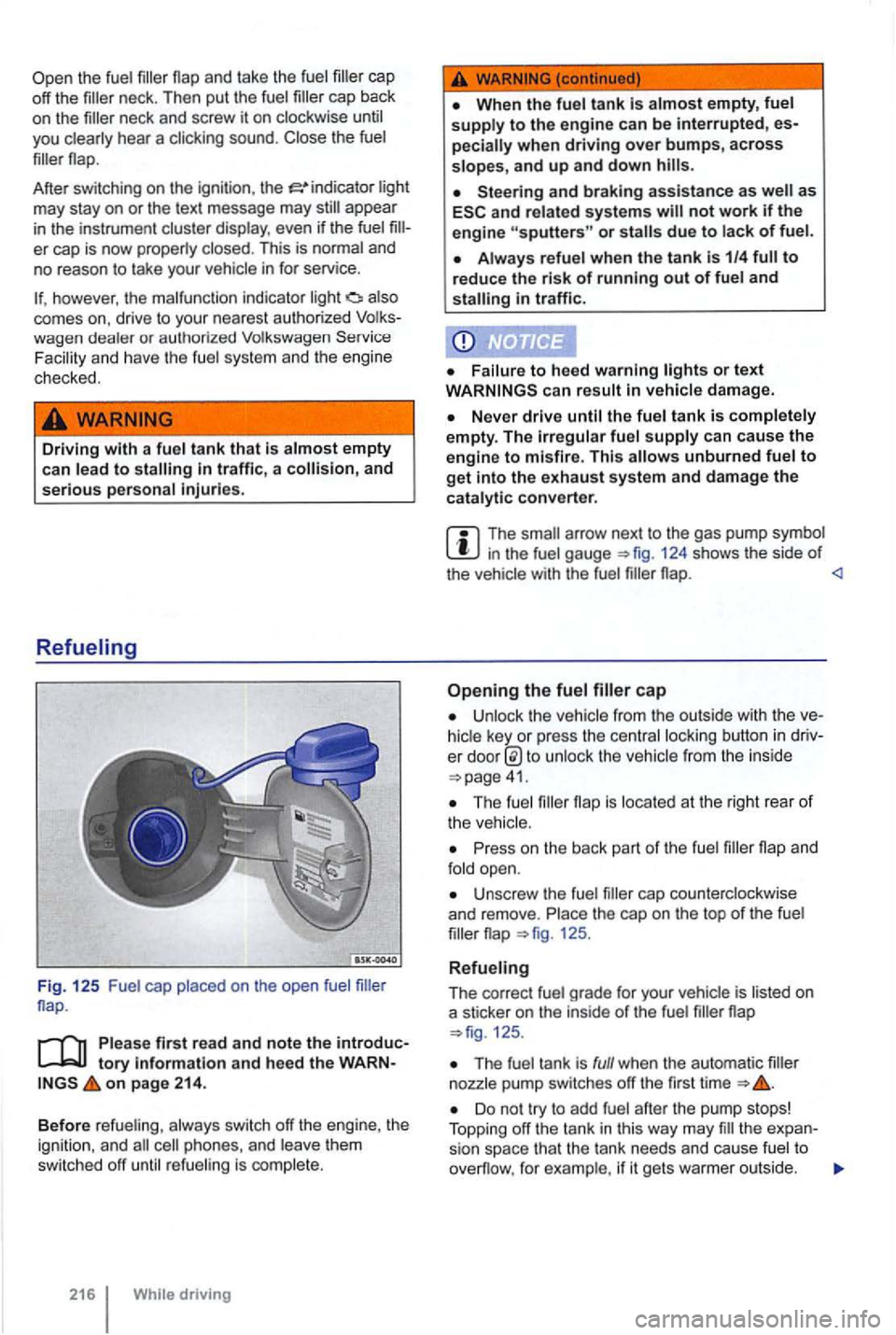
Fig . 125 Fuel cap placed on the open fuel
tory information and hee d the WARNon page 214.
Before refue ling , always switch off the engine, the
i gniti on , and phones , and leave them
switc hed off unt il refu eling is complete .
when driving over bumps, across slopes, and up and down
and relat ed systems no t work if the engine or due to lack o f f uel.
to reduce the risk of running out of fuel and stalling in traffic.
ca n re sult vehicle damage .
fuel supply can cause the
engi ne to misfire . This
The arrow next to the gas pump symbo l in the fuel gauge 124 shows the of the vehicle with the fuel filler
Unlo ck the vehicle from the outside with the ve
h ic le key or pres s the central loc king button in driv
er
to unlock the vehicle from the inside 41.
The fuel
Pre ss on the back part of the fuel and
fold open .
Unscrew the fuel cap counterclockwise
and remove . Plac e the cap on the top of the fue l 125 .
The correc t fuel grade for you r vehicle is listed on
a sticker on the insid e of the fuel 125.
The fuel tank is full when the automatic filler nozzle pump switch es off the first time
Do not try to add fuel after the pump stops!
T opping off the tank in this way may the expan
sion space that the tank needs and cause fuel to
for exam ple, if it gets warmer out side .