2012 VOLKSWAGEN GOLF MK6 headlight
[x] Cancel search: headlightPage 343 of 516
Washing the vehicle
tory information and heed the on page 243 .
T he longer insect splatter , bird droppings, tree sap,
r oad dirt , indust rial deposits , tar , soot , road
and othe r aggressive materials stay on your cle, the more damage they do to the paint finish.
H igh temperatures (includi ng strong sunlight)
oughly.
Car wash
Pay close attention to the information provided
by the car wash operator . B efo re goi ng throu gh a
ca r was h, b e s ure to take th e usual precautio ns t o
avoid damag e , such as closi ng the windows ,
The paint finish is toug h enough th at the vehicle can
the wheels and under the door
After the vehi cle ha s been washed , the wet brakes or, in winter, brake discs or pads ed with ice, react slower and need longer stopping distances .
WARNING
Always dry the brakes and clean off any ice coatings with a few careful applications of the brake . Make sure not to endanger other motorists or cyclists or disobey legal require-
ments .
edges under the vehicl e can cut ex-
posed skin.
Always protect your hands and arms from cuts on sharp metal edges when cleaning the under-body , the inside of the wheel housings,
etc.
The water temperature must not be more
than
Ne ver clean headlights with a dry cloth or sponge . Always use a w et cloth o r s ponge . For best result s use soapy water.
When washing or rinsing the vehicle in cold weather , do not
cult to open the vehicle!
To help prevent vehicle damage
in a car wash:
in the car wash to help prevent damage to wheel rims and tires!
Make sure there is enough clearance for the
height and width of the vehic le .
To help prevent paint damage to the engine
hood, place wiper blades against the shield after they have dried. Do not let them
snap back into place .
Lock the rear hatch to prevent unintentional
opening in the car wa sh .
Page 418 of 516

Fig. 167 o f a blown fuse.
tory information and heed the WARNon page 317.
Preparations
off the headlights . the ignition , and electrical consumers .
the appropriate fuse box
167.
a flashlight on th e fuse. This makes it easier
t o
165 fro m the fuse box cover .
For small fuses, slide the tweezers 168 onto the fuse from the top A. Fig
. 168 Removing
or inserting a fuse using the
p lastic tweezers .
For larger fuses, slide the tweezers onto the
f use from the side B.
the fuse is blown , replace the fuse with a new fuse of the same amperage (same color and same
impri nt) and same overall size
necessary, replace the plastic tweezers in the
fuse box cover .
Replace the cove r.
Practica l tips
Page 419 of 516
Changing
Introduction
this sec tion
bulbs in th e body of th e vehic le . . . . . . . . . . . . . . . . . . . . . . . . . . . . . . . . 325
C hangi ng t he lice nse plate
lig ht bulb . . . . . . . . 32 6
C hang ing a light bulb
requ ir es a certa in am ount of
sh ould a lwa ys kee p a box in the ve h icle with th e rep lace ment bulbs require d f or traffic safety .
R ep lacemen t bulbs are ava ilab le from you r autho r
i z ed
Additional
E xte rior views
Lig hts a nd 122
P repa ra tions for workin g in the eng ine compart
m en t
too l kit
F uses
Stop Always read and heed the before doing any work in the engine
c ompartment
Always let a burned out
of the necessary procedures. particular, never remove a headlight unless you know how to carry out the job and have the correct tools and bulbs.
you are uncertain about what to do,
have the work performed by an authorized
Volkswagen dealer, an authorized
and H7 bulbs replaced by a qualified
technic ian .
Page 420 of 516
N
After replacing a headlight bulb or other light bulb, always make sure that the rubber covers or plastic caps have been properly and secure-
Indicator light
to help prevent water from getting into the electrical connections and headlight housing and damaging the electrical system.
on
Lights up Possible cause Proper response
Light bulb of the exterior vehicle lighting not Replace the light bulb that isn't working .
working .
When the ignition is switched on, several warning
and indicator lights come on briefly for a function
check . They go
out after a few seconds.
WARNING
Failure to heed warning lights and instrument cluster text messages can cause the vehicle to break down in traffic and result in a
can result in vehicle damage.
indicated. However, indicator light come on if LEO s fail.
on
Checklist
for replacing a light bulb. Please carry out these steps only in the order listed
1.
179.
3.
4.
5.
6 .
7.
8.
9 .
position
122 .
Automatic transmission :
the transmission into Park (P) 171.
the engine and remove the key from the ignition switch 165.
Manual transmission: Engage a gear
122.
Let the burned
out light cool down.
Check
if the fuse is blown 317 .
Replace the burned
out light according to
Practical tips 321
Page 421 of 516
Checklist (continued)
12. Never touch the glass
of the light bulb with your bare hands. Fingerprints can cloud the out er surface of the light bulb when heated , affecting the lighting power, clouding the reflector, and reduc ing
the bright ness .
1 3 . Always make sure tha t the new bulb works .
cor
rectly ; the connection plug may not be complete ly seated ; the corresponding fuse may be burned
out ; or the bulb may be bad .
14. Always have the headlights adjusted by an authorized Volkswage n dealer or an author ized Vol ks
wagen Facility after a headlight bulb has been replaced.
Disregarding the safety-related checklist may
lead to accidents and serious personal injuries.
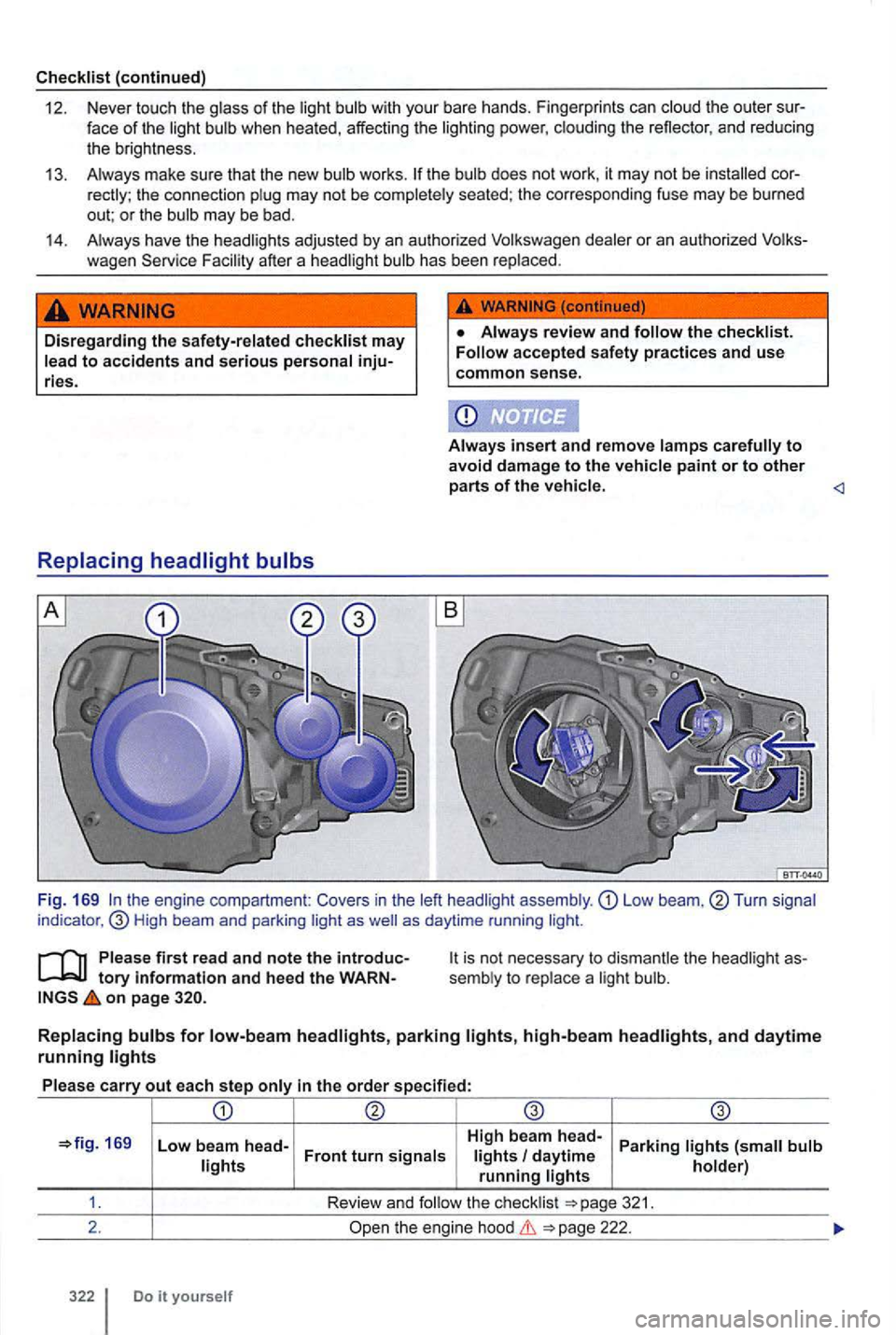
Replacing headlight bulbs
the checklist. Follow accepted safety practices and use common sense .
Always insert and remove lamps carefully to avoid damage to the vehicle paint or to other parts of the vehicle.
on page
169 Low be am head- High
beam head-
Parking
321.
2 .
the engine hood
Do
Page 423 of 516
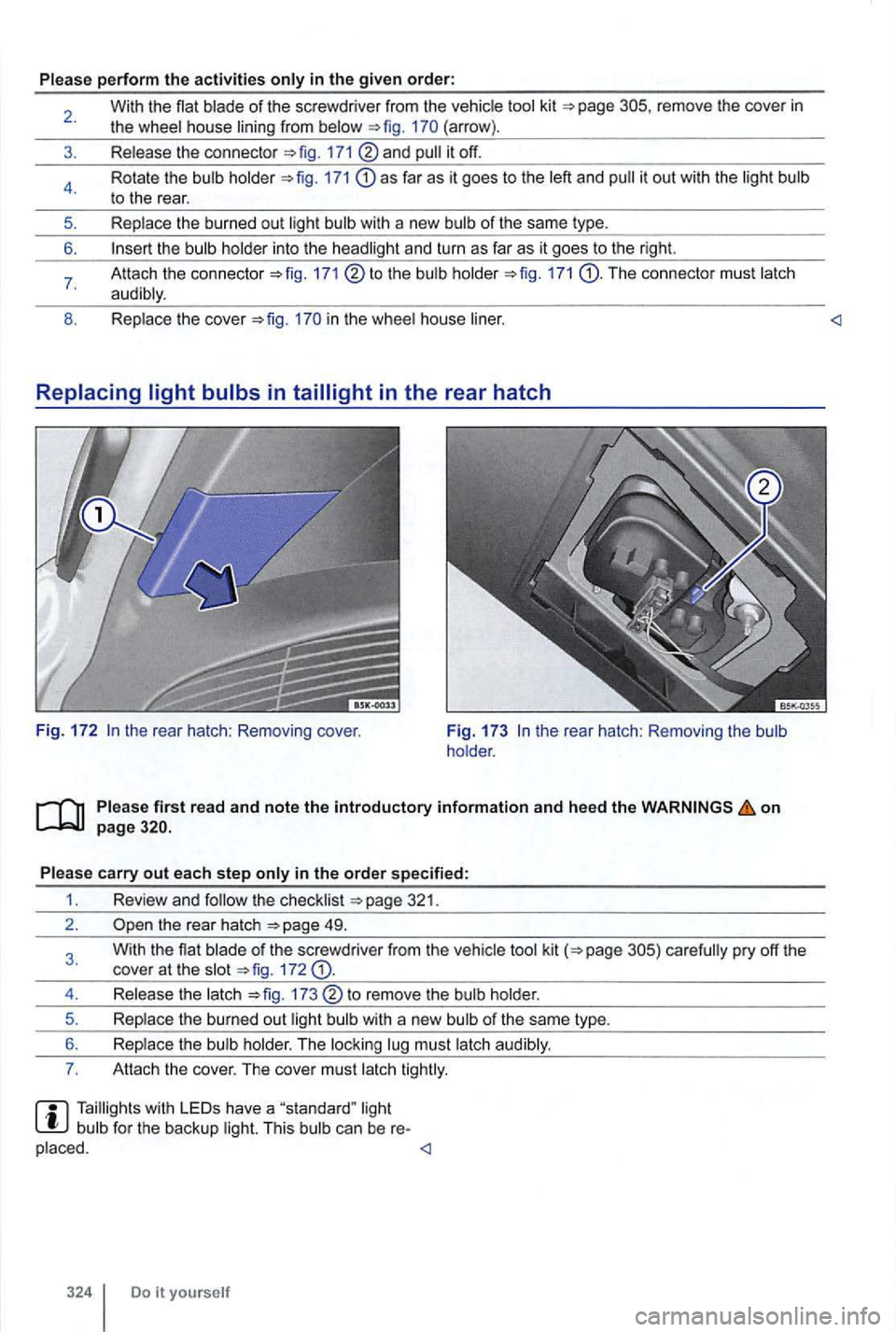
Please perform the activities
remove the cove r in the wheel house lining from (arrow) .
Release the connecto r
and
171 as far as it goes to the left and
the bulb holder into the headlight and turn as far as it goes to the right.
Attach the connector to the bulb holder The connecto r mus t latch
audibly .
Replace
the cover in the whee l house
F ig. 172 the rear hatch : Removing the bulb
ho lder.
Please first read and note the introductory information and heed the on page
in the order specified:
1 . Review and
the rear hatch
of the screwdriver from the vehicle tool kit 172
Release the latch to remove the bulb holder.
Replace the burned out light bulb with a new bulb
of the same type.
Replace the
bulb holder . The locking lug must latch audib ly .
Attach th e cover . The cover must latch
Do it yourself
Page 428 of 516
the engine
the engine of the vehicle with the good
battery that is providing help and let it run at idle
speed .
Turn on the ignition of the vehicle with the dead
b attery. the engine starts, wait 2 to 3 minutes
the engine does
not start within about seconds , turn off the tion and wait at least 1 minute ; then try again .
Removing the jumper cables
Before you remove the jumper cables. swi tch
off the headlights (if they are on) .
the vehic le with the dead batte ry , switc h on
t he heater fa n and the rea r window defroster. This
he lps
to m in im ize voltage spikes when the cables
a re disconnected.
With the engine running , remove the jumper
nected .
Disconnect the black (- ) cab le f rom the vehicle
wit h the dead battery .
Disconnec t the black (-) cable from the other
vehicle (vehicle with the good battery) .
Disconnect the red(+) cable from the other
Disconnect the red (+ ) cable from the vehicle
with the dead battery .
Close the battery cover.
Improper use of jumper cables when starting a vehicle with a dead battery can
cause the battery to explode , leading to
Always wear proper eye protection. Never
lean over the vehicle battery.
Attach the jumper cables in the correct
Never connect the negative cable from the
vehicle providing starting assistance to parts of the fuel system or to the brake hoses or brake lines.
Never
sistance.
Avoid electrostatic discharge in the may cause the hydrogen gas escaping from the vehicle battery to ignite.
Never jump-start a vehicle with a battery
that is damaged or frozen or that was frozen
and has thawed. The battery can explode.
Always the instructions of the jumper cable manufacturer.
Never connect the negati ve cable from the other vehicle directly to the negative terminal of the dead battery . The hydrogen gas from
the battery is explosive.
Never short out the battery terminals by connecting the positive(+) and negative
Practical tips 329
Page 437 of 516
Shifting . . . . . . . . . . . . . . . . . . . . . . . . . . . 175
Towing . . . . . . . . . . . . . . . . . . . . . . . 331 Vehicle key safety in terlock . . . . . . . . . . . 166
B
Background . . . . . . . . . . . . . . . . 127
Brak ing assistance systems . . . . . . . 185
Battery Rep laceme nt in rem ote cont rol vehicle key 39
Before taking the vehicle in to the shop . . 297
Belt pretensioners
D isposal . . . . . . . . . . . . . . . . . . . . . . . . . . .
Belt warning . . . . . . . . . . . . . . . . . . . . .
Bottle holder . . . . . . . . . . . . . . . . . . . . 161
Brake
Brake booster . . . . . . . . . . . . . . . . . . . . . . 184
Brake nuid . . . . . . . . . . . . . . . . . . . . . . . . 187
Brake nuid level . . . . . . . . . . . . . . . . . . . . 187
Brak e pads . . . . . . . . . . . . . . . . . . . . . . . . 183
Braking assistance systems . . . . . . . . . . . 185
Bre aking
in the brake pads . . . . . . . . . . . 183
Chang ing brake nuid . . . . . . . . . . . . . . . . 188
brake . . . . . . . . . . . . . . . . . . . . . . 18 2
Warning l igh t . . . . . . . . . . . . . . . . . . . . . .
Brake Assist (BAS) . . . . . . . . . . . . . . . . . . . 185
Brake booster . . . . . . . . . . . . . . . . . . . 184 , 185
Brake fluid . . . . . . . . . . . . . . . . . . . . . . . . . . 187
Spec ificati ons . . . . . . . . . . . . . . . . . . . . . . 187
Brake
system . . . . . . . . . . . . . . . . . . . . . . . . 185
Malfunction . . . . . . . . . . . . . . . . . . . . . . . 184
Braking . . . . . . . . . . . . . . . . . . . . . . . . . . . . . 179
Braking assistance systems . . . . . . . . . . . 18 5
Break-in period
E ngine .
.......................... 283
The fir st few miles (k ilometers ) . . . . . . . . 283 . . . . . . . . . . . . . . . . . . . . . . . . . . . . . 263
Breakdown the vehicle . . . . . . . . . . . . . . . . 299
Breaking in
B rake pads . . . . . . . . . . . . . . . . . . . . .
. . 183
Breaking in the brake pads
Care
. . . . . . . 136
Catalytic
converter . . . . . . . . . . . . . . . . . . . 296
I ndicator light . . . . . . . . . . . . . . .
. . . . 157
. . . . 288
Center
armrest . . . . . . . . . . . . . . . . . . . . . . . . 66
Center
console . . . . . . . . . . . . . . . . . . . . 12, 13
Changing a
light bulb Indicator light . . . . . . . . . . . . . . . . . . . . . . 321
Changing a wheel . . . . . . . . . . . . . . . . . . . .
. . . . . . . . 313
Wheel bolls 311 Wheel change . . . . . . . . . . . . . . . . . . . . . 315
Chang i
ng bulbs changing light bulbs . . . . . . . . . . . . .
Changing light bulbs . . . . . . . . . . . . . . . . . . fr on t bumper . . . . . . . . . . . . . . . . . . . . . 323 . . . . . . . . . . . 325 th e headlight . . . . . . . . . . . . . . . . . . . . 322 the rear hatch . . . . . . . . . . . . . . . . . . . . 324 License plate ligh t . . . . . . . . . . . . . . . 326 . . . . . . . . . . . . . . . . . . 324, 325
Characteristics Rad io reception . . . . . . . . . . . . . . . . . . . . 292
Checking
leve l . . . . . . . . . . .
. . . . . . . . . . . . 31 Gelling ready . . . . . . . . . . . . . . . . . . . . . . . 31 an eme rgen cy . . . . . . . . . . . . . . . . . 299
Lifting veh icle with jack . . . . . . . . . . . . . . 313
Light bulb replacement . . . . . . . . . . . .
. . 321 for changing a wheel 311 Safety belts . . . . . . . . . . . . . . . . . . . . . . . . 73
U phol stery . . . . . . . . . . . . . . . . . . . . . . . 252
Checks
while refueling . . . . . . . . . . . . . . 217
Child res
traint and fron t airbag . . . . . . . . . . . . . . . . . . . .
Child safety lock . . . . . . . . . . . . . . . . . . . . . . 48