Page 299 of 516
Tire Pressure Monitoring System (TPMS)
Introduction
this section you'll find information about :
Indic ato r light (telltale) . . . . . . . . . . . . . . . .
and
r e ca librat ion with the
you are drivin g. Th e se nso rs m on itor the tre ad cir cumference (rolling circumfe re nce ) and
vibrati on characteristics of the indiv idu al tires . warn s if there is a significant loss of sure in o n e or m ore tires while the vehi cle is
i n gs and tex t warn in gs in the in strum ent cluste r
disp la y if yo ur veh icle ha s this disp lay (M ulti-Func
t io n D isplay
that come with your vehicle . Th is
1 38 . By pres sing the
hicl e
Prope r use of the
More information:
Volk sw age n Information 24
Tr anspo rting
Braking, s top ping and park in g 1 79
E xterior care and clean in g
Tires and wheels
P arts. accessor ies, repa irs and mo difica tions 2 83
Incorrect tire pressures and/or underinflation can cause sudden tire failure , loss of control , collision, serious personal or even death.
Incorrect tire pressure and/or underlnflation can cause increased tire wear and can affect the handling of the vehicle and stopping ability .
The driver is responsible for the correct tire pressures for all tires on the vehicle. The
recomm ended tire pressure values are listed on a sticker the driver door 138.
The
Using incorrect tire pressure values can cause accidents or other damage . Always
Always maintain correct cold tire Inflation pressure so that can do its job.
Driving with underinfl ated tires causes them to flex (bend) more, letting them get too hot, resulting in tread separation , sudden tire failure , and loss of control.
Excessive speed and/overloadlng can
cause heat build-up, s udden tire
the tire pressure is too low or too high,
the tires will wear prematurely and the vehi
c le will not handle well.
and you do not have to cha nge a wheel immediately , drive careful
station to check the tire pressure and add air as required.
always read and heed the Information and all 258, Tires and whe els.
The Tire Pressure Monitoring
the reinstalled or replacement wheels and
Page 401 of 516
Reinsert the cover cap from top to bottom and
press i t
The anti-theft system remains activated
for the unlocked vehicle. But the
the driver door. The
The driver door can be unlocked separately from the inside the the door
handle to open the door
The anti-theft alarm system is not activated when the vehicle is
covered by a rubber
Pl ease first read and note the introductory information and heed the on page
This will not activate the anti-theft
the door.
Remove the rubber on the front side of the
door. The 147.
Unfold the key bit from the remote control
forward 148.
the front side of the right rear door:
Manual vehicle locking with the key bit in the
Reinsert the rubber the door .
Make sure that the door is locked .
Repeal the procedure for other doors if sary.
Facility.
Doors can be unlocked and opened the
door
Page 403 of 516
Emergency
on page
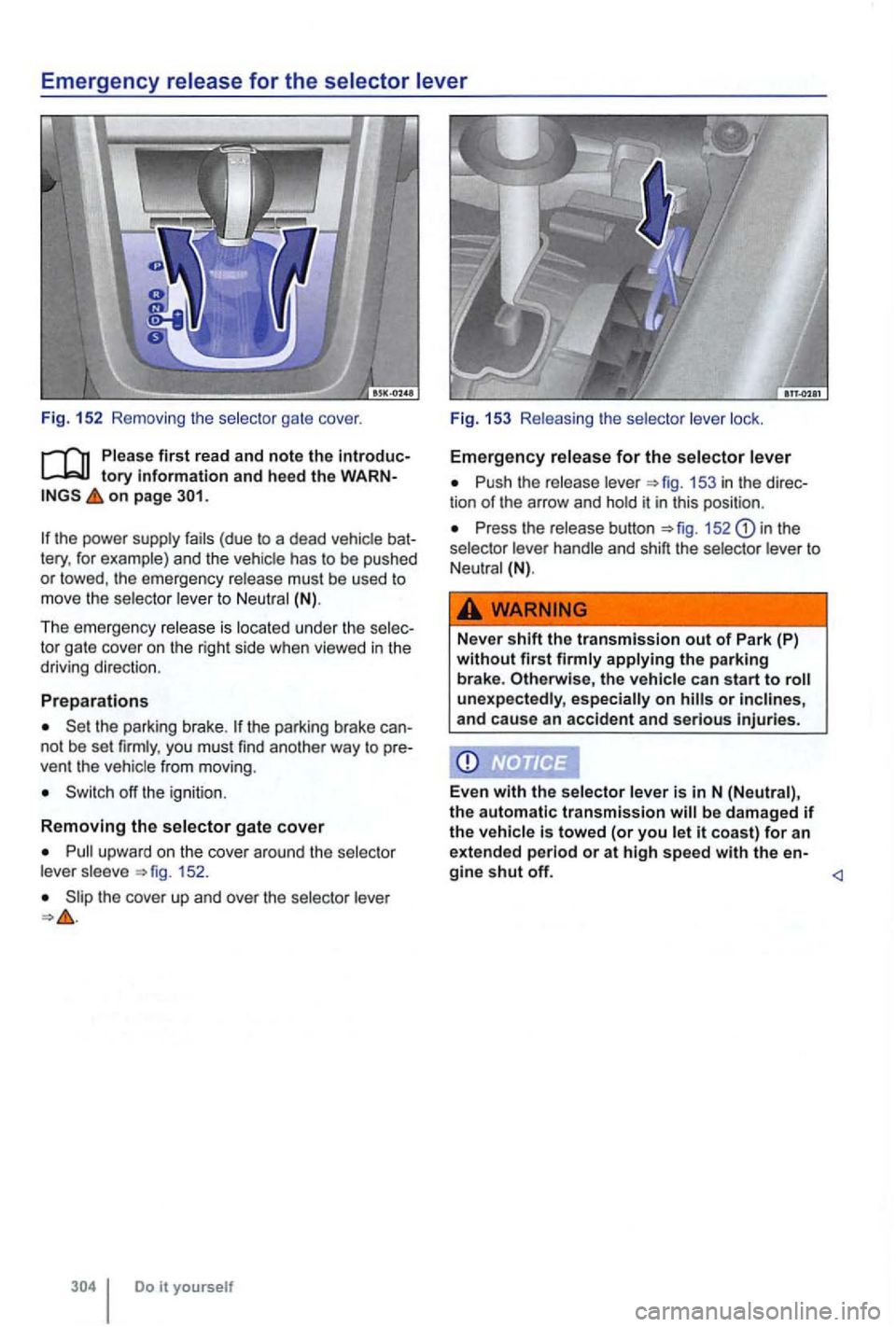
the power supply fails (due to a dead vehicle bat
tery , for example) and the vehicle has to be pushed or towed , the emergency release must be used to move the selecto r lever to N eutral (N).
Th e emerge n
cy release is located under the selec
tor gate cover on the right side when viewed in the
driving direction .
Preparations
Set the parking brake. the parking brake can
no t be set firmly , you must find another way to pre
vent the vehic le from moving .
Switch off the ignit ion.
Removing the selector gate cover
Pull upward on the cover aroun d the selec tor
lever sleeve fig. 152 .
Slip the cover up and over the selector lever
Push the release lever 153 in the direc
t ion of the arrow and hold it in this position .
Press the release button fig. 152 the
selector lever handle and shift the selector lever to Neu tral (N) .
WARNING
Never shift the tran smi ssion out of Park (P) without first firmly applying the parking
brake . the vehicle can start to roll unexp ectedly, especially on hills or inclines,
a nd cause an accident and serious injuries.
Ev en
with the selector lever is in N (Neutra l), the automatic transmission will b e damaged if the vehicle is towed (or you let it coast) for an extended period or at high speed with the en-
gine shut off.
Page 429 of 516
Towing
this sectio n you 'll find informat ion about:
T owing on a comme rc ia l tow truc k . . . . . . . . . .
Tips on towing .......................... 33 1
Installing the front tow ing eye . . . . . . . . . . . . . . 332
Installing th e rear towing eye . . . . . . . . . . . . . . 333 Driving tips towing 333
Exterior views
295
WARNING
Never tow a vehicle without any electrical
power.
denly engage and you would not be able to steer of control the vehicle. trol of the vehicle, crash , and seriously injure yourself and others.
Towing on a
on page
To help avoid damaging th e vehicle , h ave it towed
o n ly by a professional towing company. Read and
heed the following
information:
General information
N ever let the vehic le be towed at speeds above
km).
Towing a vehicle changes the way it handles
and brakes . To help reduce the risk of an cident and serious personal injury, note the following:
ed:
-
will have to use considerably more
force to turn the steering wheel because
the power steering is not working.
stalling and removing the towing eye and the cover for the threaded hole behind the bumper.
Towing manual transmission vehicles
Release the parking brake .
the transm ission into Neutral (N).
necessary, the vehicle can also be towed with the rea r wheels off the grou nd
Towing automatic transmission vehicles
Release the parking brake.
the transm issio n into Neutral (N).
Tow the vehicle only with its fron t wheels off the
gro und