Page 525 of 744
Maintenance and care4
525
4-1. Maintenance and careCleaning and protecting the vehicle exterior ......... 526
Cleaning and protecting the vehicle interior .......... 529
4-2. Maintenance Maintenance requirements .................. 532
General maintenance....... 534
Emission inspection and maintenance (I/M)
programs........................ 537
4-3. Do-it-yourself maintenance Do-it-yourself service precautions .................... 538
Hood ................................ 542
Engine compartment ........ 543
Tires ................................. 557
Tire inflation pressure ...... 565
Wheels ............................. 569
Air conditioning filter......... 572
Wireless remote control battery ............................ 575
Checking and replacing fuses .............................. 577
Light bulbs........................ 588
Page 552 of 744
552 4-3. Do-it-yourself maintenance
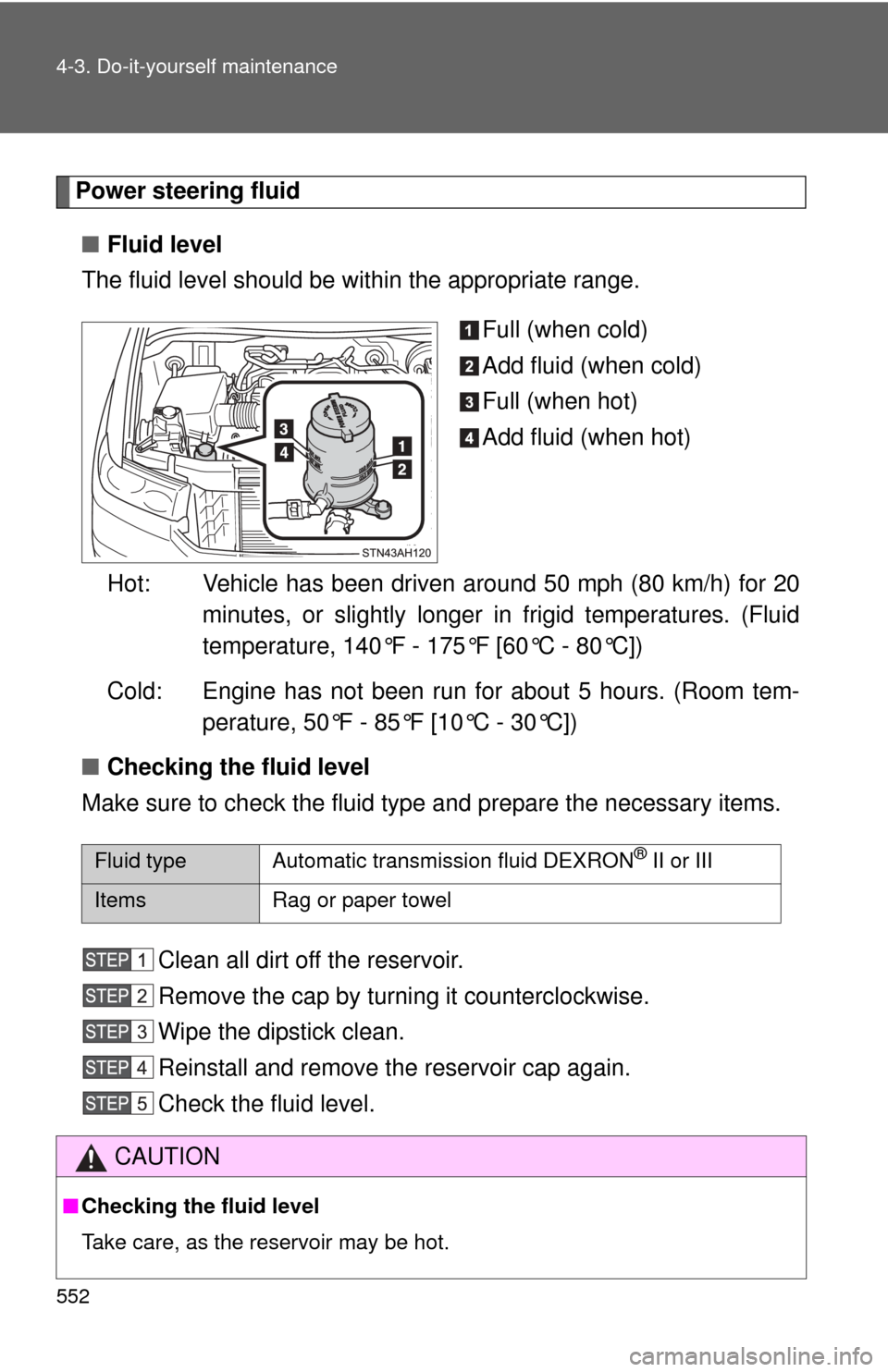
Power steering fluid■ Fluid level
The fluid level should be within the appropriate range.
Full (when cold)
Add fluid (when cold)
Full (when hot)
Add fluid (when hot)
Hot: Vehicle has been driven around 50 mph (80 km/h) for 20 minutes, or slightly longer in frigid temperatures. (Fluid
temperature, 140°F - 175°F [60°C - 80°C])
Cold: Engine has not been run for about 5 hours. (Room tem- perature, 50°F - 85°F [10°C - 30°C])
■ Checking the fluid level
Make sure to check the fluid type and prepare the necessary items.
Clean all dirt off the reservoir.
Remove the cap by turning it counterclockwise.
Wipe the dipstick clean.
Reinstall and remove the reservoir cap again.
Check the fluid level.
Fluid type Automatic transmission fluid DEXRON® II or III
Items Rag or paper towel
CAUTION
■Checking the fluid level
Take care, as the reservoir may be hot.
Page 610 of 744
610 5-2. Steps to take in an emergency
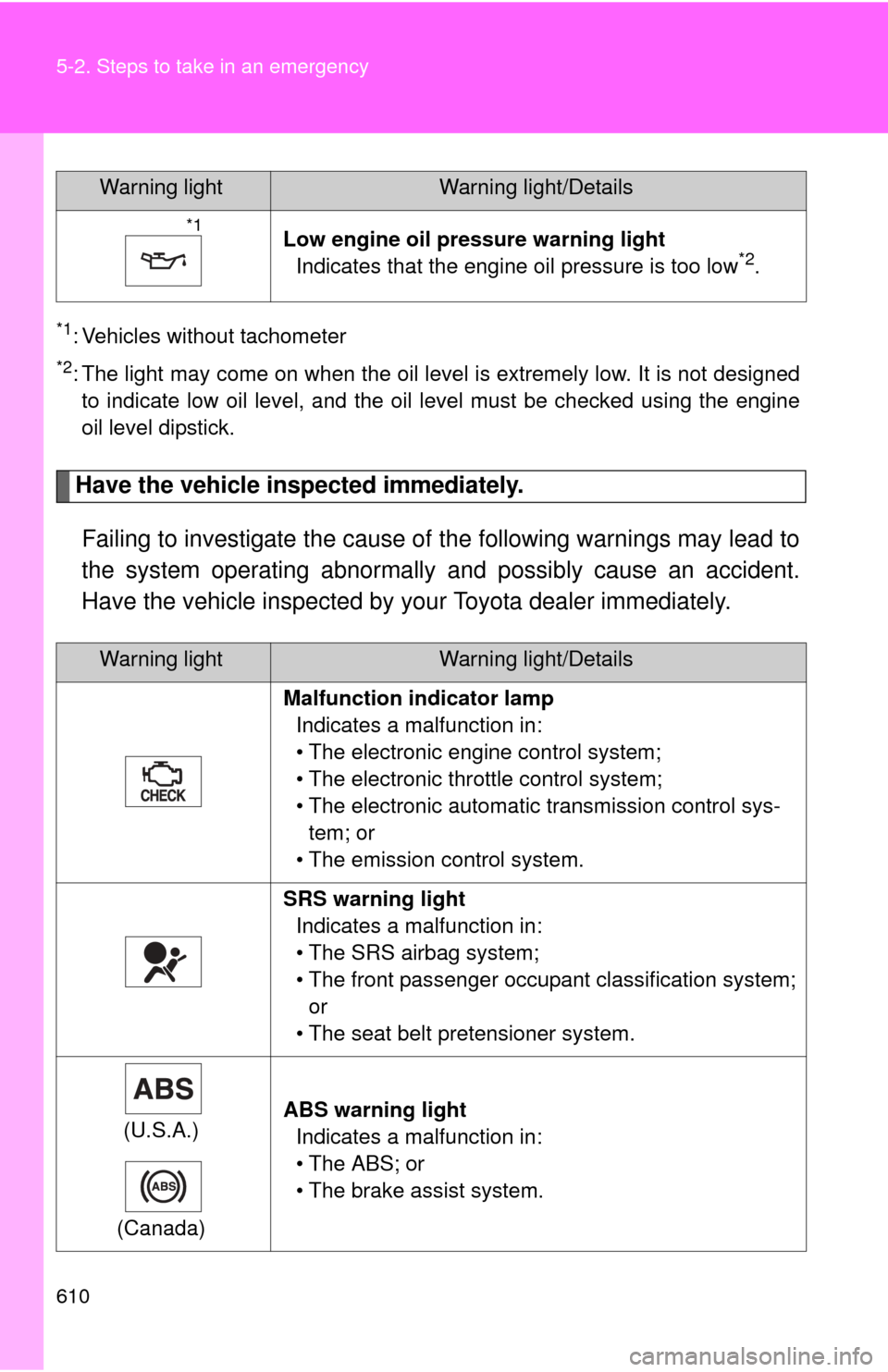
*1: Vehicles without tachometer
*2: The light may come on when the oil level is extremely low. It is not designedto indicate low oil level, and the oil level must be checked using the engine
oil level dipstick.
Have the vehicle inspected immediately.
Failing to investigate the cause of the following warnings may lead to
the system operating abnormally and possibly cause an accident.
Have the vehicle inspected by your Toyota dealer immediately.
Warning lightWarning light/Details
*1Low engine oil pressure warning light
Indicates that the engine oil pressure is too low*2.
Warning lightWarning light/Details
Malfunction indicator lamp Indicates a malfunction in:
• The electronic engine control system;
• The electronic throttle control system;
• The electronic automatic transmission control sys-tem; or
• The emission control system.
SRS warning light Indicates a malfunction in:
• The SRS airbag system;
• The front passenger occupant classification system; or
• The seat belt pretensioner system.
(U.S.A.)
(Canada) ABS warning light
Indicates a malfunction in:
• The ABS; or
• The brake assist system.
Page 614 of 744
614 5-2. Steps to take in an emergency
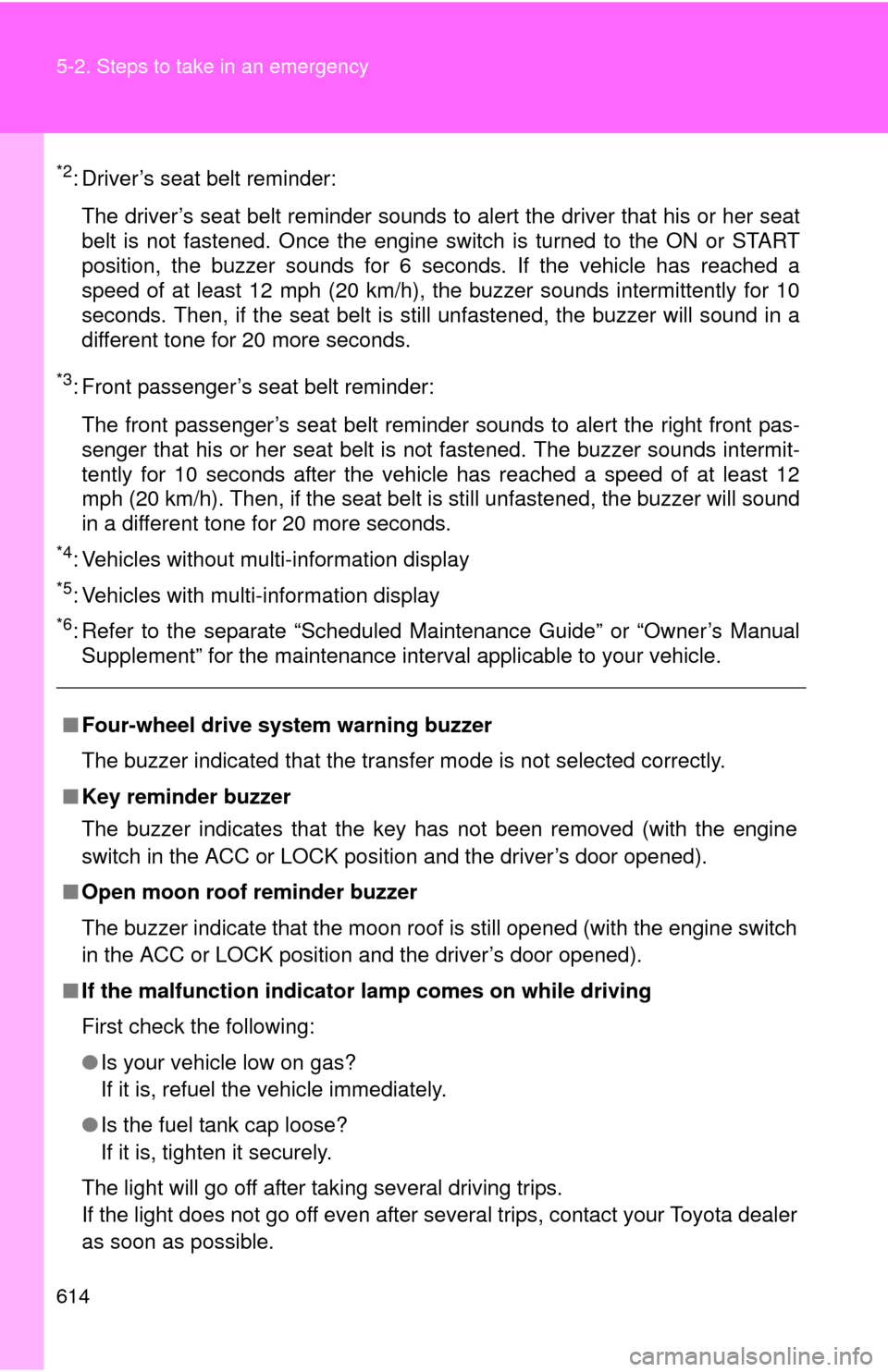
*2: Driver’s seat belt reminder:The driver’s seat belt reminder sounds to alert the driver that his or her seat
belt is not fastened. Once the engine switch is turned to the ON or START
position, the buzzer sounds for 6 seconds. If the vehicle has reached a
speed of at least 12 mph (20 km/h), the buzzer sounds intermittently for 10
seconds. Then, if the seat belt is still unfastened, the buzzer will sound in a
different tone for 20 more seconds.
*3: Front passenger’s seat belt reminder:
The front passenger’s seat belt reminder sounds to alert the right front pas-
senger that his or her seat belt is not fastened. The buzzer sounds intermit-
tently for 10 seconds after the vehicle has reached a speed of at least 12
mph (20 km/h). Then, if the seat belt is still unfastened, the buzzer will sound
in a different tone for 20 more seconds.
*4: Vehicles without multi-information display
*5: Vehicles with multi-information display
*6: Refer to the separate “Scheduled Maintenance Guide” or “Owner’s ManualSupplement” for the maintenance interval applicable to your vehicle.
■ Four-wheel drive system warning buzzer
The buzzer indicated that the transfer mode is not selected correctly.
■ Key reminder buzzer
The buzzer indicates that the key has not been removed (with the engine
switch in the ACC or LOCK position and the driver’s door opened).
■ Open moon roof reminder buzzer
The buzzer indicate that the moon roof is still opened (with the engine switch
in the ACC or LOCK position and the driver’s door opened).
■ If the malfunction indicator lamp comes on while driving
First check the following:
● Is your vehicle low on gas?
If it is, refuel the vehicle immediately.
● Is the fuel tank cap loose?
If it is, tighten it securely.
The light will go off after taking several driving trips.
If the light does not go off even after several trips, contact your Toyota dealer
as soon as possible.
Page 616 of 744
616 5-2. Steps to take in an emergency
●If there is a lot of snow or ice on the vehicle, in particular around the
wheels or wheel housings.
●If non-genuine Toyota wheels are used. (Even if you use Toyota
wheels, the tire pressu re warning system may not work properly with
some types of tires.)
●If tire chains are used.
■If the tire pressure warning light frequently comes on after blinking
for 1 minute
If the tire pressure warning light frequently comes on after blinking for 1
minute when the engine switch is turned to the ON position, have it
checked by your Toyota dealer.
■ Customization that can be co nfigured at Toyota dealer
The vehicle speed linked front passenger’s seat belt reminder buzzer can be
disabled. (Customizable features P. 696)
CAUTION
■If the tire pressure warning light comes on
Be sure to observe the following precautions. Failure to do so could
cause loss of vehicle control and re sult in death or serious injury.
●Stop your vehicle in a safe place as soon as possible. Adjust the tire
inflation pressure immediately.
●If the tire pressure warning light comes on even after tire inflation pres-
sure adjustment, it is pr obable that you have a flat tire. Check the tires.
If the tire is flat, change to the spare tire and have the flat tire repaired
by the nearest Toyota dealer.
●Avoid abrupt maneuvering and braking. If the vehicle tires deteriorate,
you could lose control of the steering wheel or the brakes.
■If a blowout or sudden air leakage should occur
The tire pressure warning syste m may not activate immediately.
Page 648 of 744
648 5-2. Steps to take in an emergency
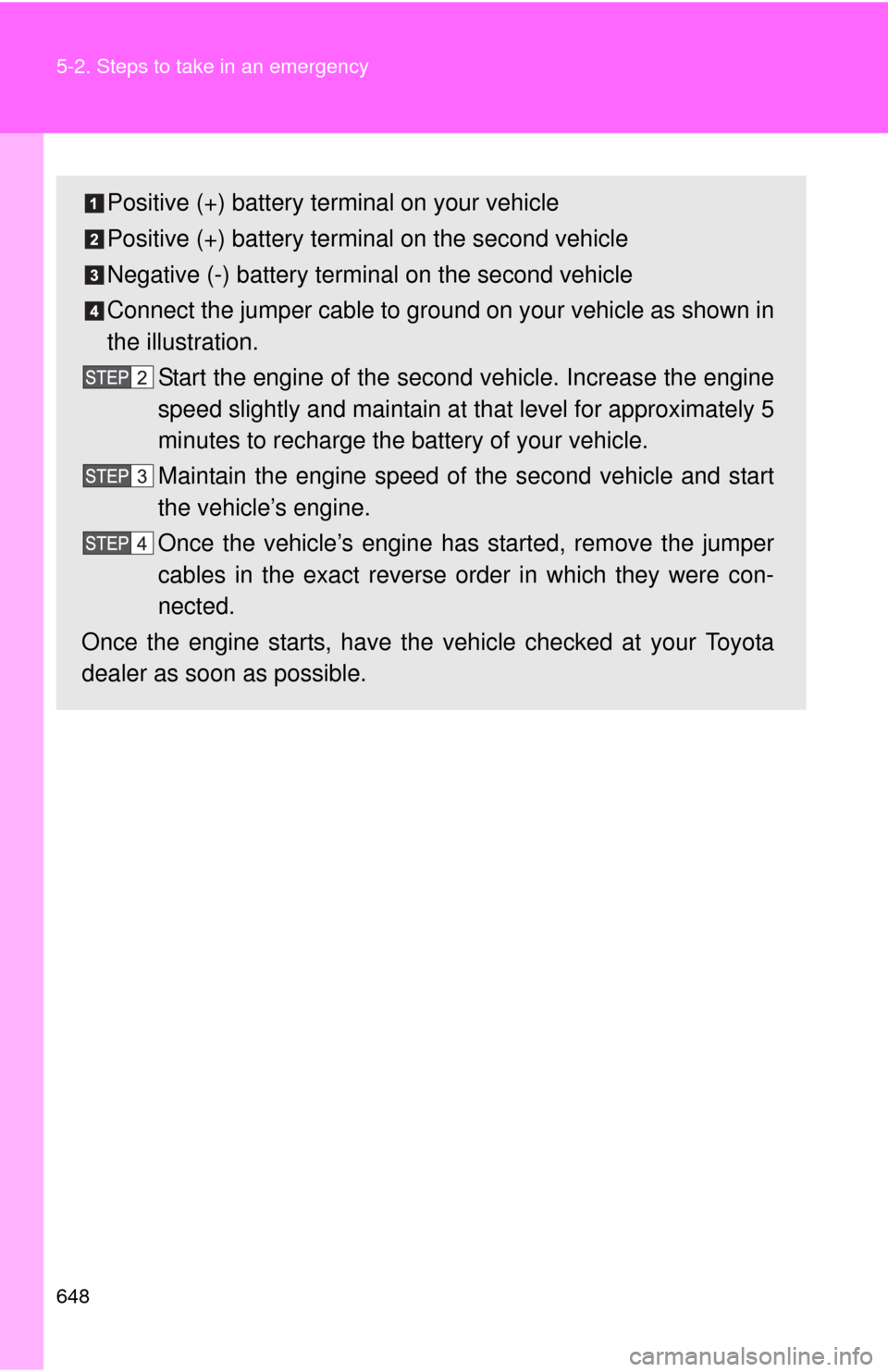
Positive (+) battery terminal on your vehicle
Positive (+) battery terminal on the second vehicle
Negative (-) battery terminal on the second vehicle
Connect the jumper cable to ground on your vehicle as shown in
the illustration.Start the engine of the second vehicle. Increase the engine
speed slightly and maintain at that level for approximately 5
minutes to recharge the battery of your vehicle.
Maintain the engine speed of the second vehicle and start
the vehicle’s engine.
Once the vehicle’s engine has started, remove the jumper
cables in the exact reverse order in which they were con-
nected.
Once the engine starts, have the vehicle checked at your Toyota
dealer as soon as possible.
Page 674 of 744
674 6-1. Specifications
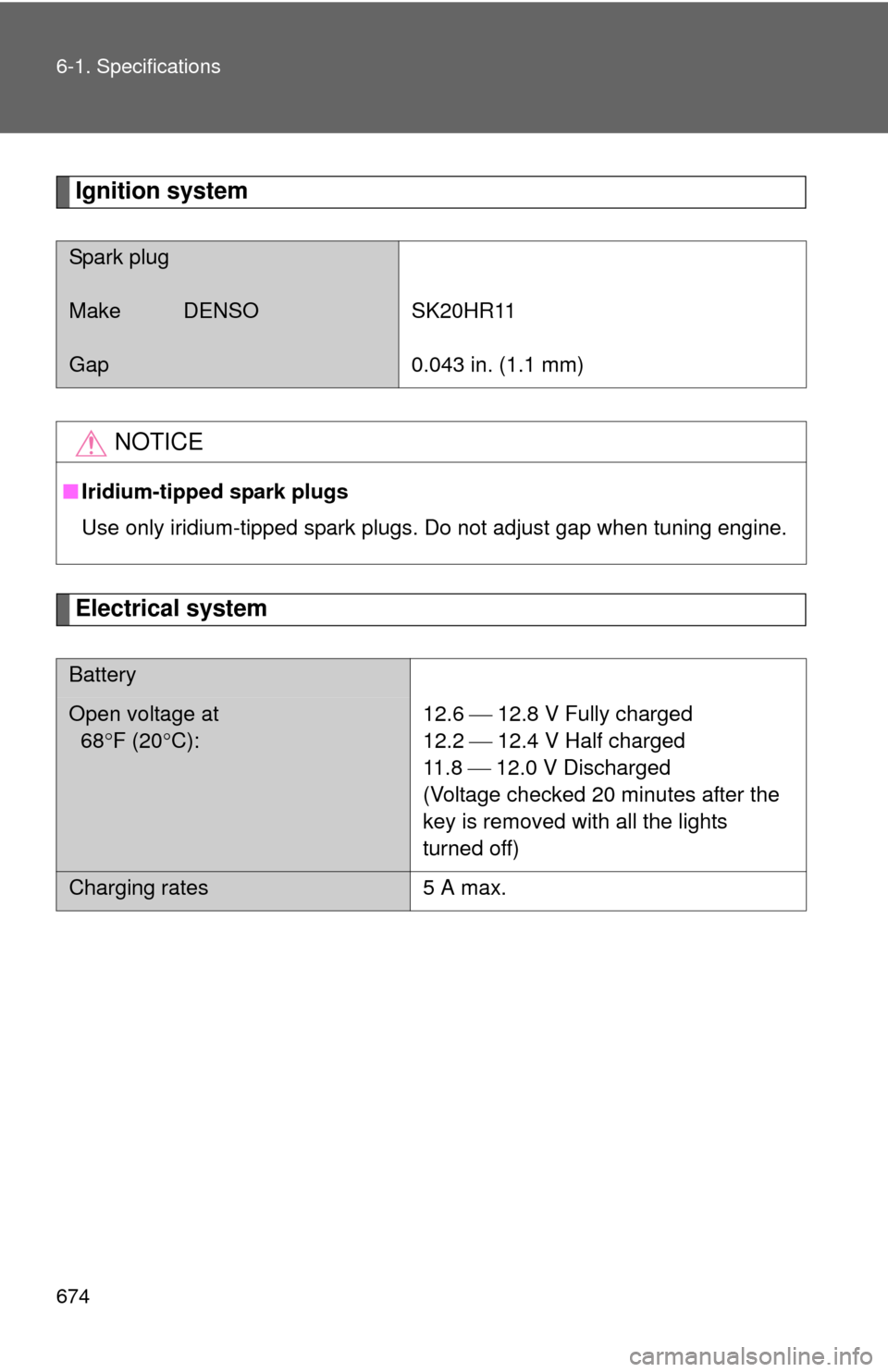
Ignition system
Electrical system
Spark plug
Make DENSO
Gap
SK20HR11
0.043 in. (1.1 mm)
NOTICE
■Iridium-tipped spark plugs
Use only iridium-tipped spark plugs. Do not adjust gap when tuning engine.
Battery
Open voltage at
68 F (20 C): 12.6 12.8 V Fully charged
12.2 12.4 V Half charged
11 . 8
12.0 V Discharged
(Voltage checked 20 minutes after the
key is removed with all the lights
turned off)
Charging rates 5 A max.
Page 732 of 744

732 Alphabetical index
Condenser ................................ 550
Console box ............................. 465
Cooling systemEngine overheating ............... 651
CRS ........................................... 140
Cruise control........................... 223
Cup holders .............................. 478
Curtain shield airbags ............. 122
Customizable features..... 203, 696
Daytime running light
system .................................... 213
Deck hooks ............................... 510
Defogger
Back window ......................... 317
Side mirrors ................... 315, 317
Dimensions............................... 658
Dinghy towing .......................... 294
Display Trip information ..................... 200
Warning message ................. 619
Do-it-yourself main tenance..... 538
Doors Door glasses ...........................96
Door lock ...........................46, 49
Open door warning........611, 620
Side doors ...............................49
Side mirrors .............................91
Driver’s seat belt reminder buzzer ..................................... 611
Driver’s seat belt
reminder light......................... 611
Driving Break-in tips .......................... 169
Correct posture ..................... 120
Driving assist systems........... 249
Procedures ............................ 168
Winter driving tips.................. 267
Driving position memory...........70
DVD player ................................ 399 Emergency flashers................. 600
Emergency flashers switch .... 600
Emergency, in case of
Blown fuse ............................ 577
If the engine will not start ...... 641
If the shift lever cannot be shifted ................................. 643
If the vehicle has
discharged battery .............. 647
If the warning buzzer sounds ................................ 609
If the warning light turns on........................................ 609
If the warning message
is displayed ......................... 619
If you have a flat tire ............. 623
If you lose your keys ............. 646
If you think something is wrong .............................. 607
If your vehicle becomes
stuck ................................... 654
If your vehicle has to be stopped in an emergency ... 655
If your vehicle needs to be towed ............................. 601
If your vehicle overheats ....... 651
Engine Compartment ........................ 543
Engine switch ........................ 178
Exhaust gas .......................... 174
Hood ..................................... 542
How to start the engine ................................. 178
Identification number............. 668
If the engine will not start ...... 641
Ignition switch ...................... 178
Immobilizer system ............... 115
Overheating .......................... 651
Warning light ......................... 610
Engine coolant Capacity ................................ 673
Checking ............................... 549
D
E