Page 677 of 860
677
4-3. Do-it-yourself maintenance
4
Maintenance and care
SIENNA_U (OM45477U)
■Tire life
Any tire over 6 years old must be checked by a qualified technician even
if it has seldom or never been used or damage is not obvious.
■Routine tire inflation pressure checks
The tire pressure warning system doe
s not replace routine tire inflation
pressure checks. Make su re to check tire inflation pressure as part of
your routine of daily vehicle checks.
■Maximum load of tire
Check that the number given by divi ding the maximum load by 1.10 of
the replacement tire is greater than 1/2 of the Gross Axle Weight Ratings
(GAWR) of either the front axle or the rear axle, whichever is greater.
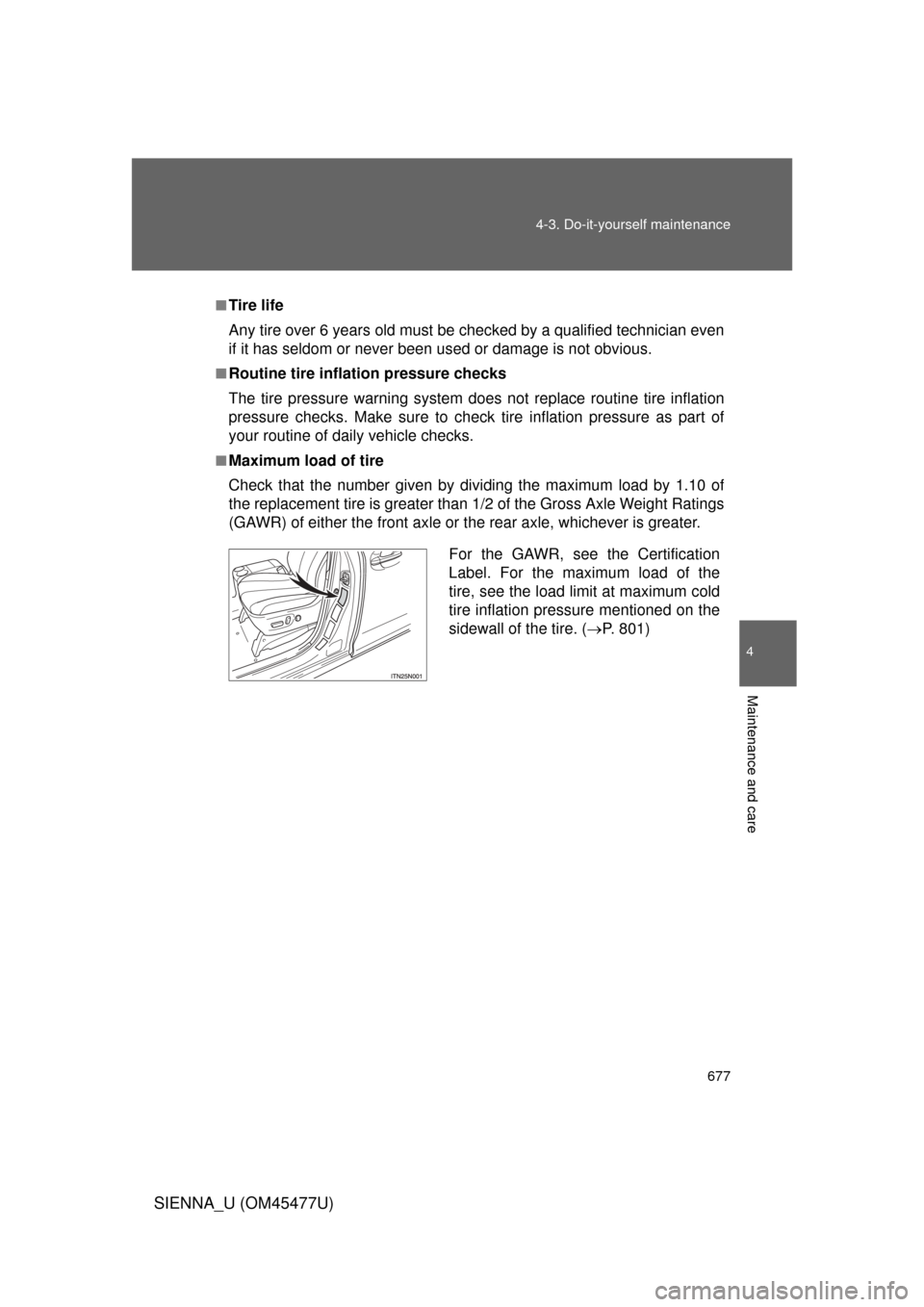
For the GAWR, see the Certification
Label. For the maximum load of the
tire, see the load limit at maximum cold
tire inflation pressure mentioned on the
sidewall of the tire. (P. 801)
Page 685 of 860
685
4-3. Do-it-yourself maintenance
4
Maintenance and care
SIENNA_U (OM45477U)
■Tire inflation pressure check interval
You should check tire inflation pressure every two weeks, or at least
once a month.
Do not forget to check the spare.
■Effects of incorrect tire inflation pressure
Driving with incorrect ti
re inflation pressure ma y result in the following:
●Reduced fuel efficiency
●Reduced driving comfort and tire life
●Reduced safety
●Damage to the drive train
If a tire needs frequent re filling, have it checked by your Toyota dealer.
■Instructions for checking tire inflation pressure
When checking tire inflation pressure, observe the following:
●Check only when the tires are cold.
If your vehicle has been parked for at least 3 hours or has not been
driven for more than 1 mile or 1.5 km, you will get an accurate cold
tire inflation pressure reading.
●Always use a tire pressure gauge.
The appearance of the tire can be mi sleading. In addition, tire infla-
tion pressure that is even just a few pounds off can affect ride quality
and handling.
●Do not reduce tire inflation pressure after driving. It is normal for tire
inflation pressure to be higher after driving.
●Never exceed the vehicle capacity weight.
Passengers and luggage weight should be placed so that the vehicle
is balanced.
Page 687 of 860
687
4-3. Do-it-yourself maintenance
4
Maintenance and care
SIENNA_U (OM45477U)
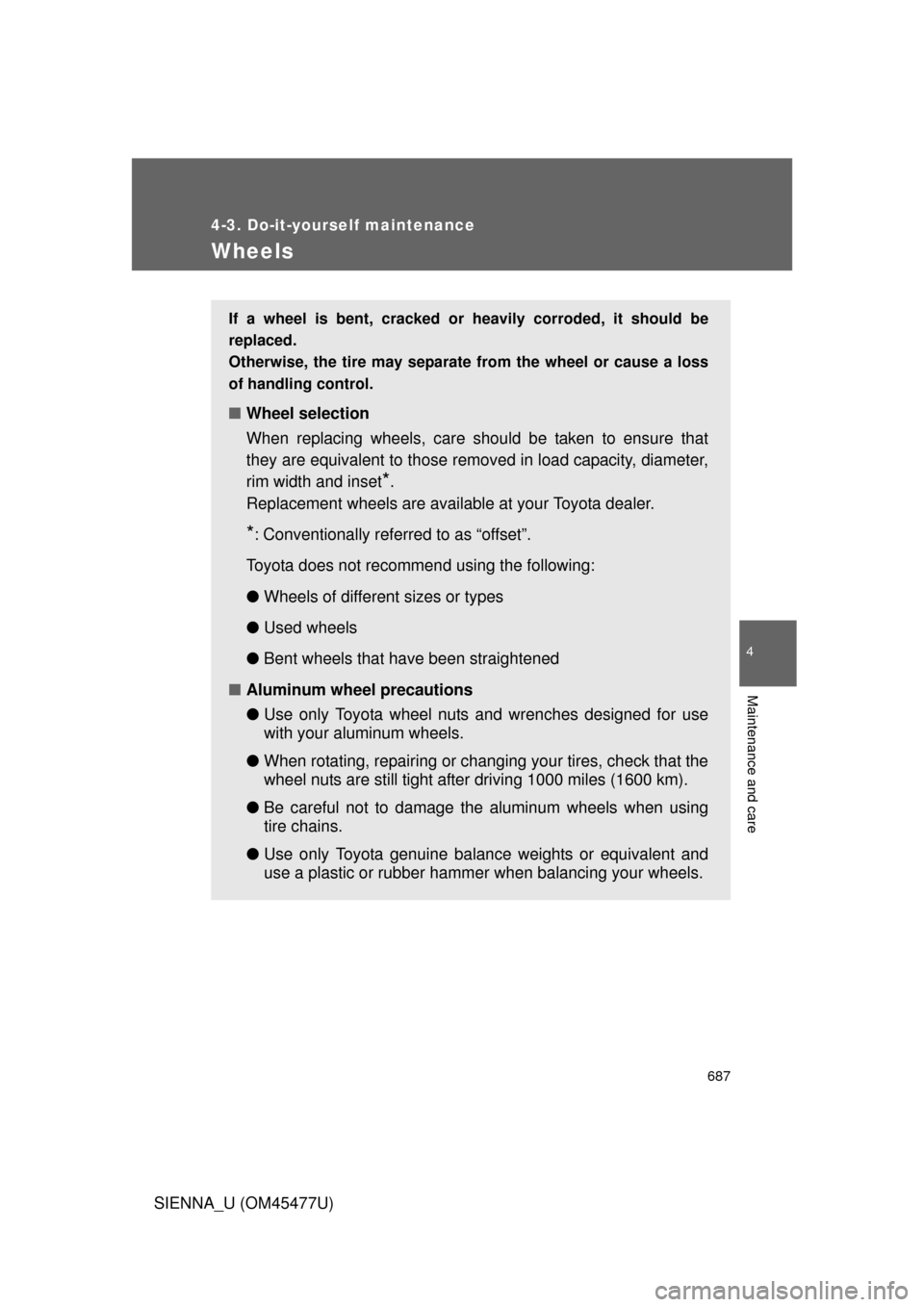
Wheels
If a wheel is bent, cracked or heavily corroded, it should be
replaced.
Otherwise, the tire may separate from the wheel or cause a loss
of handling control.
■Wheel selection
When replacing wheels, care should be taken to ensure that
they are equivalent to those removed in load capacity, diameter,
rim width and inset
*.
Replacement wheels are available at your Toyota dealer.
*: Conventionally referred to as “offset”.
Toyota does not recommend using the following:
● Wheels of different sizes or types
● Used wheels
● Bent wheels that have been straightened
■ Aluminum wheel precautions
●Use only Toyota wheel nuts and wrenches designed for use
with your aluminum wheels.
● When rotating, repairing or changing your tires, check that the
wheel nuts are still tight after driving 1000 miles (1600 km).
● Be careful not to damage the aluminum wheels when using
tire chains.
● Use only Toyota genuine bal ance weights or equivalent and
use a plastic or rubber hammer when balancing your wheels.
Page 784 of 860
784
SIENNA_U (OM45477U)
6-1. Specifications
Maintenance data (fuel, oil level, etc.)
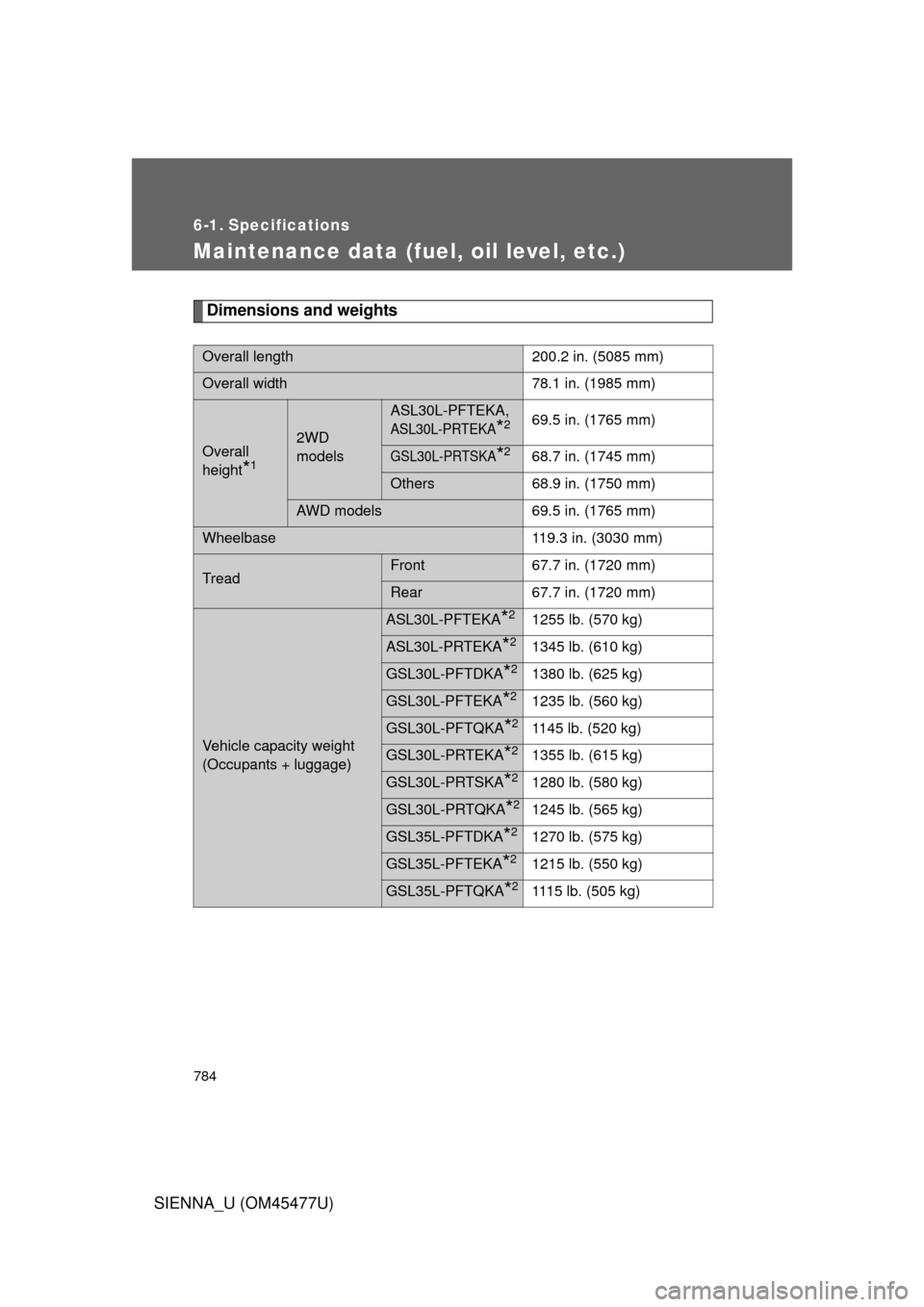
Dimensions and weights
Overall length200.2 in. (5085 mm)
Overall width78.1 in. (1985 mm)
Overall
height
*1
2WD
models
ASL30L-PFTEKA,
ASL30L-PRTEKA*269.5 in. (1765 mm)
GSL30L-PRTSKA*268.7 in. (1745 mm)
Others68.9 in. (1750 mm)
AWD models 69.5 in. (1765 mm)
Wheelbase 119.3 in. (3030 mm)
TreadFront67.7 in. (1720 mm)
Rear67.7 in. (1720 mm)
Vehicle capacity weight
(Occupants + luggage)
ASL30L-PFTEKA*21255 lb. (570 kg)
ASL30L-PRTEKA*21345 lb. (610 kg)
GSL30L-PFTDKA*21380 lb. (625 kg)
GSL30L-PFTEKA*21235 lb. (560 kg)
GSL30L-PFTQKA*21145 lb. (520 kg)
GSL30L-PRTEKA*21355 lb. (615 kg)
GSL30L-PRTSKA*21280 lb. (580 kg)
GSL30L-PRTQKA*21245 lb. (565 kg)
GSL35L-PFTDKA*21270 lb. (575 kg)
GSL35L-PFTEKA*21215 lb. (550 kg)
GSL35L-PFTQKA*21115 lb. (505 kg)
Page 785 of 860
785
6-1. Specifications
6
Vehicle specifications
SIENNA_U (OM45477U)
*1: Unladen vehicle
*2: The model code is indicated on the Certification Label. For details, see
“Vehicle identification” below.
Vehicle identification
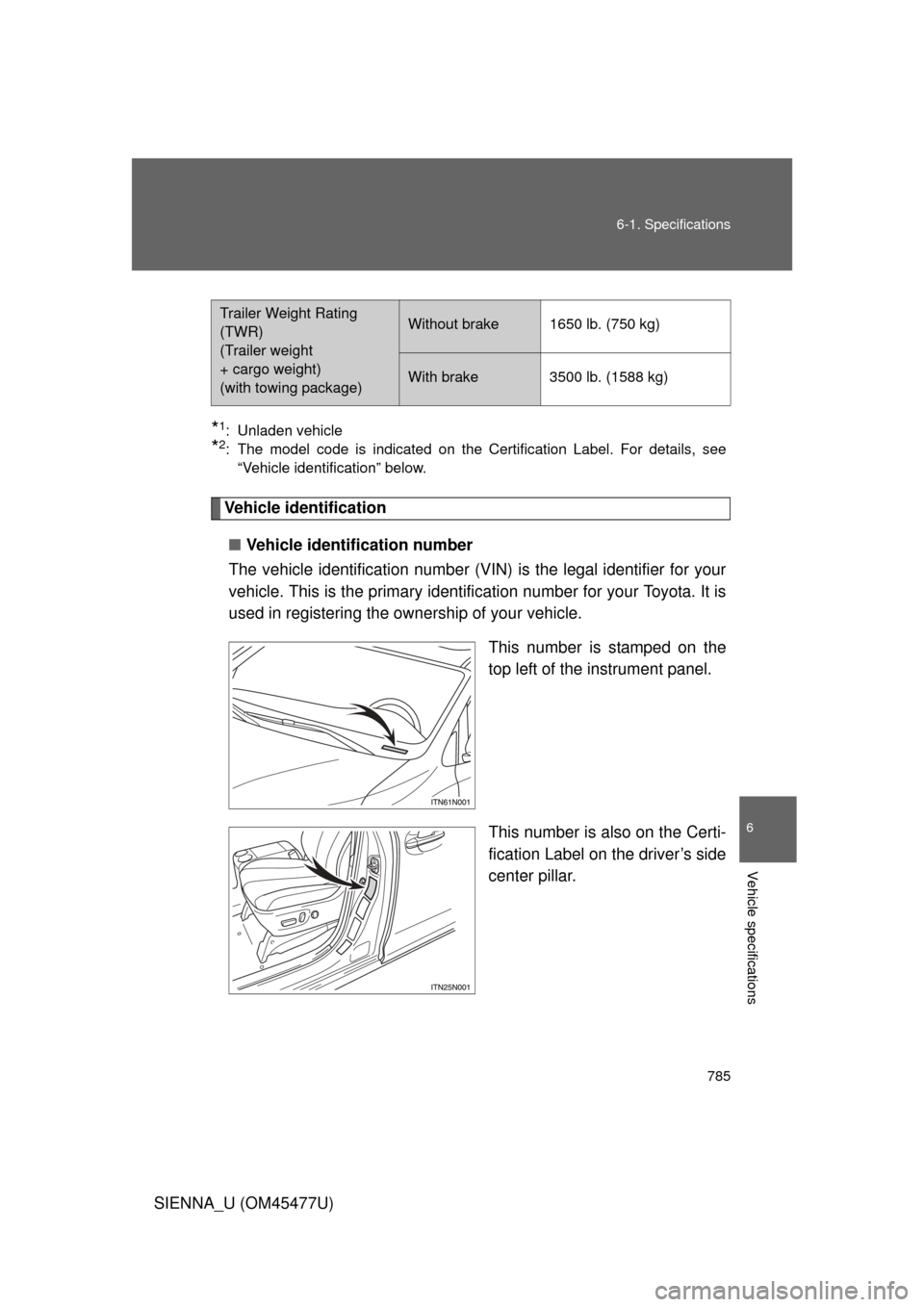
■ Vehicle identification number
The vehicle identificati on number (VIN) is the legal identifier for your
vehicle. This is the primary identification number for your Toyota. It is
used in registering the ownership of your vehicle.
This number is stamped on the
top left of the instrument panel.
This number is also on the Certi-
fication Label on the driver’s side
center pillar.
Trailer Weight Rating
(TWR)
(Trailer weight
+ cargo weight)
(with towing package)Without brake 1650 lb. (750 kg)
With brake 3500 lb. (1588 kg)
Page 808 of 860

808 6-1. Specifications
SIENNA_U (OM45477U)
Glossary of tire terminology
Tire related termMeaning
Cold tire inflation pres-
sure Tire pressure when the vehicle has been
parked for three hours or more, or has not
been driven more than 1 mile or 1.5 km under
that condition
Maximum inflation
pressure The maximum cold inflated
pressure to which a
tire may be inflated, s hown on the sidewall of
the tire
Recommended infla-
tion pressure Cold tire inflation pressure recommended by a
manufacturer
Accessory weight The combined weight (in excess of those stan-
dard items which may be replaced) of auto-
matic transmission, power steering, power
brakes, power windows, power seats, radio
and heater, to the extent that these items are
available as factory-installed equipment
(whether installed or not)
Curb weight The weight of a motor vehicle with standard
equipment, including the maximum capacity of
fuel, oil and coolant, and if so equipped, air
conditioning and additional weight optional
engine
Maximum loaded vehi-
cle weight The sum of:
(a) Curb weight
(b) Accessory weight
(c) Vehicle capacity weight
(d) Production options weight
Page 809 of 860
809
6-1. Specifications
6
Vehicle specifications
SIENNA_U (OM45477U)
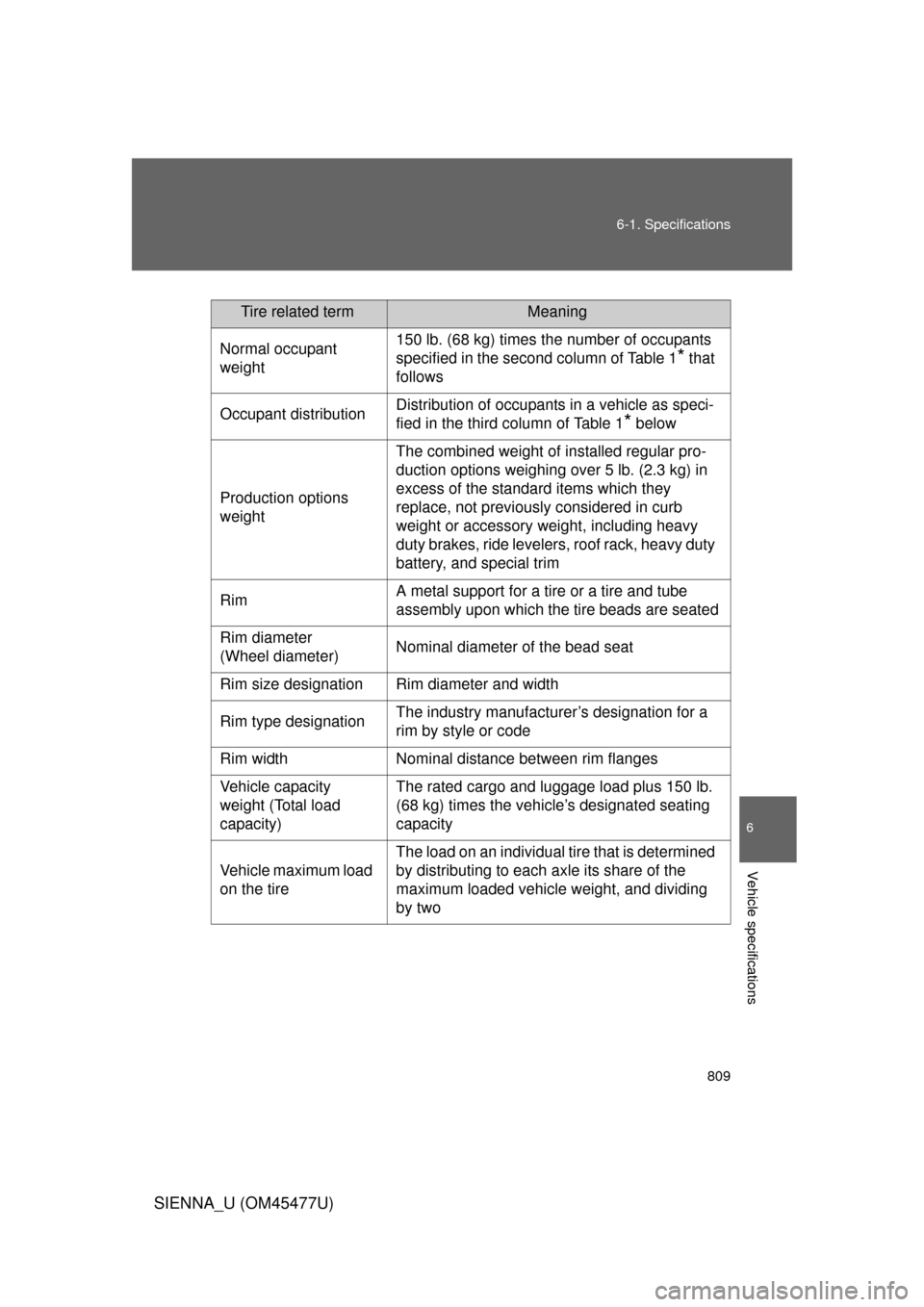
Tire related termMeaning
Normal occupant
weight 150 lb. (68 kg) times the number of occupants
specified in the second column of Table 1
* that
follows
Occupant distribution Distribution of occupants in a vehicle as speci-
fied in the third column of Table 1
* below
Production options
weight The combined weight of installed regular pro-
duction options weighing over 5 lb. (2.3 kg) in
excess of the standard items which they
replace, not previously considered in curb
weight or accessory weight, including heavy
duty brakes, ride levelers, roof rack, heavy duty
battery, and special trim
Rim A metal support for a tire or a tire and tube
assembly upon which the tire beads are seated
Rim diameter
(Wheel diameter) Nominal diameter of the bead seat
Rim size designation Rim diameter and width
Rim type designation The industry manufacturer’s designation for a
rim by style or code
Rim width Nominal distance between rim flanges
Vehicle capacity
weight (Total load
capacity) The rated cargo and luggage load plus 150 lb.
(68 kg) times the vehicle’s designated seating
capacity
Vehicle maximum load
on the tire The load on an individual tire that is determined
by distributing to each axle its share of the
maximum loaded vehicle weight, and dividing
by two
Page 810 of 860

810 6-1. Specifications
SIENNA_U (OM45477U)
Tire related termMeaning
Vehicle normal load
on the tire The load on an individual tire that is determined
by distributing to each axle its share of curb
weight, accessory weight, and normal occu-
pant weight (distributed in accordance with
Ta b l e 1
* below), and dividing by two
Weather side The surface area of the rim not covered by the
inflated tire
Bead The part of the tire that is made of steel wires,
wrapped or reinforced by ply cords and that is
shaped to fit the rim
Bead separation A breakdown of the bond between components
in the bead
Bias ply tire A pneumatic tire in which the ply cords that
extend to the beads are laid at alternate angles
substantially less than 90 degrees to the cen-
terline of the tread
Carcass The tire structure, except tread and sidewall
rubber which, when inflated, bears the load
Chunking The breaking away of pieces of the tread or
sidewall
Cord The strands forming the plies in the tire
Cord separation The parting of cords from adjacent rubber com-
pounds
Cracking Any parting within the tread, sidewall, or inner-
liner of the tire ext
ending to cord material