Page 762 of 860
762
5-2. Steps to take in an emergency
SIENNA_U (OM45477U)
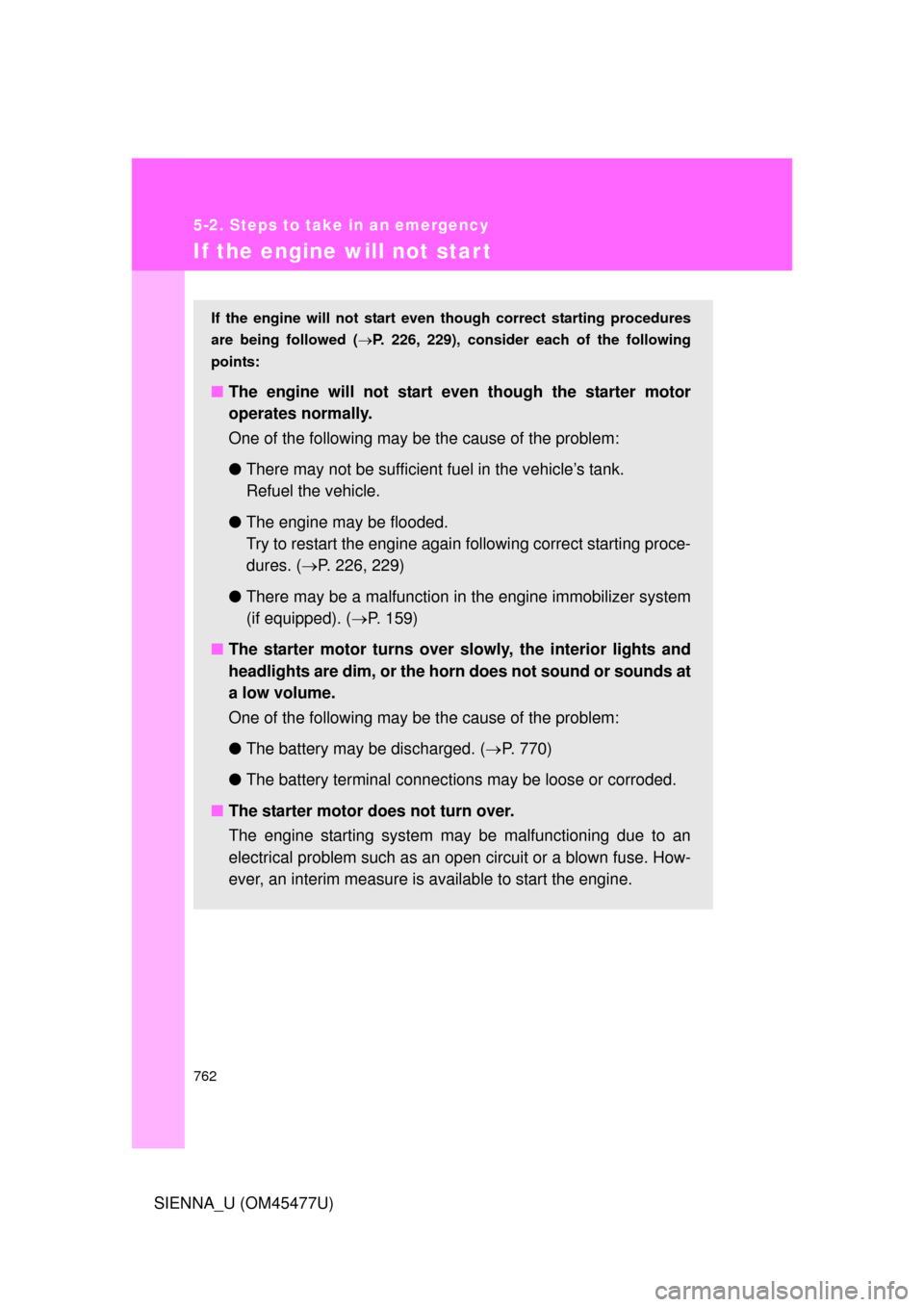
If the engine will not star t
If the engine will not start even though correct starting procedures
are being followed ( P. 226, 229), consider each of the following
points:
■ The engine will not start even though the starter motor
operates normally.
One of the following may be the cause of the problem:
●There may not be sufficient fuel in the vehicle’s tank.
Refuel the vehicle.
● The engine may be flooded.
Try to restart the engine again following correct starting proce-
dures. ( P. 226, 229)
● There may be a malfunction in the engine immobilizer system
(if equipped). ( P. 159)
■ The starter motor turns over slowly, the interior lights and
headlights are dim, or the horn does not sound or sounds at
a low volume.
One of the following may be the cause of the problem:
●The battery may be discharged. ( P. 770)
● The battery terminal connec tions may be loose or corroded.
■ The starter motor does not turn over.
The engine starting system may be malfunctioning due to an
electrical problem such as an open circuit or a blown fuse. How-
ever, an interim measure is available to start the engine.
Page 763 of 860
5
When trouble arises
763
5-2. Steps to take in an emergency
SIENNA_U (OM45477U)
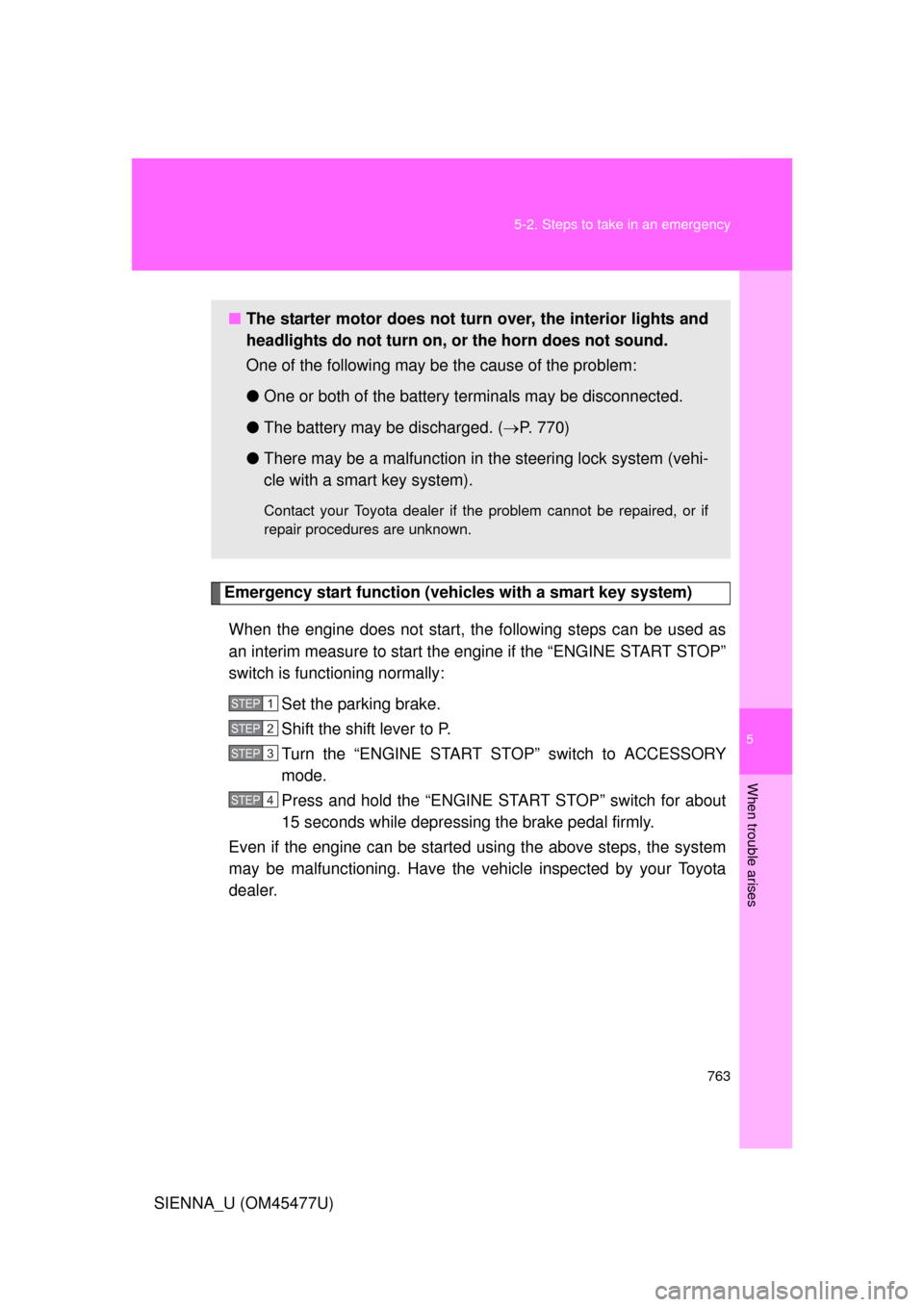
Emergency start function (vehicles with a smart key system)
When the engine does not start, the following steps can be used as
an interim measure to start the engine if the “ENGINE START STOP”
switch is functioning normally: Set the parking brake.
Shift the shift lever to P.
Turn the “ENGINE START STOP” switch to ACCESSORY
mode.
Press and hold the “ENGINE START STOP” switch for about
15 seconds while depressing the brake pedal firmly.
Even if the engine can be start ed using the above steps, the system
may be malfunctioning. Have the vehicle inspected by your Toyota
dealer.
■ The starter motor does not turn over, the interior lights and
headlights do not turn on, or the horn does not sound.
One of the following may be the cause of the problem:
● One or both of the battery terminals may be disconnected.
● The battery may be discharged. ( P. 770)
● There may be a malfunction in the steering lock system (vehi-
cle with a smart key system).
Contact your Toyota dealer if the problem cannot be repaired, or if
repair procedures are unknown.
STEP1
STEP2
STEP3
STEP4
Page 772 of 860
772 5-2. Steps to take in an emergency
SIENNA_U (OM45477U)
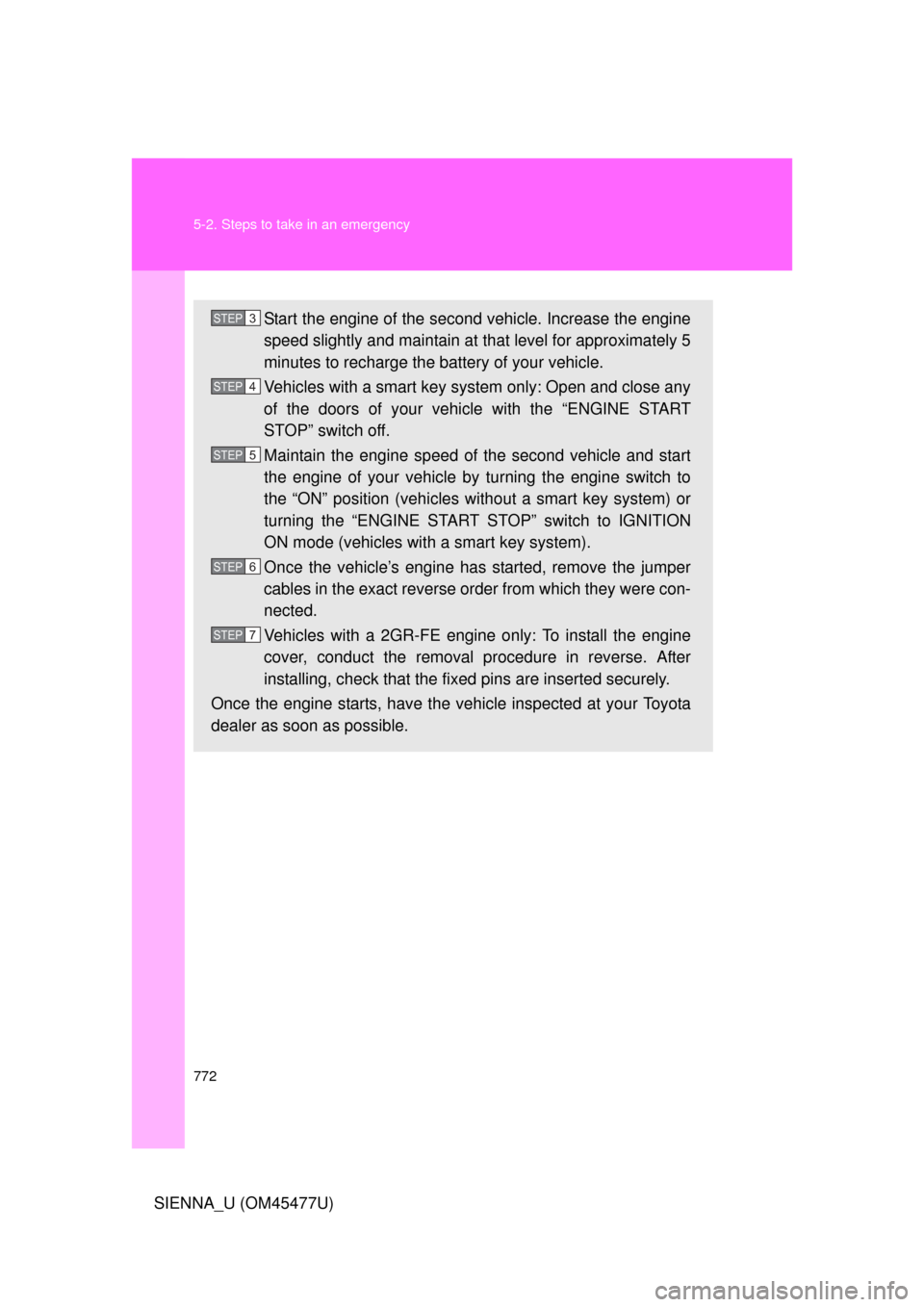
Start the engine of the second vehicle. Increase the engine
speed slightly and maintain at that level for approximately 5
minutes to recharge the battery of your vehicle.
Vehicles with a smart key system only: Open and close any
of the doors of your vehicle with the “ENGINE START
STOP” switch off.
Maintain the engine speed of the second vehicle and start
the engine of your vehicle by turning the engine switch to
the “ON” position (vehicles without a smart key system) or
turning the “ENGINE START STOP” switch to IGNITION
ON mode (vehicles with a smart key system).
Once the vehicle’s engine has started, remove the jumper
cables in the exact reverse or der from which they were con-
nected.
Vehicles with a 2GR-FE engine only: To install the engine
cover, conduct the removal procedure in reverse. After
installing, check that the fixed pins are inserted securely.
Once the engine starts, have the vehicle inspected at your Toyota
dealer as soon as possible.STEP3
STEP4
STEP5
STEP6
STEP7
Page 773 of 860
5
When trouble arises
773
5-2. Steps to take in an emergency
SIENNA_U (OM45477U)
■
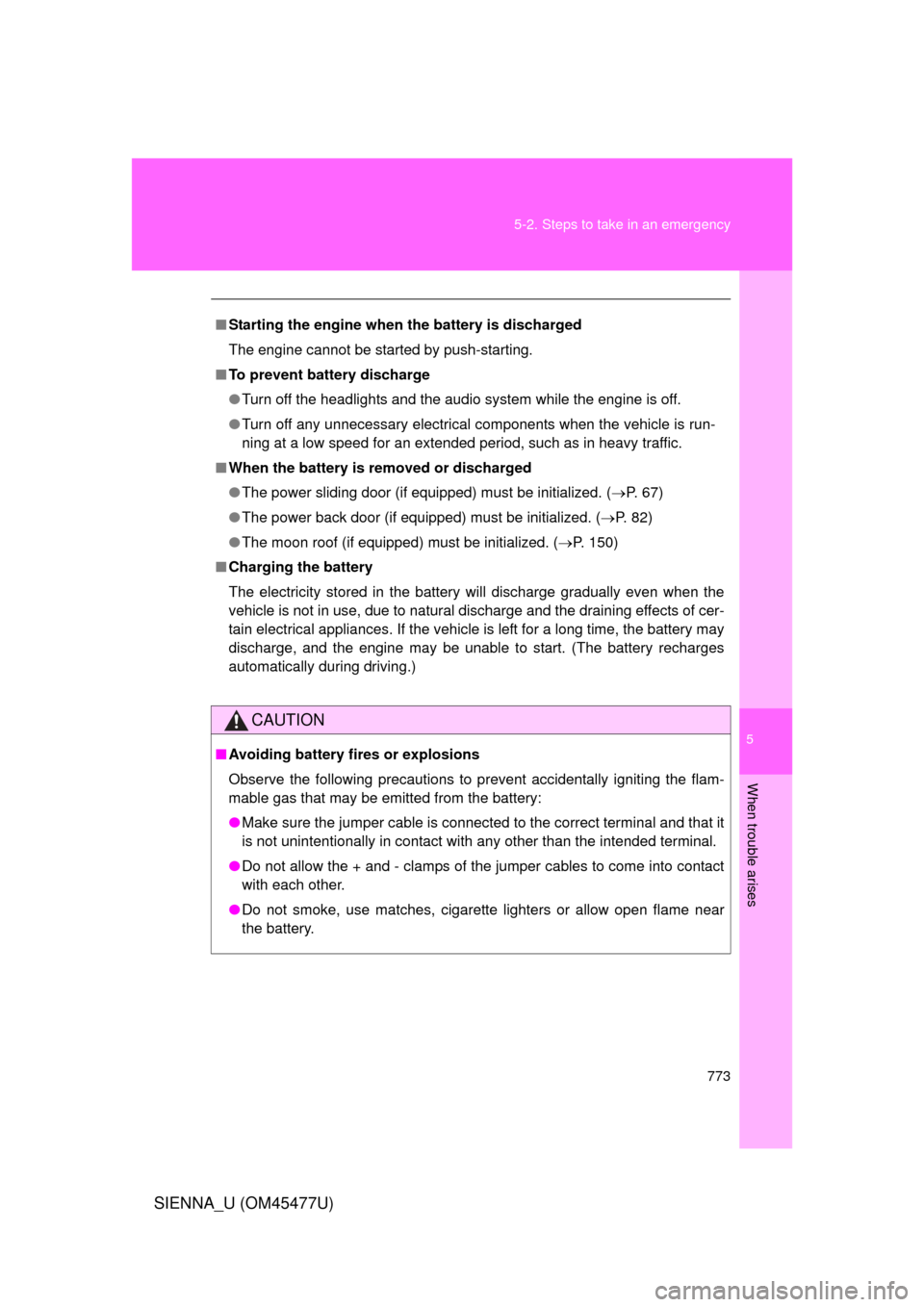
Starting the engine when the battery is discharged
The engine cannot be started by push-starting.
■ To prevent battery discharge
● Turn off the headlights and the audio system while the engine is off.
● Turn off any unnecessary electrical components when the vehicle is run-
ning at a low speed for an extended period, such as in heavy traffic.
■ When the battery is removed or discharged
● The power sliding door (if equipped) must be initialized. ( P. 67)
● The power back door (if equipped) must be initialized. ( P. 82)
● The moon roof (if equipped) must be initialized. ( P. 150)
■ Charging the battery
The electricity stored in the battery will discharge gradually even when the
vehicle is not in use, due to natural discharge and the draining effects of cer-
tain electrical appliances. If the vehicle is left for a long time, the battery may
discharge, and the engine may be unable to start. (The battery recharges
automatically during driving.)
CAUTION
■Avoiding battery fires or explosions
Observe the following precautions to prevent accidentally igniting the flam-
mable gas that may be emitted from the battery:
● Make sure the jumper cable is connected to the correct terminal and that it
is not unintentionally in contact with any other than the intended terminal.
● Do not allow the + and - clamps of the jumper cables to come into contact
with each other.
● Do not smoke, use matches, cigarette lighters or allow open flame near
the battery.
Page 791 of 860
791
6-1. Specifications
6
Vehicle specifications
SIENNA_U (OM45477U)
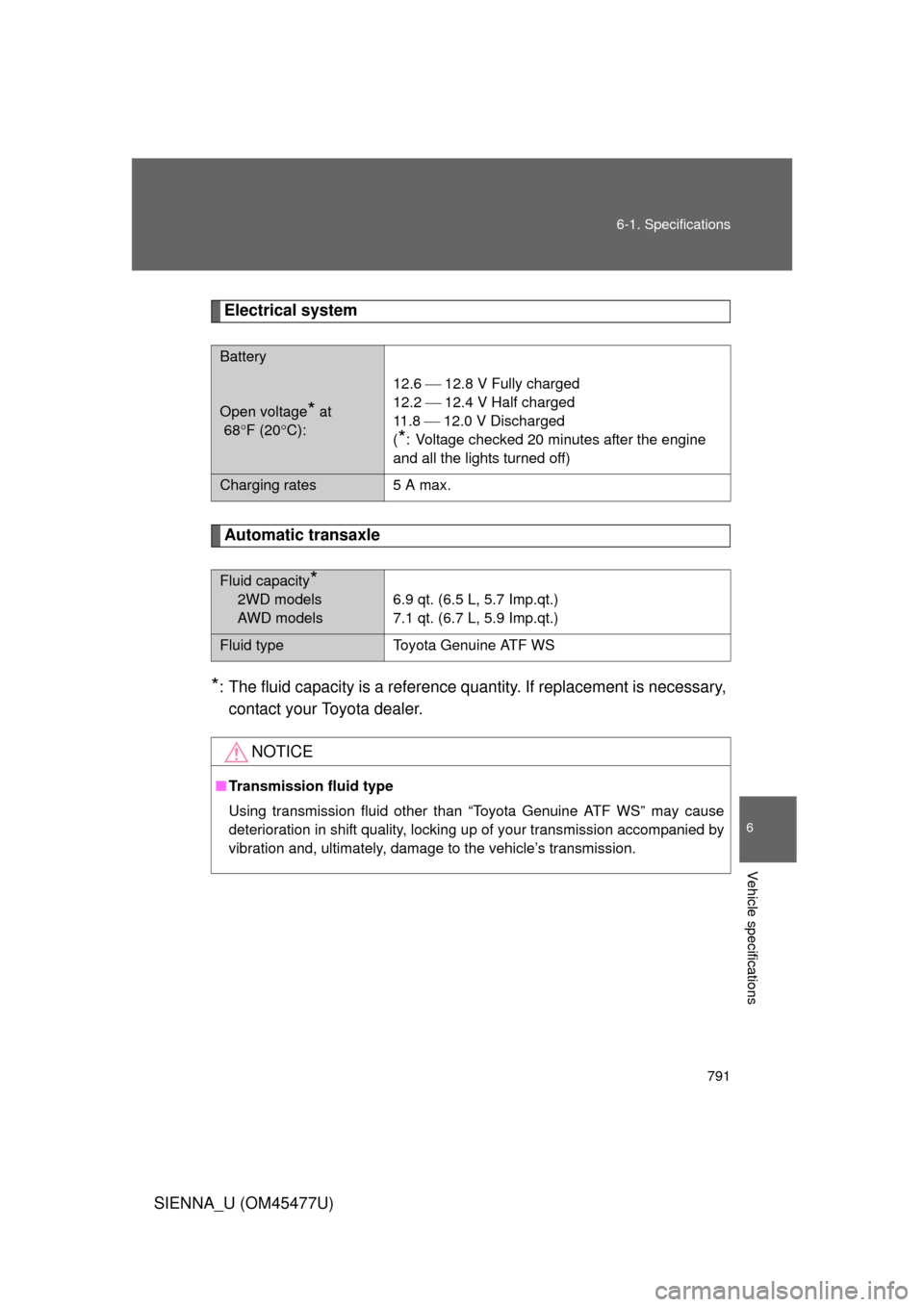
Electrical system
Automatic transaxle
*: The fluid capacity is a reference q
uantity. If replacement is necessary,
contact your Toyota dealer.
Battery
Open voltage* at
68 F (20 C): 12.6 12.8 V Fully charged
12.2 12.4 V Half charged
11 . 8
12.0 V Discharged
(
*: Voltage checked 20 minutes after the engine
and all the lights turned off)
Charging rates 5 A max.
Fluid capacity*
2WD models
AWD models6.9 qt. (6.5 L, 5.7 Imp.qt.)
7.1 qt. (6.7 L, 5.9 Imp.qt.)
Fluid type
Toyota Genuine ATF WS
NOTICE
■Transmission fluid type
Using transmission fluid other than “Toyota Genuine ATF WS” may cause
deterioration in shift quality, locking up of your transmission accompanied by
vibration and, ultimately, damage to the vehicle’s transmission.
Page 796 of 860
796 6-1. Specifications
SIENNA_U (OM45477U)
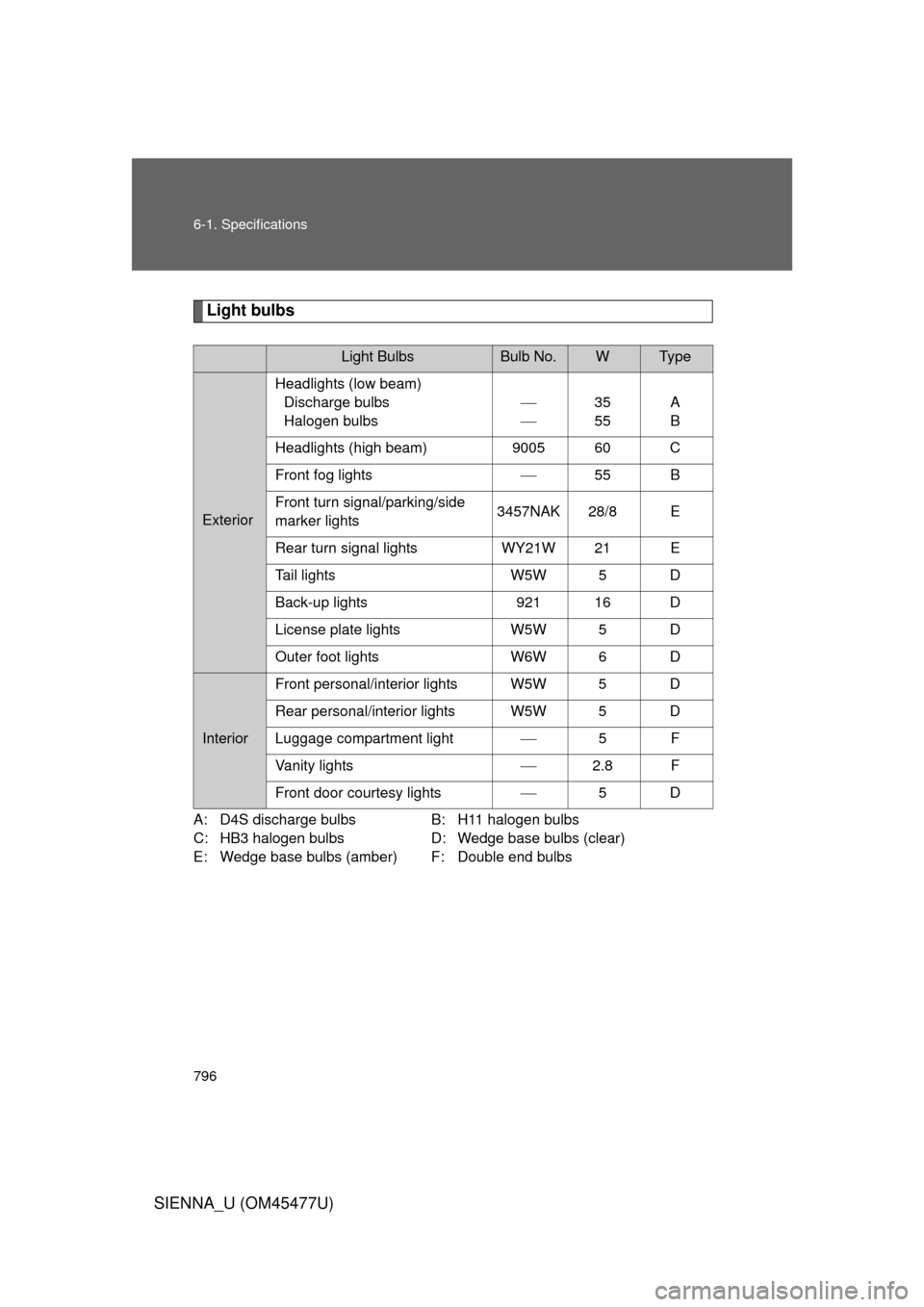
Light bulbs
A: D4S discharge bulbsB: H11 halogen bulbs
C: HB3 halogen bulbs D: Wedge base bulbs (clear)
E: Wedge base bulbs (amber) F: Double end bulbs
Light BulbsBulb No.WTy pe
Exterior Headlights (low beam)
Discharge bulbs
Halogen bulbs
35
55 A
B
Headlights (high beam) 9005 60 C
Front fog lights 55 B
Front turn signal/parking/side
marker lights 3457NAK 28/8 E
Rear turn signal lights WY21W 21 E
Tail lights W5W 5 D
Back-up lights 921 16 D
License plate lights W5W 5 D
Outer foot lights W6W 6 D
Interior Front personal/interior lights W5W 5 D
Rear personal/interior lights W5W 5 D
Luggage compartment light
5F
Vanity lights 2.8 F
Front door courtesy lights 5D
Page 799 of 860
799
6-1. Specifications
6
Vehicle specifications
SIENNA_U (OM45477U)
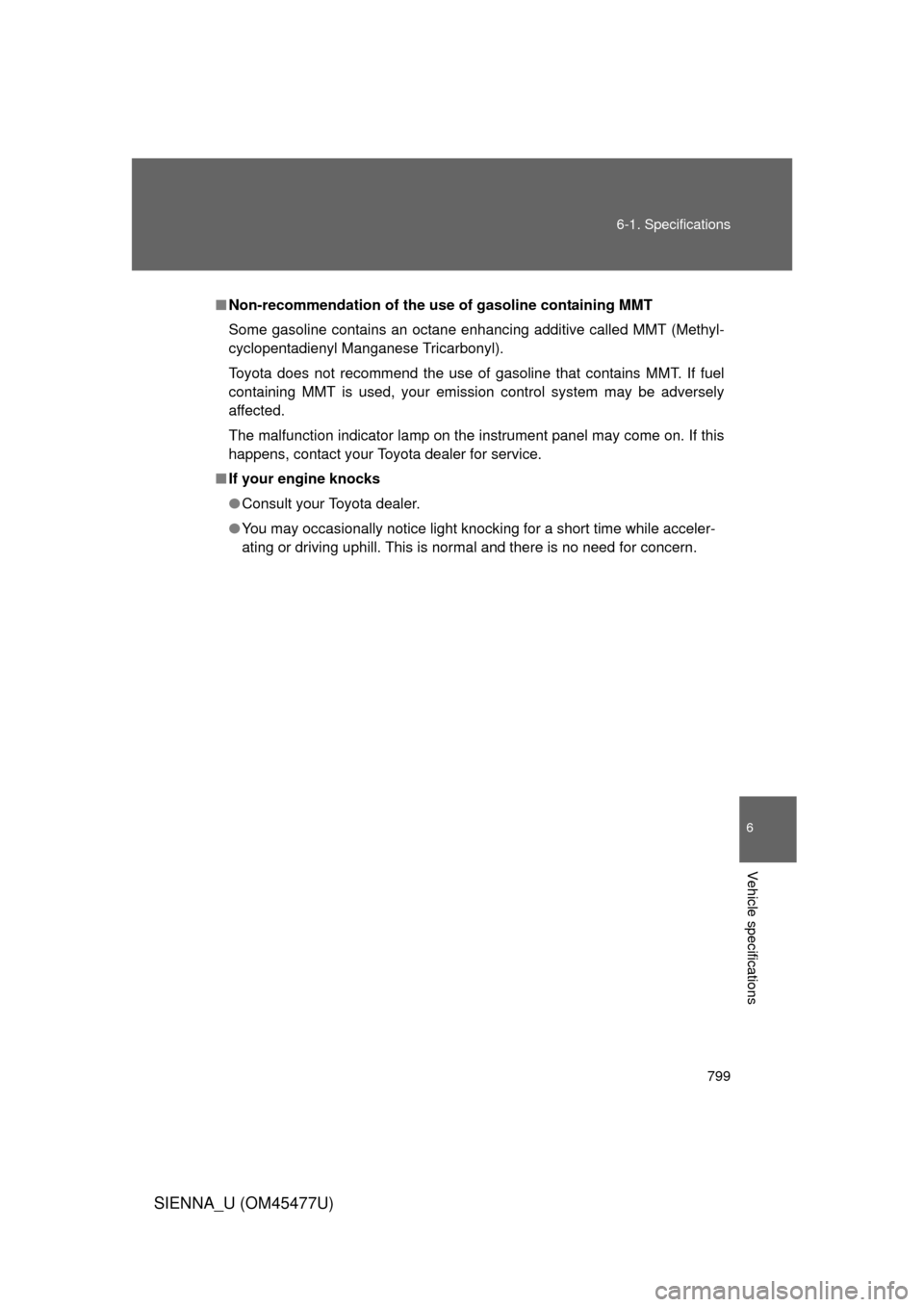
■
Non-recommendation of the use of gasoline containing MMT
Some gasoline contains an octane enhancing additive called MMT (Methyl-
cyclopentadienyl Manganese Tricarbonyl).
Toyota does not recommend the use of gasoline that contains MMT. If fuel
containing MMT is used, your emission control system may be adversely
affected.
The malfunction indicator lamp on the instrument panel may come on. If this
happens, contact your Toyota dealer for service.
■ If your engine knocks
● Consult your Toyota dealer.
● You may occasionally notice light knocking for a short time while acceler-
ating or driving uphill. This is normal and there is no need for concern.
Page 811 of 860
811
6-1. Specifications
6
Vehicle specifications
SIENNA_U (OM45477U)
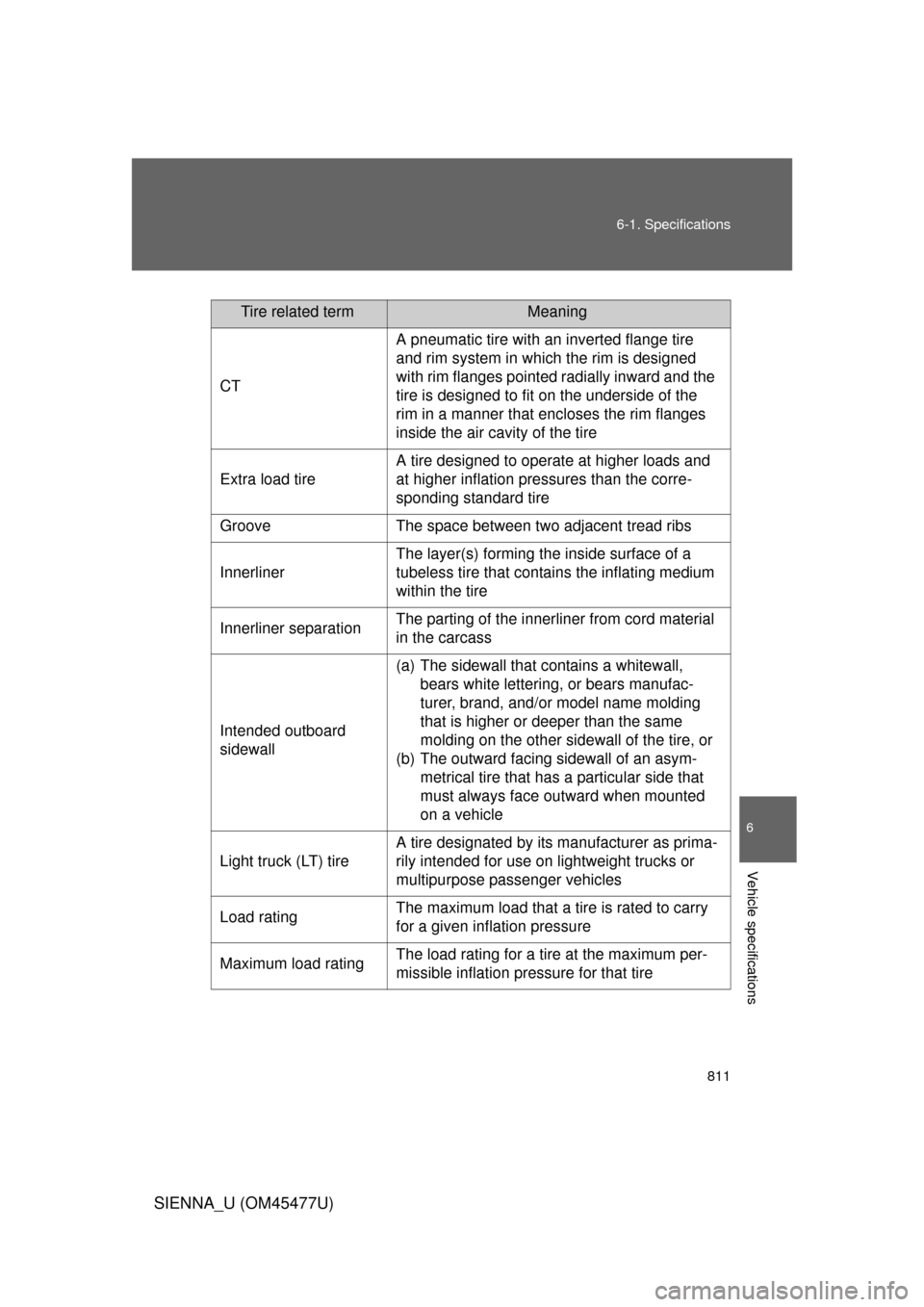
Tire related termMeaning
CT A pneumatic tire with an inverted flange tire
and rim system in which the rim is designed
with rim flanges pointed radially inward and the
tire is designed to fit on the underside of the
rim in a manner that encloses the rim flanges
inside the air cavity of the tire
Extra load tire A tire designed to operate at higher loads and
at higher inflation pressures than the corre-
sponding standard tire
Groove The space between two adjacent tread ribs
Innerliner The layer(s) forming the inside surface of a
tubeless tire that contains the inflating medium
within the tire
Innerliner separation The parting of the innerliner from cord material
in the carcass
Intended outboard
sidewall (a) The sidewall that contains a whitewall,
bears white lettering, or bears manufac-
turer, brand, and/or model name molding
that is higher or deeper than the same
molding on the other sidewall of the tire, or
(b) The outward facing sidewall of an asym- metrical tire that has a particular side that
must always face outward when mounted
on a vehicle
Light truck (LT) tire A tire designated by its manufacturer as prima-
rily intended for use on lightweight trucks or
multipurpose passenger vehicles
Load rating The maximum load that a tire is rated to carry
for a given inflation pressure
Maximum load rating The load rating for a tire at the maximum per-
missible inflation pressure for that tire