Page 719 of 860
719
4-3. Do-it-yourself maintenance
4
Maintenance and care
SIENNA_U (OM45477U)
CAUTION
■
Discharge headligh ts (if equipped)
● Contact your Toyota dealer before replacing discharge headlights (includ-
ing light bulbs).
● Do not touch the discharge headlight’s high voltage socket when the head-
lights are turned on.
An extremely high voltage of 30000 V will be discharged and could result
in serious injury or death by electric shock.
● Do not attempt to take apart or repair the low beam headlight bulbs, con-
nectors, power supply circuits, or related components.
Doing so could result in electric shock and serious injury or death.
■ To prevent damage or fire
Make sure bulbs are fully seated and locked.
NOTICE
■When installing the back door trim
To prevent damage, be careful not to pinch any of the wire harnesses or
connectors with the back door trim.
Page 722 of 860
722
SIENNA_U (OM45477U)
5-1. Essential information
Emergency flashers
NOTICE
■To prevent battery discharge
Do not leave the emergency flashers on longer than necessary when the
engine is not running.
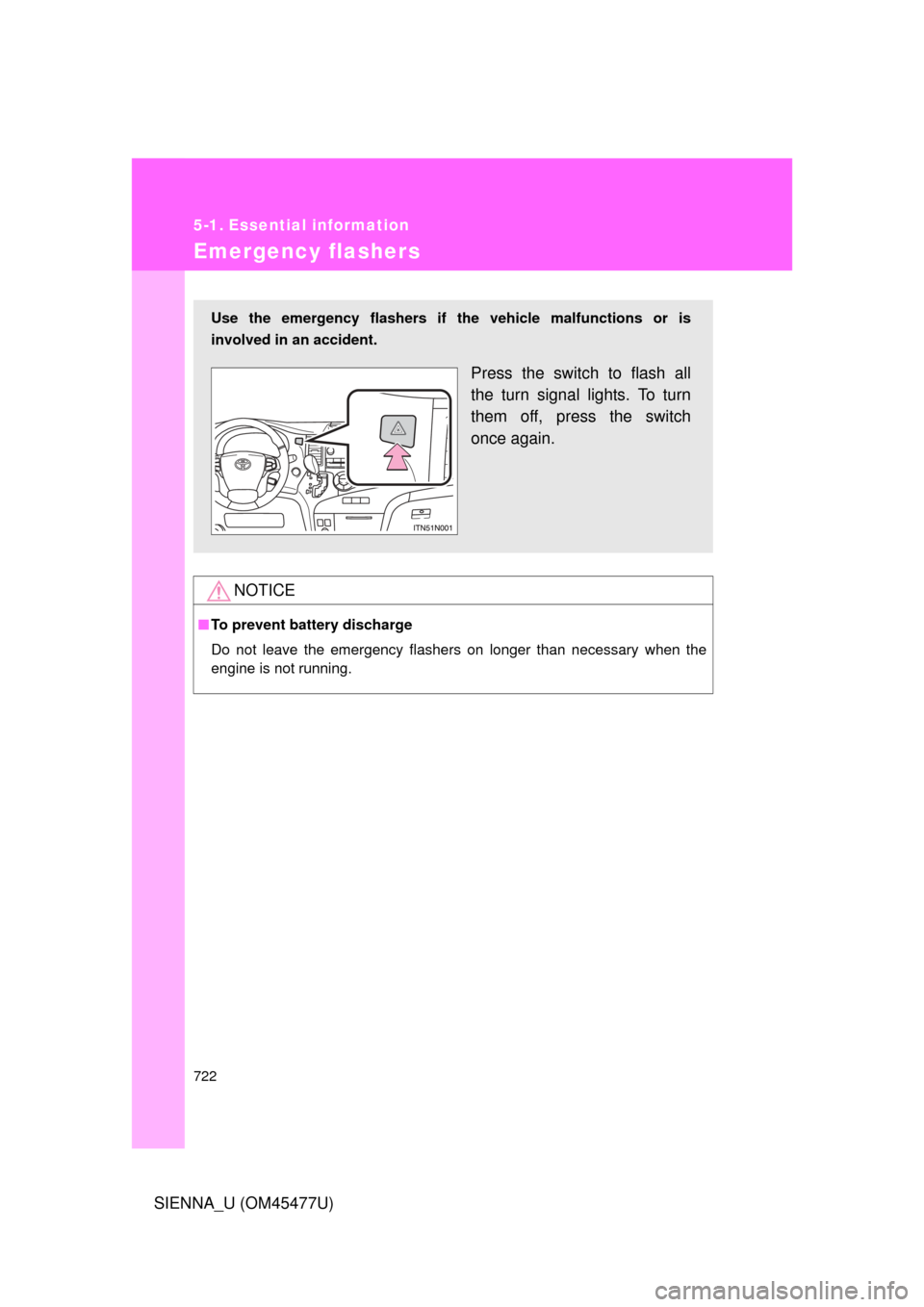
Use the emergency flashers if th e vehicle malfunctions or is
involved in an accident.
Press the switch to flash all
the turn signal lights. To turn
them off, press the switch
once again.
Page 729 of 860
5
When trouble arises
729
SIENNA_U (OM45477U)
5-2. Steps to take in an emergency
If a war ning light turns on or a war ning buzzer sounds...
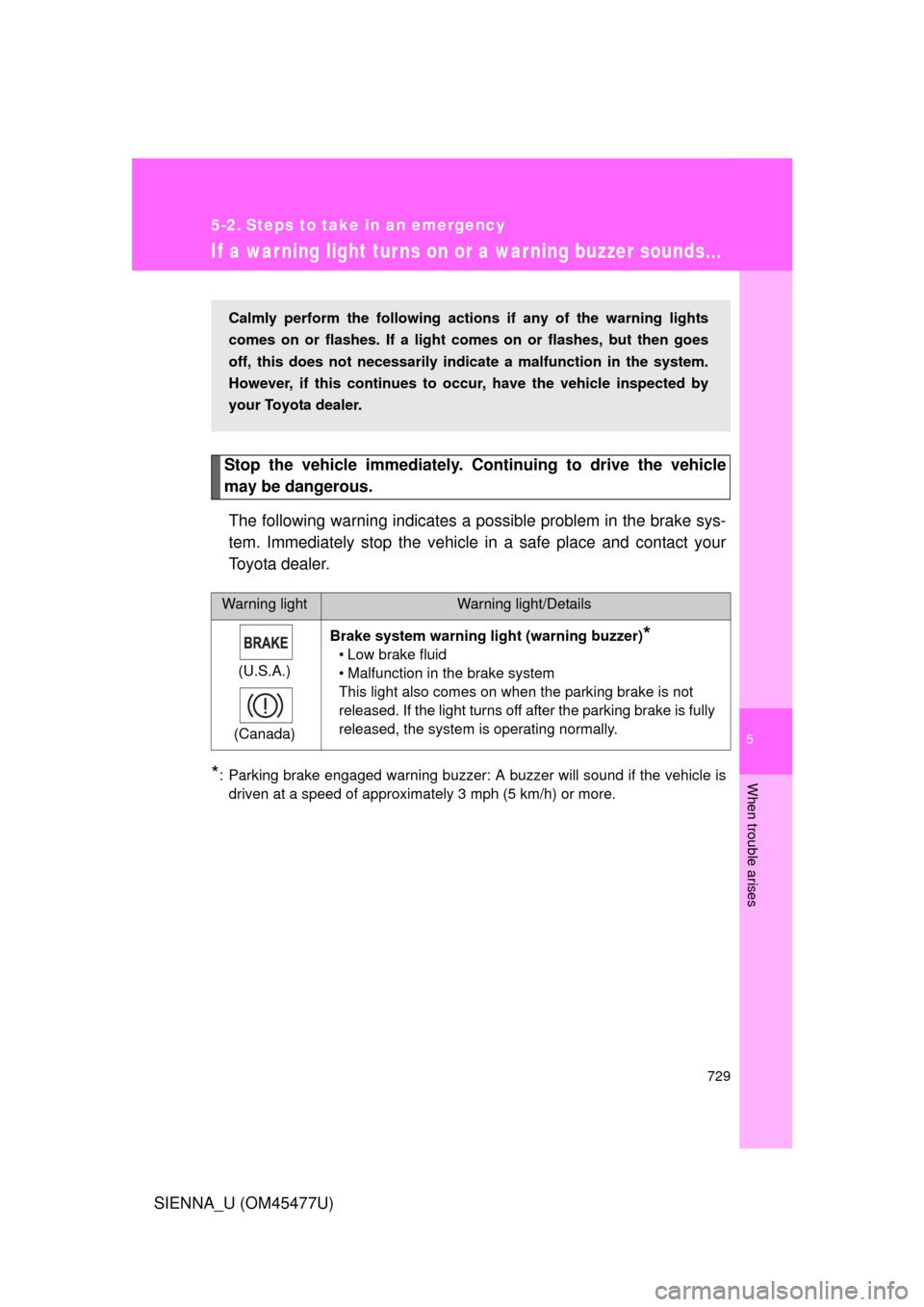
Stop the vehicle immediately. Continuing to drive the vehicle
may be dangerous.The following warning indicates a possible problem in the brake sys-
tem. Immediately stop the vehicle in a safe place and contact your
Toyota dealer.
*: Parking brake engaged warning buzzer: A buzzer will sound if the vehicle is driven at a speed of approximately 3 mph (5 km/h) or more.
Warning lightWarning light/Details
(U.S.A.)
(Canada) Brake system warning light (warning buzzer)
*
• Low brake fluid
• Malfunction in the brake system
This light also comes on when the parking brake is not
released. If the light turns off after the parking brake is fully
released, the system is operating normally.
Calmly perform the following actio
ns if any of the warning lights
comes on or flashes. If a light comes on or flashes, but then goes
off, this does not necessarily indicate a malfunction in the system.
However, if this continues to o ccur, have the vehicle inspected by
your Toyota dealer.
Page 762 of 860
762
5-2. Steps to take in an emergency
SIENNA_U (OM45477U)
If the engine will not star t
If the engine will not start even though correct starting procedures
are being followed ( P. 226, 229), consider each of the following
points:
■ The engine will not start even though the starter motor
operates normally.
One of the following may be the cause of the problem:
●There may not be sufficient fuel in the vehicle’s tank.
Refuel the vehicle.
● The engine may be flooded.
Try to restart the engine again following correct starting proce-
dures. ( P. 226, 229)
● There may be a malfunction in the engine immobilizer system
(if equipped). ( P. 159)
■ The starter motor turns over slowly, the interior lights and
headlights are dim, or the horn does not sound or sounds at
a low volume.
One of the following may be the cause of the problem:
●The battery may be discharged. ( P. 770)
● The battery terminal connec tions may be loose or corroded.
■ The starter motor does not turn over.
The engine starting system may be malfunctioning due to an
electrical problem such as an open circuit or a blown fuse. How-
ever, an interim measure is available to start the engine.
Page 763 of 860
5
When trouble arises
763
5-2. Steps to take in an emergency
SIENNA_U (OM45477U)
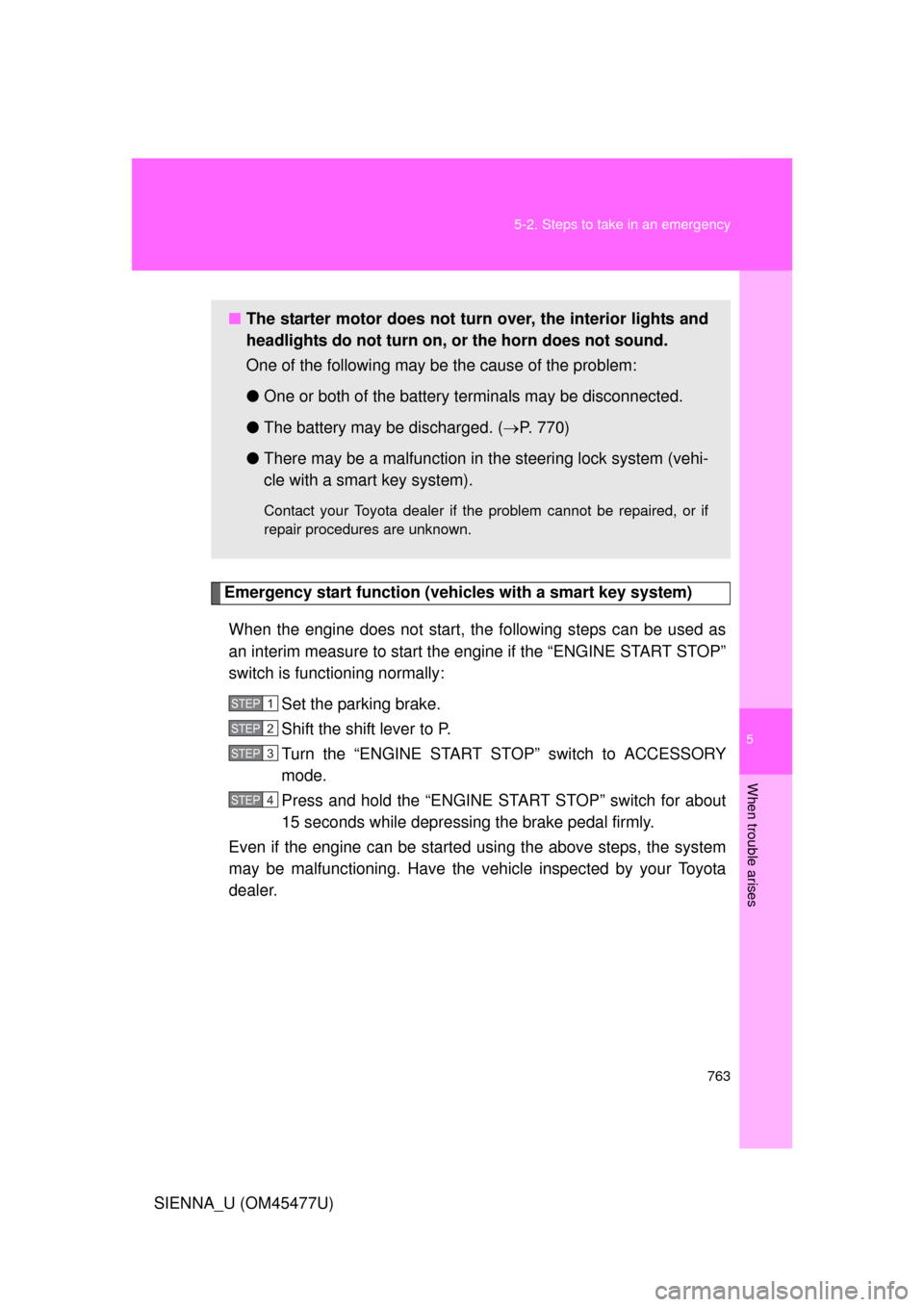
Emergency start function (vehicles with a smart key system)
When the engine does not start, the following steps can be used as
an interim measure to start the engine if the “ENGINE START STOP”
switch is functioning normally: Set the parking brake.
Shift the shift lever to P.
Turn the “ENGINE START STOP” switch to ACCESSORY
mode.
Press and hold the “ENGINE START STOP” switch for about
15 seconds while depressing the brake pedal firmly.
Even if the engine can be start ed using the above steps, the system
may be malfunctioning. Have the vehicle inspected by your Toyota
dealer.
■ The starter motor does not turn over, the interior lights and
headlights do not turn on, or the horn does not sound.
One of the following may be the cause of the problem:
● One or both of the battery terminals may be disconnected.
● The battery may be discharged. ( P. 770)
● There may be a malfunction in the steering lock system (vehi-
cle with a smart key system).
Contact your Toyota dealer if the problem cannot be repaired, or if
repair procedures are unknown.
STEP1
STEP2
STEP3
STEP4
Page 773 of 860
5
When trouble arises
773
5-2. Steps to take in an emergency
SIENNA_U (OM45477U)
■
Starting the engine when the battery is discharged
The engine cannot be started by push-starting.
■ To prevent battery discharge
● Turn off the headlights and the audio system while the engine is off.
● Turn off any unnecessary electrical components when the vehicle is run-
ning at a low speed for an extended period, such as in heavy traffic.
■ When the battery is removed or discharged
● The power sliding door (if equipped) must be initialized. ( P. 67)
● The power back door (if equipped) must be initialized. ( P. 82)
● The moon roof (if equipped) must be initialized. ( P. 150)
■ Charging the battery
The electricity stored in the battery will discharge gradually even when the
vehicle is not in use, due to natural discharge and the draining effects of cer-
tain electrical appliances. If the vehicle is left for a long time, the battery may
discharge, and the engine may be unable to start. (The battery recharges
automatically during driving.)
CAUTION
■Avoiding battery fires or explosions
Observe the following precautions to prevent accidentally igniting the flam-
mable gas that may be emitted from the battery:
● Make sure the jumper cable is connected to the correct terminal and that it
is not unintentionally in contact with any other than the intended terminal.
● Do not allow the + and - clamps of the jumper cables to come into contact
with each other.
● Do not smoke, use matches, cigarette lighters or allow open flame near
the battery.
Page 791 of 860
791
6-1. Specifications
6
Vehicle specifications
SIENNA_U (OM45477U)
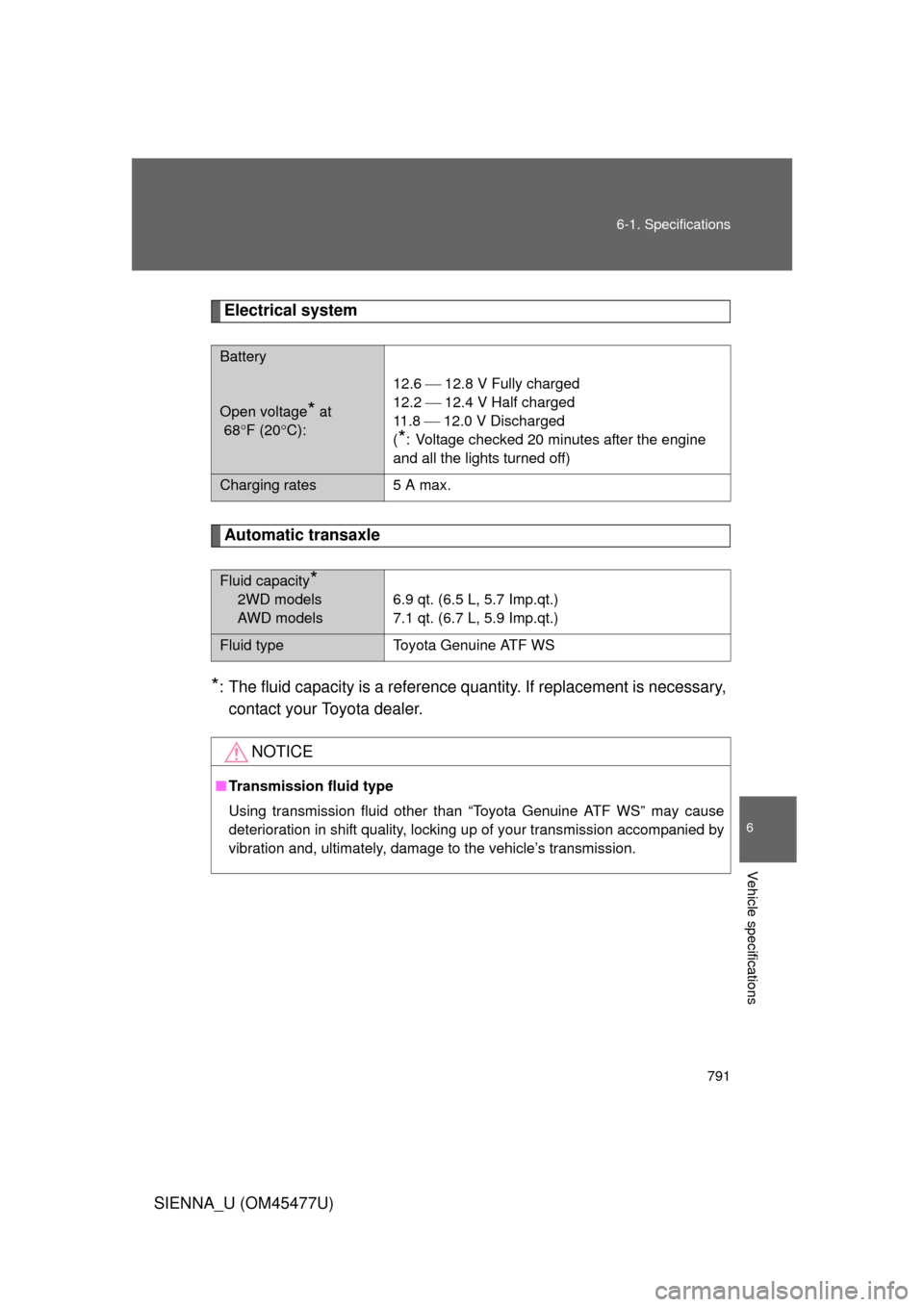
Electrical system
Automatic transaxle
*: The fluid capacity is a reference q
uantity. If replacement is necessary,
contact your Toyota dealer.
Battery
Open voltage* at
68 F (20 C): 12.6 12.8 V Fully charged
12.2 12.4 V Half charged
11 . 8
12.0 V Discharged
(
*: Voltage checked 20 minutes after the engine
and all the lights turned off)
Charging rates 5 A max.
Fluid capacity*
2WD models
AWD models6.9 qt. (6.5 L, 5.7 Imp.qt.)
7.1 qt. (6.7 L, 5.9 Imp.qt.)
Fluid type
Toyota Genuine ATF WS
NOTICE
■Transmission fluid type
Using transmission fluid other than “Toyota Genuine ATF WS” may cause
deterioration in shift quality, locking up of your transmission accompanied by
vibration and, ultimately, damage to the vehicle’s transmission.
Page 796 of 860
796 6-1. Specifications
SIENNA_U (OM45477U)
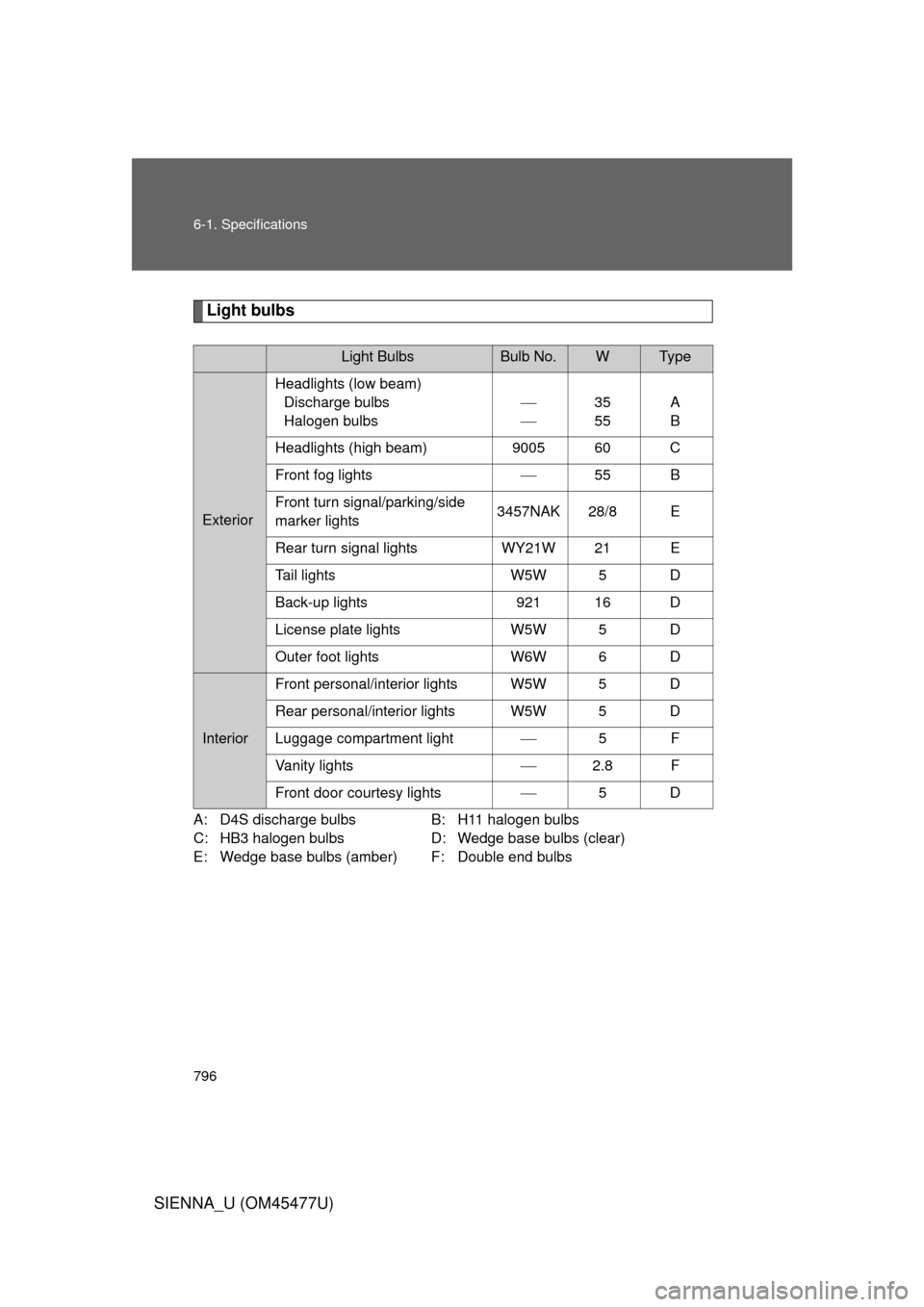
Light bulbs
A: D4S discharge bulbsB: H11 halogen bulbs
C: HB3 halogen bulbs D: Wedge base bulbs (clear)
E: Wedge base bulbs (amber) F: Double end bulbs
Light BulbsBulb No.WTy pe
Exterior Headlights (low beam)
Discharge bulbs
Halogen bulbs
35
55 A
B
Headlights (high beam) 9005 60 C
Front fog lights 55 B
Front turn signal/parking/side
marker lights 3457NAK 28/8 E
Rear turn signal lights WY21W 21 E
Tail lights W5W 5 D
Back-up lights 921 16 D
License plate lights W5W 5 D
Outer foot lights W6W 6 D
Interior Front personal/interior lights W5W 5 D
Rear personal/interior lights W5W 5 D
Luggage compartment light
5F
Vanity lights 2.8 F
Front door courtesy lights 5D