Page 380 of 544
380 4-3. Do-it-yourself maintenance
Washer fluidFor vehicles sold in U.S.A. Add washer fluid in the following
situations.
●Any washer does not work.
● The low washer fluid warning
light comes on.
For vehicles sold in Canada
If any washer does not work or the low windshield washer fluid warn-
ing light comes on, the washer tank may be empty. Add washer fluid.
CAUTION
■ When filling the washer fluid
Do not refill the washer fluid when the engine is hot or running, as the
washer fluid contains alcohol and may catch fire if spilled on the engine etc.
NOTICE
■Do not use any fluid other than washer fluid
Do not use soapy water or engine antifreeze instead of washer fluid.
Doing so may cause streaking on the vehicle’s painted surfaces.
■ Diluting washer fluid
Dilute washer fluid with water as necessary.
Refer to the freezing temperatures listed on the label of the washer fluid bot-
tle.
Page 432 of 544
432
5-1. Essential information
If you think something is wrong
If you notice any of the following symptoms, your vehicle probably
needs adjustment or repair. Contact your Toyota dealer as soon as
possible.
■ Visible symptoms
●Fluid leaks under the vehicle
(Water dripping from the air cond itioning after use is normal.)
● Flat-looking tires or uneven tire wear
● Engine coolant temperature g auge needle continually points
higher than normal
■ Audible symptoms
●Changes in exhaust sound
● Excessive tire squeal when cornering
● Strange noises related to the suspension system
● Pinging or other noises related to the engine
■ Operational symptoms
●Engine missing, stumbling or running rough
● Appreciable loss of power
● Vehicle pulls heavily to one side when braking
● Vehicle pulls heavily to one side when driving on a level road
● Loss of brake effectiveness, s pongy feeling, pedal almost
touches the floor
Page 436 of 544

436
5-2. Steps to take in an emergency
If a war ning light tur ns on or a war ning buzzer sounds...
Stop the vehicle immediately. Continuing to drive the vehicle may be dangerous.
The following warning indicates a possible problem in the brake sys-
tem. Immediately stop the vehicle in a safe place and contact your
Toyota dealer.
*: Parking brake engaged warning buzzer: The buzzer sounds to indicate that the parking brake is still engaged (with
the vehicle having reached a speed of 3 mph [5 km/h]).
Warning lightWarning light/Details
(U.S.A.)
(Canada) Brake system warning light (warning buzzer)*
• Low brake fluid
• Malfunction in the brake system
This light also comes on when the parking brake is not
released. If the light turns off after the parking brake is fully
released the system is operating normally.
Calmly perform the following actions if any of the warning lights turn
on or flash. If a light turns on or flashes, but then turns off, this does
not necessarily indicate a malfunction in the system.
Page 439 of 544

5
When trouble arises
439
5-2. Steps to take in an emergency
Low fuel level warning
light
Indicates that remaining
fuel is about 2.4 gal. (9.0
L, 2.0 Imp. gal.) or less Refuel the vehicle.
Driver’s seat belt
reminder light
(warning buzzer)*
1
Warns the driver to fasten
his/her seat belt. Fasten the seat belt.
(on the center panel) Front passenger’s seat
belt reminder light
(warning buzzer)*
1
Warns the front passen-
ger to fasten his or her
seat belt.
Fasten the seat belt.
(Flashes) Active Torque Control
4WD system warning light
(4WD models)
Indicates that the driveline
temperature is too high.
(When the light comes on.
P. 437) Reduce vehicle speed (until
the light goes off) or stop
the vehicle at a safe place
and allow the engine to idle
until the light goes off.
Automatic transmission
fluid temperature warning
light (if equipped) Indicates that the auto-
matic transmission fluid
temperature is too high. Stop the vehicle in a safe
place and shift the shift
lever to P.
If the light does not go off,
contact your Toyota dealer.
Low washer fluid warning
light Low level of washer fluid Fill the tank.
Warning lightWarning light/DetailsCorrection procedure
Page 475 of 544

5
When trouble arises
475
5-2. Steps to take in an emergency
CAUTION
■
Avoiding battery fires or explosions
Observe the following precautions to prevent accidentally igniting the flam-
mable gas that may be emitted from the battery.
●Make sure the jumper cable is connected to the correct terminal and that it
is not unintentionally in contact with any part other than the intended termi-
nal.
● Do not allow the jumper cables to come into contact with the “+” and “-” ter-
minals.
● Do not smoke, use matches, cigarette lighters or allow open flame near
the battery.
■ Battery precautions
The battery contains poisonous and corrosive acidic electrolyte, while
related parts contain lead and lead compounds. Observe the following pre-
cautions when handling the battery.
●When working with the battery, always wear safety glasses and take care
not to allow any battery fluids (acid) to come into contact with skin, clothing
or the vehicle body.
● Do not lean over the battery.
● In the event that battery fluid comes into contact with the skin or eyes,
immediately wash the affected area with water and seek medical attention.
Place a wet sponge or cloth over the affected area until medical attention
can be received.
● Always wash your hands after handling the battery support, terminals, and
other battery-related parts.
● Do not allow children near the battery.
NOTICE
■When handling jumper cables
Be careful that the jumper cables do not become tangled in the cooling fans
or any of the belts when connecting or disconnecting them.
Page 492 of 544
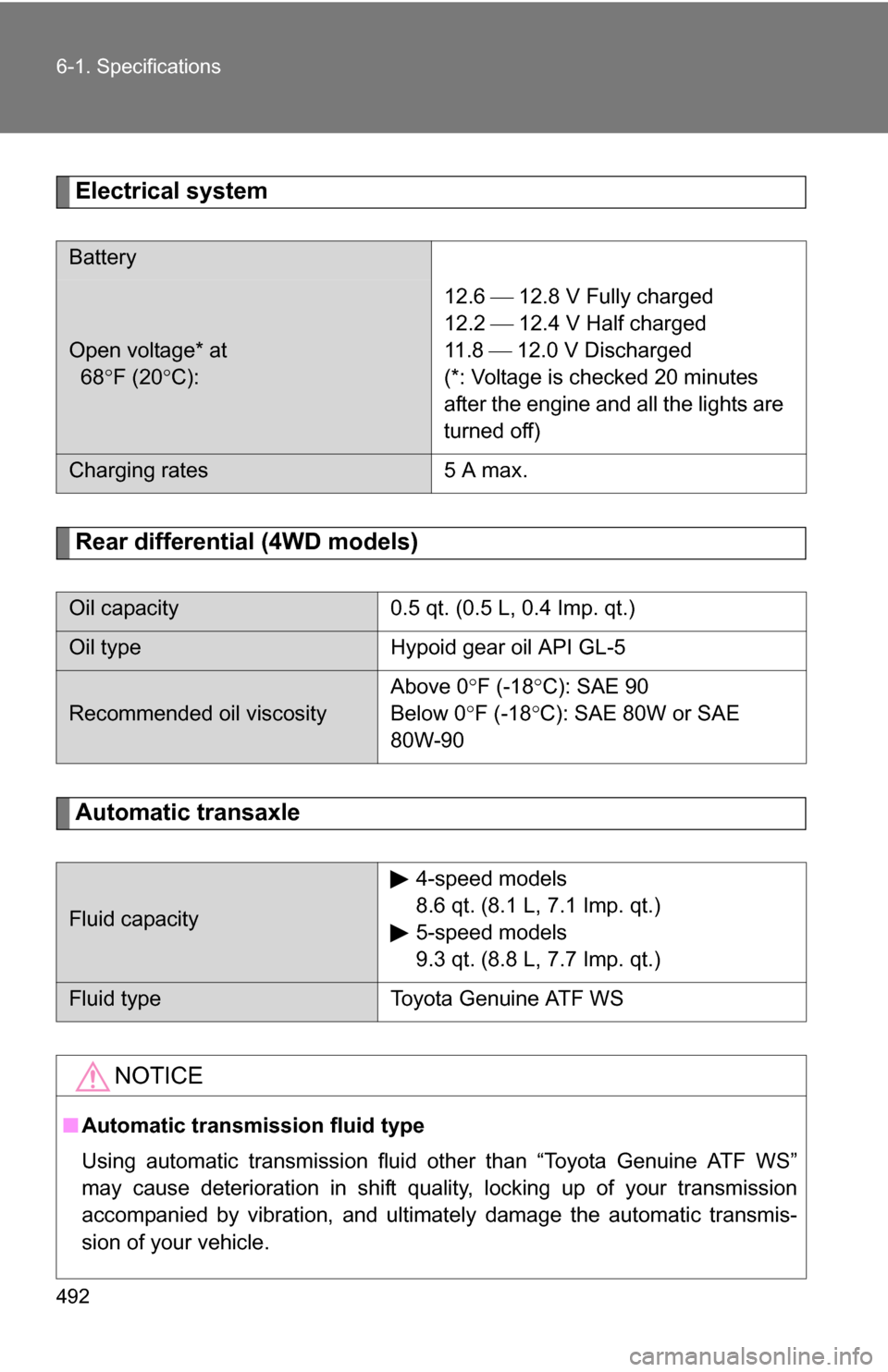
492 6-1. Specifications
Electrical system
Rear differential (4WD models)
Automatic transaxle
Battery
Open voltage* at
68F (20 C): 12.6 12.8 V Fully charged
12.2 12.4 V Half charged
11 . 8
12.0 V Discharged
(*: Voltage is checked 20 minutes
after the engine and all the lights are
turned off)
Charging rates 5 A max.
Oil capacity0.5 qt. (0.5 L, 0.4 Imp. qt.)
Oil typeHypoid gear oil API GL-5
Recommended oil viscosityAbove 0
F (-18 C): SAE 90
Below 0 F (-18 C): SAE 80W or SAE
80W-90
Fluid capacity 4-speed models
8.6 qt. (8.1 L, 7.1 Imp. qt.)
5-speed models
9.3 qt. (8.8 L, 7.7 Imp. qt.)
Fluid type
Toyota Genuine ATF WS
NOTICE
■Automatic transmission fluid type
Using automatic transmission fluid other than “Toyota Genuine ATF WS”
may cause deterioration in shift quality, locking up of your transmission
accompanied by vibration, and ultimately damage the automatic transmis-
sion of your vehicle.
Page 493 of 544
493
6-1. Specifications
6
Vehicle specifications
Transfer (4WD models)
Brakes
*1: Minimum pedal clearance when depressed with a force of 110 lbf (490 N,
50 kgf) while the engine is running
*
2: Parking brake pedal travel when depress ed with a force of 45 lbf (200 N, 21
kgf)
Steering
Oil capacity 0.48 qt. (0.45 L, 0.40 Imp. qt.)
Oil typeHypoid gear oil API GL-5
Recommended oil viscosityAbove 0
F (-18 C): SAE 90
Below 0 F (-18 C): SAE 80W or SAE
80W-90
Pedal clearance*1Without third seats
3.7 in. (95 mm)
With third seats
4.7 in. (120 mm)
Pedal free play 0.04 0.24 in. (1 6 mm)
Brake pad wear limit 0.04 in. (1.0 mm)
Parking brake lining wear limit 0.04 in. (1.0 mm)
Parking brake pedal travel*26 8 clicks
Fluid type SAE J1703 or FMVSS No. 116 DOT 3
Free playLess than 1.2 in. (30 mm)
Page 508 of 544

508 6-1. Specifications
Tire related termMeaning
Ply A layer of rubber-coated parallel cords
Ply separation A parting of rubber compound between adja-
cent plies
Pneumatic tire A mechanical device made of rubber, chemi-
cals, fabric and steel or
other materials, that,
when mounted on an automotive wheel, pro-
vides the traction and contains the gas or fluid
that sustains the load
Radial ply tire A pneumatic tire in which the ply cords that
extend to the beads are laid at substantially 90
degrees to the centerline of the tread
Reinforced tire A tire designed to operate at higher loads and
at higher inflation pressures than the corre-
sponding standard tire
Section width The linear distance between the exteriors of
the sidewalls of an inflated tire, excluding ele-
vations due to labeling, decoration, or protec-
tive bands
Sidewall That portion of a tire between the tread and
bead
Sidewall separation The parting of the rubber compound from the
cord material in the sidewall
Snow tire A tire that attains a traction index equal to or
greater than 110, compared to the ASTM
E-1136 Standard Reference Test Tire, when
using the snow traction test as described in
ASTM F-1805-00, Standard Test Method for
Single Wheel Driving Traction in a Straight Line
on Snow-and Ice-Covered Surfaces, and which
is marked with an Alpine Symbol ( ) on at
least one sidewall
Te s t r i m The rim on which a tire is fitted for testing, and
may be any rim listed as appropriate for use
with that tire