Page 406 of 636
406 4-2. Maintenance
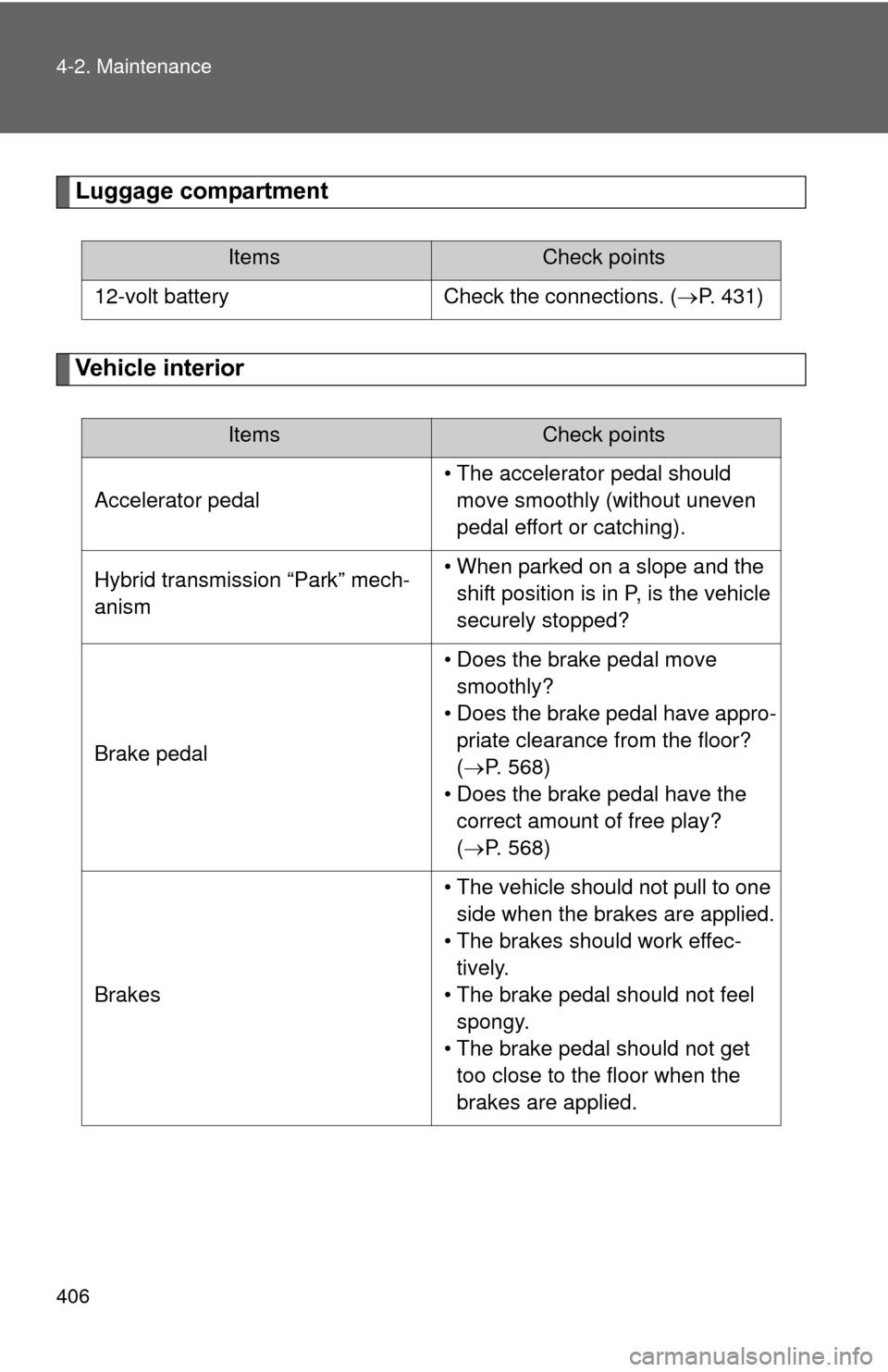
Luggage compartment
Vehicle interior
ItemsCheck points
12-volt battery Check the connections. ( P. 431)
ItemsCheck points
Accelerator pedal
• The accelerator pedal should
move smoothly (without uneven
pedal effort or catching).
Hybrid transmission “Park” mech-
anism • When parked on a slope and the
shift position is in P, is the vehicle
securely stopped?
Brake pedal • Does the brake pedal move
smoothly?
• Does the brake pedal have appro- priate clearance from the floor?
(P. 568)
• Does the brake pedal have the correct amount of free play?
(P. 568)
Brakes • The vehicle should not pull to one
side when the brakes are applied.
• The brakes should work effec- tively.
• The brake pedal should not feel spongy.
• The brake pedal should not get too close to the floor when the
brakes are applied.
Page 409 of 636

409
4-2. Maintenance
4
Maintenance and care
Emission inspection and maintenance (I/M) programs
Some states have vehicle emission inspection programs which
include OBD (On Board Diagnostics) checks. The OBD system moni-
tors the operation of th e emission control system.
■If the malfunction indicator lamp comes on
The OBD system determines that a problem exists somewhere
in the emission control system. Your vehicle may not pass the I/
M test and may need to be repaired. Contact your Toyota dealer
to service the vehicle.
■ Your vehicle may not pass the I/M test in the following situa-
tions:
●When the 12-volt battery is disconnected or discharged
Readiness codes that are se t during ordinary driving are
erased.
Also, depending on your driving habits, the readiness codes
may not be completely set.
● When the fuel tank cap is loose
The malfunction indicator lamp comes on indicating a tempo-
rary malfunction and your vehi cle may not pass the I/M test.
■ When the malfunction indicator lamp still remains on after
several driving trips
The error code in the OBD system will not be cleared unless the
vehicle is driven 40 or more times.
■ If your vehicle does not pass the I/M test
Contact your Toyota dealer to prepare the vehicle for re-testing.
Page 410 of 636
410
4-3. Do-it-yourself maintenance
Do-it-yourself ser vice precautions
If you perform maintenance by yourself, be sure to follow the correct
procedure as given in these sections.
ItemsParts and tools
12-volt battery condition (P. 431)• Grease
• Conventional wrench
(for terminal clamp bolts)
Brake fluid level ( P. 427)
• FMVSS No.116 DOT 3 or SAE
J1703 brake fluid
• Rag or paper towel
• Funnel (used only for adding brake fluid)
Engine/power control unit coolant
level ( P. 424)
• “Toyota Super Long Life Coolant”
or a similar high quality ethylene
glycol-based non-silicate, non-
amine, non-nitrite and non-borate
coolant with long-life hybrid
organic acid technology
For the U.S.A.:
“Toyota Super Long Life Cool-
ant” is pre-mixed with 50% cool-
ant and 50% deionized water.
For Canada:
“Toyota Super Long Life Cool-
ant” is pre-mixed with 55% cool-
ant and 45% deionized water.
• Funnel (used only for adding cool- ant)
Page 419 of 636
419
4-3. Do-it-yourself maintenance
4
Maintenance and care
Engine compar tment
■12-volt battery
P. 431
Engine coolant reservoir
( P. 424)
Engine oil level dipstick ( P. 420)
Engine oil filler cap ( P. 420)
Power control unit coolant
reservoir ( P. 424)Brake fluid reservoir
( P. 427)
Fuse box ( P. 456)
Radiator ( P. 426)
Condenser ( P. 426)
Electric cooling fans
Washer fluid tank ( P. 429)
Page 431 of 636
431
4-3. Do-it-yourself maintenance
4
Maintenance and care
12-volt batter y
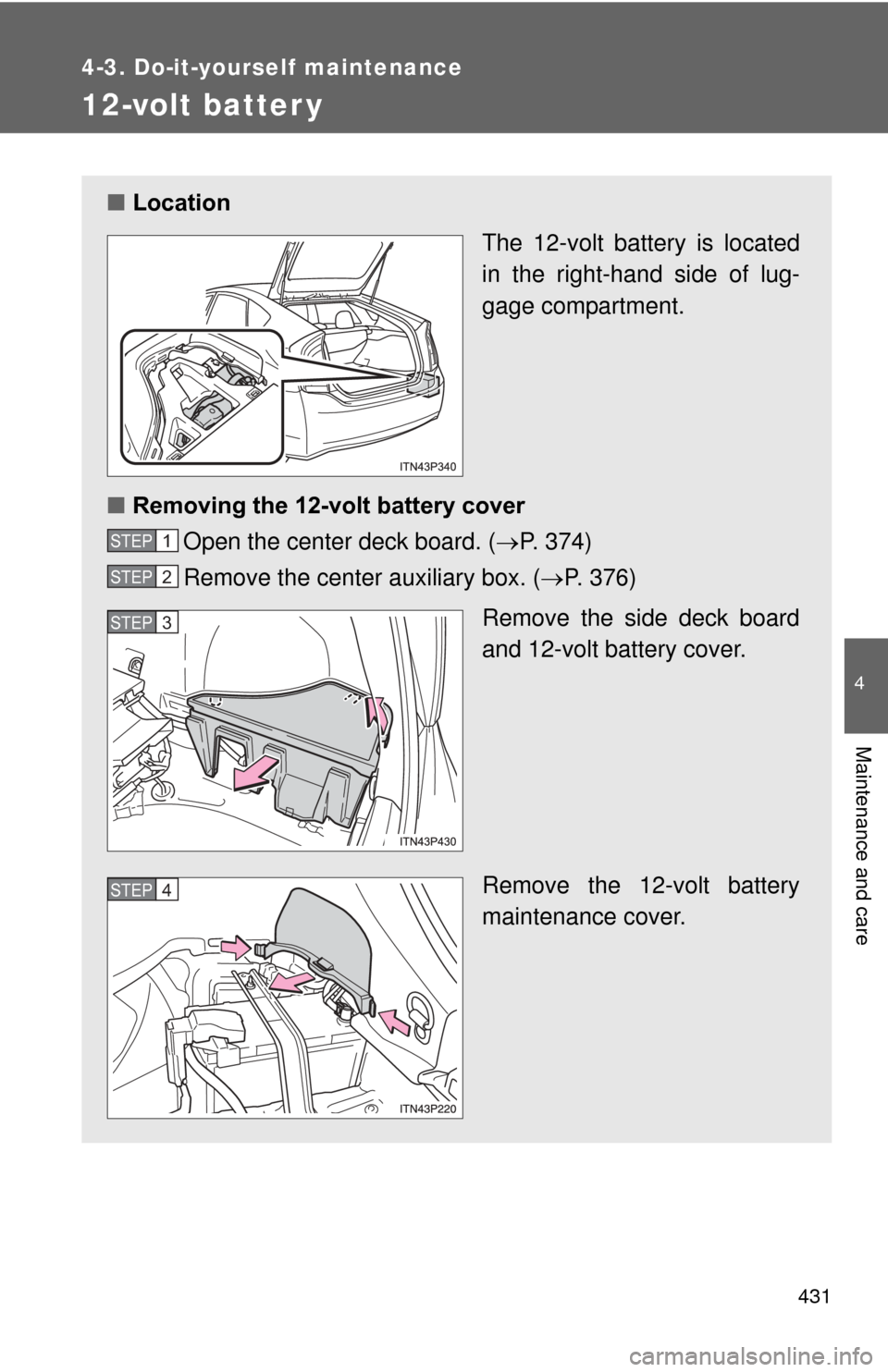
■Location
The 12-volt battery is located
in the right-hand side of lug-
gage compartment.
■ Removing the 12-volt battery cover
Open the center deck board. ( P. 374)
Remove the center auxiliary box. ( P. 376)
Remove the side deck board
and 12-volt battery cover.
Remove the 12-volt battery
maintenance cover.
STEP 1
STEP 2
STEP 3
STEP 4
Page 432 of 636
432 4-3. Do-it-yourself maintenance
■Before recharging
When recharging, the 12-volt battery produces hydrogen gas which is flam-
mable and explosive. Therefore, observe the following precautions before
recharging:
●If recharging with the 12-volt battery installed on the vehicle, be sure to
disconnect the ground cable.
● Make sure the power switch on the charger is off when connecting and
disconnecting the charger cables to the 12-volt battery.
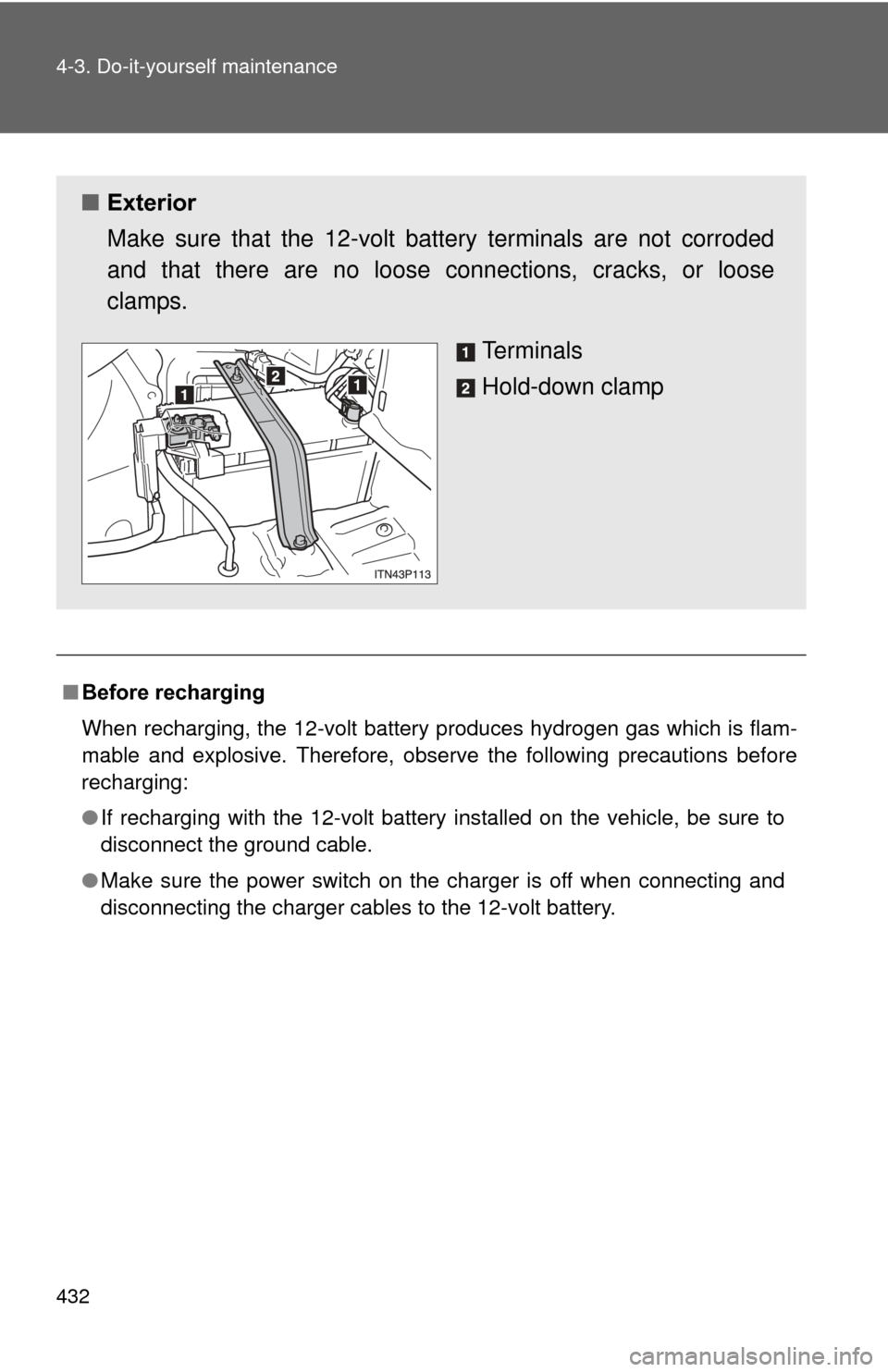
■ Exterior
Make sure that the 12-volt battery terminals are not corroded
and that there are no loose c onnections, cracks, or loose
clamps.
Terminals
Hold-down clamp
Page 433 of 636
433
4-3. Do-it-yourself maintenance
4
Maintenance and care
■
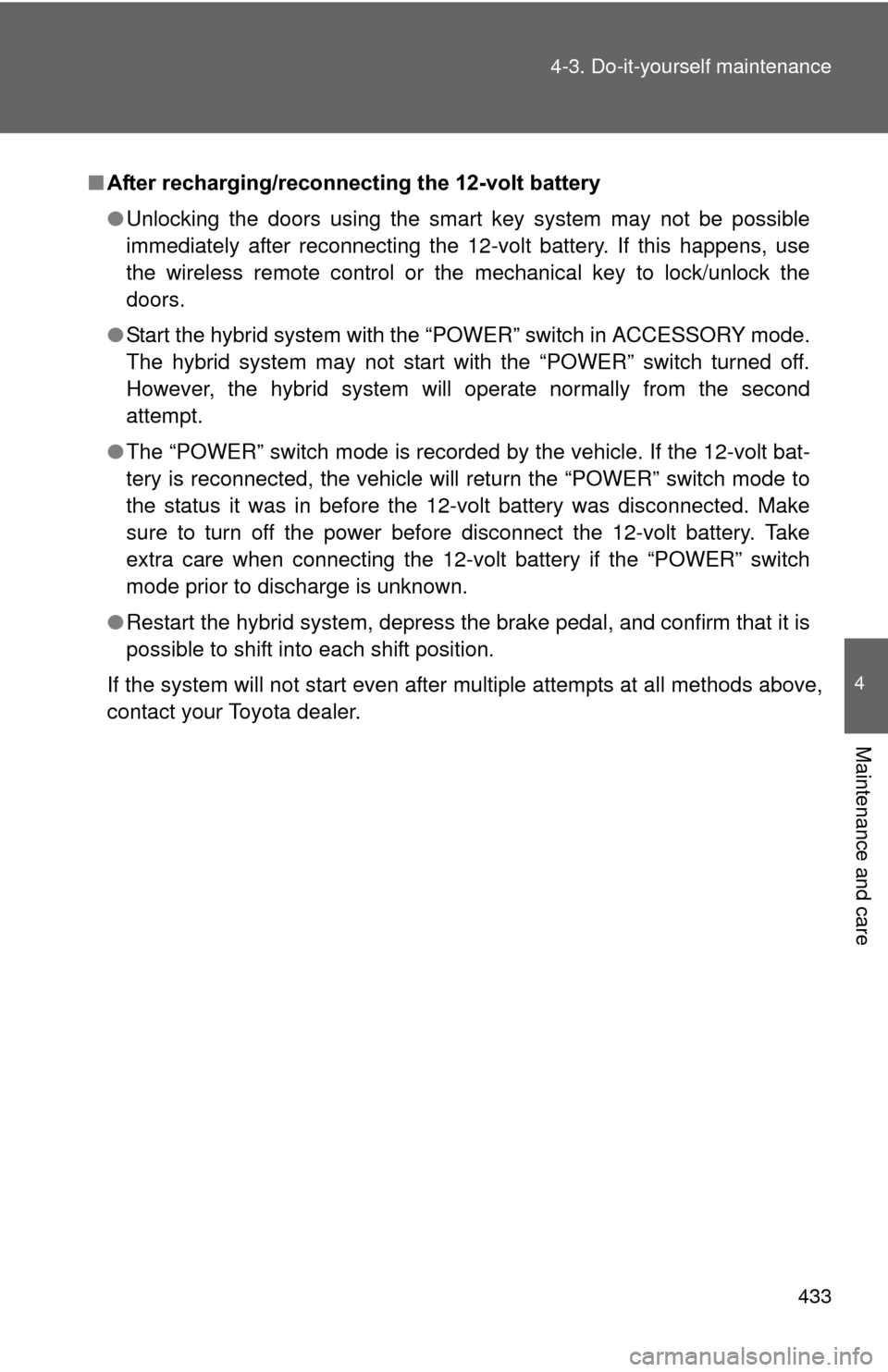
After recharging/reconnecting the 12-volt battery
●Unlocking the doors using the smart key system may not be possible
immediately after reconnecting the 12-volt battery. If this happens, use
the wireless remote control or the mechanical key to lock/unlock the
doors.
● Start the hybrid system with the “POWER” switch in ACCESSORY mode.
The hybrid system may not start with the “POWER” switch turned off.
However, the hybrid system will operate normally from the second
attempt.
● The “POWER” switch mode is recorded by the vehicle. If the 12-volt bat-
tery is reconnected, the vehicle will return the “POWER” switch mode to
the status it was in before the 12-volt battery was disconnected. Make
sure to turn off the power before disconnect the 12-volt battery. Take
extra care when connecting the 12-volt battery if the “POWER” switch
mode prior to discharge is unknown.
● Restart the hybrid system, depress the brake pedal, and confirm that it is
possible to shift into each shift position.
If the system will not start even after multiple attempts at all methods above,
contact your Toyota dealer.
Page 434 of 636
434 4-3. Do-it-yourself maintenance
CAUTION
■Chemicals in the 12-volt battery
The 12-volt battery contains poisonous and corrosive sulfuric acid and may
produce hydrogen gas which is flammable and explosive. To reduce the risk
of death or serious injury, take the following precautions while working on or
near the 12-volt battery:
●Do not cause sparks by touching the 12-volt battery terminals with tools.
● Do not smoke or light a match near the 12-volt battery.
● Avoid contact with eyes, skin and clothes.
● Never inhale or swallow electrolyte.
● Wear protective safety glasses when working near the 12-volt battery.
● Keep children away from the 12-volt battery.
■ Where to safely charge the 12-volt battery
Always charge the 12-volt battery in an open area. Do not charge the 12-volt
battery in a garage or closed room where there is insufficient ventilation.
■ How to recharge the 12-volt battery
Only perform a slow charge (5 A or less). The 12-volt battery may explode if
charged at a quicker rate.