Page 464 of 636
464 4-3. Do-it-yourself maintenance
FUSEAmpereCircuit
25 RR WIP 20A Rear window wiper and washer
26 WIP 30A Windshield wipers
27 MET 7.5A Gauges and meters
28 IGN 10ABrake system, driver support sys-
tem, multiport fuel injection sys-
tem/sequential multiport fuel
injection system, SRS airbag sys-
tem, front passenger occupant
classification system (ECU and
sensors), power management sys-
tem, smart key system, front pas-
senger’s seat belt reminder light
29 PANEL 10AAir conditioning system, personal
light, transmission, P position
switch, navigation system, Solar
Ventilation System, Remote Air
Conditioning System, advanced
parking guidance system, head-
light cleaner, front passenger’s
seat belt reminder light, headlight
leveling system, glove box light,
clock, audio system, MPH or km/h
switch
30 TAIL 10AHeadlight leveling system, park-
ing lights, tail lights, license plate
lights, front fog lights, side marker
lights
Page 488 of 636
488 5-1. Essential information
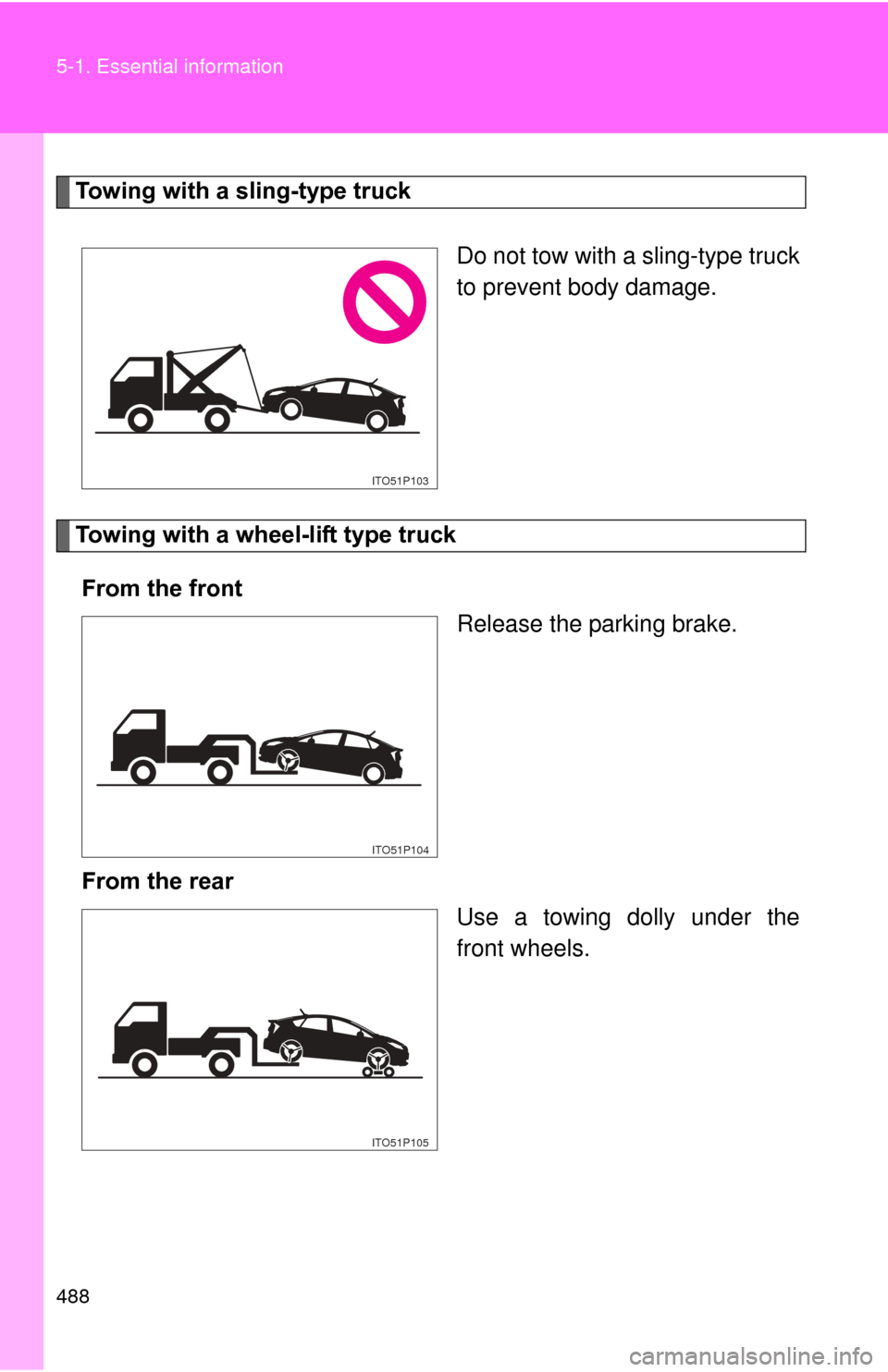
Towing with a sling-type truckDo not tow with a sling-type truck
to prevent body damage.
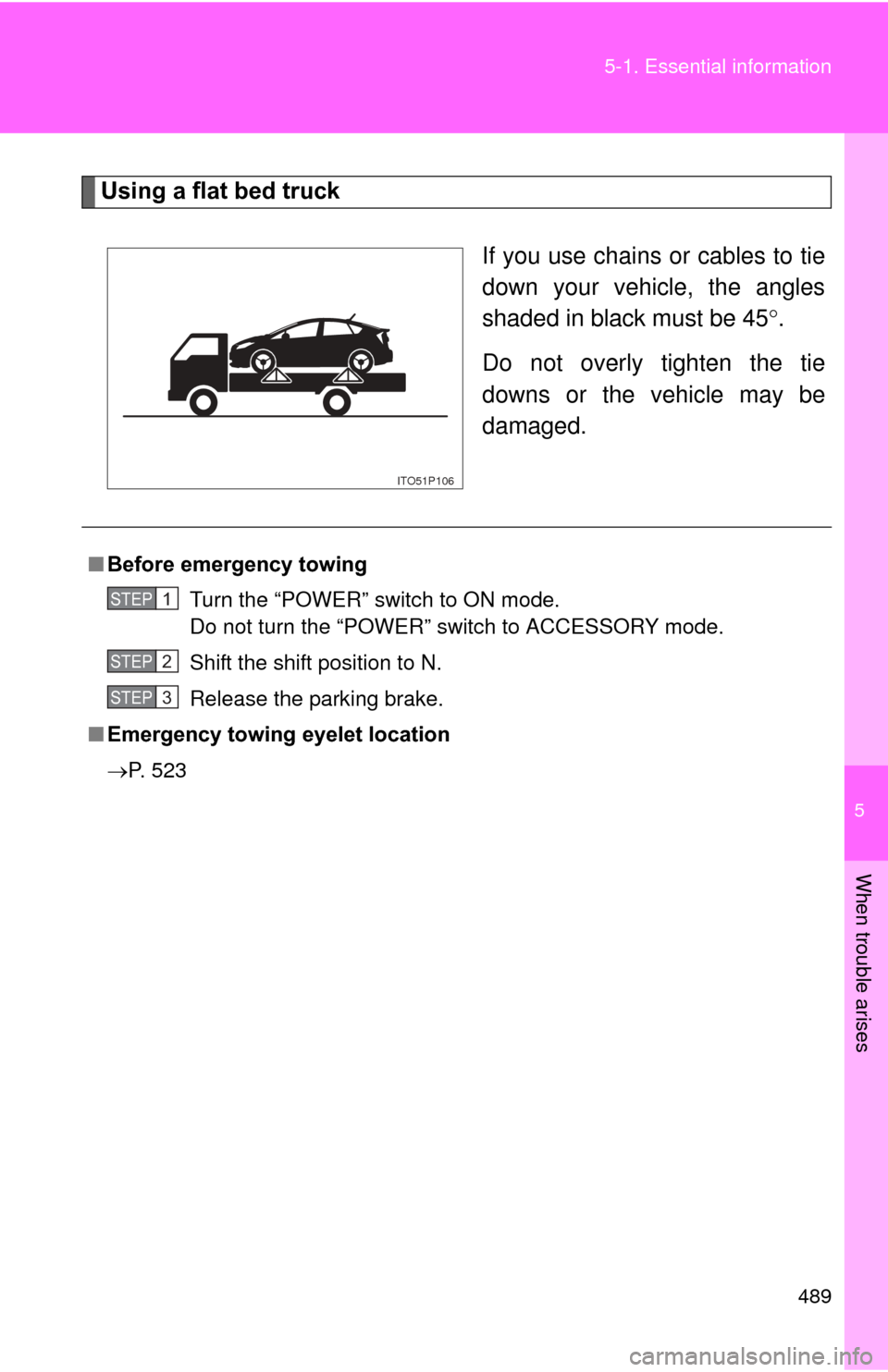
Towing with a wheel-lift type truckFrom the front Release the parking brake.
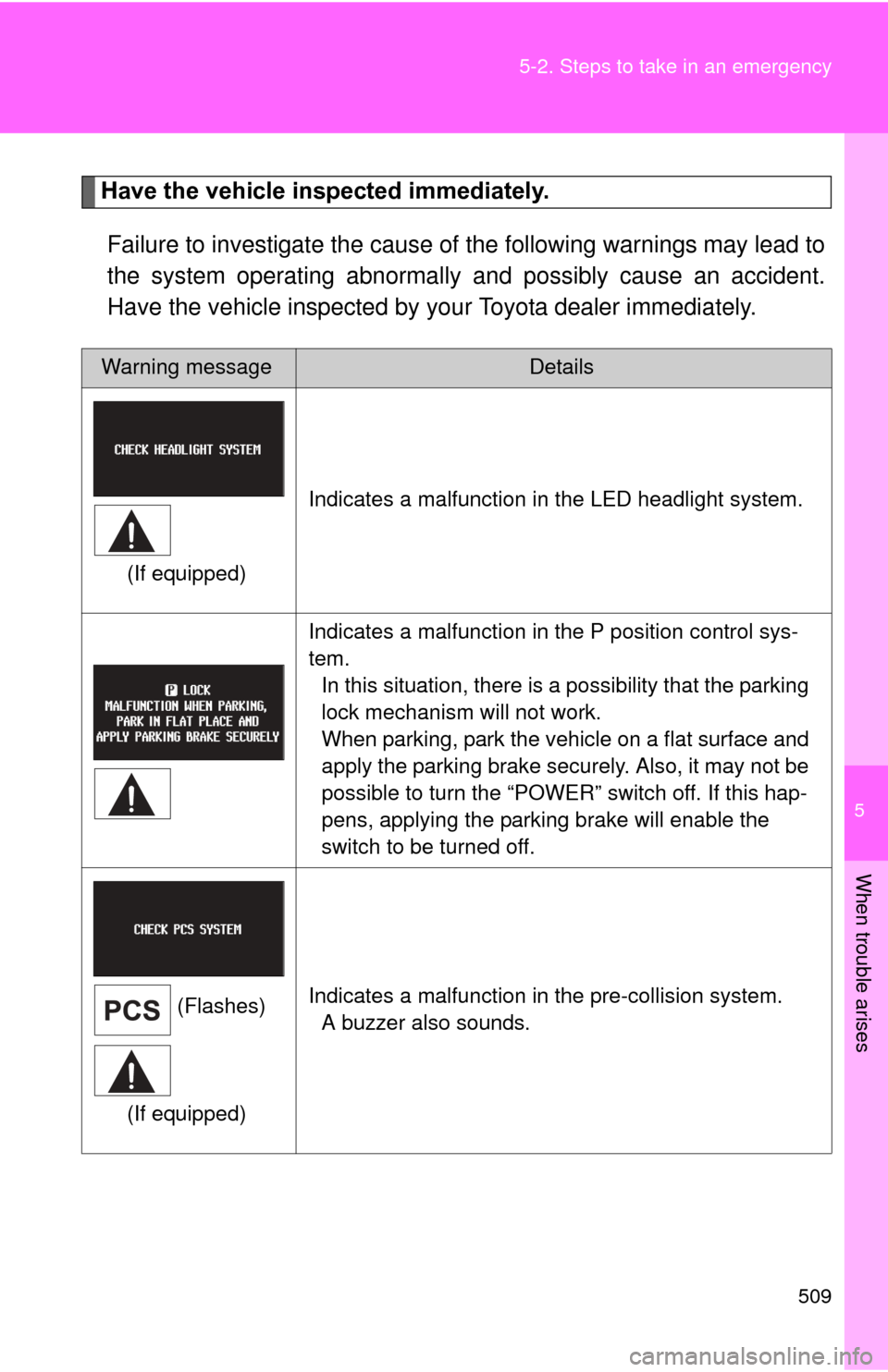
From the rear Use a towing dolly under the
front wheels.
ITO51P103
ITO51P104
ITO51P105
Page 489 of 636
5
When trouble arises
489
5-1. Essential information
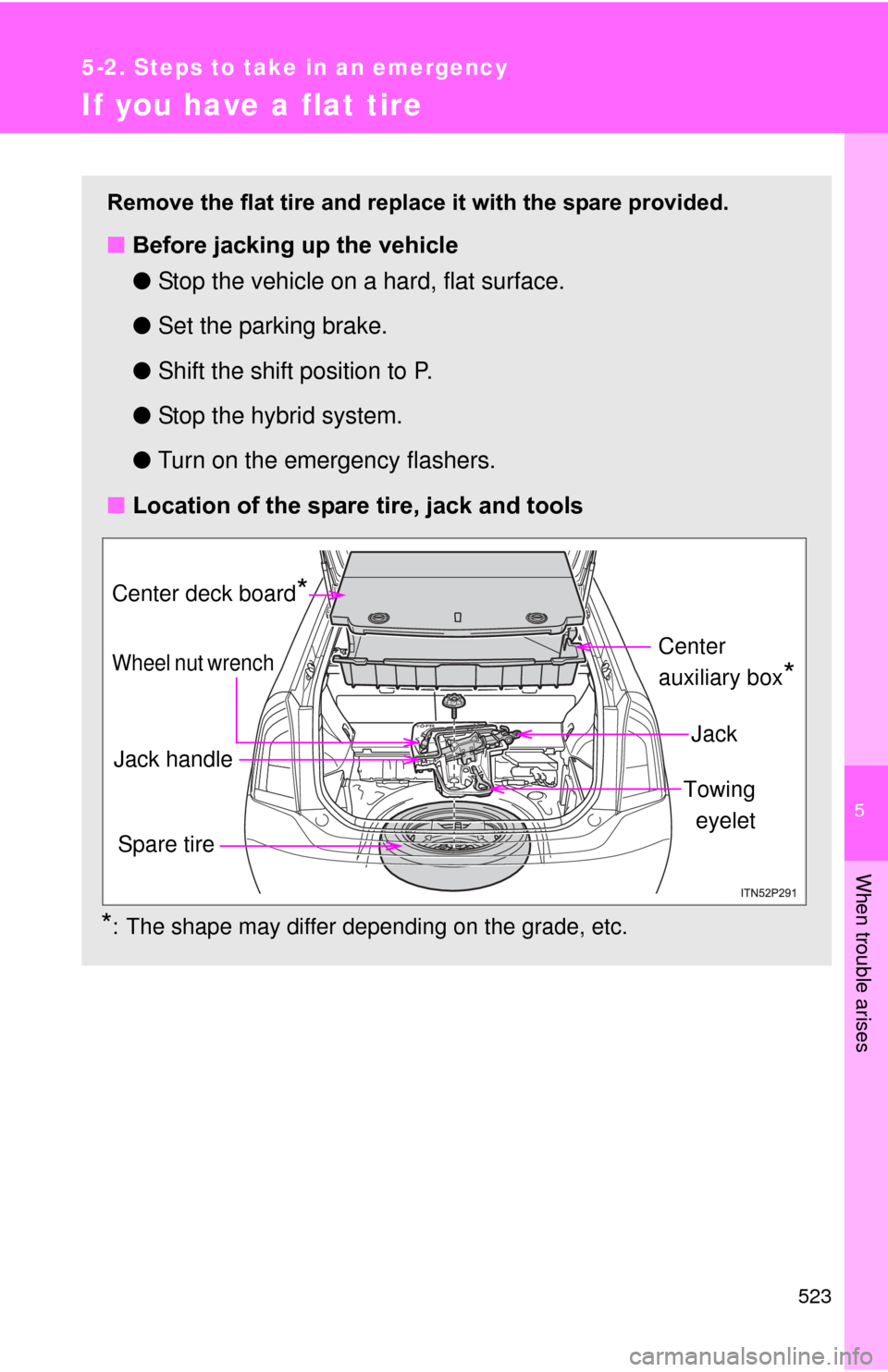
Using a flat bed truck
If you use chains or cables to tie
down your vehicle, the angles
shaded in black must be 45.
Do not overly tighten the tie
downs or the vehicle may be
damaged.
ITO51P106
■ Before emergency towing
Turn the “POWER” switch to ON mode.
Do not turn the “POWER” switch to ACCESSORY mode.
Shift the shift position to N.
Release the parking brake.
■ Emergency towing eyelet location
P. 523
STEP 1
STEP 2
STEP 3
Page 490 of 636
490 5-1. Essential information
CAUTION
■Caution while towing
●Use extreme caution when towing the vehicle.
Avoid sudden starts or erratic driving maneuvers which place excessive
stress on the emergency towing eyelets and the cables or chains. Always
be cautious of the surroundings and other vehicles while towing.
● Do not turn the “POWER” switch off.
This may lead to an accident as the front wheels will be locked by the
parking lock.
● If the hybrid system is off, the power assist for the brakes and steering will
not function, making steering and braking more difficult.
■ Installing towing eyelets to the vehicle
Make sure that towing eyelets are installed securely.
If not securely installed, towing eyelets may come loose during towing. This
may lead to accidents that cause serious injury or even death.
Page 493 of 636
5
When trouble arises
493
5-2. Steps to take in an emergency
If a war ning light tur ns on or a war ning buzzer sounds
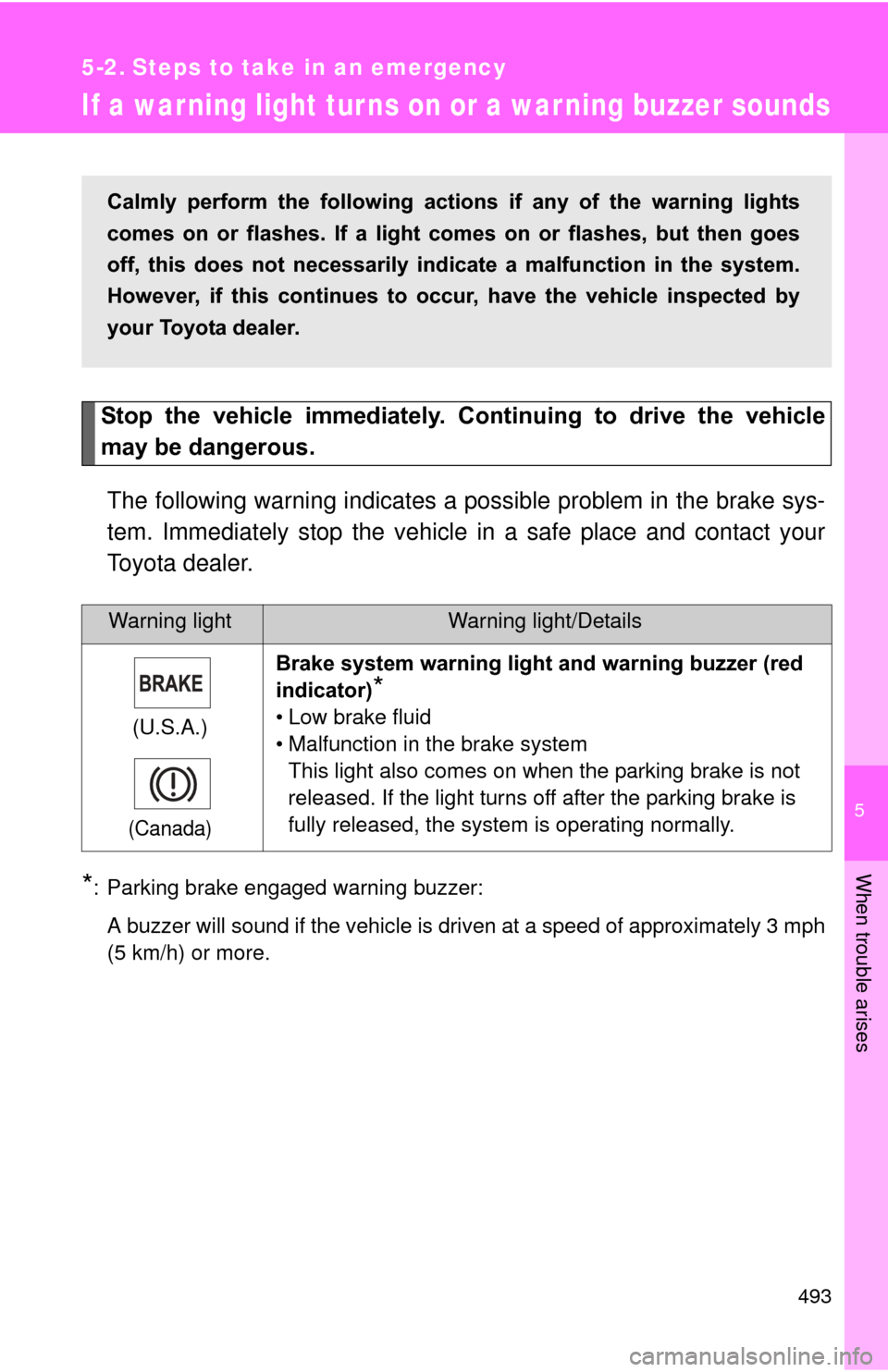
Stop the vehicle immediately. Continuing to drive the vehicle
may be dangerous.The following warning indicates a possible problem in the brake sys-
tem. Immediately stop the vehicle in a safe place and contact your
Toyota dealer.
*: Parking brake engaged warning buzzer:
A buzzer will sound if the vehicle is driven at a speed of approximately 3 mph
(5 km/h) or more.
Warning lightWarning light/Details
(U.S.A.)
(Canada)
Brake system warning light and warning buzzer (red
indicator)
*
• Low brake fluid
• Malfunction in the brake systemThis light also comes on when the parking brake is not
released. If the light turns off after the parking brake is
fully released, the system is operating normally.
Calmly perform the following actio ns if any of the warning lights
comes on or flashes. If a light comes on or flashes, but then goes
off, this does not necessarily indicate a malfunction in the system.
However, if this continues to o ccur, have the vehicle inspected by
your Toyota dealer.
Page 509 of 636
5
When trouble arises
509
5-2. Steps to take in an emergency
Have the vehicle inspected immediately.
Failure to investigate the cause of the following warnings may lead to
the system operating abnormally and possibly cause an accident.
Have the vehicle inspected by your Toyota dealer immediately.
Warning messageDetails
(If equipped) Indicates a malfunction in the LED headlight system.
Indicates a malfunction in the P position control sys-
tem.
In this situation, there is a possibility that the parking
lock mechanism will not work.
When parking, park the vehicle on a flat surface and
apply the parking brake securely. Also, it may not be
possible to turn the “POWER” switch off. If this hap-
pens, applying the parking brake will enable the
switch to be turned off.
(Flashes)
(If equipped) Indicates a malfunction in the pre-collision system.
A buzzer also sounds.
Page 523 of 636
5
When trouble arises
523
5-2. Steps to take in an emergency
If you have a flat tire
Remove the flat tire and replace it with the spare provided.
■Before jacking up the vehicle
●Stop the vehicle on a hard, flat surface.
● Set the parking brake.
● Shift the shift position to P.
● Stop the hybrid system.
● Turn on the emergency flashers.
■ Location of the spare tire, jack and tools
*: The shape may differ depending on the grade, etc.
Center deck board*
Wheel nut wrench
Jack handle
Spare tire Towing
eyelet
Jack
Center
auxiliary box
*
Page 534 of 636
534 5-2. Steps to take in an emergency
CAUTION
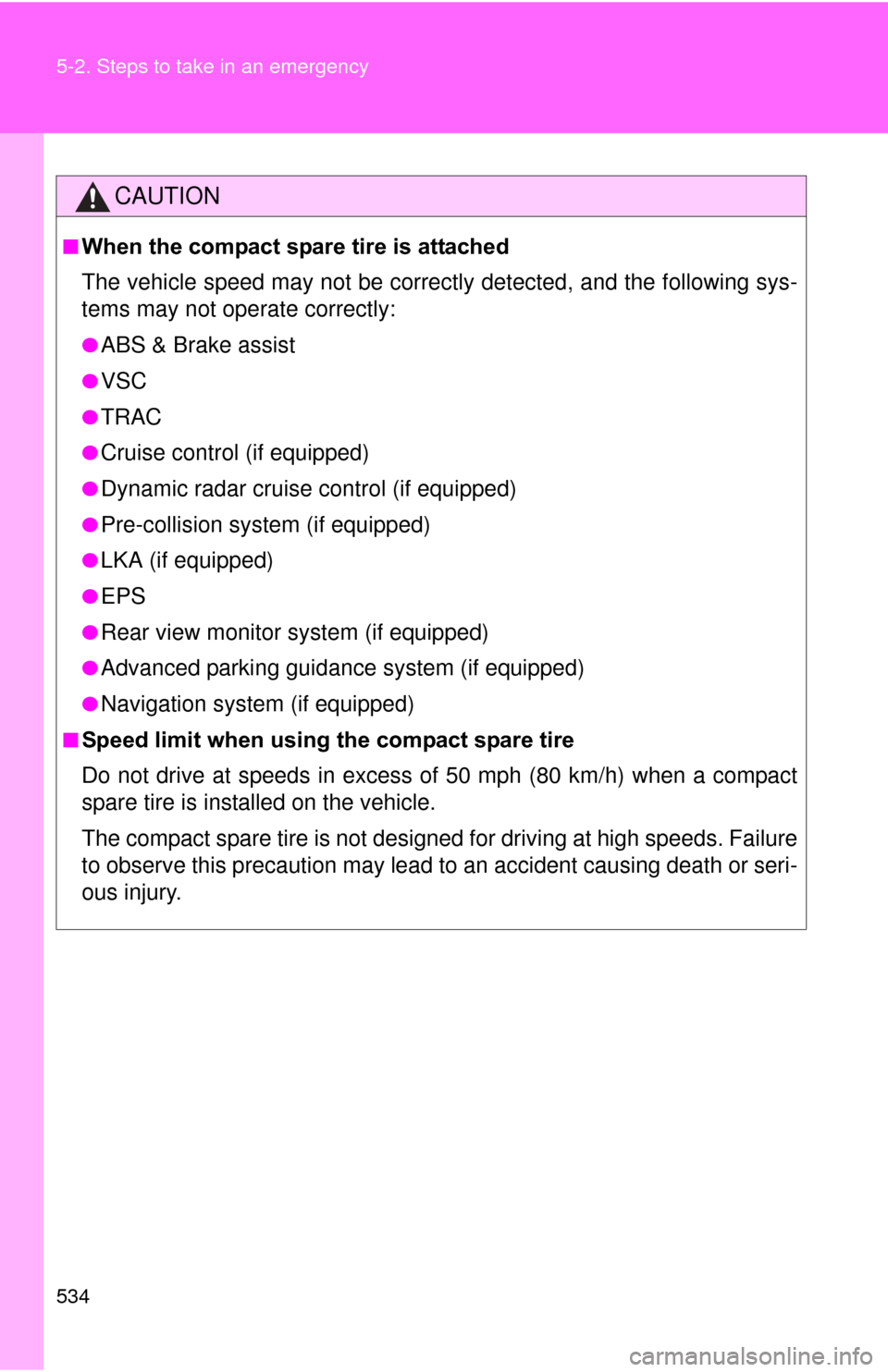
■When the compact spare tire is attached
The vehicle speed may not be correctly detected, and the following sys-
tems may not operate correctly:
●ABS & Brake assist
●VSC
●TRAC
●Cruise control (if equipped)
●Dynamic radar cruise control (if equipped)
●Pre-collision system (if equipped)
●LKA (if equipped)
●EPS
●Rear view monitor system (if equipped)
●Advanced parking guidance system (if equipped)
●Navigation system (if equipped)
■Speed limit when using the compact spare tire
Do not drive at speeds in excess of 50 mph (80 km/h) when a compact
spare tire is installed on the vehicle.
The compact spare tire is not designed for driving at high speeds. Failure
to observe this precaution may lead to an accident causing death or seri-
ous injury.