Page 497 of 692
497
4
Maintenance and care
L/C200_EE (OM60G38E)
4-3. Do-it-yourself maintenance
Do-it-yourself ser vice precautions
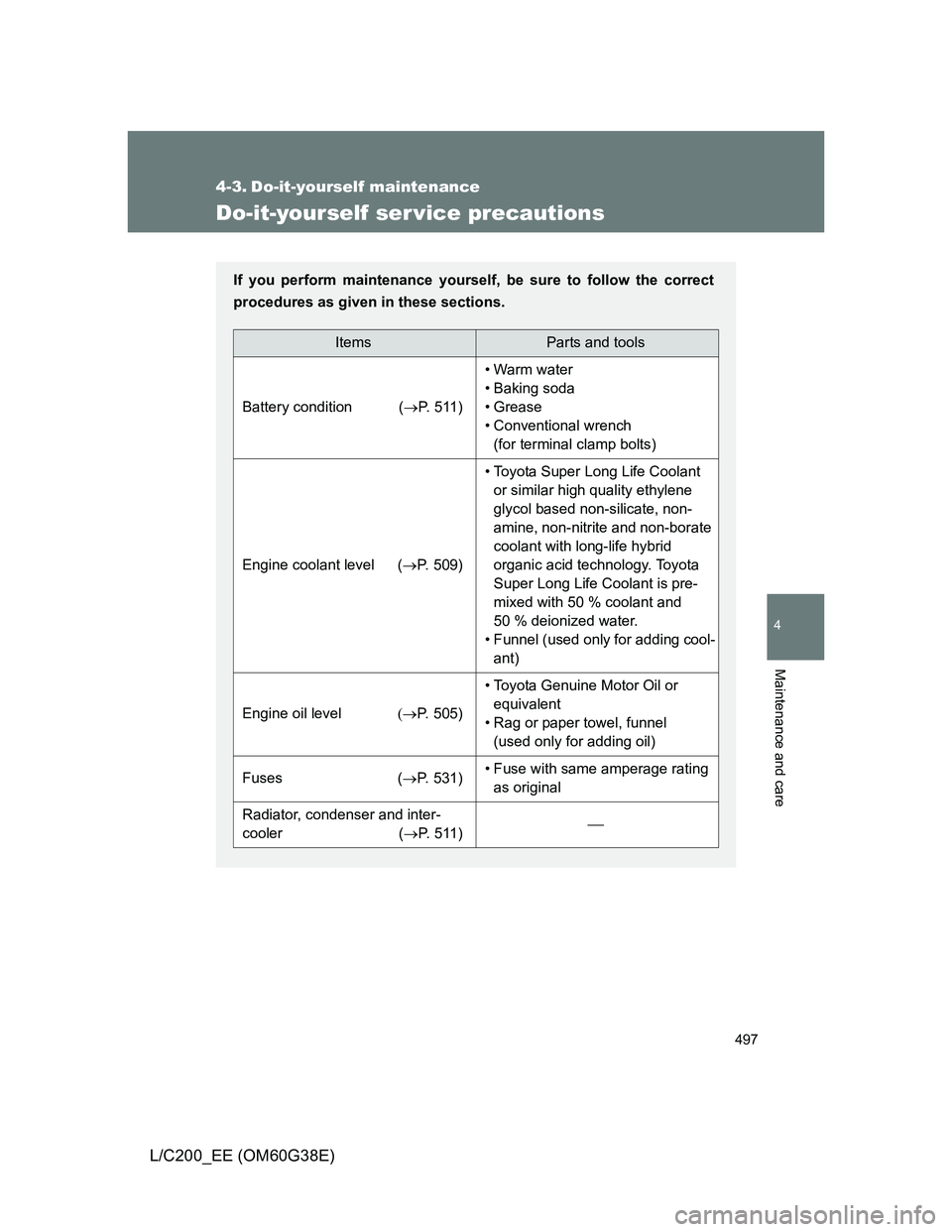
If you perform maintenance yourself, be sure to follow the correct
procedures as given in these sections.
ItemsParts and tools
Battery condition (P. 5 1 1 )
•Warm water
• Baking soda
• Grease
• Conventional wrench
(for terminal clamp bolts)
Engine coolant level (P. 509)
• Toyota Super Long Life Coolant
or similar high quality ethylene
glycol based non-silicate, non-
amine, non-nitrite and non-borate
coolant with long-life hybrid
organic acid technology. Toyota
Super Long Life Coolant is pre-
mixed with 50 % coolant and
50 % deionized water.
• Funnel (used only for adding cool-
ant)
Engine oil levelP. 505)
• Toyota Genuine Motor Oil or
equivalent
• Rag or paper towel, funnel
(used only for adding oil)
Fuses (P. 531)• Fuse with same amperage rating
as original
Radiator, condenser and inter-
cooler (P. 5 1 1 )
Page 499 of 692
499 4-3. Do-it-yourself maintenance
4
Maintenance and care
L/C200_EE (OM60G38E)
CAUTION
The engine compartment contains many mechanisms and fluids that may
move suddenly, become hot, or become electrically energized. To avoid death
or serious injury observe the following precautions.
When working on the engine compartment
Keep hands, clothing, and tools away from the moving fan and engine
drive belt.
Be careful not to touch the engine, radiator, exhaust manifold, etc. right
after driving as they may be hot. Oil and other fluids may also be hot.
Do not leave anything that may burn easily, such as paper or rags, in the
engine compartment.
Do not smoke, cause sparks or expose an open flame to fuel or the bat-
tery. Fuel and battery fumes are flammable.
Be extremely cautious when working on the battery. It contains poisonous
and corrosive sulfuric acid.
Take care because brake fluid can harm your hands or eyes and damage
painted surfaces.
If fluid gets on your hands or in your eyes, flush the affected area with
clean water immediately.
If you still experience discomfort, see a doctor.
When working near the electric cooling fan or radiator grille
Be sure the “ENGINE START STOP” switch is off.
With the “ENGINE START STOP” switch in IGNITION ON mode, the electric
cooling fan may automatically start to run if the air conditioning is on and/or
the coolant temperature is high. (P. 511)
When working on or under the vehicle
Do not get under the vehicle with just the jack supporting it.
Always use automotive jack stands or other solid supports.
Use eye protection to prevent flying or falling material, fluid spray, etc. from
getting in your eyes.
Page 502 of 692
502
4-3. Do-it-yourself maintenance
L/C200_EE (OM60G38E)
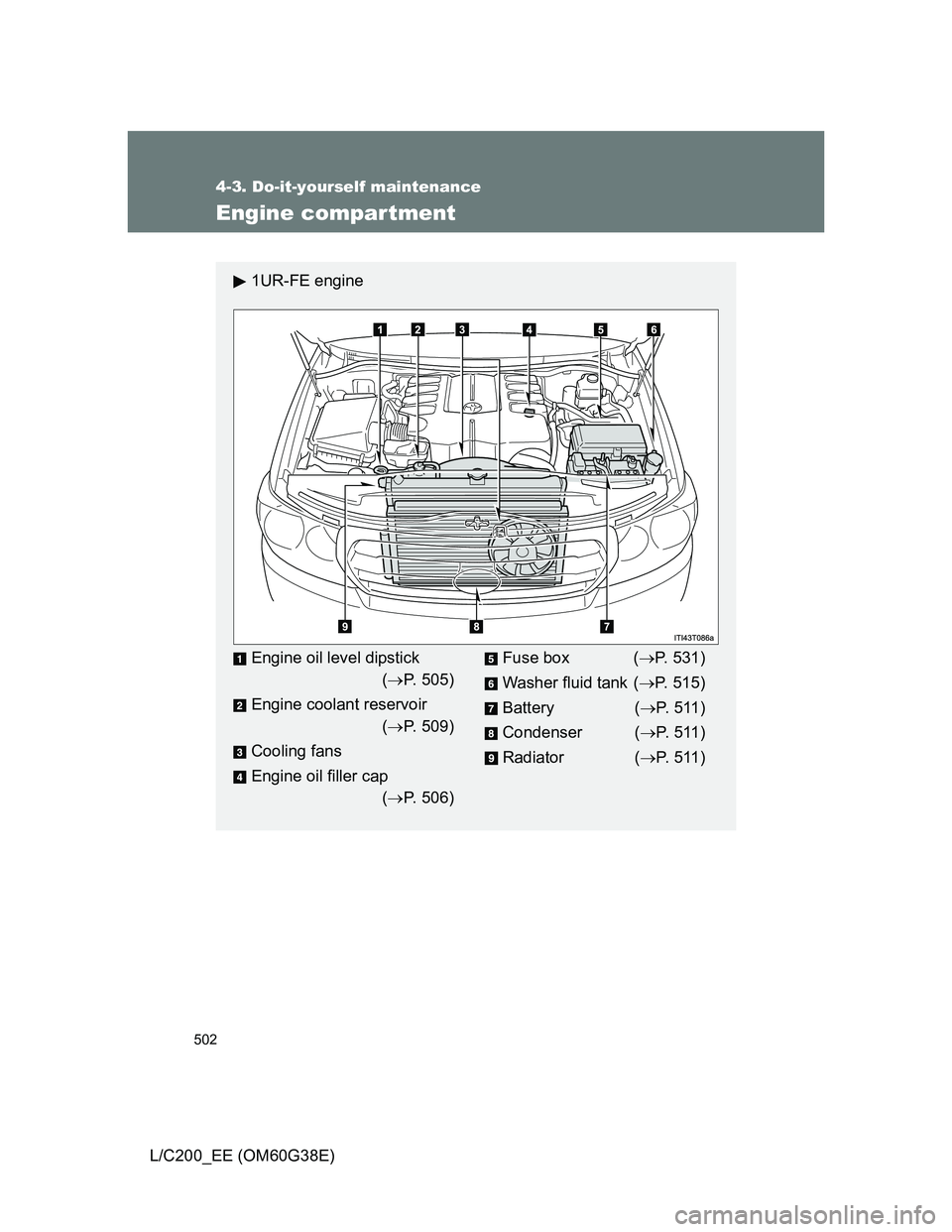
Engine compartment
1UR-FE engine
Engine oil level dipstick
(P. 505)
Engine coolant reservoir
(P. 509)
Cooling fans
Engine oil filler cap
(P. 506)Fuse box (P. 531)
Washer fluid tank (P. 515)
Battery (P. 5 11 )
Condenser (P. 5 11 )
Radiator (P. 5 11 )
Page 503 of 692
503 4-3. Do-it-yourself maintenance
4
Maintenance and care
L/C200_EE (OM60G38E)
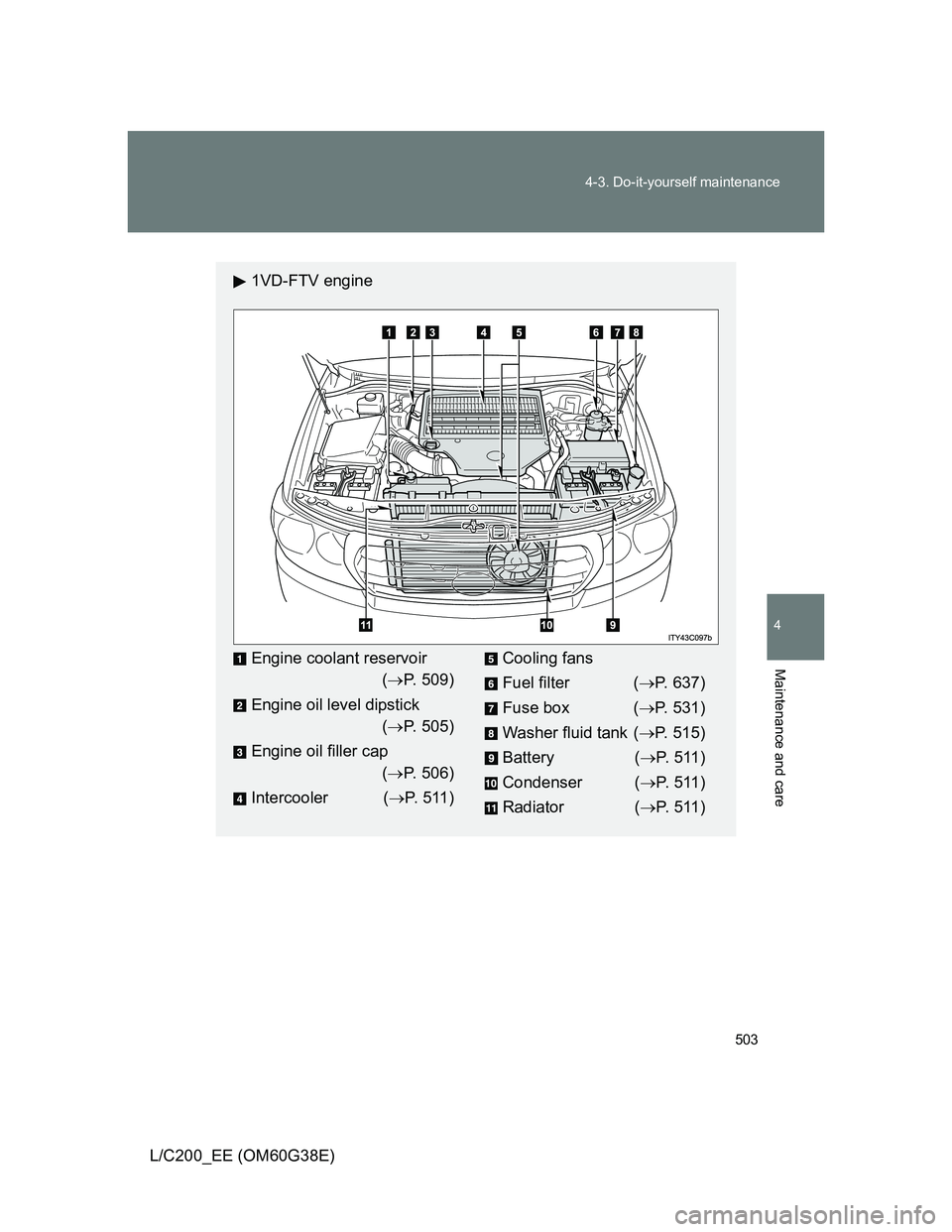
1VD-FTV engine
Engine coolant reservoir
(P. 509)
Engine oil level dipstick
(P. 505)
Engine oil filler cap
(P. 506)
Intercooler (P. 5 11 )Cooling fans
Fuel filter (P. 637)
Fuse box (P. 531)
Washer fluid tank (P. 515)
Battery (P. 5 11 )
Condenser (P. 5 11 )
Radiator (P. 5 11 )
Page 509 of 692
509 4-3. Do-it-yourself maintenance
4
Maintenance and care
L/C200_EE (OM60G38E)
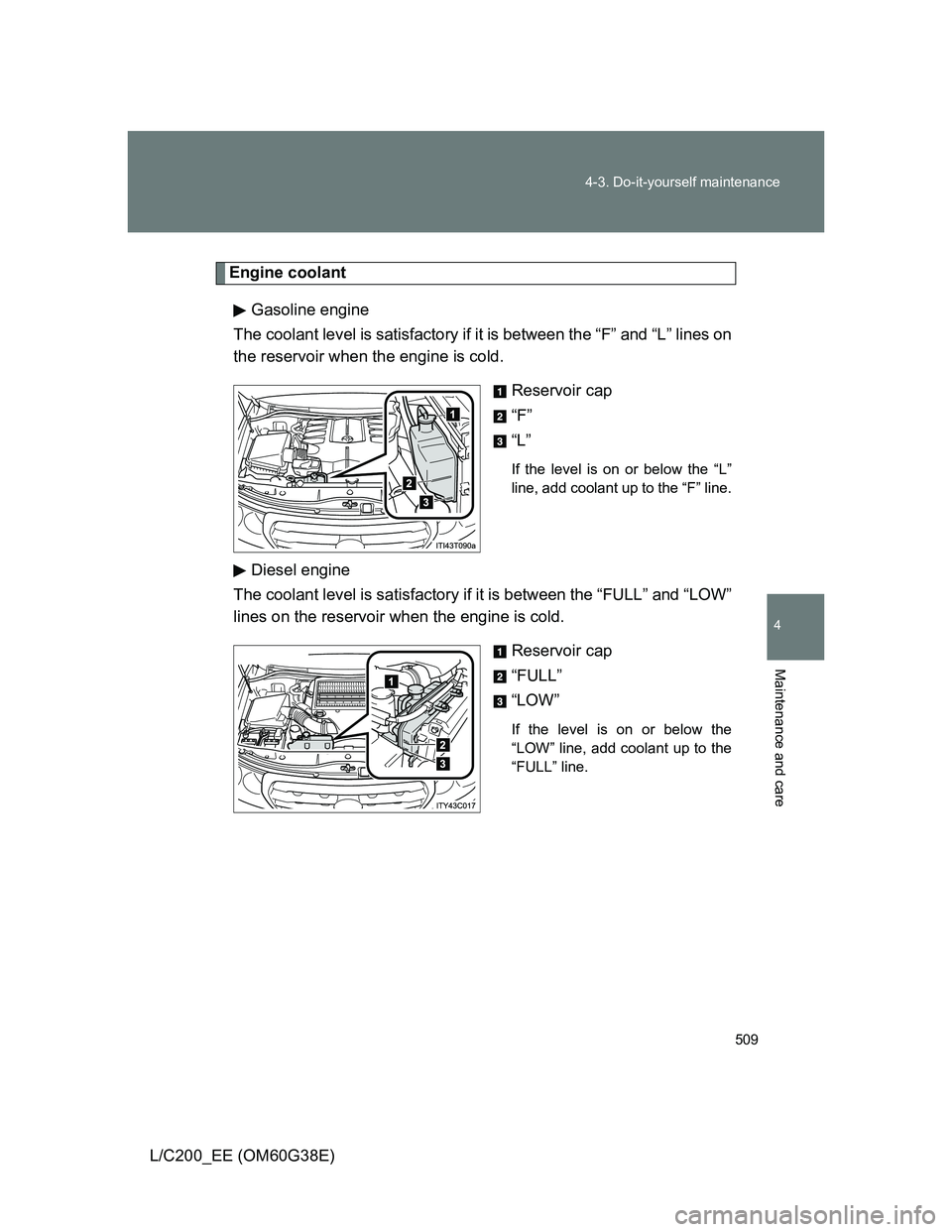
Engine coolant
Gasoline engine
The coolant level is satisfactory if it is between the “F” and “L” lines on
the reservoir when the engine is cold.
Reservoir cap
“F”
“L”
If the level is on or below the “L”
line, add coolant up to the “F” line.
Diesel engine
The coolant level is satisfactory if it is between the “FULL” and “LOW”
lines on the reservoir when the engine is cold.
Reservoir cap
“FULL”
“LOW”
If the level is on or below the
“LOW” line, add coolant up to the
“FULL” line.
Page 510 of 692
510 4-3. Do-it-yourself maintenance
L/C200_EE (OM60G38E)
If the coolant level drops within a short time after replenishing
Visually check the radiator, hoses, reservoir cap, radiator cap, drain cock
and water pump.
If you cannot find a leak, have any authorized Toyota dealer or repairer, or
another duly qualified and equipped professional, test the cap and check for
leaks in the cooling system.
Coolant selection
Only use “Toyota Super Long Life Coolant” or similar high quality ethylene
glycol based non-silicate, non-amine, non-nitrite, and non-borate coolant
with long-life hybrid organic acid technology.
“Toyota Super Long Life Coolant” is a mixture of 50 % coolant and 50 %
deionized water. (Enabled: -35C [-31F])
For more details about engine coolant, contact any authorized Toyota dealer
or repairer, or another duly qualified and equipped professional.
CAUTION
When the engine is hot
Do not remove the coolant reservoir cap.
The cooling system may be under pressure and may spray hot coolant if the
cap is removed, causing serious injuries, such as burns.
NOTICE
When adding engine coolant
Coolant is neither plain water nor straight antifreeze. The correct mixture of
water and antifreeze must be used to provide proper lubrication, corrosion
protection and cooling. Be sure to read the antifreeze or coolant label.
If you spill coolant
Be sure to wash it off with water to prevent damage to parts or paint.
Page 571 of 692
5
571
5-1. Essential information
When trouble arises
L/C200_EE (OM60G38E)
If you think something is wrong
If you notice any of the following symptoms, your vehicle probably
needs adjustment or repair. Contact any authorized Toyota dealer or
repairer, or another duly qualified and equipped professional, as
soon as possible.
Visible symptoms
Fluid leaks under the vehicle
(Water dripping from the air conditioning after use is normal.)
Flat-looking tires or uneven tire wear
Engine coolant temperature gauge needle continually points
higher than normal
Engine oil pressure gauge continually points lower than nor-
mal.
Voltmeter continually points higher or lower than normal.
Audible symptoms
Changes in exhaust sound
Excessive tire squeal when cornering
Strange noises related to the suspension system
Pinging or other noises related to the engine
Operational symptoms
Engine missing, stumbling or running rough
Appreciable loss of power
Vehicle pulls heavily to one side when braking
Vehicle pulls heavily to one side when driving on a level road
Loss of brake effectiveness, spongy feeling, pedal almost
touches the floor
Page 634 of 692
634
5-2. Steps to take in an emergency
L/C200_EE (OM60G38E)
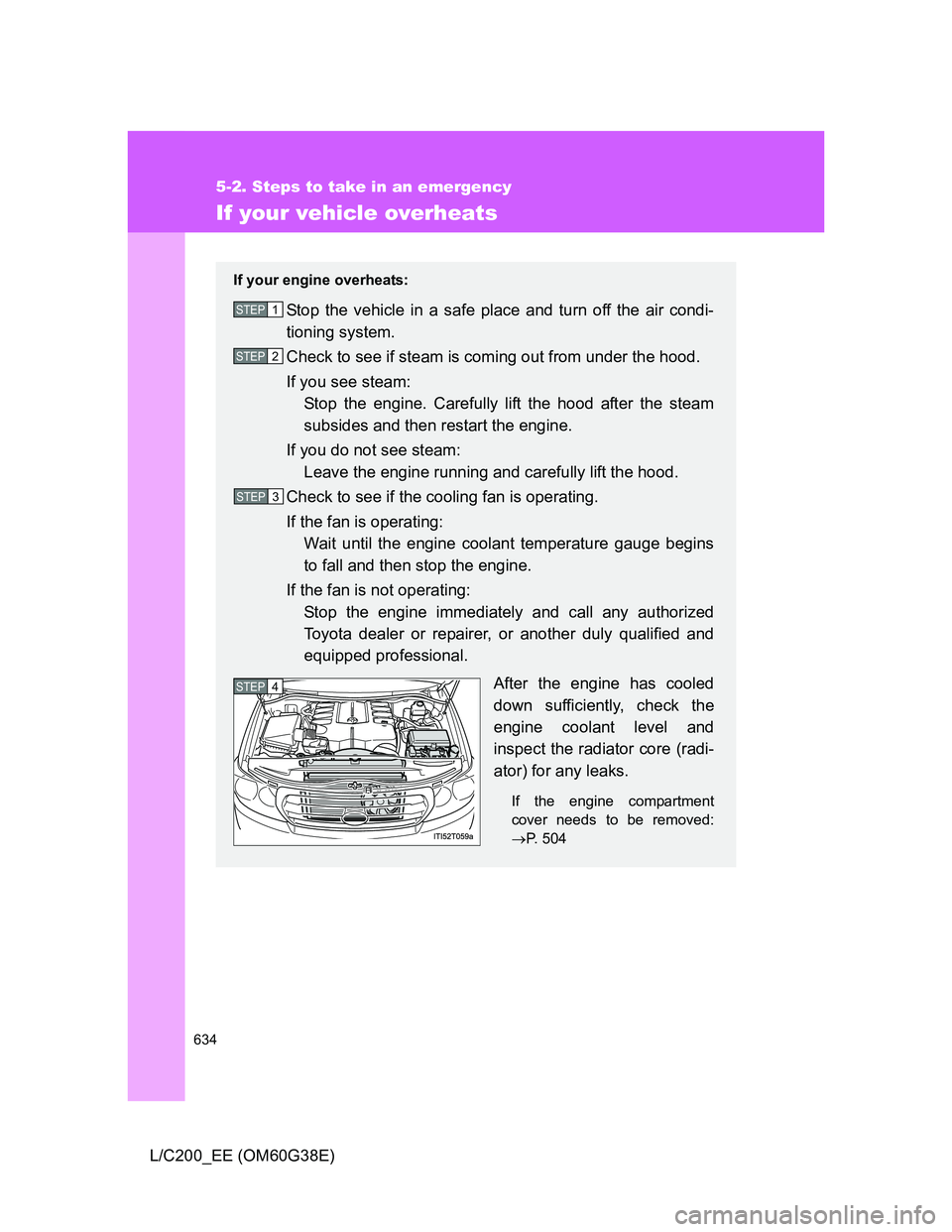
If your vehicle overheats
If your engine overheats:
Stop the vehicle in a safe place and turn off the air condi-
tioning system.
Check to see if steam is coming out from under the hood.
If you see steam:
Stop the engine. Carefully lift the hood after the steam
subsides and then restart the engine.
If you do not see steam:
Leave the engine running and carefully lift the hood.
Check to see if the cooling fan is operating.
If the fan is operating:
Wait until the engine coolant temperature gauge begins
to fall and then stop the engine.
If the fan is not operating:
Stop the engine immediately and call any authorized
Toyota dealer or repairer, or another duly qualified and
equipped professional.
After the engine has cooled
down sufficiently, check the
engine coolant level and
inspect the radiator core (radi-
ator) for any leaks.
If the engine compartment
cover needs to be removed:
P. 504
STEP1
STEP2
STEP3
STEP4