Page 540 of 636
540
5-2. Steps to take in an emergency
If you have a flat tire
Remove the flat tire and replace it with the spare provided.
■Before jacking up the vehicle
●Stop the vehicle on a hard, flat surface.
● Set the parking brake.
● Shift the shift lever to P.
● Stop the engine.
● Turn on the emergency flashers.
■ Location of the spare tire, jack and tools
Jack handle
Adapter
socket Towing eyelet
Jack handle
Wheel nut wrench
Spare tire
Jack
Page 550 of 636
550 5-2. Steps to take in an emergency
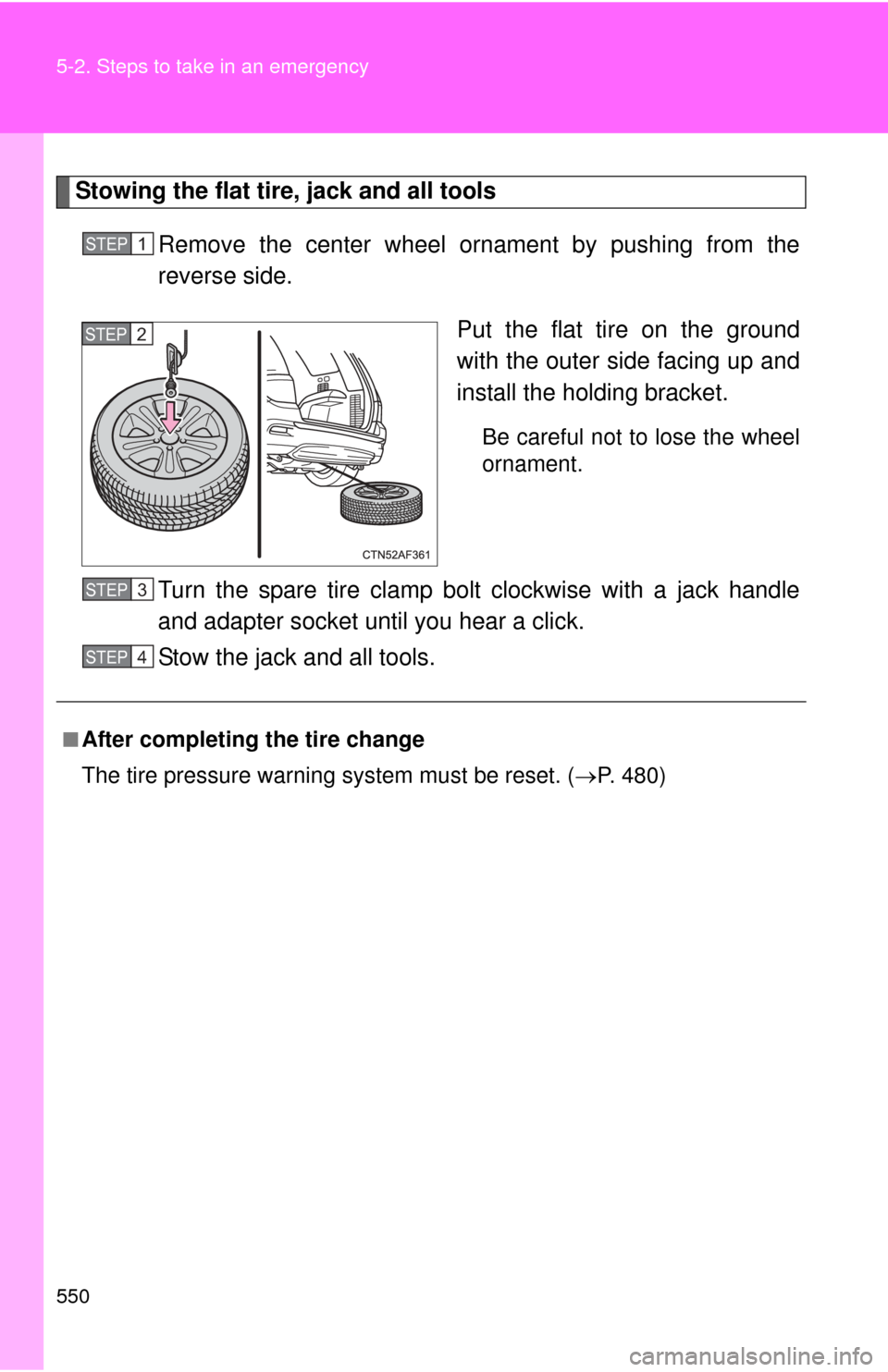
Stowing the flat tire, jack and all toolsRemove the center wheel ornament by pushing from the
reverse side. Put the flat tire on the ground
with the outer side facing up and
install the holding bracket.
Be careful not to lose the wheel
ornament.
Turn the spare tire clamp bolt clockwise with a jack handle
and adapter socket until you hear a click.
Stow the jack and all tools.
STEP1
STEP2
■After completing the tire change
The tire pressure warning system must be reset. ( P. 480)
STEP3
STEP4
Page 553 of 636

5
When trouble arises
553
5-2. Steps to take in an emergency
NOTICE
■Do not drive the vehicle with a flat tire.
Do not continue driving with a flat tire.
Driving even a short distance with a flat tire can damage the tire and the
wheel beyond repair.
■When replacing the tires
When removing or fitting the wheels, tires or the tire pressure warning
valve and transmitter, contact your
Toyota dealer as the tire pressure
warning valve and transmitter may be damaged if not handled correctly.
■To avoid damage to the tire pressure warning valves and transmit-
ters
When a tire is repaired with liquid sealants, the tire pressure warning
valve and transmitter may not operate properly. If a liquid sealant is
used, contact your Toyota dealer or other qualified service shop as soon
as possible. Make sure to replace the tire pressure warning valve and
transmitter when replacing the tire. ( P. 480)
■When stowing the flat tire
●Ensure that there is no object caught between the tire and the vehicle
underbody.
●Tighten the spare tire clamp bolt to hold the spare wheel carrier by the
hook securely.
Page 568 of 636
568 5-2. Steps to take in an emergency
NOTICE
■To avoid damaging the transmission and other components
●Avoid spinning the wheels and do not rev the engine.
● If the vehicle remains stuck after trying these procedures, the vehicle may
require towing to be freed.
Page 572 of 636
572
6-1. Specifications
Maintenance data (fuel, oil level, etc.)
Dimensions and weights
*1: Without towing package
*2: With towing package
Overall length188.4 in. (4785 mm)
Overall width75.2 in. (1910 mm)
Overall height Without roof rails
68.1 in. (1730 mm)
With roof rails
69.3 in. (1760 mm)
Wheelbase
109.8 in. (2790 mm)
Front tread 64.0 in. (1625 mm)
Rear tread2WD models 64.2 in. (1630 mm)
4WD models 64.0 in. (1625 mm)
Vehicle capacity weight
(Occupant + luggage)1200 lb. (544 kg)
Trailer
Weight Rat-
ing (Trailer
weight +
cargo)2.7 L 4-cylin-
der (1AR-FE)
engine1500 lb. (680 kg)*1
3500 lb. (1500 kg)*2
3.5 L V6
(2GR-FE)
engine2000 lb. (900 kg)*1
5000 lb. (2000 kg)*2
Page 580 of 636
580 6-1. Specifications
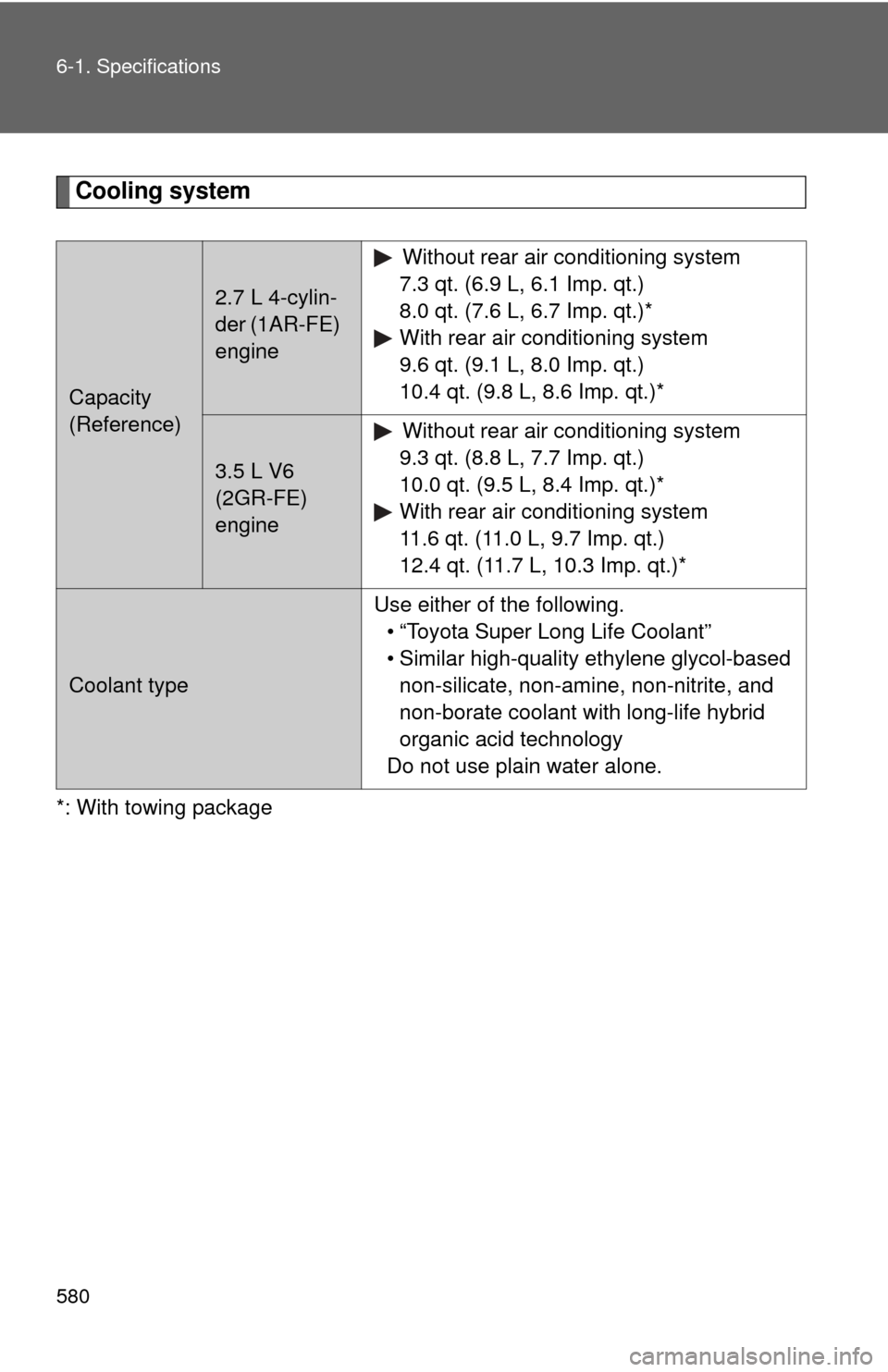
Cooling system
*: With towing package
Capacity
(Reference)
2.7 L 4-cylin-
der (1AR-FE)
engineWithout rear air conditioning system
7.3 qt. (6.9 L, 6.1 Imp. qt.)
8.0 qt. (7.6 L, 6.7 Imp. qt.)*
With rear air conditioning system
9.6 qt. (9.1 L, 8.0 Imp. qt.)
10.4 qt. (9.8 L, 8.6 Imp. qt.)*
3.5 L V6
(2GR-FE)
engine Without rear air conditioning system
9.3 qt. (8.8 L, 7.7 Imp. qt.)
10.0 qt. (9.5 L, 8.4 Imp. qt.)*
With rear air conditioning system
11.6 qt. (11.0 L, 9.7 Imp. qt.)
12.4 qt. (11.7 L, 10.3 Imp. qt.)*
Coolant type Use either of the following.
• “Toyota Super Long Life Coolant”
• Similar high-quality ethylene glycol-based non-silicate, non-amine, non-nitrite, and
non-borate coolant with long-life hybrid
organic acid technology
Do not use plain water alone.
Page 585 of 636
585
6-1. Specifications
6
Vehicle specifications
Type B
Tire size
P245/55R19 103S
Tire inflation pressure
(Recommended cold tire
inflation pressure) Driving under normal conditions
Front:
30 psi (210 kPa, 2.1 kgf/cm
2 or bar)
Rear:
30 psi (210 kPa, 2.1 kgf/cm
2 or bar)
Spare:
30 psi (210 kPa, 2.1 kgf/cm
2 or bar)
Driving at high speeds above 100 mph
(160 km/h) (in countries where such speeds
are permitted by law) Add 5 psi (30 kPa, 0.3 kgf/cm
2 or bar) to the
front tires and rear tires. Never exceed the
maximum cold tire infl ation pressure indi-
cated on the tire sidewall.
When towing trailer Add 6 psi (40 kPa, 0.4 kgf/cm
2 or bar) to the
rear tires. Never exceed the maximum cold
tire inflation pressure indicated on the tire
sidewall.
Wheel size 19 7 1/2 J
Wheel nut torque 76 ft•lbf (103 N•m, 10.5 kgf•m)
Page 606 of 636
606
6-3. Initialization
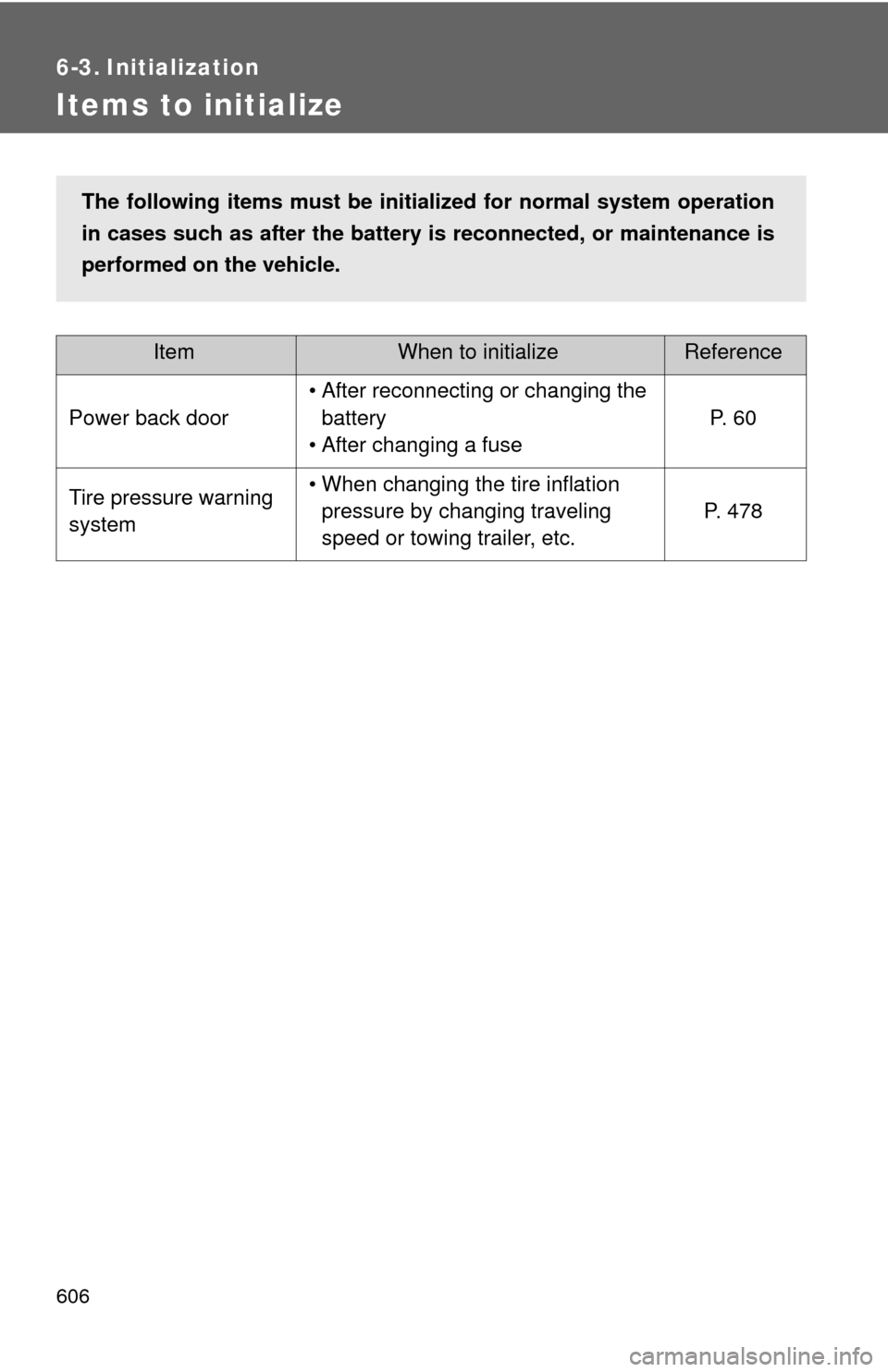
Items to initialize
ItemWhen to initializeReference
Power back door • After reconnecting or changing the
battery
• After changing a fuse P. 6 0
Tire pressure warning
system • When changing the tire inflation
pressure by changing traveling
speed or towing trailer, etc. P. 478
The following items must be initia
lized for normal system operation
in cases such as after the battery is reconnected, or maintenance is
performed on the vehicle.