Page 504 of 636

504 4-3. Do-it-yourself maintenance
23 EPS80 A Electric power steering
24 ST 30 A Starting system
25 CRT 10 ARear seat entertainment system,
audio system
26 RADIO NO.1 20 A Audio system
27 ECU-B NO.1 10 A Steering sensor, gauges and
meters, clock, main body ECU,
wireless remote control, smart key
system, power back door, multi-
information display, front passen-
ger occupant classification system
28 DOME 10 AVanity lights, personal lights, inte-
rior light, gauges and meters,
engine switch light, door courtesy
lights
29 TOWING 30 A Trailer lights
30 STR LOCK 20 A Steering lock system
31 EFI MAIN 25 AMultiport fuel injection system/
sequential multiport fuel injection
system, EFI NO.2, EFI NO.3
32 HAZ 15 A Turn signal lights
33 IG2 25 AINJ NO.1, INJ NO.2, IGN, GAUGE
NO.2
34 AMP 15 A Audio system
35 RR FOG 7.5 A No circuit
36 DEICER 15 A Windshield wiper de-icer
37 G/H 10 AGlass hatch, multiplex communica-
tion system, outer foot lights
38 ALT-S 7.5 A Charging system
39 AM2 7.5 A Multiplex communication system
40 H-LP LH HI 15 A Left-hand headlight (high beam)
FuseAmpereCircuit
Page 517 of 636
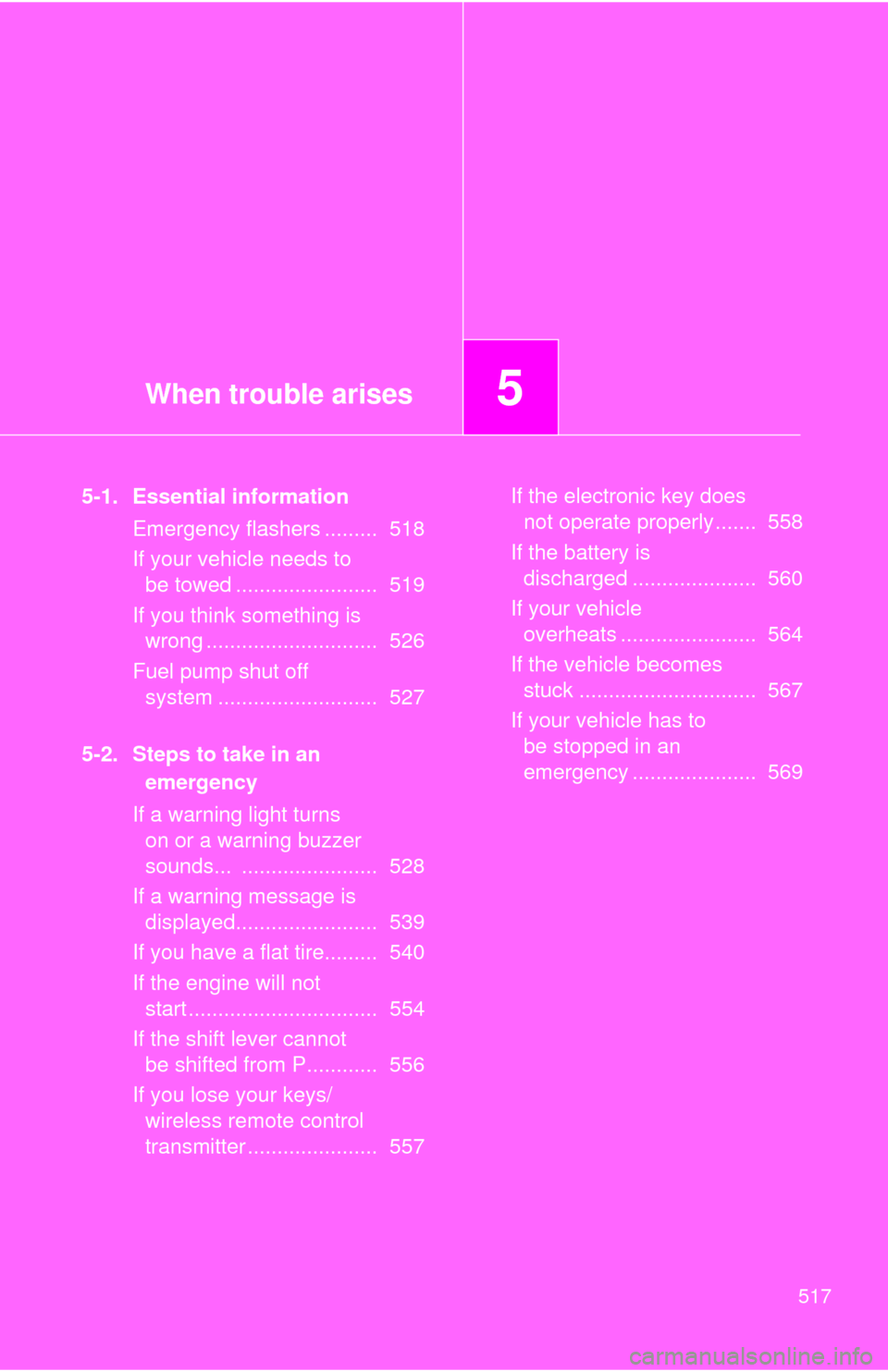
When trouble arises5
517
5-1. Essential informationEmergency flashers ......... 518
If your vehicle needs to be towed ........................ 519
If you think something is wrong ............................. 526
Fuel pump shut off system ........................... 527
5-2. Steps to take in an emergency
If a warning light turns on or a warning buzzer
sounds... ....................... 528
If a warning message is displayed........................ 539
If you have a flat tire......... 540
If the engine will not start ................................ 554
If the shift lever cannot be shifted from P............ 556
If you lose your keys/ wireless remote control
transmitter ...................... 557 If the electronic key does
not operate properly....... 558
If the battery is discharged ..................... 560
If your vehicle overheats ....................... 564
If the vehicle becomes stuck .............................. 567
If your vehicle has to be stopped in an
emergency ..................... 569
Page 519 of 636
5
When trouble arises
519
5-1. Essential information
If your vehicle needs to be towed
Before towingThe following may indicate a problem with your transmission. Contact
your Toyota dealer before towing.
● The engine is running, but the vehicle will not move.
● The vehicle makes an abnormal sound.
If towing is necessary, we recommend having your vehicle towed by
your Toyota dealer or a commerci al towing service, using a lift-type
truck or a flat bed truck.
Use a safety chain system for all to wing, and abide by all state/pro-
vincial and local laws.
2WD models: If towing from the fr ont, the vehicle's rear wheels and
axles must be in good condition. (P. 523)
If they are damaged, use a towing dolly or flat bed truck.
Page 520 of 636
520 5-1. Essential information
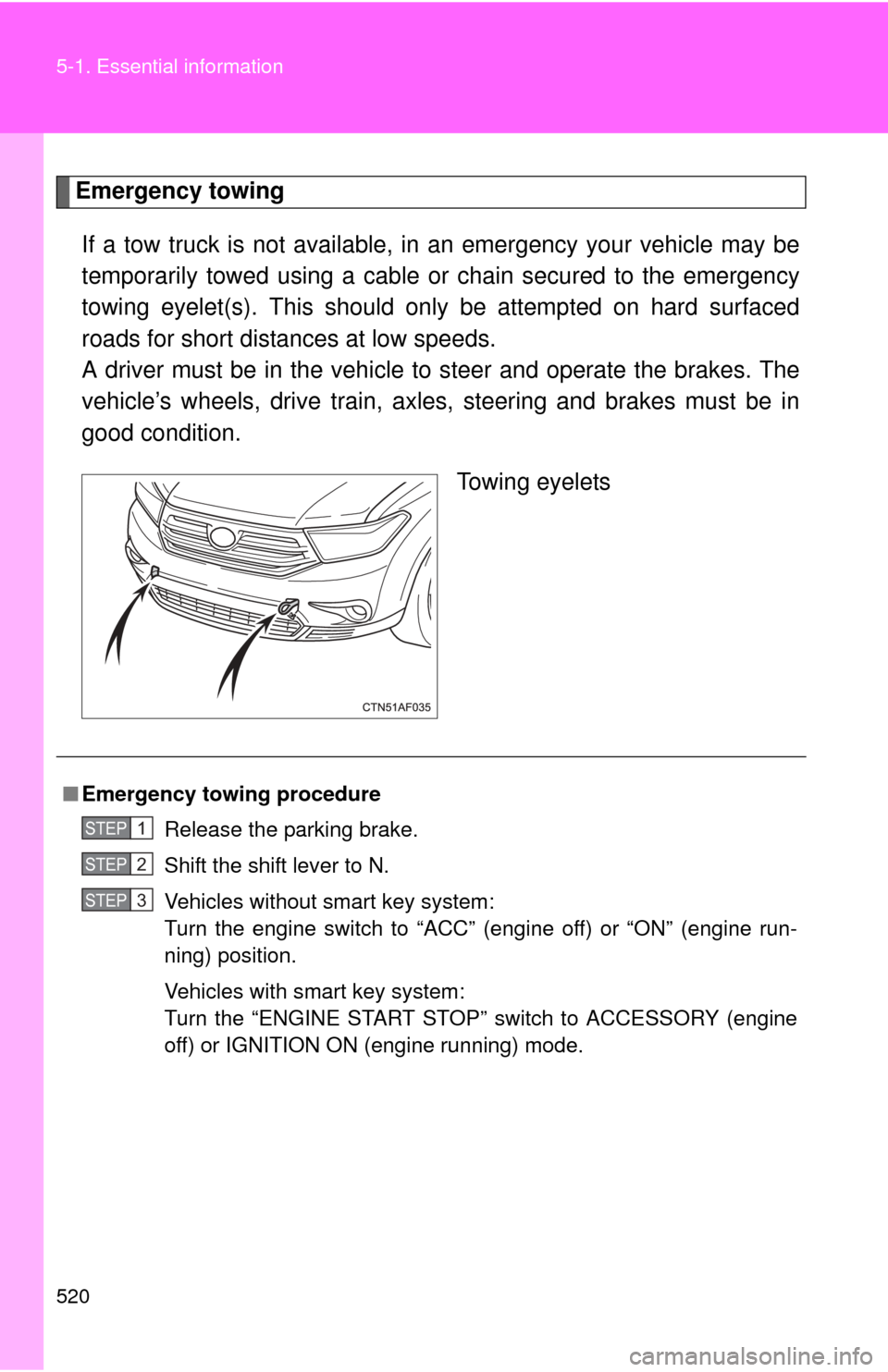
Emergency towingIf a tow truck is not available, in an emergency your vehicle may be
temporarily towed using a cable or chain secured to the emergency
towing eyelet(s). This should only be attempted on hard surfaced
roads for short distances at low speeds.
A driver must be in the vehicle to steer and operate the brakes. The
vehicle’s wheels, drive train, axles, steering and brakes must be in
good condition.
Towing eyelets
■Emergency towin g procedure
Release the parking brake.
Shift the shift lever to N.
Vehicles without smart key system:
Turn the engine switch to “ACC” (engine off) or “ON” (engine run-
ning) position.
Vehicles with smart key system:
Turn the “ENGINE START STOP” switch to ACCESSORY (engine
off) or IGNITION ON (engine running) mode.
STEP1
STEP2
STEP3
Page 521 of 636
5
When trouble arises
521
5-1. Essential information
Installing a towing eyelet
Remove the eyelet cover using a
flathead screwdriver.
To protect the bodywork, place a
rag between the screwdriver and
the vehicle body, as shown in the
illustration.
Insert the towing eyelet into the
hole and tighten partially by
hand.
CAUTION
■Caution while towing
●Use extreme caution when towing the vehicle.
Avoid sudden starts or erratic driving maneuvers which place excessive
stress on the emergency towing eyelets and the cables or chains. Always
be cautious of the surroundings and other vehicles while towing.
● If the engine is not running, the power assist for the brakes and steering
will not function, making steering and braking more difficult.
NOTICE
■To prevent causing serious dama ge to the transmission
Never tow this vehicle from the rear with the front wheels on the ground.
This may cause serious damage to the transmission.
STEP1
STEP2
Page 522 of 636
522 5-1. Essential information
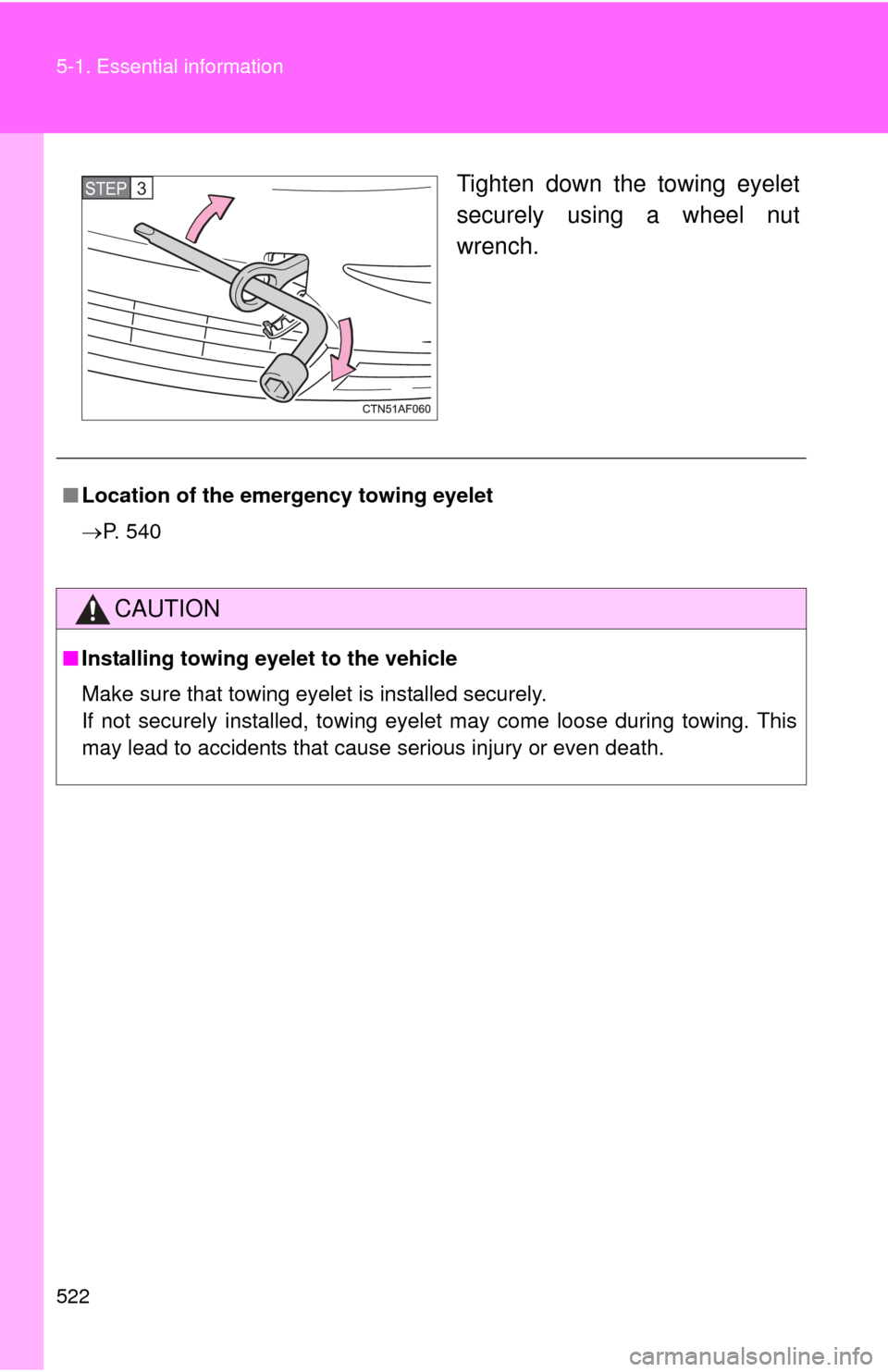
Tighten down the towing eyelet
securely using a wheel nut
wrench.STEP3
■Location of the emer gency towing eyelet
P. 540
CAUTION
■ Installing towing eyelet to the vehicle
Make sure that towing eyelet is installed securely.
If not securely installed, towing eyelet may come loose during towing. This
may lead to accidents that cause serious injury or even death.
Page 523 of 636
5
When trouble arises
523
5-1. Essential information
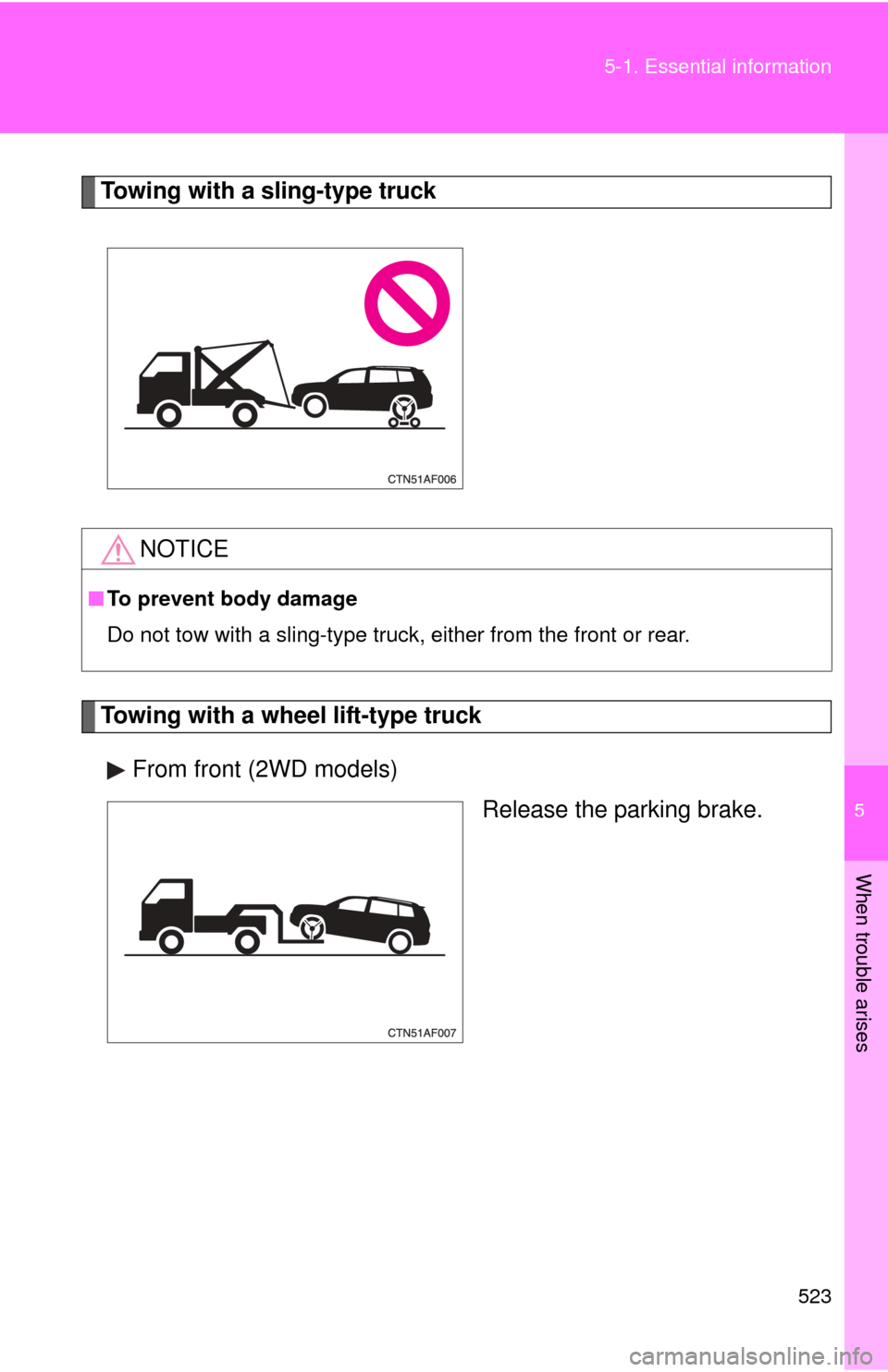
Towing with a sling-type truck
Towing with a wheel lift-type truck
From front (2WD models) Release the parking brake.
NOTICE
■To prevent body damage
Do not tow with a sling-type truck, either from the front or rear.
Page 524 of 636
524 5-1. Essential information
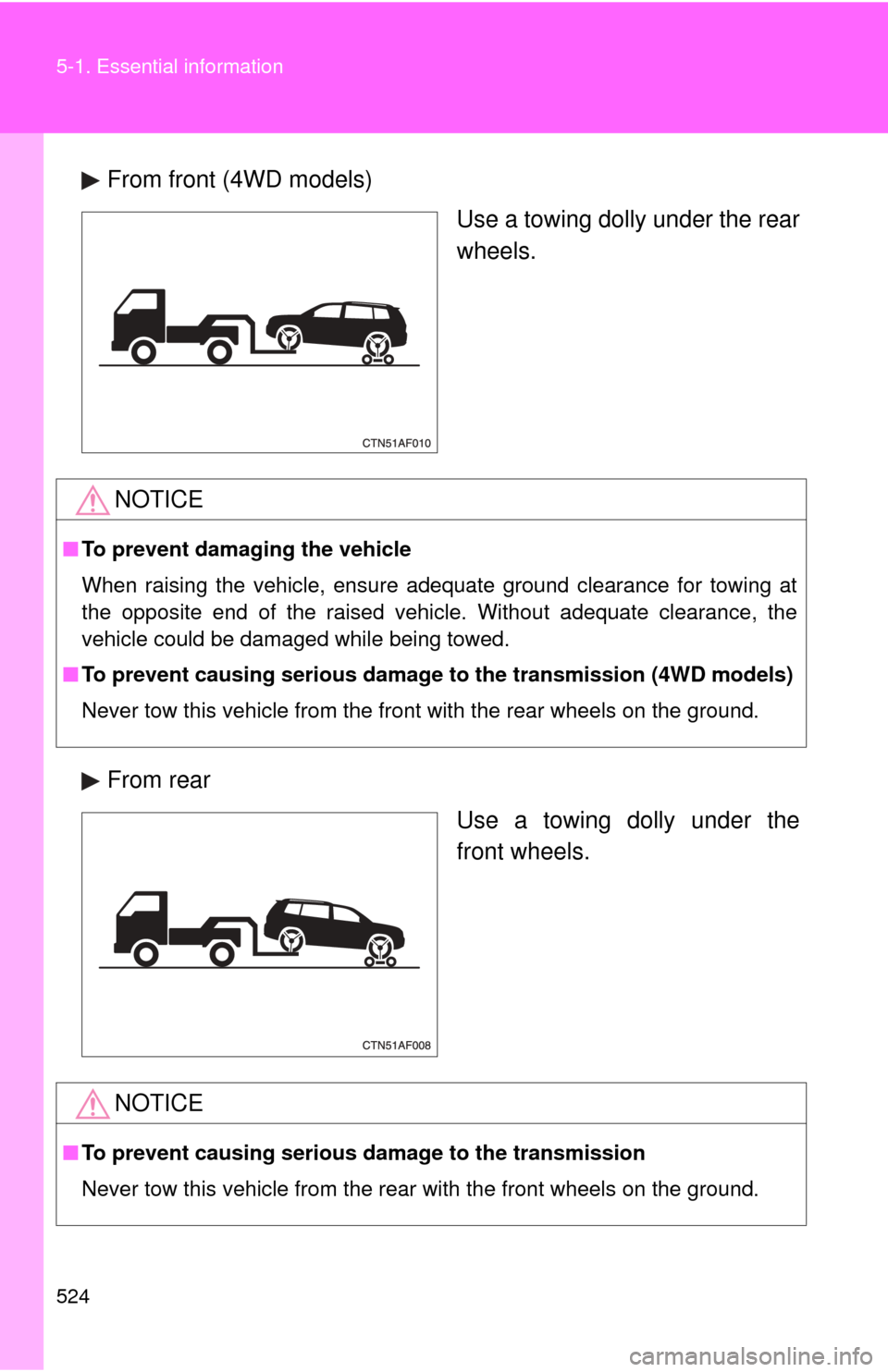
From front (4WD models)Use a towing dolly under the rear
wheels.
From rear Use a towing dolly under the
front wheels.
NOTICE
■To prevent damaging the vehicle
When raising the vehicle, ensure adequate ground clearance for towing at
the opposite end of the raised vehicle. Without adequate clearance, the
vehicle could be damaged while being towed.
■ To prevent causing serious damage to the transmission (4WD models)
Never tow this vehicle from the front with the rear wheels on the ground.
NOTICE
■To prevent causing serious damage to the transmission
Never tow this vehicle from the rear with the front wheels on the ground.