Page 527 of 636
5
When trouble arises
527
5-1. Essential information
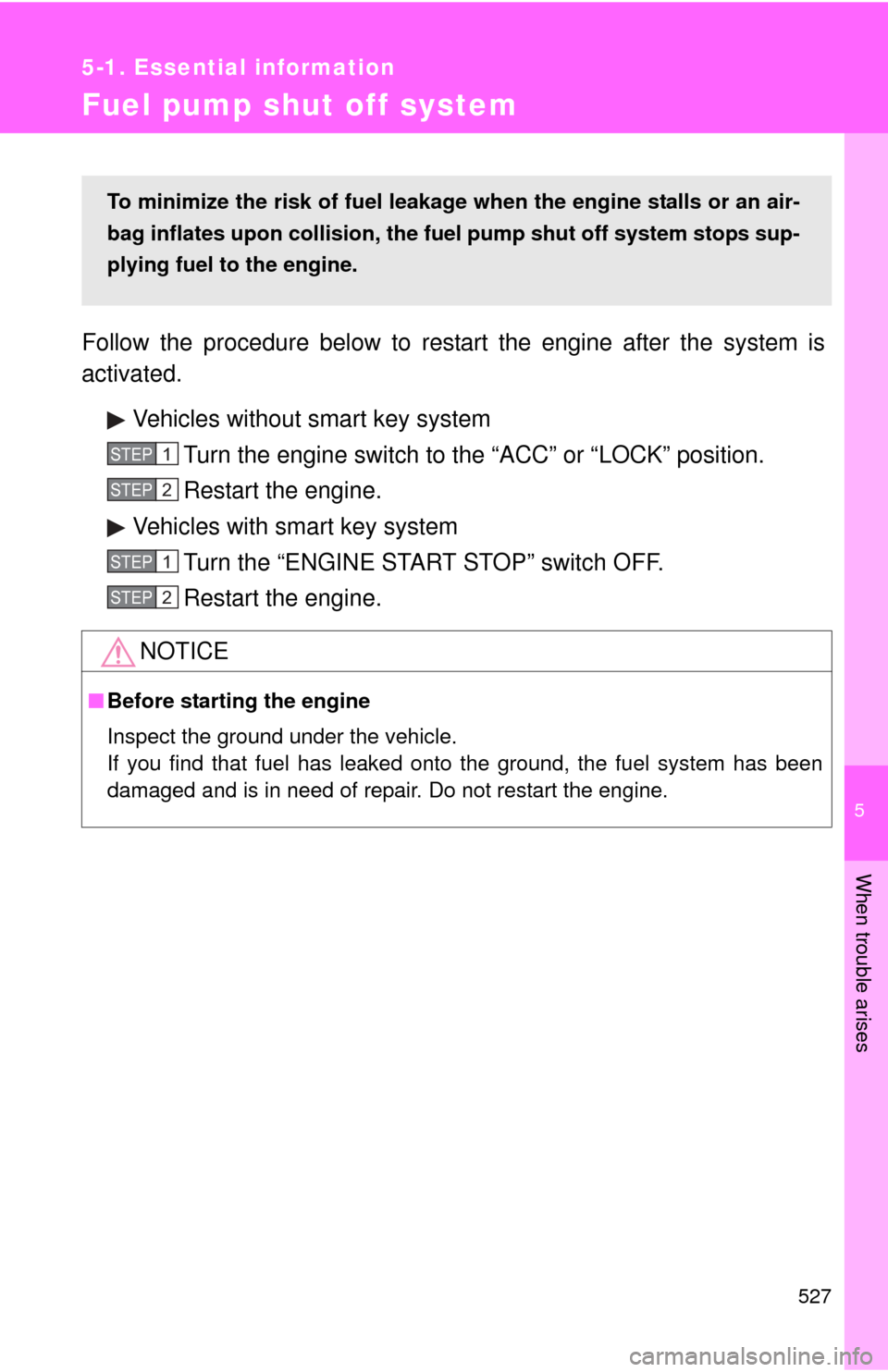
Fuel pump shut off system
Follow the procedure below to restart the engine after the system is
activated.Vehicles without smart key systemTurn the engine switch to the “ACC” or “LOCK” position.
Restart the engine.
Vehicles with smart key system Turn the “ENGINE START STOP” switch OFF.
Restart the engine.
NOTICE
■Before starting the engine
Inspect the ground under the vehicle.
If you find that fuel has leaked onto the ground, the fuel system has been
damaged and is in need of repair. Do not restart the engine.
To minimize the risk of fuel leakage when the engine stalls or an air-
bag inflates upon collision, the fu el pump shut off system stops sup-
plying fuel to the engine.
STEP1
STEP2
STEP1
STEP2
Page 530 of 636
530 5-2. Steps to take in an emergency
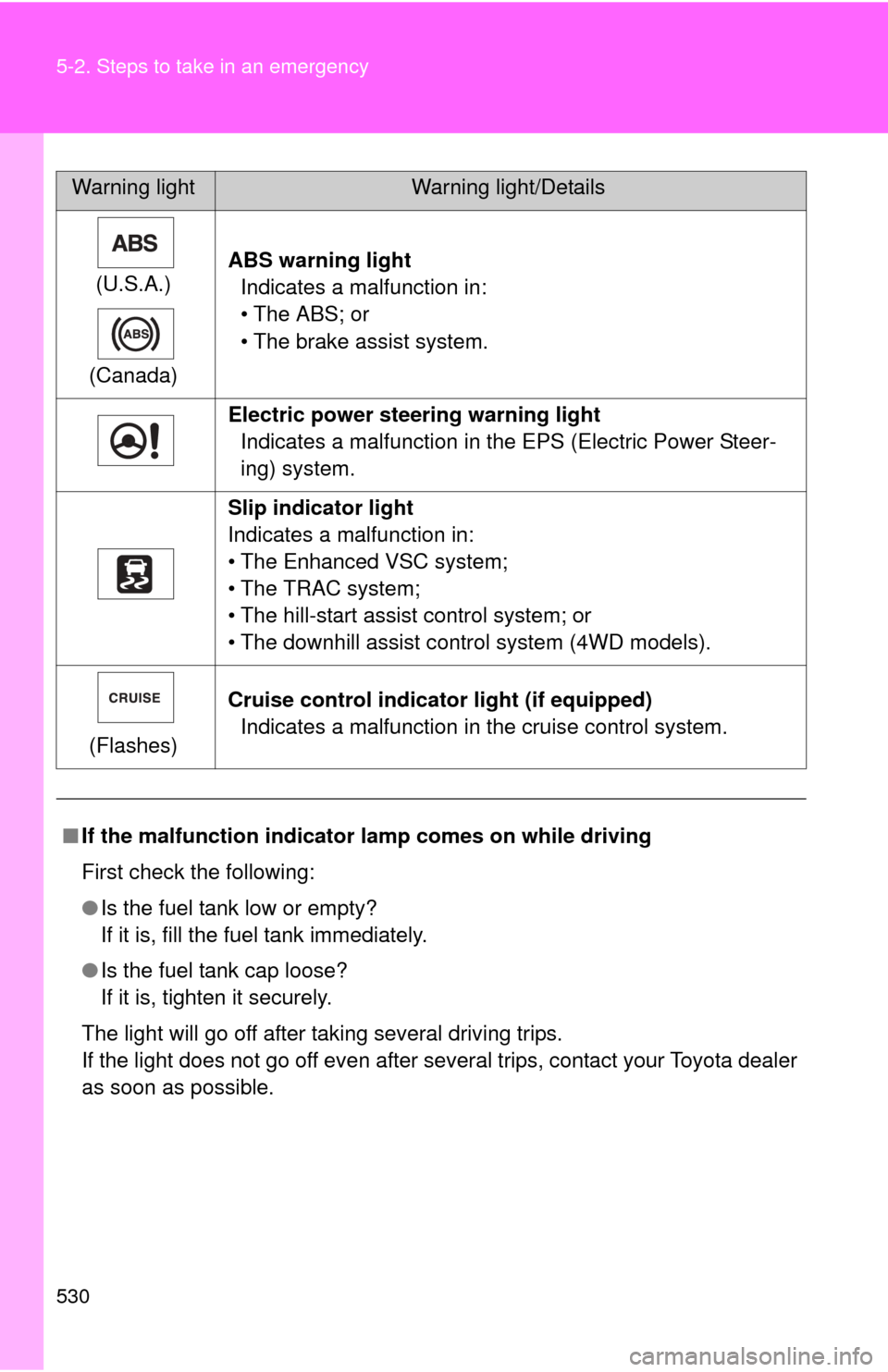
(U.S.A.)
(Canada) ABS warning light
Indicates a malfunction in:
• The ABS; or
• The brake assist system.
Electric power steering warning light Indicates a malfunction in the EPS (Electric Power Steer-
ing) system.
Slip indicator light
Indicates a malfunction in:
• The Enhanced VSC system;
• The TRAC system;
• The hill-start assist control system; or
• The downhill assist control system (4WD models).
(Flashes) Cruise control indicator
light (if equipped)
Indicates a malfunction in the cruise control system.
■ If the malfunction indicator lamp comes on while driving
First check the following:
● Is the fuel tank low or empty?
If it is, fill the fuel tank immediately.
● Is the fuel tank cap loose?
If it is, tighten it securely.
The light will go off after taking several driving trips.
If the light does not go off even after several trips, contact your Toyota dealer
as soon as possible.
Warning lightWarning light/Details
Page 531 of 636

5
When trouble arises
531
5-2. Steps to take in an emergency
Follow the correction procedures.
After taking the specified steps to correct the suspected problem,
check that the warning light turns off.
Warning lightWarning light/DetailsCorrection procedure
Open door warning light
(warning buzzer)
*1
Indicates that a door is not
fully closed. Check that all doors are
closed.
Low fuel level warning
light Indicates that remaining
fuel is about 2.2 gal. (8.3
L, 1.8 Imp. gal.) or less Refuel the vehicle.
Driver’s seat belt
reminder light
(warning buzzer)
*2
Warns the driver to fasten
his/her seat belt. Fasten the seat belt.
*3
*4
(On the center
panel) Front passenger’s seat
belt reminder light
(warning buzzer)
*2
Warns the front passen-
ger to fasten his or her
seat belt.
Fasten the seat belt.
Automatic transmission
fluid temperature warning
light (vehicles without
multi-information display) Indicates that the auto-
matic transmission fluid
temperature is too high. Stop the vehicle in a safe
place and shift the shift
lever to P.
If the light does not go off,
contact your Toyota dealer.
Page 537 of 636

5
When trouble arises
537
5-2. Steps to take in an emergency
CAUTION
■If the tire pressure warning light comes on
Be sure to observe the following precautions. Failure to do so could
cause loss of vehicle control and result in death or serious injury.
●Stop your vehicle in a safe place as
soon as possible. Adjust the tire
inflation pressure immediately.
●If the tire pressure warning light comes on even after tire inflation pres-
sure adjustment, it is pr obable that you have a flat tire. Check the tires.
If the tire is flat, change to the spare tire and have the flat tire repaired
by the nearest Toyota dealer.
●Avoid abrupt maneuvering and braking. If the vehicle tires deteriorate,
you could lose control of the steering wheel or the brakes.
■If a blowout or sudden air leakage should occur
The tire pressure warning syste m may not activate immediately.
■Maintenance of the tires
Each tire, including the spare (if provided), should be checked monthly
when cold and inflated to the inflation pressure recommended by the
vehicle manufacturer on the vehicle placard or tire inflation pressure
label (tire and load information label). (If your vehicle has tires of a differ-
ent size than the size indicated on the vehicle placard or tire inflation
pressure label [tire and load information label], you should determine the
proper tire inflation pr essure for those tires.)
As an added safety feature, your vehicle has been equipped with a tire
pressure monitoring system (TPMS-ti re pressure warning system) that
illuminates a low tire pressure telltal e (tire pressure warning light) when
one or more of your tires is significantly under-inflated. Accordingly,
when the low tire pressure telltale (tire pre ssure warning light) illumi-
nates, you should stop and check your tires as soon as possible, and
inflate them to the proper pressure. Driving on a significantly under-
inflated tire causes the tire to overheat and can lead to tire failure.
Under-inflation also reduces fuel effi ciency and tire tread life, and may
affect the vehicle's hand ling and stopping ability.
Page 554 of 636
554
5-2. Steps to take in an emergency
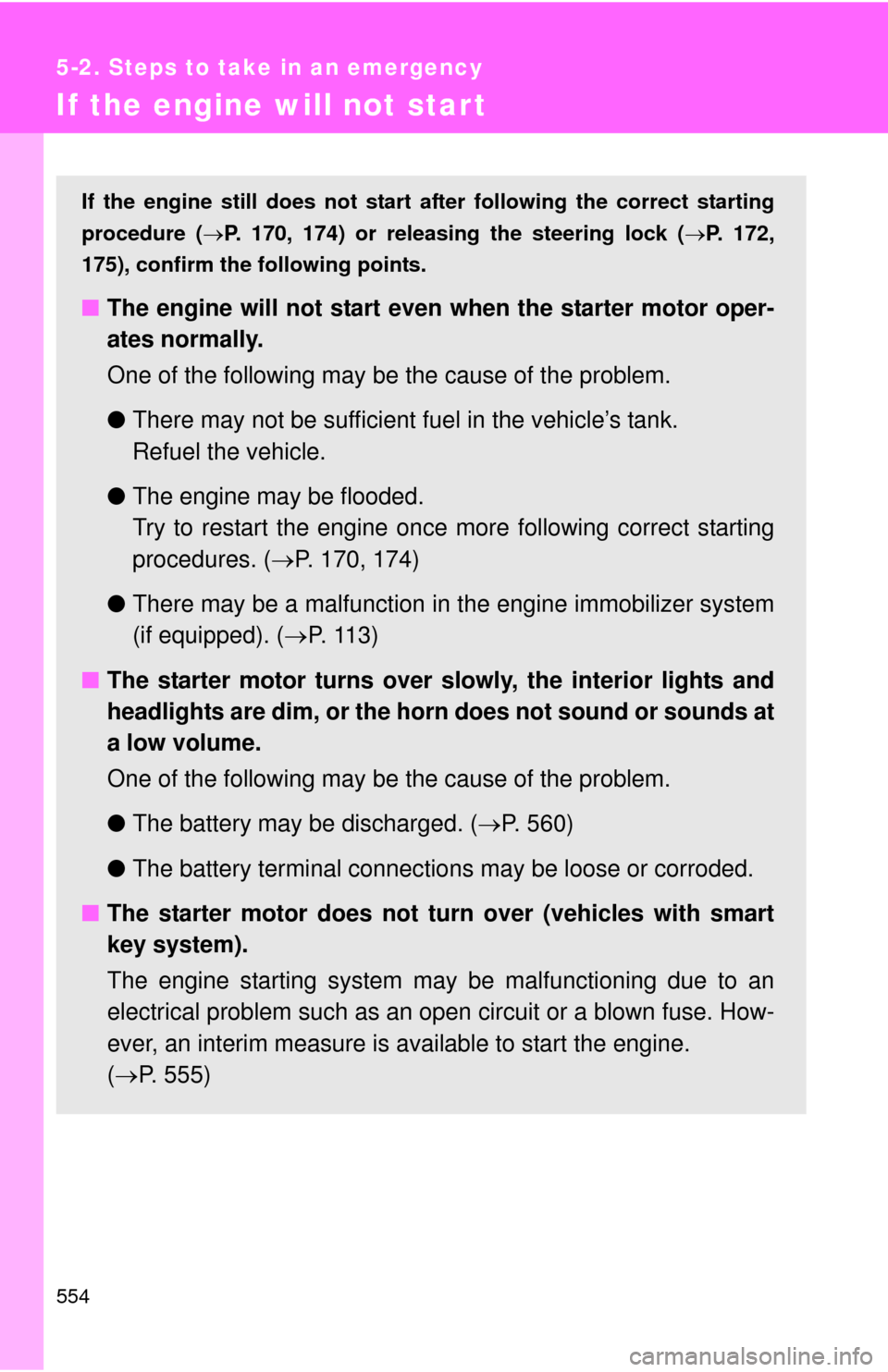
If the engine will not star t
If the engine still does not start after following the correct starting
procedure (P. 170, 174) or releasing the steering lock ( P. 172,
175), confirm the fo llowing points.
■The engine will not start even when the starter motor oper-
ates normally.
One of the following may be the cause of the problem.
●There may not be sufficient fuel in the vehicle’s tank.
Refuel the vehicle.
● The engine may be flooded.
Try to restart the engine once more following correct starting
procedures. ( P. 170, 174)
● There may be a malfunction in the engine immobilizer system
(if equipped). ( P. 11 3 )
■ The starter motor turns over slowly, the interior lights and
headlights are dim, or the horn does not sound or sounds at
a low volume.
One of the following may be the cause of the problem.
●The battery may be discharged. ( P. 560)
● The battery terminal connec tions may be loose or corroded.
■ The starter motor does not turn over (vehicles with smart
key system).
The engine starting system may be malfunctioning due to an
electrical problem such as an open circuit or a blown fuse. How-
ever, an interim measure is available to start the engine.
( P. 555)
Page 571 of 636
Vehicle specifications6
571
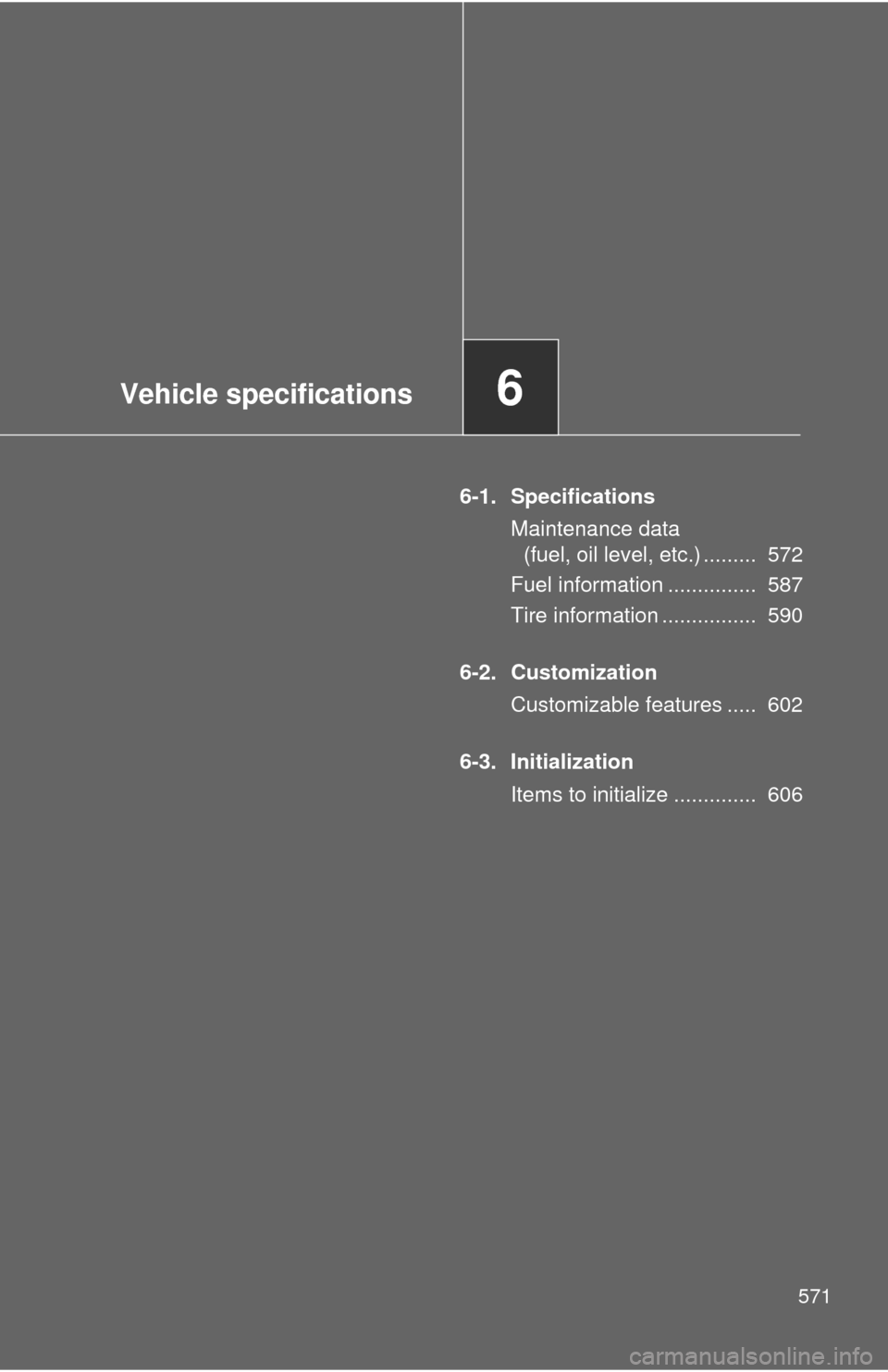
6-1. SpecificationsMaintenance data (fuel, oil level, etc.) ......... 572
Fuel information ............... 587
Tire information ................ 590
6-2. Customization Customizable features ..... 602
6-3. Initialization Items to initialize .............. 606
Page 572 of 636
572
6-1. Specifications
Maintenance data (fuel, oil level, etc.)
Dimensions and weights
*1: Without towing package
*2: With towing package
Overall length188.4 in. (4785 mm)
Overall width75.2 in. (1910 mm)
Overall height Without roof rails
68.1 in. (1730 mm)
With roof rails
69.3 in. (1760 mm)
Wheelbase
109.8 in. (2790 mm)
Front tread 64.0 in. (1625 mm)
Rear tread2WD models 64.2 in. (1630 mm)
4WD models 64.0 in. (1625 mm)
Vehicle capacity weight
(Occupant + luggage)1200 lb. (544 kg)
Trailer
Weight Rat-
ing (Trailer
weight +
cargo)2.7 L 4-cylin-
der (1AR-FE)
engine1500 lb. (680 kg)*1
3500 lb. (1500 kg)*2
3.5 L V6
(2GR-FE)
engine2000 lb. (900 kg)*1
5000 lb. (2000 kg)*2
Page 575 of 636
575
6-1. Specifications
6
Vehicle specifications
Engine
Fuel
Model
1AR-FE2GR-FE
Ty p e 4-cylinder in line,
4-cycle, gasoline6-cylinder V type,
4-cycle, gasoline
Bore and stroke
3.54
4.13 in.
(90.0 105.0 mm) 3.70
3.27 in.
(94.0 83.0 mm)
Displacement 163.1 cu.in. (2672 cm3) 210.9 cu.in. (3456 cm3)
Drive belt tension Automatic adjustment
Fuel type Unleaded gasoline only
Octane rating87 (Research Octane Number 91) or higher
Fuel tank capacity
(Reference) 19.2 gal. (72.5 L, 15.9 Imp. gal.)