Page 214 of 540
214
2-5. Driving information
Dinghy towing
NOTICE
■To avoid serious damage to your vehicle
Do not tow your vehicle with four wheels on the ground.
Your vehicle is not designed to be dinghy towed (with 4 wheels on
the ground) behind a motor home.
Page 338 of 540
338 3-6. Using the storage features
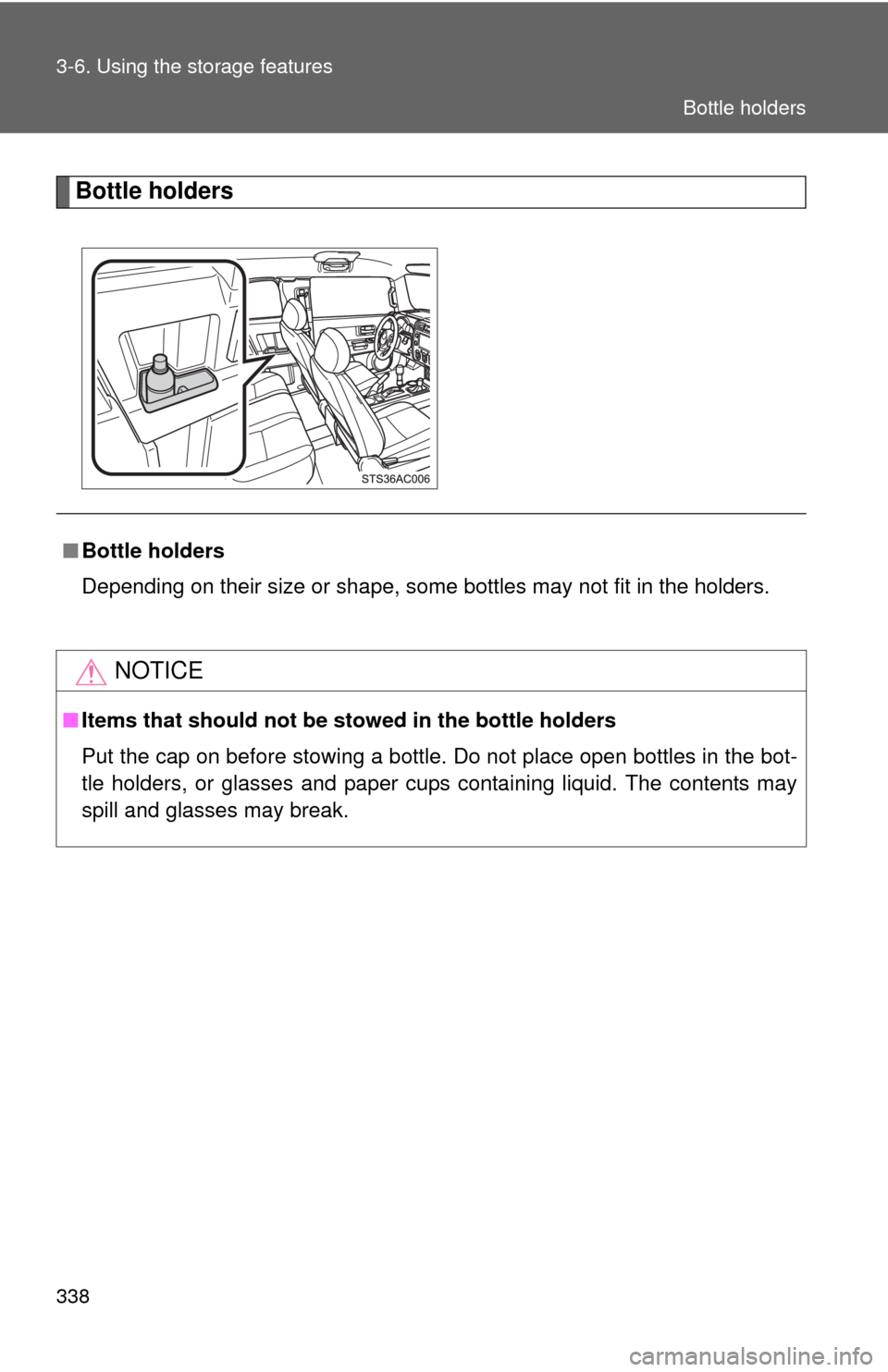
Bottle holders
■Bottle holders
Depending on their size or shape, some bottles may not fit in the holders.
NOTICE
■Items that should not be stowed in the bottle holders
Put the cap on before stowing a bottle. Do not place open bottles in the bot-
tle holders, or glasses and paper cups containing liquid. The contents may
spill and glasses may break.
Bottle holders
Page 354 of 540
354
3-7. Other interior features
Luggage storage box (vehicles without sub woofer)
CAUTION
■Caution while driving
Keep the luggage storage box closed. Injuries may result in the event of an
accident or sudden braking.
Push the lid down and pull it
towards you.
Page 361 of 540

361
3-7. Other interior features
3
Interior features
■
Conditions unfavorable to correct operation
The compass may not show the correct direction in the following conditions:
●The vehicle is stopped immediately after turning.
The compass does not adjust while the vehicle is stopped.
● The engine switch is turned off immediately after turning.
● The vehicle is on an inclined surface.
● The vehicle is in a place where the earth’s magnetic field is subject to
interference by artificial magnetic fields (underground car park/parking
lot, under a steel tower, between buildings, roof car park/parking lot, near
an intersection, near a large vehicle, etc.).
● The vehicle has become magnetized.
(There is a magnet or metal object on or near the accessory meter.)
● The battery has been disconnected.
■ When disconnecting and reco nnecting battery terminals
COMPASS flashes and the compass is reset to its initial mode.
CAUTION
■ While driving the vehicle
Do not adjust the display. Be sure to adjust the display only when the vehicle
is stopped.
■ When doing the circling calibration
Be sure to secure a wide space, and watch out for people and vehicles in the
neighborhood. Do not violate any local traffic rules while performing circling
calibration.
Page 376 of 540

376
4-3. Do-it-yourself maintenance
Do-it-yourself ser vice precautions
If you perform maintenance yourself, be sure to follow the correct
procedures as given in these sections.
ItemsParts and tools
Battery condition ( P. 390)
•Warm water
• Baking soda
• Grease
• C
onventional wrench
(for t
erminal clamp bolts)
Brake fluid level ( P. 387)
• SAE J1703 or FMVSS No.116
DOT 3 brake fluid
• Rag or paper towel
Engine coolant level ( P. 386)
• “Toyota Super Long Life Coolant”
or similar high quality ethylene
glyc
ol based non-silicate, non-
amine, non-nitrite and non-borate
coolant with
lon
g-life hybrid
organic acid technology.
U.S.A.:
“T
oyota Super Long Li
fe Coolant”
is pre-mixed with 50% coolant
and 50% de
ionized water.
Canada:
“Toyota Super Long Li
fe Coolant”
is pre-mixed with 55% coolant
and 45% de
ionized water.
Engine oil level P. 382)
• Toyota Genuine Motor Oil or
equivalent
•
Rag or paper towel
• Funnel (used only for adding oil)
Fuses (P. 415)• Fuse with same amperage rating
as original
Page 377 of 540
377
4-3. Do-it-yourself maintenance
4
Maintenance and care
ItemsParts and tools
Light bulbs
(P. 426)
• Bulb with same number and watt-
age rating as original
• Phillips-head screwdriver
Power steering fluid level (P. 389)• Automatic transmission fluid
DEXRON® II or III
• Rag or paper towel
Radiator and condenser (P. 387)
Tire inflation pressure ( P. 403)• Tire pressure gauge
• Compressed air source
Washer fluid (P. 393)
• Water
• Washer fluid containing antifreeze
(for winter use)
Page 388 of 540

388 4-3. Do-it-yourself maintenance
■Adding fluid
Make sure to check the fluid type and prepare the necessary items.
Turn the engine switch off.
Depress the brake pedal 20 times or more.
Remove the reservoir cap.
Add newly opened brake fluid up to the MAX line.
Fluid type SAE J1703 or FMVSS No.116 DOT 3 brake fluid
Items Rag or paper towel
■ Brake fluid can absorb moisture from the air
Excess moisture in the fluid can cause a dangerous loss of braking effi-
ciency. Use only newly opened brake fluid.
CAUTION
■When filling the reservoir
Take care because brake fluid can harm your hands or eyes and damage
painted surfaces.
If fluid gets on your hands or in your eyes, flush the affected area with clean
water immediately.
If you still experience discomfort, see a doctor.
NOTICE
■If the fluid level is low or high
It is normal for the brake fluid level to go down slightly as the brake pads
wear or when the fluid level in the accumulator is high.
If the reservoir needs frequent refilling, it may indicate a serious pro\
blem.
■ If you spill fluid
Be sure to wash it off with water to prevent damage to parts or paint.
Page 389 of 540
389
4-3. Do-it-yourself maintenance
4
Maintenance and care
Power steering fluid
■ Fluid level
The fluid level should be within the appropriate range.
Full (when cold)
Add fluid (when cold)
Full (when hot)
Add fluid (when hot)
Hot: Vehicle has been driven around 50 mph (80 km/h) for 20 minutes, or slightly longer in frigid temperatures. (Fluid tem-
perature, 140°F - 175°F [60°C - 80°C])
Cold: Engine has not been run for about 5 hours. (Room temper- ature, 50°F - 85°F [10°C - 30°C])
■ Checking the fluid level
Make sure to check the fluid type and prepare the necessary items.
Clean all dirt off the reservoir.
Remove the cap by turning it counterclockwise.
Wipe the dipstick clean.
Reinstall and remove the reservoir cap again.
Check the fluid level.
Fluid type Automatic transmission fluid DEXRON® II or III
Items Rag or paper towel