Page 354 of 529
354
4-3. Do-it-yourself maintenance
Engine compar tment
1.8 L 4-cylinder (2ZR-FE) engine
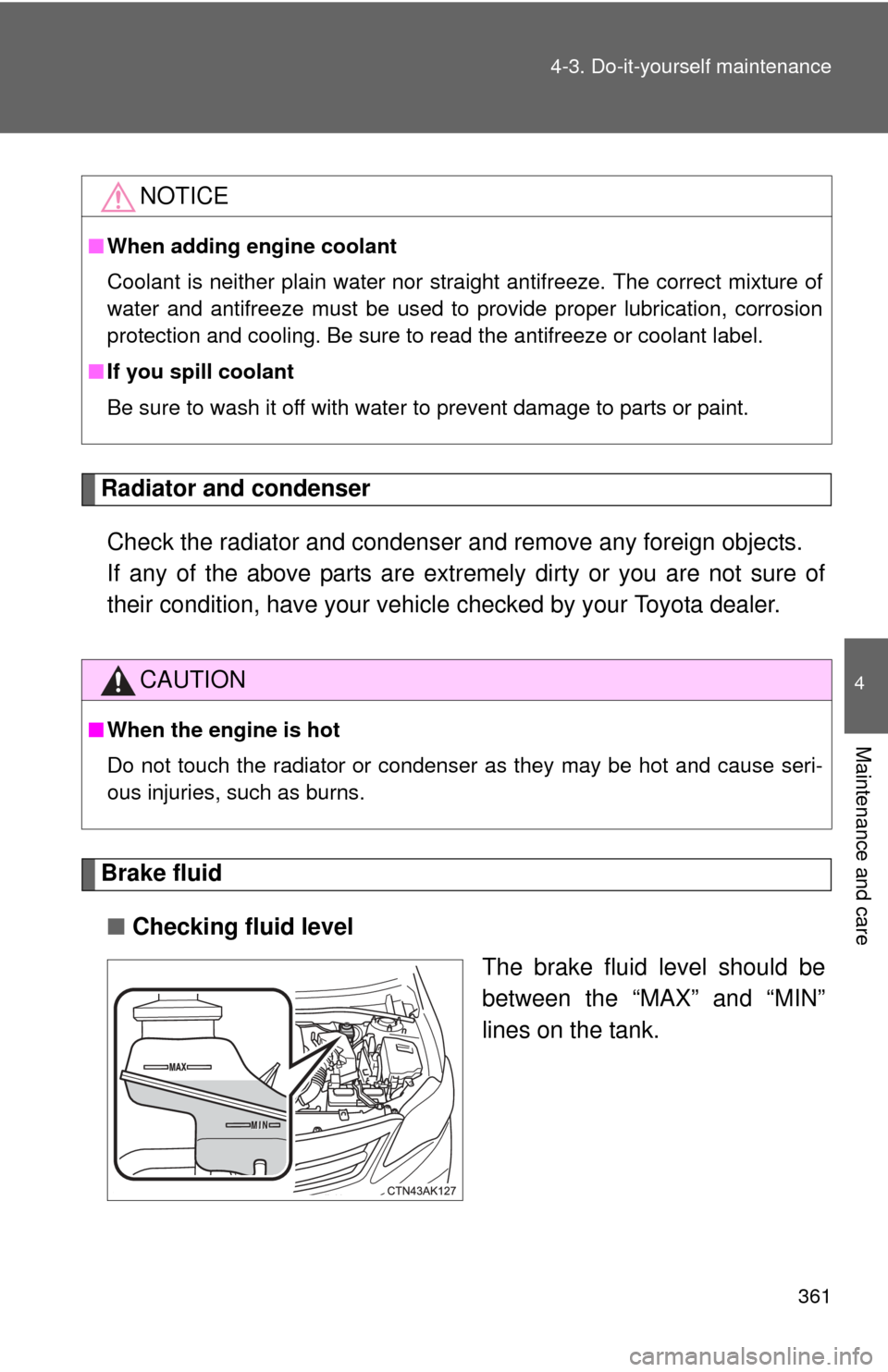
Engine coolant reservoir( P. 360)
Engine oil filler cap ( P. 357)
Brake fluid reservoir ( P. 361)
Fuse box ( P. 389)Battery ( P. 364)
Radiator ( P. 361)
Electric cooling fan
Condenser ( P. 361)
Engine oil level dipstick ( P. 356)
Washer fluid tank ( P. 366)
Page 355 of 529
355
4-3. Do-it-yourself maintenance
4
Maintenance and care
2.4 L 4-cylinder (2AZ-FE) engine
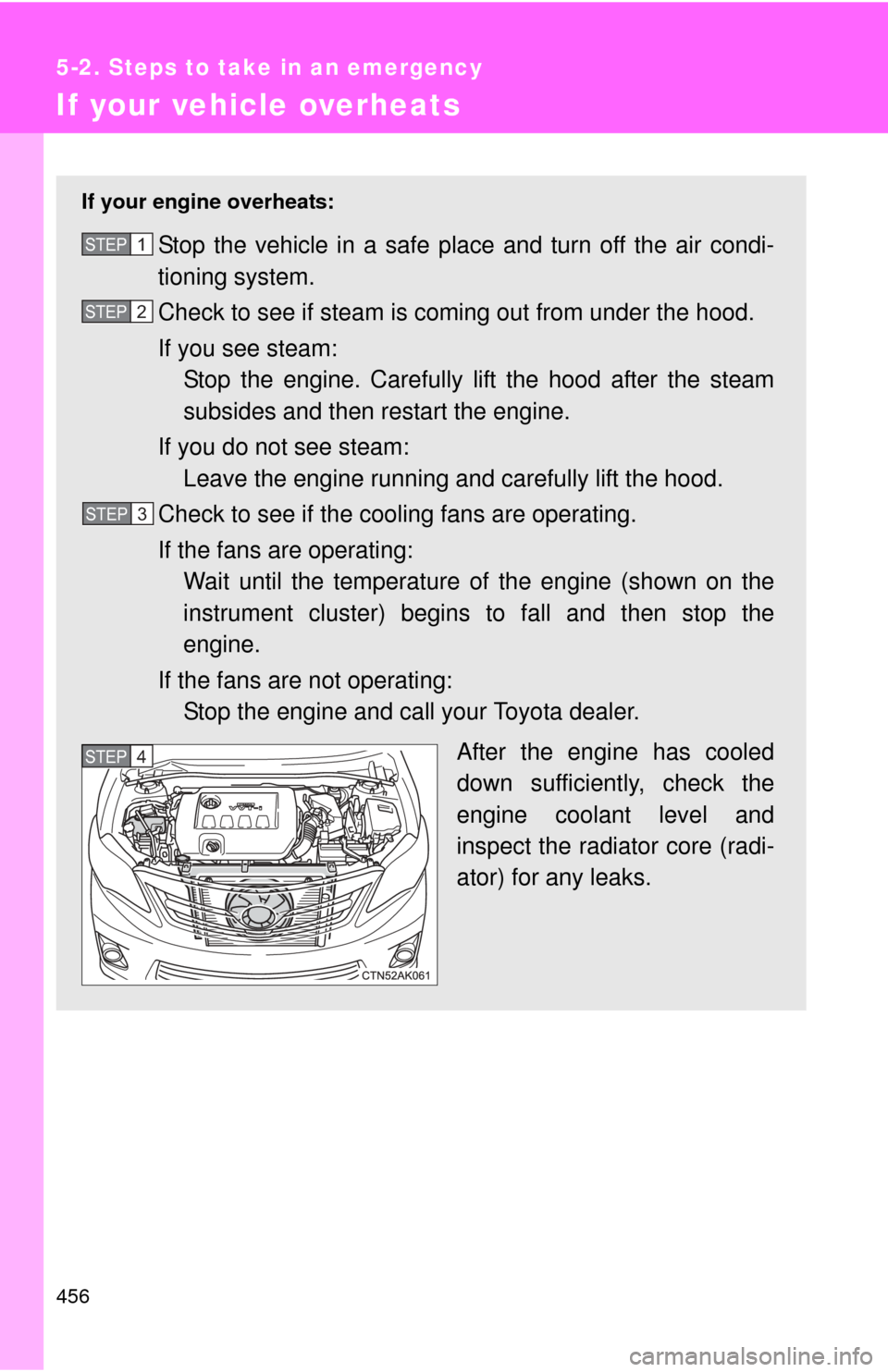
Engine coolant reservoir
( P. 360)
Engine oil filler cap ( P. 357)
Engine oil level dipstick ( P. 356)
Brake fluid reservoir ( P. 361)Fuse box ( P. 389)
Battery ( P. 364)
Radiator ( P. 361)
Electric cooling fans
Condenser ( P. 361)
Washer fluid tank ( P. 366)
Page 360 of 529
360 4-3. Do-it-yourself maintenance
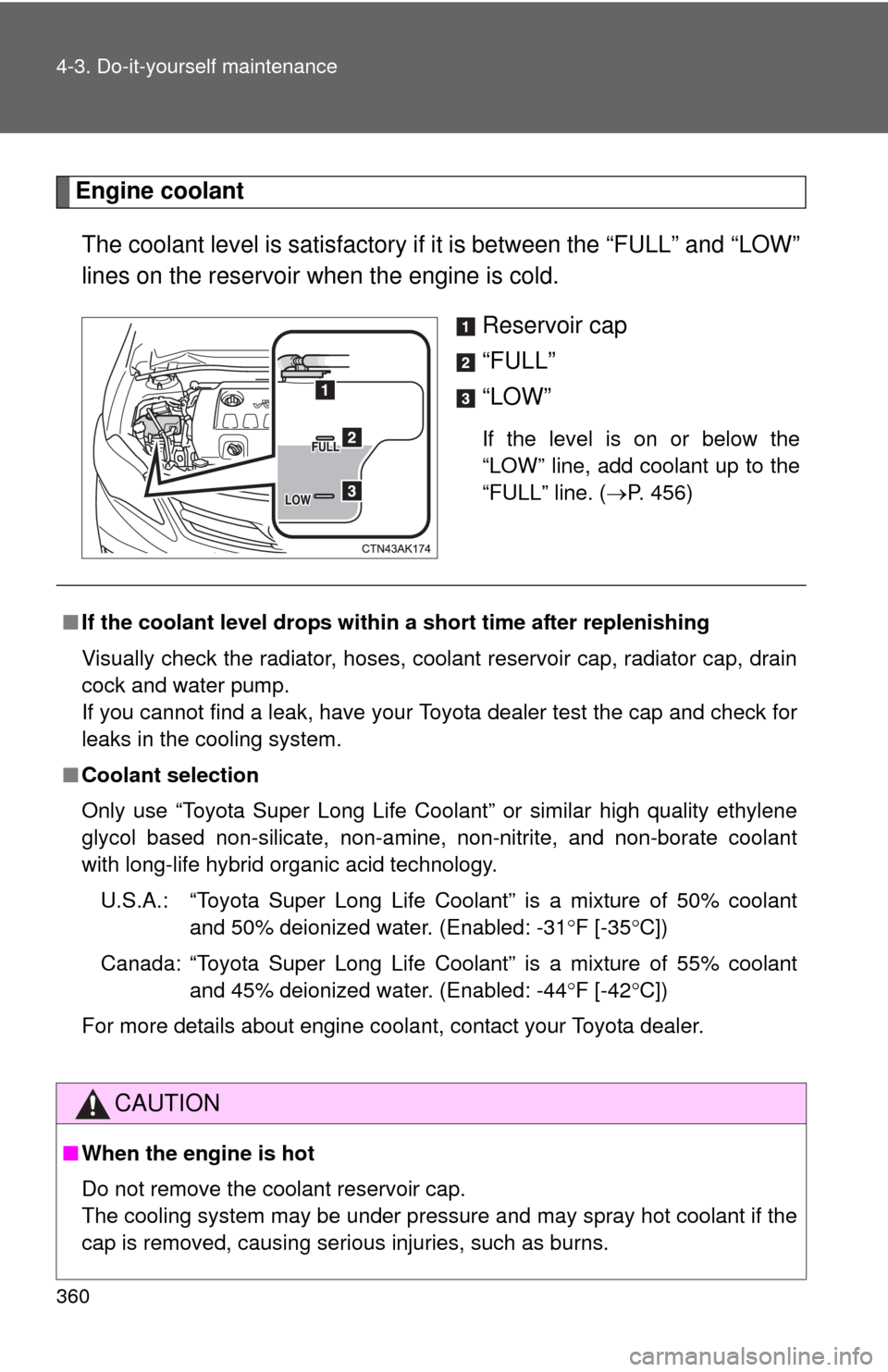
Engine coolantThe coolant level is satisfactory if it is between the “FULL” and “LOW”
lines on the reservoir when the engine is cold.
Reservoir cap
“FULL”
“LOW”
If the level is on or below the
“LOW” line, add coolant up to the
“FULL” line. (P. 456)
■If the coolant level drops within a short time after replenishing
Visually check the radiator, hoses, coolant reservoir cap, radiator cap, drain
cock and water pump.
If you cannot find a leak, have your Toyota dealer test the cap and check for
leaks in the cooling system.
■ Coolant selection
Only use “Toyota Super Long Life Coolant” or similar high quality ethylene
glycol based non-silicate, non-amine, non-nitrite, and non-borate coolant
with long-life hybrid organic acid technology.
U.S.A.: “Toyota Super Long Life Coolant” is a mixture of 50% coolant and 50% deionized water. (Enabled: -31 F [-35 C])
Canada: “Toyota Super Long Life Coolant” is a mixture of 55% coolant and 45% deionized water. (Enabled: -44 F [-42 C])
For more details about engine coolant, contact your Toyota dealer.
CAUTION
■ When the engine is hot
Do not remove the coolant reservoir cap.
The cooling system may be under pressure and may spray hot coolant if the
cap is removed, causing serious injuries, such as burns.
Page 361 of 529
361
4-3. Do-it-yourself maintenance
4
Maintenance and care
Radiator and condenser
Check the radiator and condenser and remove any foreign objects.
If any of the above parts are extr emely dirty or you are not sure of
their condition, have your vehicl e checked by your Toyota dealer.
Brake fluid
■ Checking fluid level
The brake fluid level should be
between the “MAX” and “MIN”
lines on the tank.
NOTICE
■When adding engine coolant
Coolant is neither plain water nor stra ight antifreeze. The correct mixture of
water and antifreeze must be used to provide proper lubrication, corrosion
protection and cooling. Be sure to read the antifreeze or coolant label.
■ If you spill coolant
Be sure to wash it off with water to prevent damage to parts or paint.
CAUTION
■When the engine is hot
Do not touch the radiator or condenser as they may be hot and cause seri-
ous injuries, such as burns.
Page 456 of 529
456
5-2. Steps to take in an emergency
If your vehicle overheats
If your engine overheats:
Stop the vehicle in a safe place and turn off the air condi-
tioning system.
Check to see if steam is coming out from under the hood.
If you see steam: Stop the engine. Carefully lift the hood after the steam
subsides and then restart the engine.
If you do not see steam: Leave the engine running and carefully lift the hood.
Check to see if the cooling fans are operating.
If the fans are operating: Wait until the temperature of the engine (shown on the
instrument cluster) begins to fall and then stop the
engine.
If the fans are not operating: Stop the engine and call your Toyota dealer.
After the engine has cooled
down sufficiently, check the
engine coolant level and
inspect the radiator core (radi-
ator) for any leaks.STEP 1
STEP 2
STEP 3
STEP 5 STEP 4
Page 457 of 529
5
When trouble arises
457
5-2. Steps to take in an emergency
■
Overheating
If you observe the following, your vehicle may be overheating.
●The engine coolant temperature gauge enters the red zone or a loss of
power is experienced.
● Steam is coming from under the hood.
CAUTION
■To prevent an accident or injury when inspecting under the hood of
your vehicle
●If steam is seen coming from under the hood, do not open the hood until
the steam has subsided. The engine compartment may be very hot, caus-
ing serious injury such as burns.
● Keep hands and clothing away from the fan and other belts while the
engine is running.
● Do not loosen the coolant reservoir cap while the engine and radiator are
hot.
Serious injury, such as burns, may result from hot coolant and steam
released under pressure.
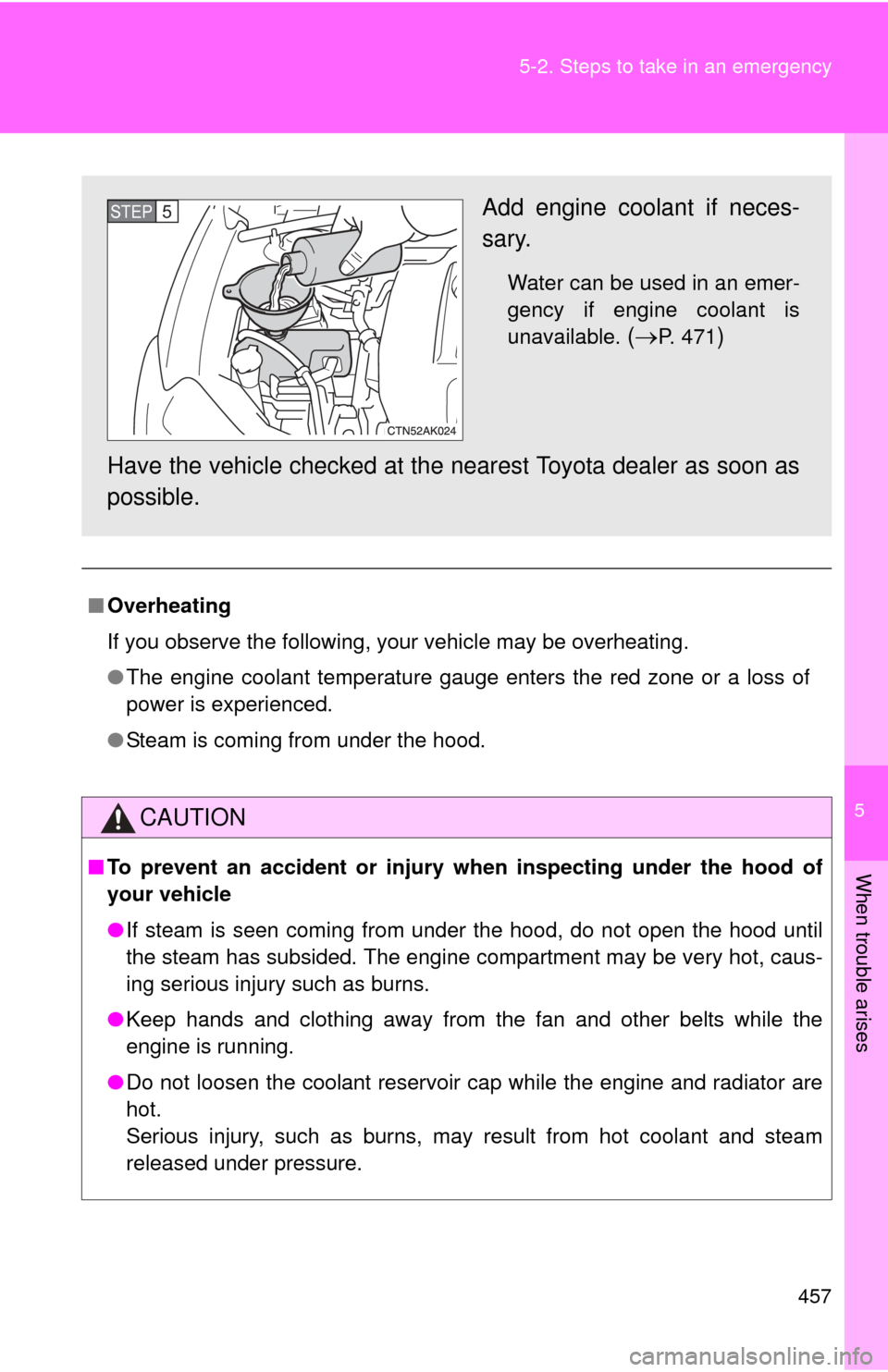
Add engine coolant if neces-
sary.
Water can be used in an emer-
gency if engine coolant is
unavailable.
(P. 471)
Have the vehicle chec ked at the nearest Toyota dealer as soon as
possible.
STEP 5
Page 520 of 529
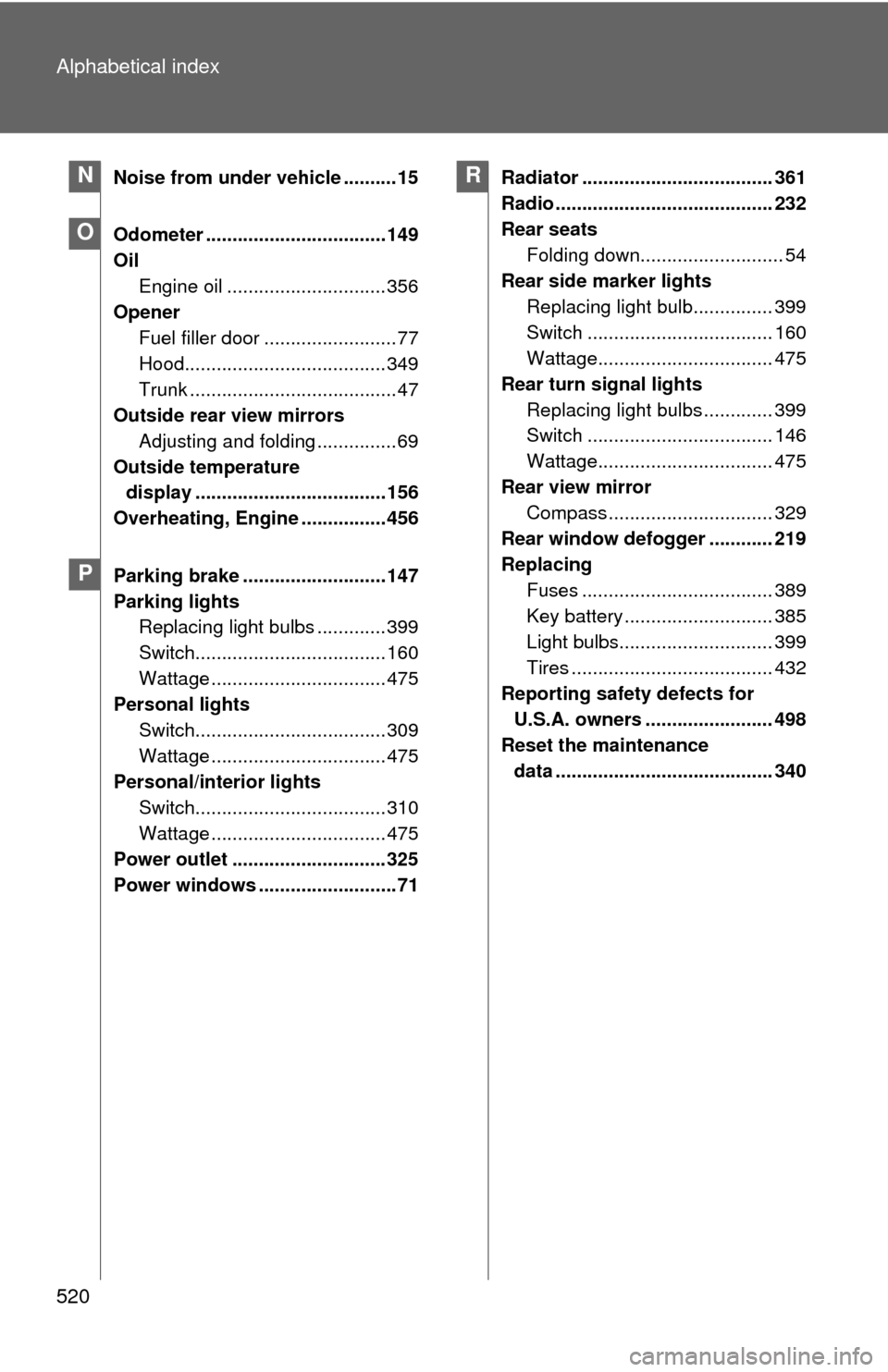
520 Alphabetical index
Noise from under vehicle ..........15
Odometer .................................. 149
OilEngine oil .............................. 356
Opener Fuel filler door .........................77
Hood...................................... 349
Trunk .......................................47
Outside rear view mirrors
Adjusting and folding ...............69
Outside temperature display .................................... 156
Overheating, Engine ................456
Parking brake ........................... 147
Parking lights Replacing light bulbs ............. 399
Switch.................................... 160
Wattage ................................. 475
Personal lights
Switch.................................... 309
Wattage ................................. 475
Personal/interior lights
Switch.................................... 310
Wattage ................................. 475
Power outlet ............................. 325
Power windows ..........................71 Radiator .................................... 361
Radio ......................................... 232
Rear seats
Folding down........................... 54
Rear side marker lights
Replacing light bulb............... 399
Switch ................................... 160
Wattage................................. 475
Rear turn signal lights Replacing light bulbs ............. 399
Switch ................................... 146
Wattage................................. 475
Rear view mirror Compass ............................... 329
Rear window defogger ............ 219
Replacing Fuses .................................... 389
Key battery ............................ 385
Light bulbs............................. 399
Tires ...................................... 432
Reporting safety defects for U.S.A. owners ........................ 498
Reset the maintenance
data ......................................... 340N
O
P
R