Page 171 of 529
171
2-4. Using other
driving systems
2
When driving
■Cruise control can be set when
●Automatic transmission:
The shift lever is in the D or range 3 (standard type), or in the D or range
4 or higher of S has been selected (multi-mode type).
● Vehicle speed is above approximately 25 mph (40 km/h).
■ Accelerating after setting the vehicle speed
●The vehicle can be accelerated normally. After acceleration, the set
speed resumes.
● Even without canceling the cruise control, the set speed can be
increased by first accelerating the vehicle to the desired speed and then
pushing the lever down to set the new speed.
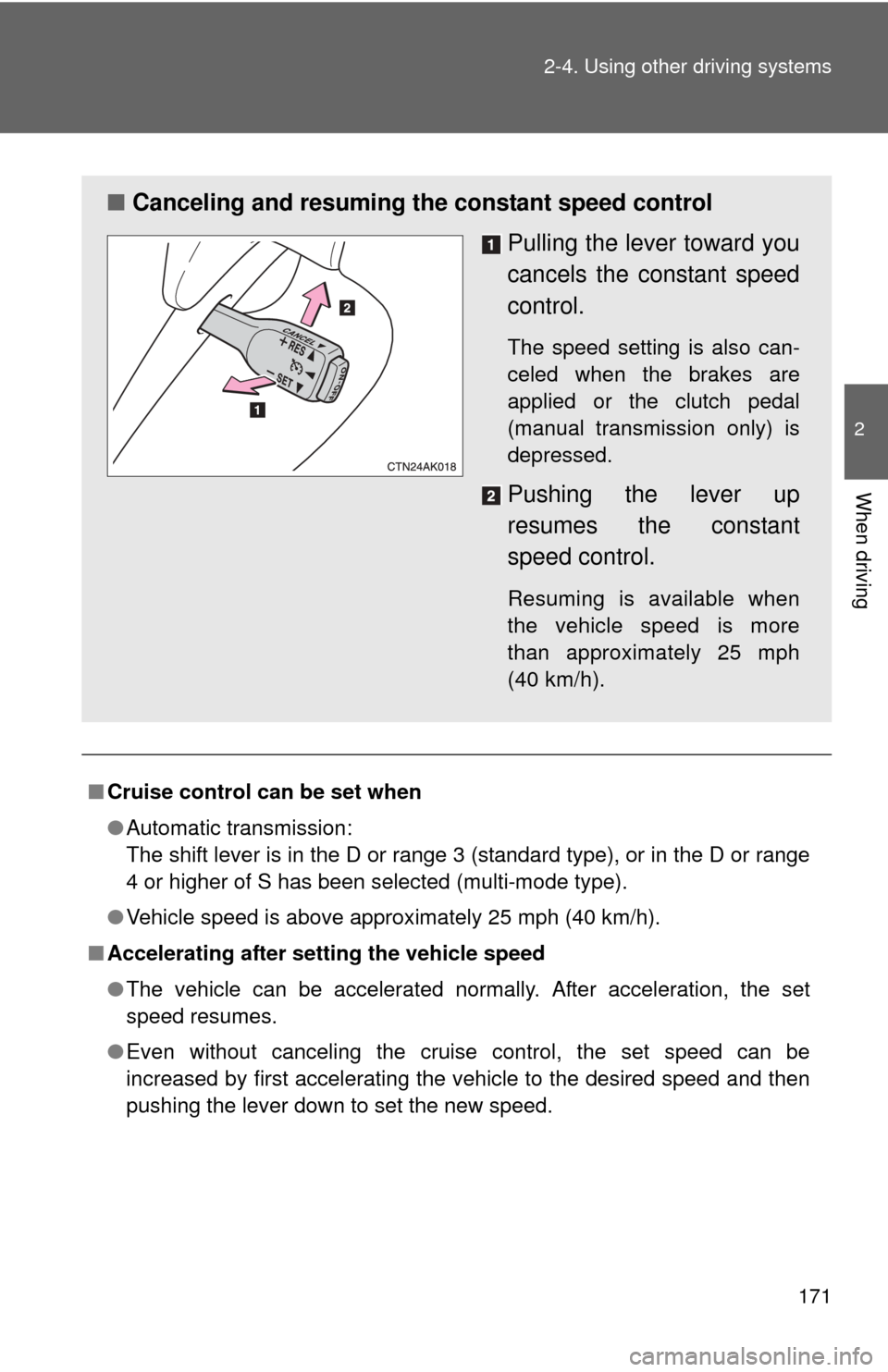
■ Canceling and resuming the constant speed control
Pulling the lever toward you
cancels the constant speed
control.
The speed setting is also can-
celed when the brakes are
applied or the clutch pedal
(manual transmission only) is
depressed.
Pushing the lever up
resumes the constant
speed control.
Resuming is available when
the vehicle speed is more
than approximately 25 mph
(40 km/h).
Page 172 of 529
172 2-4. Using other driving systems
■Automatic cruise control cancelation
Cruise control will stop maintaining the vehicle speed in any of the following
situations.
●Actual vehicle speed falls more than approximately 10 mph (16 km/h)
below the preset vehicle speed.
At this time, the memorized set speed is not retained.
● Actual vehicle speed is below approximately 25 mph (40 km/h).
● VSC is activated.
■ If the cruise control indicator light flashes
Press the “ON-OFF” button once to deactivate the system, and then press
the button again to reactivate the system.
If the cruise control speed cannot be set or if the cruise control cancels
immediately after being activated, there may be a malfunction in the cruise
control system. Have the vehicle inspected by your Toyota dealer.
CAUTION
■To avoid operating the cruise control by mistake
Switch the cruise control off using the “ON-OFF” button when not in use.
■ Situations unsuitable for cruise control
Do not use cruise control in any of the following situations.
Doing so may result in loss of control and could cause an accident resulting
in death or serious injury.
●In heavy traffic
● On roads with sharp bends
● On winding roads
● On slippery roads, such as those covered with rain, ice or snow
● On steep hills
Vehicle speed may exceed the set speed when driving down a steep hill.
● When your vehicle is towing a trailer or during emergency towing
Page 198 of 529

198 2-5. Driving information
CAUTION
■To avoid accident or injury
●Do not exceed the TWR, unbraked TWR, GCWR, GVWR or GAWR.
● Adjust the tongue weight within the appropriate range. Place heavier loads
as close to the trailer axle as possible.
● Do not exceed 65 mph (104 km/h), the posted towing speed limit or the
speed limit for your trailer as set forth in your trailer owner’s manual,
whichever is lowest. Slow down sufficiently before making a turn, in cross
winds, on wet or slippery surface, etc. to help avoid an accident. If you
experience a vehicle-trailer instability from reducing a certain speed, slow
down and make sure you keep your vehicle speed under the speed of
which you experience the instability.
● Do not make jerky, abrupt or sharp turns.
● Do not apply the brakes suddenly as you may skid, resulting in jackknifing
and loss of vehicle control. This is especially true on wet or slippery sur-
faces.
● Do not exceed the trailer hitch assembly weight, gross vehicle weight,
gross axle weight and trailer tongue weight capacities.
● Do not use cruise control when towing.
● Slow down and downshift before descending steep or long downhill
grades. Do not make sudden downshifts while descending steep or long
downhill grades.
● Vehicle-trailer instability is more likely on steep long downhills. Before
descending steep or long downhill grades, slow down and downshift. Do
not make sudden downshifts when descending steep or long downhill
grades. Avoid holding the brake pedal down too long or applying the
brakes too frequently. This could cause the brakes to overheat and result
in reduced braking efficiency.
● Do not tow a trailer when the compact spare tire is installed on your vehi-
cle.
Page 397 of 529

397
4-3. Do-it-yourself maintenance
4
Maintenance and care
14 POWER
30 A Power windows
15 SEAT HTR 15 A Seat heater
16 HTR-IG 10 A Air conditioning system
17 WIPER 25 A Windshield wipers
18 WASHER 15 A Windshield washer
19 ECU-IG NO. 1 10 A Automatic transmission, main body
ECU, electric power steering, elec-
tric cooling fan(s), shift lock control
system, anti-lock brake system, tire
pressure warning system, vehicle
stability control system, cruise con-
trol system
20 ECU-IG NO. 2 10 A Back-up lights, charging system,
rear window defogger, air condi-
tioning system, multiport fuel injec-
tion system/sequential multiport
fuel injection system, moon roof
21 OBD 7.5 A On-board diagnosis system
22 STOP 10 AStop lights, high mounted stop-
light, anti-lock brake system, main
body ECU, multiport fuel injection
system/sequential multiport fuel
injection system, shift lock control
system, vehicle stability control
system
23 DOOR 25 A Power door lock system
24 ACC-B 25 A CIG, ACC
25 FR FOG 15 A Front fog lights
26 AM1 7.5 A Starting system, ACC, CIG
FuseAmpereCircuit
Page 421 of 529
5
When trouble arises
421
5-2. Steps to take in an emergency
Have the vehicle inspected immediately.
Failing to investigate the cause of the following warnings may lead to
the system operating abnormally and possibly cause an accident.
Have the vehicle inspected by your Toyota dealer immediately.
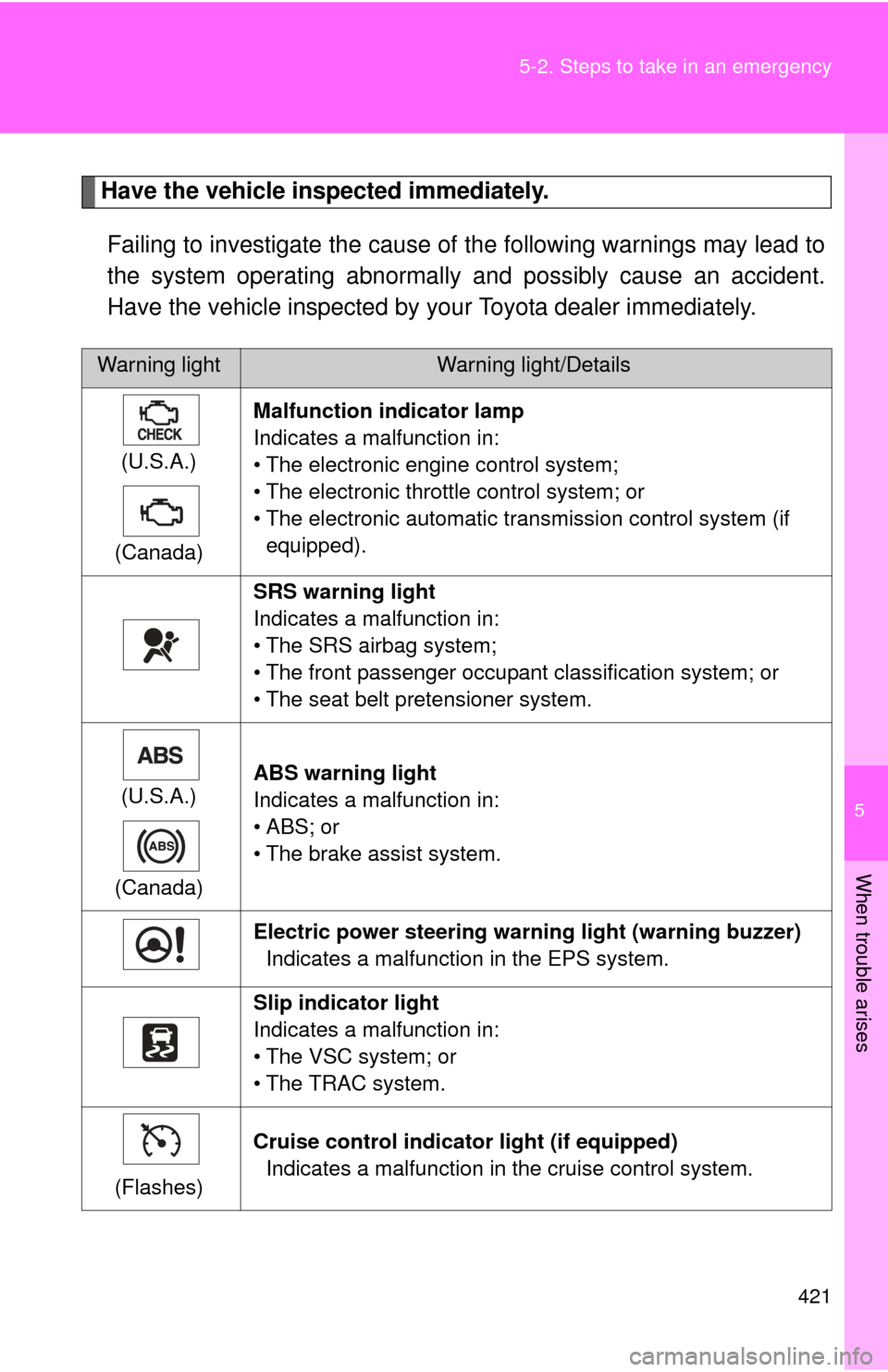
Warning lightWarning light/Details
(U.S.A.)
(Canada) Malfunction indicator lamp
Indicates a malfunction in:
• The electronic engine control system;
• The electronic throttle control system; or
• The electronic automatic transmission control system (if
equipped).
SRS warning light
Indicates a malfunction in:
• The SRS airbag system;
• The front passenger occupant classification system; or
• The seat belt pretensioner system.
(U.S.A.)
(Canada) ABS warning light
Indicates a malfunction in:
•ABS; or
• The brake assist system.
Electric power steering warning light (warning buzzer)
Indicates a malfunction in the EPS system.
Slip indicator light
Indicates a malfunction in:
• The VSC system; or
• The TRAC system.
(Flashes) Cruise control indicator light (if equipped)
Indicates a malfunction in the cruise control system.
Page 516 of 529

516 Alphabetical index
Child safetyAirbag precautions ..................93
Battery precautions ....... 365, 454
Child restraint system............ 103
Child-protectors .......................42
How your child should wear
the seat belt ..........................62
Installing child restraints ........ 107
Moon roof precautions ............76
Power window lock switch.......71
Power window precautions .....72
Removed key battery
precautions ......................... 388
Seat belt comfort guide ........... 59
Seat belt extender
precautions ...........................65
Seat belt precautions ..............64
Seat heater precautions ........ 326
Trunk precautions ...................49
Child-protectors .........................42
Cleaning
Exterior .................................. 334
Interior ................................... 336
Seat belts .............................. 337
Clock ......................................... 322
Compass ................................... 329
Condenser ................................ 361
Console box ............................. 312
Cooling system Engine overheating ............... 456
Cruise control........................... 169
Cup holder ................................ 314
Curtain shield airbags ...............86
Customizable features............. 491 Daytime running light
system .................................... 162
Defogger Rear window ......................... 219
Side mirror ............................ 219
Dimension ................................ 464
Dinghy towing ................... 201,202
Display Trip information ..................... 156
Do-it-yourself maintenance .... 345
Doors Door lock ..................... 25, 36, 41
Door windows ......................... 71
Side mirrors............................. 69
Driver's seat belt reminder light ......................................... 422
Driving
Break-in tips .......................... 123
Correct posture ....................... 84
Procedures............................ 120
Winter driving tips ................. 181D
Page 527 of 529
527
What to do if...
■
Warning lights
P. 422
or
P. 4 2 0P. 422
P. 4 2 0P. 421
P. 4 2 0P. 421
P. 421
or
P. 4 2 1P. 422
P. 4 2 1P. 422
P. 422
or
P. 4 2 1P. 422
P. 4 2 2P. 430
*: The light flashes to indicate a malfunction.
Brake system warning
lightTire pressure warning
light
Low windshield washer fluid level
warning light
Charging system warn-
ing lightElectric power steering
warning light
Low engine oil pressure
warning lightSlip indicator
light
Malfunction indicator
lampCruise control indicator
light
*
Open door warning light
SRS warning lightLow fuel level warning
light
ABS warning lightDriver’s seat belt
reminder light
Front passenger’s seat belt
reminder light
Maintenance required
reminder lightSmart key system warn-
ing light
