Page 433 of 532

5
When trouble arises
433
5-2. Steps to take in an emergency
CAUTION
■If a blowout or sudden air leakage
should occur (vehicles with a tire
pressure warning system)
The tire pressure warning syste m may not activate immediately.
■Maintenance of the tires (vehicles with a tire pressure warning sys-
tem)
Each tire, including the spare (if provided), should be checked monthly
when cold and inflated to the inflation pressure recommended by the
vehicle manufacturer on the vehicle placard or tire inflation pressure
label (tire and load information label). (If your vehicle has tires of a differ-
ent size than the size indicated on the vehicle placard or tire inflation
pressure label [tire and load information label], you should determine the
proper tire inflation pr essure for those tires.)
As an added safety feature, your vehicle has been equipped with a tire
pressure monitoring system (TPMS-ti re pressure warning system) that
illuminates a low tire pressure telltal e (tire pressure warning light) when
one or more of your tires is significantly under-inflated. Accordingly,
when the low tire pressure telltale (tire pre ssure warning light) illumi-
nates, you should stop and check your tires as soon as possible, and
inflate them to the proper pressure. Driving on a significantly under-
inflated tire causes the tire to overheat and can lead to tire failure.
Under-inflation also reduces fuel effi ciency and tire tread life, and may
affect the vehicle's hand ling and stopping ability.
Please note that the TPMS (tire pressure warning system) is not a sub-
stitute for proper ti re maintenance, an d it is the driver's responsibility to
maintain correct tire pressure, even if under-inflation has not reached the
level to trigger illu mination of the TPMS low ti re pressure telltale (tire
pressure warning light).
Page 447 of 532
5
When trouble arises
447
5-2. Steps to take in an emergency
If the engine will not star t
If the engine will not start even though correct starting procedures
are being followed (
P. 145, 148), consider each of the following
points:
■ The engine will not start even though the starter motor
operates normally.
One of the following may be the cause of the problem:
●There may not be sufficient fuel in the vehicle’s tank.
Refuel the vehicle.
● The engine may be flooded.
Try to restart the engine again following correct starting proce-
dures. ( P. 145, 148)
● There may be a malfunction in the engine immobilizer system.
( P. 9 2 )
■ The starter motor turns over slowly, the interior lights and
headlights are dim, or the horn does not sound or sounds at
a low volume.
One of the following may be the cause of the problem:
●The battery may be discharged. ( P. 454)
● The battery terminal connec tions may be loose or corroded.
■ The starter motor does not turn over (vehicles with a smart
key system).
The engine starting system may be malfunctioning due to an
electrical problem such as an open circuit or a blown fuse. How-
ever, an interim measure is available to start the engine.
( P. 448)
Page 465 of 532
Vehicle specifications6
465
6-1. SpecificationsMaintenance data (fuel, oil level, etc.) ......... 466
Fuel information ............... 478
Tire information ................ 481
6-2. Customization Customizable features ..... 493
6-3. Initialization Items to initialize .............. 499
Page 466 of 532
466
6-1. Specifications
Maintenance data (fuel, oil level, etc.)
Dimensions and weights
*1: Unladen vehicles
*2: P215/55R17 and P225/45R18 tires
*3: P205/65R16 tires
Vehicle identification■ Vehicle identification number
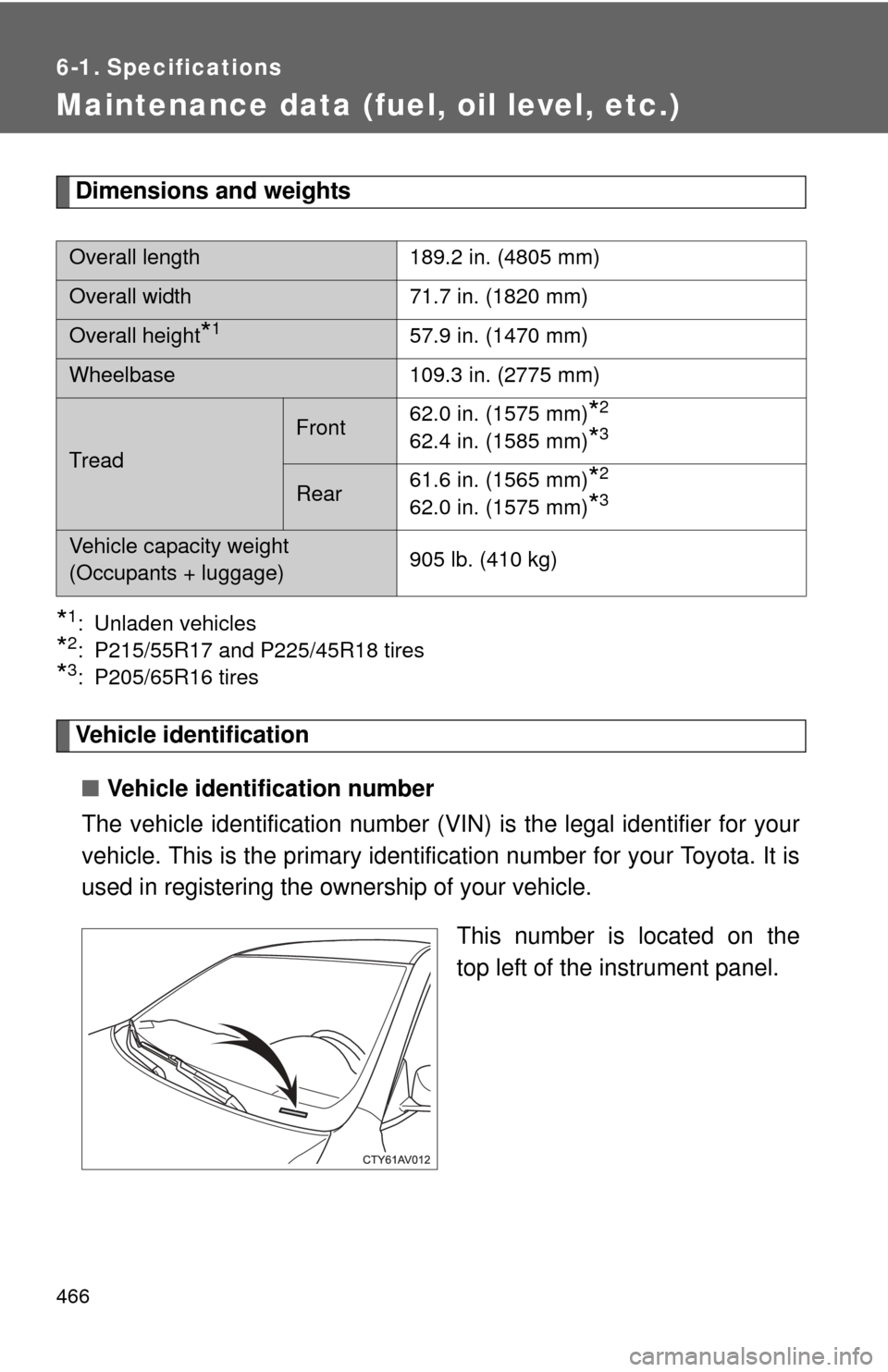
The vehicle identificati on number (VIN) is the legal identifier for your
vehicle. This is the primary identification number for your Toyota. It is
used in registering the ownership of your vehicle.
This number is located on the
top left of the instrument panel.
Overall length 189.2 in. (4805 mm)
Overall width71.7 in. (1820 mm)
Overall height*157.9 in. (1470 mm)
Wheelbase109.3 in. (2775 mm)
Tread
Front62.0 in. (1575 mm)*2
62.4 in. (1585 mm)*3
Rear61.6 in. (1565 mm)*2
62.0 in. (1575 mm)*3
Vehicle capacity weight
(Occupants + luggage) 905 lb. (410 kg)
Page 468 of 532
468 6-1. Specifications
Engine
Fuel
Model2AR-FE 2GR-FE
Ty p e4-cylinder in line,
4-cycle, gasoline 6-cylinder V type,
4-cycle, gasoline
Bore and stroke
3.54
3.86 in.
(90.0 98.0 mm) 3.70
3.27 in.
(94.0 83.0 mm)
Displacement 152.2 cu.in. (2494 cm3) 210.9 cu.in. (3456 cm3)
Drive belt tension Automatic adjustment
Valve clearance
(engine cold) Automatic adjustment
NOTICE
■
Drive belt type (2.5 L 4-cy linder [2AR-FE] engine only)
The high strength drive belt is used for the generator side drive belt.
When replacing the drive belt, use Toyota genuine drive belt or equivalent
high strength drive belt. If the high strength drive belt is not used, durability
of the belt may become less than expected. The high strength drive belt is a
belt with Aramid core which has higher strength compared to usually avail-
able belts with PET or PEN core.
Fuel type Unleaded gasoline only
Octane rating 87 (Research Octane Number 91) or higher
Fuel tank capacity
(Reference) 17.0 gal. (64.35 L, 14.2 Imp. gal.)
Page 469 of 532

469
6-1. Specifications
6
Vehicle specifications
Lubrication system
*: The engine oil capacity is a reference quantity to be used when changing the
engine oil. Warm up and turn off the engine, wait more than 5 minutes, and
check the oil level on the dipstick.
■Engine oil selection
“Toyota Genuine Motor Oil” is used in your Toyota vehicle. Use
Toyota approved “Toyota Genuine Motor Oil” or equivalent to satisfy
the following grade and viscosity.
Oil grade: ILSAC multigrade engine oil
Recommended viscosity: SAE 0W-20
SAE 0W-20 is the best choice for
good fuel economy and good
starting in cold weather.
If SAE 0W-20 is not available,
SAE 5W-20 oil may be used.
However, it must be replaced
with SAE 0W-20 at the next oil
change.
Oil capacity
(Drain and refill
refer-
ence*) With filter
Without filter 2.5 L 4-cylinder (2AR-FE) engine
4.6 qt. (4.4 L, 3.9 Imp. qt.)
3.5 L V6 (2GR-FE) engine
6.4 qt. (6.1 L, 5.4 Imp. qt.)
2.5 L 4-cylinder (2AR-FE) engine
4.2 qt. (4.0 L, 3.5 Imp. qt.)
3.5 L V6 (2GR-FE) engine
6.0 qt. (5.7 L, 5.0 Imp. qt.)
Outside temperature
Page 478 of 532
478
6-1. Specifications
Fuel infor mation
■Fuel tank opening fo r unleaded gasoline
To help prevent incorrect fueling, your vehicle has a fuel tank opening that
only accommodates the special nozzle on unleaded fuel pumps.
■ Gasoline quality
In very few cases, driveability problems may be caused by the brand of gas-
oline you are using. If driveability problems persist, try changing the brand of
gasoline. If this does not correct the problem, consult your Toyota dealer.
■ Gasoline quality standards
●Automotive manufacturers in the U.S.A., Europe and Japan have devel-
oped a specification for fuel quality called the World-Wide Fuel Charter
(WWFC), which is expected to be applied worldwide.
● The WWFC consists of four categories that are based on required emis-
sion levels. In the U.S., category 4 has been adopted.
● The WWFC improves air quality by lowering emissions in vehicle fleets,
and improves customer satisfaction through better performance.
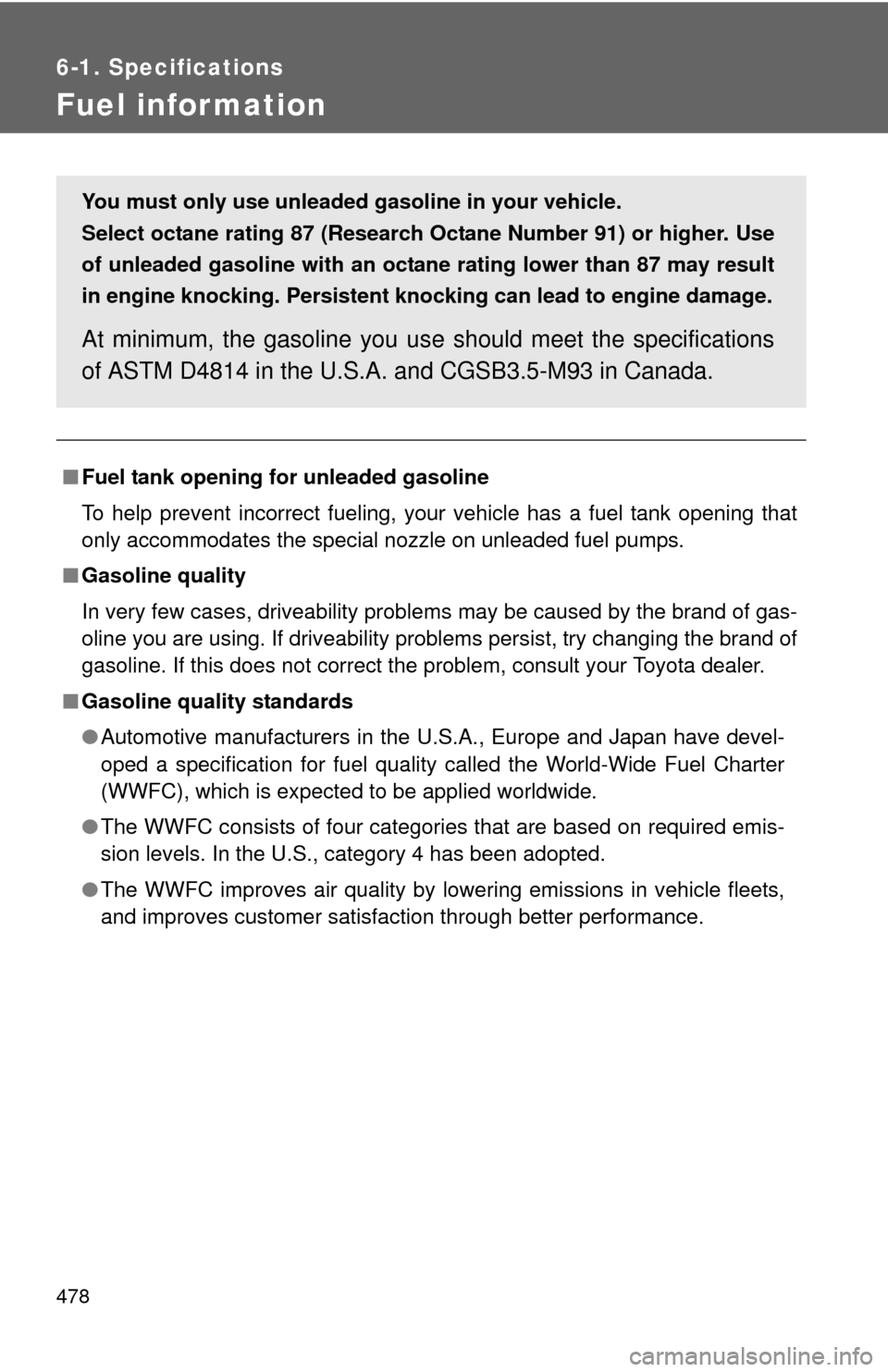
You must only use unleaded gasoline in your vehicle.
Select octane rating 87 (Research Octane Number 91) or higher. Use
of unleaded gasoline with an octane rating lower than 87 may result
in engine knocking. Persistent kno cking can lead to engine damage.
At minimum, the gasoline you use should meet the specifications
of ASTM D4814 in the U.S.A. and CGSB3.5-M93 in Canada.
Page 479 of 532
479
6-1. Specifications
6
Vehicle specifications
■
Recommendation of the use of gaso line containing detergent additives
● Toyota recommends the use of gasoline that contains detergent additives
to avoid the build-up of engine deposits.
● All gasoline sold in the U.S.A. contains detergent additives to clean and/
or keep clean intake systems.
■ Recommendation of the use of cleaner burning gasoline
Cleaner burning gasoline, including reformulated gasoline that contains oxy-
genates such as ethanol or MTBE (Methyl Tertiary Butyl Ether) is available in
many areas.
Toyota recommends the use of cleaner burning gasoline and appropriately
blended reformulated gasoline. These types of gasoline provide excellent
vehicle performance, reduce vehicle emissions and improve air quality.
■ Non-recommendation of the use of blended gasoline
●If you use gasohol in your vehicle, be sure that it has an octane rating no
lower than 87.
● Toyota does not recommend the use of gasoline containing methanol.
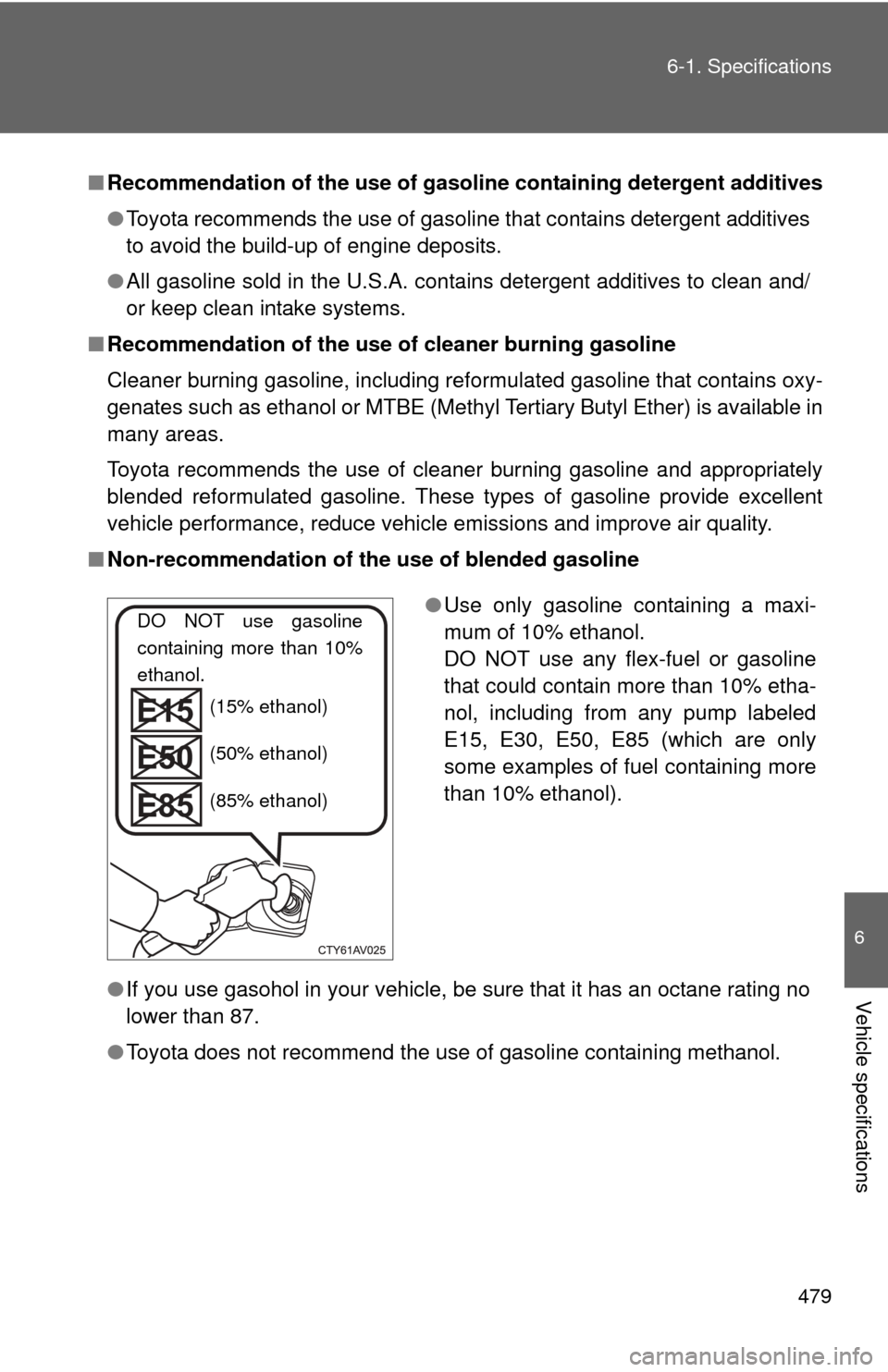
●Use only gasoline containing a maxi-
mum of 10% ethanol.
DO NOT use any flex-fuel or gasoline
that could contain more than 10% etha-
nol, including from any pump labeled
E15, E30, E50, E85 (which are only
some examples of fuel containing more
than 10% ethanol).DO NOT use gasoline
containing more than 10%
ethanol.
(15% ethanol)
(50% ethanol)
(85% ethanol)