Page 455 of 532
5
When trouble arises
455
5-2. Steps to take in an emergency
Start the engine of the second vehicle. Increase the engine
speed slightly and maintain at
that level for approximately 5
minutes to recharge the battery of your vehicle.
Vehicles with a smart key system: Open and close any of
the doors with the “ENGINE START STOP” switch off.
Vehicles without a smart key system: Maintain the engine
speed of the second vehicle and turn the engine switch to
the “ON” position, then start the vehicle's engine.
Vehicles with a smart key system: Maintain the engine
speed of the second vehicle and turn the “ENGINE START
STOP” switch to IGNITION ON mode, then start the vehi-
cle's engine.
Once the vehicle’s engine has started, remove the jumper
cables in the exact reverse or der from which they were con-
nected.
Once the engine starts, have the vehicle checked at your Toyota
dealer as soon as possible.STEP3
STEP4
STEP4STEP5
STEP6
Page 456 of 532

456 5-2. Steps to take in an emergency
■Starting the engine when the battery is discharged
The engine cannot be started by push-starting.
■ To prevent battery discharge
●Turn off the headlights and the audio system while the engine is off.
● Turn off any unnecessary electrical components when the vehicle is run-
ning at a low speed for an extended period, such as in heavy traffic.
■ Precautions when the battery is discharged (vehicles with a smart key
system)
●In some cases, it may not be possible to unlock the doors using the smart
key system when the battery is discharged. Use the wireless remote con-
trol or the mechanical key to lock or unlock the doors.
● The engine may not start on the first attempt after the battery has
recharged but will start normally after the second attempt. This is not a
malfunction.
● The “ENGINE START STOP” switch mode is memorized by the vehicle.
When the battery is reconnected, the system will return to the mode it
was in before the battery was discharged. Before disconnecting the bat-
tery, turn the “ENGINE START STOP” switch off.
If you are unsure what mode the “ENGINE START STOP” switch was in
before the battery discharged, be especially careful when reconnecting
the battery.
Page 459 of 532
5
When trouble arises
459
5-2. Steps to take in an emergency
If your vehicle overheats
If your engine overheats:
Stop the vehicle in a safe place and turn off the air condi-
tioning system.
Check to see if steam is coming out from under the hood.
If you see steam:
Stop the engine. Carefully lift the hood after the steam sub-
sides and then restart the engine.
If you do not see steam:
Leave the engine running and carefully lift the hood.
Check to see if the cooling fans are operating.
If the fans are operating:
Wait until the high engine coolant temperature warning light
goes off and then stop the engine.
If the fans are not operating:
Stop the engine immediately and call your Toyota dealer.
After the engine has cooled
down sufficiently, check the
engine coolant level and
inspect the radiator core (radi-
ator) for any leaks.STEP1
STEP2
STEP3
STEP5STEP4
Page 462 of 532

462
5-2. Steps to take in an emergency
If the vehicle becomes stuck
CAUTION
■When attempting to free a stuck vehicle
If you choose to push the vehicle back and forth to free it, make sure the sur-
rounding area is clear to avoid striking other vehicles, objects or people. The
vehicle may also lunge forward or lunge back suddenly as it becomes free.
Use extreme caution.
■ When shifting the shift lever
Be careful not to shift the shift lever with the accelerator pedal depressed.
This may lead to unexpected rapid acceleration of the vehicle that may
cause an accident resulting in death or serious injury.
NOTICE
■To avoid damage to the transmission and other components
●Avoid spinning the wheels and depressing the accelerator pedal more
than necessary.
● If the vehicle remains stuck even after these procedures are performed,
the vehicle may require towing to be freed.
Carry out the following procedures if the tires spin or the vehicle
becomes stuck in mud, dirt or snow:
Stop the engine. Set the parki ng brake and shift the shift
lever to P.
Remove the mud, snow or sand from around the stuck tire.
Place wood, stones or some other material under the tires
to help provide traction.
Restart the engine.
Shift the shift lever to the D or R position and carefully apply
the accelerator to free the vehicle.
Turn off TRAC and VSC if these functions are hampering your
attempts to free the vehicle. ( P. 204)
STEP1
STEP2
STEP3
STEP4
STEP5
Page 464 of 532
464 5-2. Steps to take in an emergency
CAUTION
■If the engine has to be turned off while driving
●Power assist for the brakes and steering wheel will be lost, making the
brake pedal harder to depress and the steering wheel heavier to turn.
Decelerate as much as possible before turning off the engine.
● Vehicles without a smart key system: Never attempt to remove the key, as
doing so will lock the steering wheel.
Vehicles with a smart key sys-
tem: To stop the engine, press
and hold the “ENGINE START
STOP” switch for 2 consecu-
tive seconds or more, or press
it briefly 3 times or more in
succession.
Stop the vehicle in a safe place by the road.STEP4
Press and hold for 2 seconds or more,
or press briefly 3 times or more
STEP5
Page 469 of 532

469
6-1. Specifications
6
Vehicle specifications
Lubrication system
*: The engine oil capacity is a reference quantity to be used when changing the
engine oil. Warm up and turn off the engine, wait more than 5 minutes, and
check the oil level on the dipstick.
■Engine oil selection
“Toyota Genuine Motor Oil” is used in your Toyota vehicle. Use
Toyota approved “Toyota Genuine Motor Oil” or equivalent to satisfy
the following grade and viscosity.
Oil grade: ILSAC multigrade engine oil
Recommended viscosity: SAE 0W-20
SAE 0W-20 is the best choice for
good fuel economy and good
starting in cold weather.
If SAE 0W-20 is not available,
SAE 5W-20 oil may be used.
However, it must be replaced
with SAE 0W-20 at the next oil
change.
Oil capacity
(Drain and refill
refer-
ence*) With filter
Without filter 2.5 L 4-cylinder (2AR-FE) engine
4.6 qt. (4.4 L, 3.9 Imp. qt.)
3.5 L V6 (2GR-FE) engine
6.4 qt. (6.1 L, 5.4 Imp. qt.)
2.5 L 4-cylinder (2AR-FE) engine
4.2 qt. (4.0 L, 3.5 Imp. qt.)
3.5 L V6 (2GR-FE) engine
6.0 qt. (5.7 L, 5.0 Imp. qt.)
Outside temperature
Page 470 of 532
470 6-1. Specifications
Oil viscosity (0W-20 is explained here as an example):
• The 0W in 0W-20 indicates the characteristic of the oil which allowscold startability. Oils with a lower value before the W allow for easier
starting of the engine in cold weather.
• The 20 in 0W-20 indicates the viscosity characteristic of the oil when the oil is at high temperature. An oil with a higher viscosity (one with a
higher value) may be better suited if the vehicle is operated at high
speeds, or under extreme load conditions.
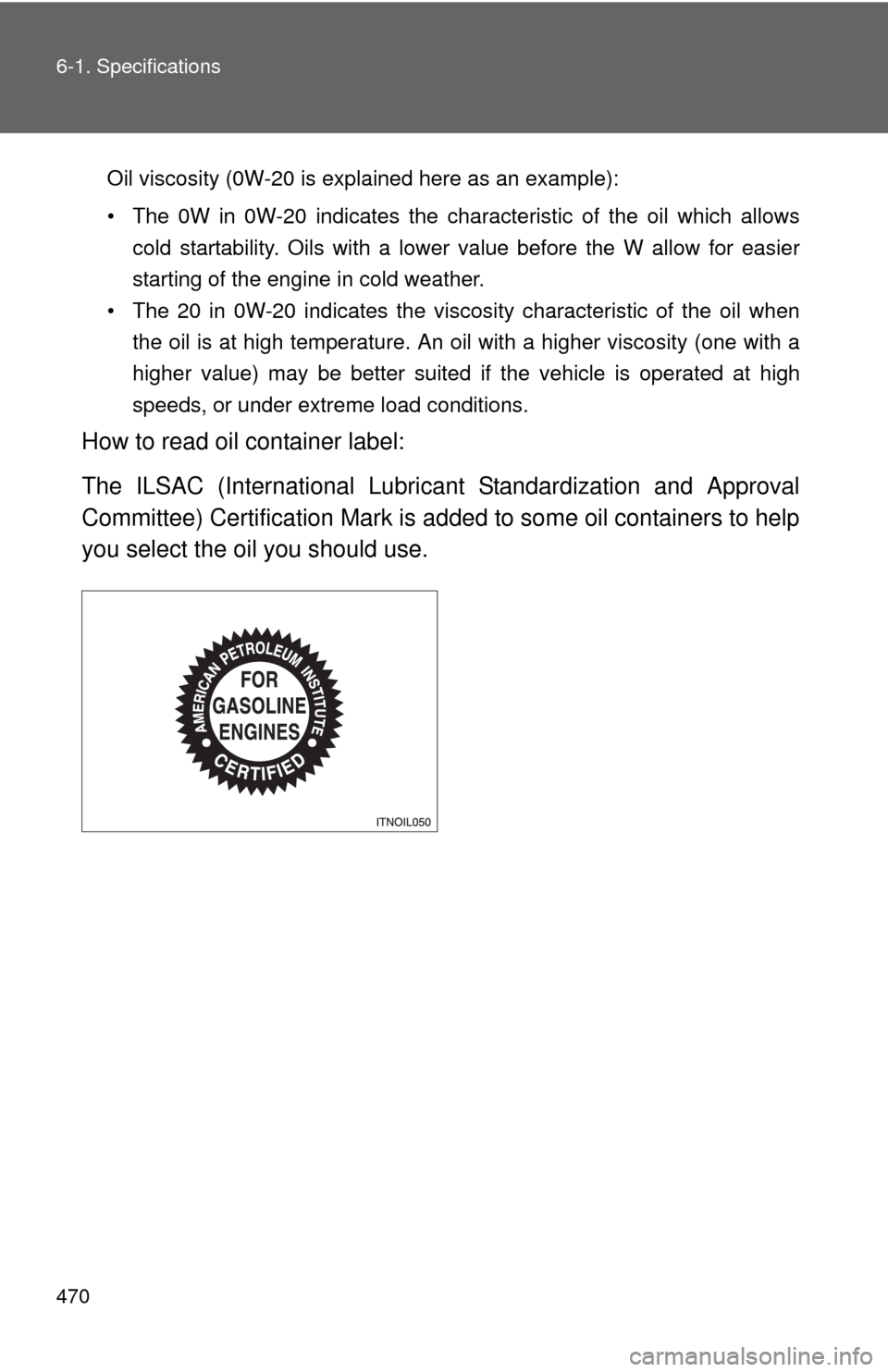
How to read oil container label:
The ILSAC (International Lubricant Standardization and Approval
Committee) Certification Mark is added to some oil containers to help
you select the oil you should use.
Page 480 of 532

480 6-1. Specifications
■Non-recommendation of the use of gasoline containing MMT
Some gasoline contains an octane enhancing additive called MMT (Methyl-
cyclopentadienyl Manganese Tricarbonyl).
Toyota does not recommend the use of gasoline that contains MMT. If fuel
containing MMT is used, your emission control system may be adversely
affected.
The malfunction indicator lamp on the instrument cluster may come on. If
this happens, contact your Toyota dealer for service.
■ If your engine knocks
●Consult your Toyota dealer.
● You may occasionally notice light knocking for a short time while acceler-
ating or driving uphill. This is normal and there is no need for concern.
NOTICE
■Notice on fuel quality
●Do not use improper fuels. If improper fuels are used, the engine will be
damaged.
● Do not use leaded gasoline.
Leaded gasoline can cause damage to your vehicle’s three-way catalytic
converters causing the emission control system to malfunction.
● Do not use gasohol other than the type previously stated.
Other gasohol may cause fuel system damage or vehicle performance
problems.
● Using unleaded gasoline with an octane number or rating lower than the
level previously stated will cause persistent heavy knocking.
At worst, this will lead to engine damage.
■ Fuel-related poor driveability
If poor driveability is encountered after using a different type of fuel (poor hot
starting, vaporization, engine knocking, etc.), discontinue the use of that type
of fuel.
■ When refueling with gasohol
Take care not to spill gasohol. It can damage your vehicle's paint.