Page 48 of 772
48 1-2. Opening, closing and locking the doors
AVENSIS_EE (OM20B44E)
It may not be possible to lock the doors if the sensor area is covered by
mud, ice, snow etc. In this event, try locking again after cleaning the
area, or lock by touching the sensor area on the underside of the door
handle.
Gripping the door handle when wearing a glove may not unlock or lock
the door.
If the wireless remote control is used to lock the doors when the elec-
tronic key is near the vehicle, there is a possibility that the door may not
be unlocked by the smart entry & start system. (Use the wireless remote
control to unlock the doors.)
A sudden approach to the effective range or door handle operation may
prevent the doors from being unlocked. In this case, return the door han-
dle to the original position and check that the doors unlock before pulling
the door handle again.
When the vehicle is not driven for extended periods
To prevent theft of the vehicle, do not leave the electronic key within 2 m (6
ft.) of the vehicle.
Security feature
If a door is not opened within approximately 30 seconds after the vehicle is
unlocked, the security feature automatically locks the vehicle again.
Alarms and warning indicators
A combination of exterior and interior alarms are used to prevent theft of the
vehicle and unforeseeable accidents resulting from erroneous operation.
Take appropriate measures according to the warning message shown on the
multi-information display. (P. 624)
The following table describes circumstances and correction procedures
when only alarms are sounded.
Page 90 of 772
90 1-2. Opening, closing and locking the doors
AVENSIS_EE (OM20B44E)
CAUTION
When children are in the vehicle
Observe the following precautions.
Failure to do so may result in death or serious injury.
Do not allow children to enter the trunk.
If a child is accidentally locked in the trunk, they could have heat exhaus-
tion or suffocate.
Do not allow a child to open or close the trunk lid.
Doing so may cause the trunk lid operate unexpectedly, or cause the
child’s hands, head, or neck to be caught by the closing trunk lid.
Using the trunk
Observe the following precautions.
Failure to do so may cause parts of the body to be caught, resulting in seri-
ous injury.
Remove any heavy loads, such as snow and ice, from the trunk lid before
opening it. Failure to do so may cause the trunk lid to fall closed again
after it is opened.
When opening or closing the trunk lid, thoroughly check to make sure the
surrounding area is safe.
If anyone is in the vicinity, make sure they are safe and let them know that
the trunk is about to open or close.
Use caution when opening or closing the trunk lid in windy weather as it
may move abruptly in strong wind.
Page 95 of 772
95 1-2. Opening, closing and locking the doors
1
Before driving
AVENSIS_EE (OM20B44E)
CAUTION
When children are in the vehicle
Observe the following precautions.
Failure to do so may result in death or serious injury.
Do not leave children alone in the luggage compartment.
If a child is accidentally locked in the luggage compartment, they could
have heat exhaustion.
Do not allow a child to open or close the back door.
Doing so may cause the back door to move unexpectedly, or cause the
child’s hands, head, or neck to be caught by the closing back door.
Operating the back door
Observe the following precautions.
Failure to do so may cause parts of the body to be caught, resulting in death
or serious injury.
Remove any heavy loads, such as snow and ice, from the back door
before opening it. Failure to do so may cause the back door to fall closed
again after it is opened.
When opening or closing the back door, thoroughly check to make sure
the surrounding area is safe.
If anyone is in the vicinity, make sure they are safe and let them know that
the back door is about to open or close.
Use caution when opening or closing the back door in windy weather as it
may move abruptly in strong wind.
Page 151 of 772
151 1-6. Theft deterrent system
1
Before driving
AVENSIS_EE (OM20B44E)
Unstable items, such as dangling accessories or clothes hanging on the
coat hooks, are in the vehicle.
A window is open.
The vehicle is inside an automatic or high-pressure car washer.
The vehicle experiences impacts, such as hail, lightning strikes, or other
kinds of repeated impacts or vibrations.
The vehicle is parked in a place where
extreme vibrations or noises occur,
such as in a parking garage.
Ice or snow is removed from the vehi-
cle, causing the vehicle to receive
repeated impacts or vibrations.
The wind or something similar causes a
frost cover to move.
Page 167 of 772
167 1-7. Safety information
1
Before driving
AVENSIS_EE (OM20B44E)
CAUTION
SRS airbag precautions
If breathing becomes difficult after the SRS airbag has deployed, open a
door or window to allow fresh air in, or leave the vehicle if it is safe to do
so. Wash off any residue as soon as possible to prevent skin irritation.
If the areas where the SRS airbags are stored, such as the steering wheel
pad and front and rear pillar garnishes, are damaged or cracked, have
them replaced by any authorized Toyota dealer or repairer, or another duly
qualified and equipped professional.
Modification and disposal of SRS airbag system components
Do not dispose of your vehicle or perform any of the following modifications
without consulting any authorized Toyota dealer or repairer, or another duly
qualified and equipped professional.
The SRS airbags may malfunction or deploy (inflate) accidentally, causing
death or serious injury.
Installation, removal, disassembly and repair of the SRS airbags.
Repairs, modifications, removal or replacement of the steering wheel,
instrument panel, dashboard, seats or seat upholstery, front, center and
rear pillars or roof side rail.
Repairs or modifications of the front fender, front bumper, or side of the
occupant compartment.
Installation of snow plows, winches, etc. to the front grille (bull bars, kan-
garoo bar etc.).
Modifications to the vehicle’s suspension system.
Installation of electronic devices such as RF-transmitter radios or CD play-
ers.
Page 204 of 772
204 2-1. Driving procedures
AVENSIS_EE (OM20B44E)
CAUTION
When the vehicle is parked
Do not leave glasses, cigarette lighters, spray cans, or soft drink cans in
the vehicle when it is in the sun.
Doing so may result in the following:
• Gas may leak from a cigarette lighter or spray can, and may lead to a
fire.
• The temperature inside the vehicle may cause the plastic lenses and
plastic material of eye glasses to deform or crack.
• Soft drink cans may fracture, causing the contents to spray over the
interior of the vehicle, and may also cause a short circuit in the vehi-
cle’s electrical components.
Always apply the parking brake, shift the shift lever to “P” (vehicles with a
Multidrive or automatic transmission), stop the engine and lock the vehi-
cle.
Do not leave the vehicle unattended while the engine is running.
Do not touch the exhaust pipe while the engine is running or immediately
after turning the engine off.
Doing so may cause burns.
Do not leave the engine running in an area with snow build up, or where it
is snowing. If snowbanks build up around the vehicle while the engine is
running, exhaust gases may collect and enter the vehicle. This may lead
to death or a serious health hazard.
Page 280 of 772
280 2-4. Using other driving systems
AVENSIS_EE (OM20B44E)
CAUTION
To avoid operating the cruise control by mistake
Switch the cruise control off using the “ON-OFF” button when not in use.
Situations unsuitable for cruise control
Do not use cruise control in any of the following situations.
Doing so may result in loss of control and could cause an accident resulting
in death or serious injury.
In heavy traffic
On roads with sharp bends
On winding roads
On slippery roads, such as those covered with rain, ice or snow
On steep hills
Vehicle speed may exceed the set speed when driving down a steep hill.
When your vehicle is towing a trailer or during emergency towing
Page 293 of 772
293 2-4. Using other driving systems
2
When driving
AVENSIS_EE (OM20B44E)
Automatic cancelation of constant speed control
The cruise control will stop maintaining the vehicle speed in the following sit-
uations:
Actual vehicle speed is more than approximately 16 km/h (10 mph)
below the set vehicle speed.
At this time, the memorized set speed is not retained.
Actual vehicle speed falls below approximately 40 km/h (25 mph).
VSC is activated.
Speed limiter is activated. (if equipped)
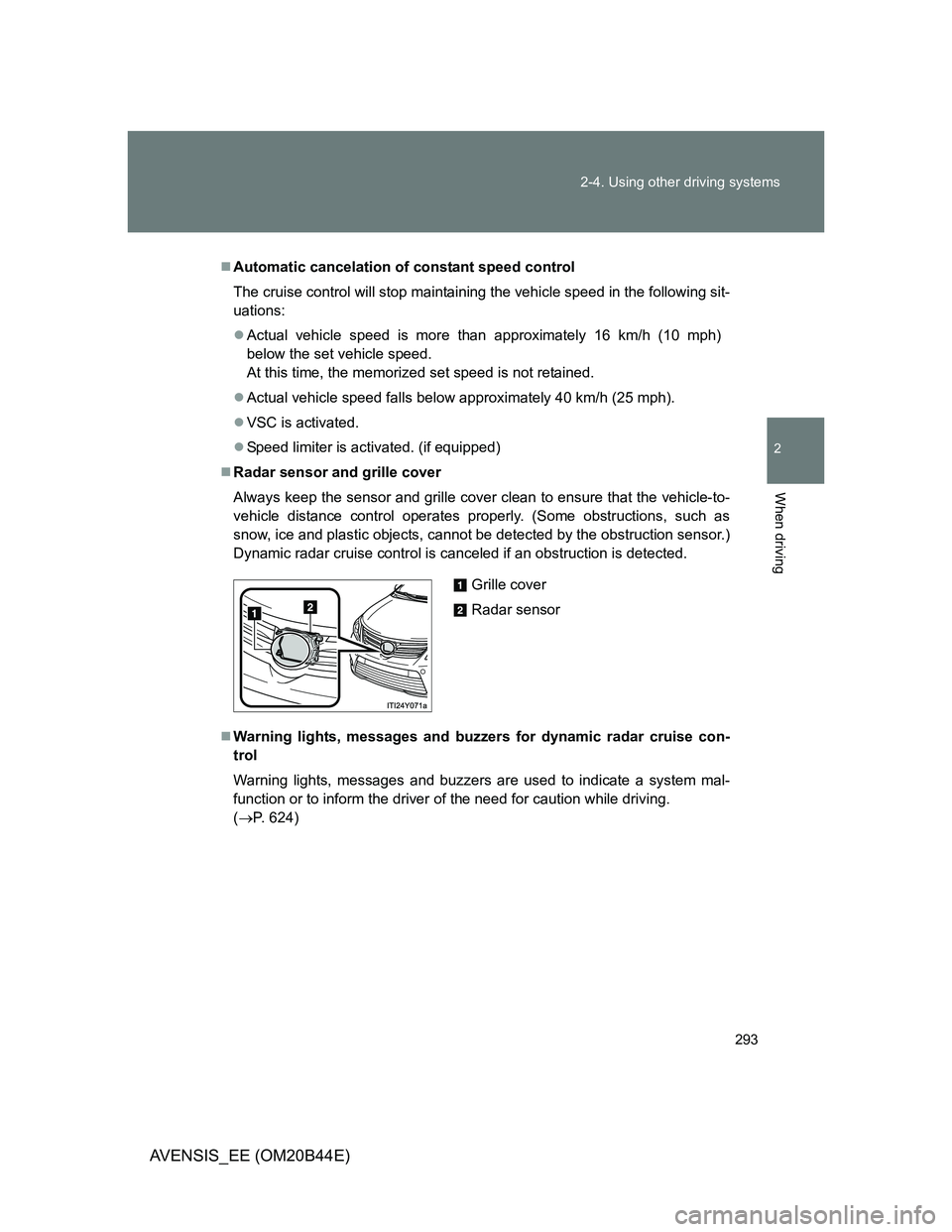
Radar sensor and grille cover
Always keep the sensor and grille cover clean to ensure that the vehicle-to-
vehicle distance control operates properly. (Some obstructions, such as
snow, ice and plastic objects, cannot be detected by the obstruction sensor.)
Dynamic radar cruise control is canceled if an obstruction is detected.
Warning lights, messages and buzzers for dynamic radar cruise con-
trol
Warning lights, messages and buzzers are used to indicate a system mal-
function or to inform the driver of the need for caution while driving.
(P. 624)
Grille cover
Radar sensor