Page 325 of 772
325 2-4. Using other driving systems
2
When driving
AVENSIS_EE (OM20B44E)
NOTICE
In the following situations, the LKA will not work, or will not perform
reliably
When lane markers are interrupted or are not present, such as before a
tollbooth.
When lane markers are only on one side of the road.
When driving on a sharp curve.
When lanes are extremely narrow or extremely wide.
When the vehicle leans to one side an unusual amount due to a heavy
load or improper tire inflation pressure.
When the following distance between your vehicle and the vehicle ahead
is extremely short.
When the lane markers are broken or “Raised pavement marker”.
When lane markers are obscured or partially obscured by sand, dirt, etc.
When driving on a particularly bright road surface, such as concrete.
When driving on a road surface that is bright due to reflected light.
When driving in a location where the light level changes rapidly, such as
the entrance to or exit from a tunnel.
When sunlight or the headlights of oncoming vehicles are shining directly
into the camera lens.
When driving on roads that are branching or merging.
When pavement lane markers are difficult to see due to rain, snow, fog,
etc.
When driving on a road surface that is wet due to rain, previous rainfall,
standing water, etc.
When the vehicle experiences strong up-and-down motion such as when
driving on an extremely rough road or on a seam in the pavement.
When headlight brightness is reduced due to dirt on the lenses, or when
the headlights are misaligned.
When driving with a strong crosswind.
Page 326 of 772
326 2-4. Using other driving systems
AVENSIS_EE (OM20B44E)
NOTICE
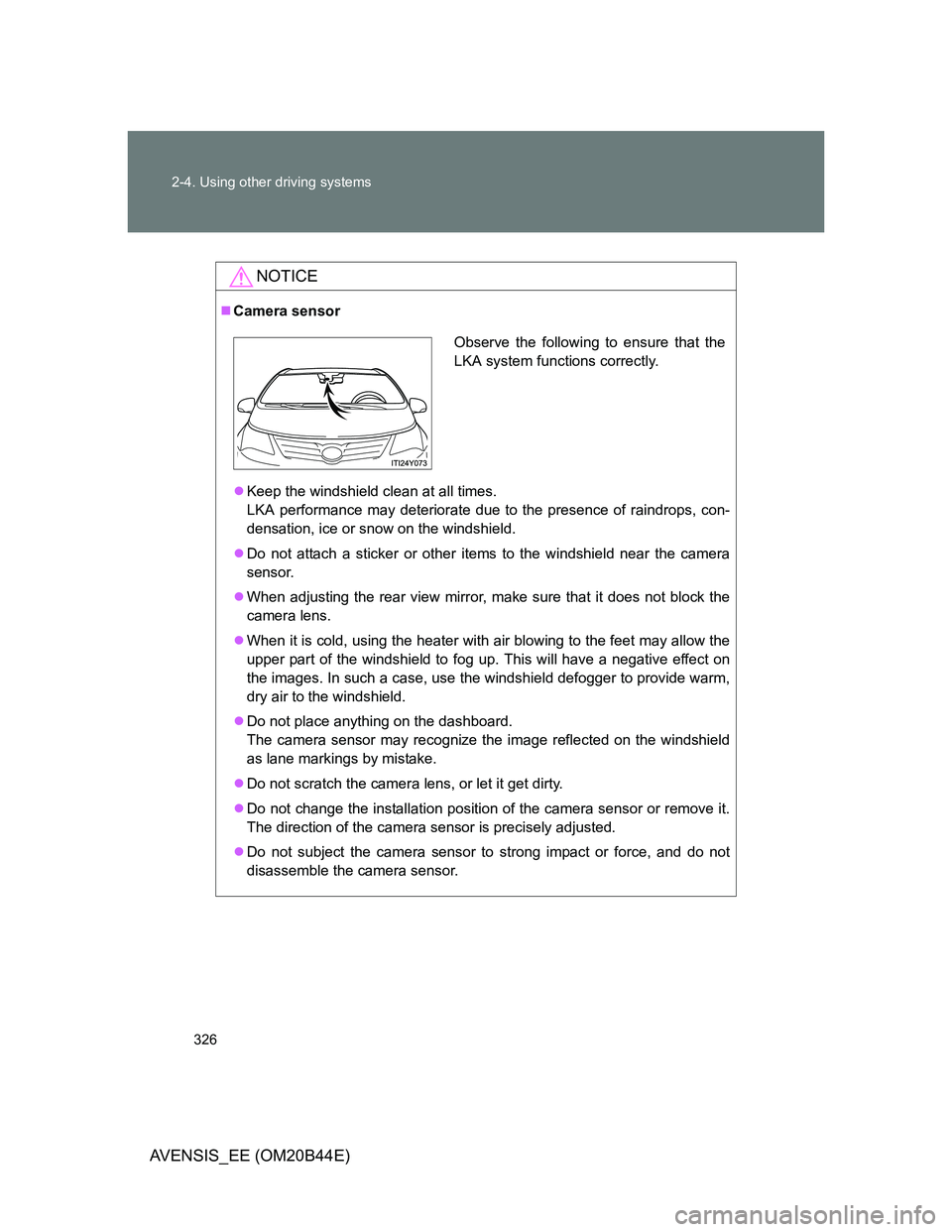
Camera sensor
Keep the windshield clean at all times.
LKA performance may deteriorate due to the presence of raindrops, con-
densation, ice or snow on the windshield.
Do not attach a sticker or other items to the windshield near the camera
sensor.
When adjusting the rear view mirror, make sure that it does not block the
camera lens.
When it is cold, using the heater with air blowing to the feet may allow the
upper part of the windshield to fog up. This will have a negative effect on
the images. In such a case, use the windshield defogger to provide warm,
dry air to the windshield.
Do not place anything on the dashboard.
The camera sensor may recognize the image reflected on the windshield
as lane markings by mistake.
Do not scratch the camera lens, or let it get dirty.
Do not change the installation position of the camera sensor or remove it.
The direction of the camera sensor is precisely adjusted.
Do not subject the camera sensor to strong impact or force, and do not
disassemble the camera sensor.
Observe the following to ensure that the
LKA system functions correctly.
Page 328 of 772
328 2-4. Using other driving systems
AVENSIS_EE (OM20B44E)
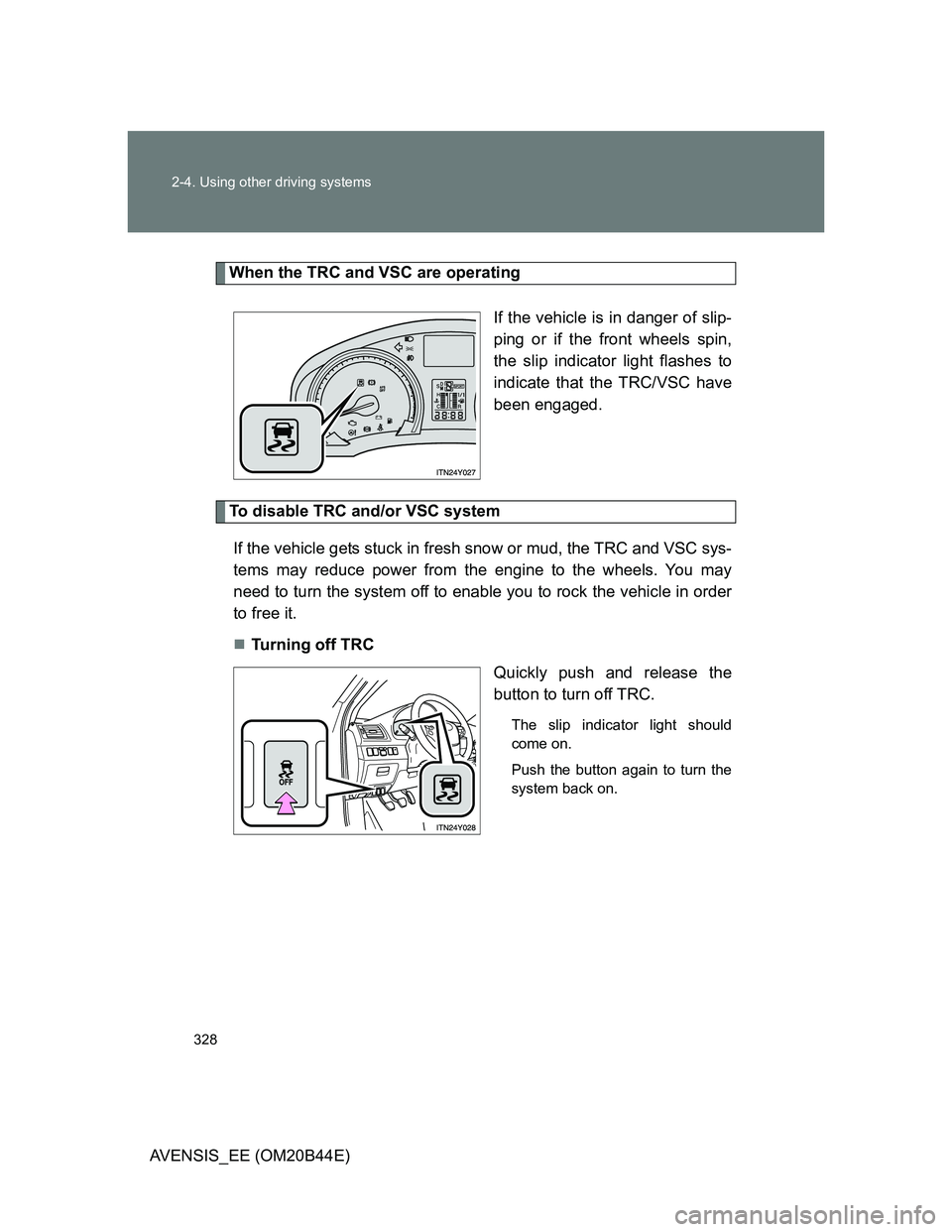
When the TRC and VSC are operating
If the vehicle is in danger of slip-
ping or if the front wheels spin,
the slip indicator light flashes to
indicate that the TRC/VSC have
been engaged.
To disable TRC and/or VSC system
If the vehicle gets stuck in fresh snow or mud, the TRC and VSC sys-
tems may reduce power from the engine to the wheels. You may
need to turn the system off to enable you to rock the vehicle in order
to free it.
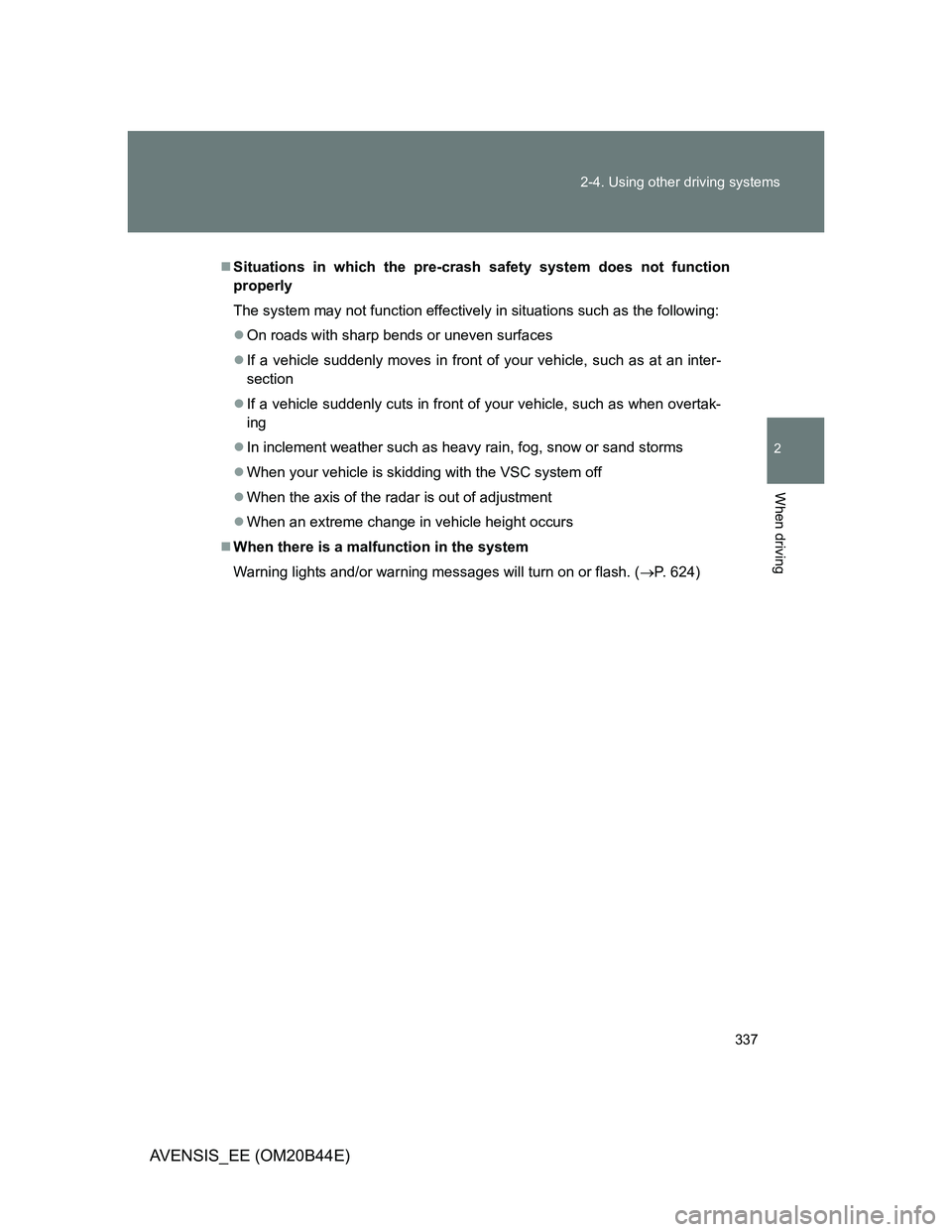
Turning off TRC
Quickly push and release the
button to turn off TRC.
The slip indicator light should
come on.
Push the button again to turn the
system back on.
Page 331 of 772
331 2-4. Using other driving systems
2
When driving
AVENSIS_EE (OM20B44E)
CAUTION
Any of the following conditions may result in an accident which could cause
death or serious injury:
The ABS does not operate effectively when
The limits of tire gripping performance have been exceeded.
The vehicle hydroplanes while driving at high speed on a wet or slick road.
Stopping distance when the ABS is operating may exceed that of nor-
mal conditions
The ABS is not designed to shorten the vehicle’s stopping distance. Always
maintain a safe distance from the vehicle in front of you in the following situ-
ations:
When driving on dirt, gravel or snow-covered roads
When driving with tire chains
When driving over bumps in the road
When driving over roads with potholes or roads with uneven roads
TRC may not operate effectively when
Directional control and power may not be achievable while driving on slip-
pery road surfaces, even if the TRC is operating.
Do not drive the vehicle in conditions where stability and power may be lost.
When the VSC is activated
The slip indicator light flashes. Always drive carefully.
Reckless driving may cause an accident. Exercise particular care when the
indicator light flashes.
Page 335 of 772
335 2-4. Using other driving systems
2
When driving
AVENSIS_EE (OM20B44E)
Obstacles not detected
The sensor cannot detect plastic obstacles such as pylons. There may also
be occasions when the radar sensor cannot detect pedestrians, animals,
bicycles, motorcycles, trees, or snowdrifts.
The pre-crash safety is operational when
Pre-crash seat belts (Type A):
• Vehicle speed is greater than about 30 km/h (19 mph).
• The system detects sudden braking or skidding.
• The front occupants are wearing a seat belt.
Pre-crash seat belts (Type B):
• Vehicle speed is above 5 km/h (4 mph).
• The relative speed difference between your vehicle and another vehi-
cle that is ahead of your vehicle, or the speed at which your vehicle is
approaching an obstacle is greater than 30 km/h (19 mph).
• The front occupants are wearing a seat belt.
Pre-crash brake assist:
• Vehicle speed is above 30 km/h (19 mph).
• The relative speed difference between your vehicle and another vehi-
cle that is ahead of your vehicle, or the speed at which your vehicle is
approaching an obstacle is greater than 30 km/h (19 mph).
• The brake pedal is depressed.
Pre-crash braking:
• The pre-crash braking OFF switch is not pressed.
• Vehicle speed is above 15 km/h (10 mph).
• The relative speed difference between your vehicle and another vehi-
cle that is ahead of your vehicle, or the speed at which your vehicle is
approaching an obstacle is greater than 15 km/h (10 mph).
Page 337 of 772
337 2-4. Using other driving systems
2
When driving
AVENSIS_EE (OM20B44E)
Situations in which the pre-crash safety system does not function
properly
The system may not function effectively in situations such as the following:
On roads with sharp bends or uneven surfaces
If a vehicle suddenly moves in front of your vehicle, such as at an inter-
section
If a vehicle suddenly cuts in front of your vehicle, such as when overtak-
ing
In inclement weather such as heavy rain, fog, snow or sand storms
When your vehicle is skidding with the VSC system off
When the axis of the radar is out of adjustment
When an extreme change in vehicle height occurs
When there is a malfunction in the system
Warning lights and/or warning messages will turn on or flash. (P. 624)
Page 344 of 772
344
2-5. Driving information
AVENSIS_EE (OM20B44E)
Winter driving tips
Carry out the necessary preparations and inspections before driving
the vehicle in winter. Always drive the vehicle in a manner appropri-
ate to the prevailing weather conditions.
Pre-winter preparations
Use fluids that are appropriate to the prevailing outside tem-
peratures.
• Engine oil
• Engine coolant
• Washer fluid
Have a service technician inspect the level and specific grav-
ity of battery electrolyte.
Have the vehicle fitted with four snow tires or purchase a set
of tire chains for the front tires.
Ensure that all tires are the same size and brand, and that chains
match the size of the tires.
Page 345 of 772
345 2-5. Driving information
2
When driving
AVENSIS_EE (OM20B44E)
Before driving the vehicle
Perform the following according to the driving conditions.
Do not try to forcibly open a window or move a wiper that is
frozen. Pour warm water over the frozen area to melt the ice.
Wipe away the water immediately to prevent it from freezing.
To ensure proper operation of the climate control system fan,
remove any snow that has accumulated on the air inlet vents
in front of the windshield.
Remove any ice that has accumulated on the vehicle chassis.
Periodically check for and remove any excess ice or snow
that may have accumulated in the wheel well or on the
brakes.
When driving the vehicle
Accelerate the vehicle slowly and drive at a reduced speed suit-
able to road conditions.
When parking the vehicle
Park the vehicle and move the shift lever to “P” (Multidrive or
automatic transmission) or “R” (manual transmission) without
setting the parking brake. The parking brake may freeze up, pre-
venting it from being released. If necessary, block the wheels to
prevent inadvertent sliding or creeping.