Page 312 of 580
312 3-4. Using the hands-free system (for cellular phone)
■Steering wheel
Vo l u m e
The voice guidance volume
cannot be adjusted by using
this button.
On-hook switch
Turns the hands-free system
off/ends a call/refuses a call
Off-hook switch
Turns the hands-free system
on/starts a call
Talk switch
Turns the voice command sys-
tem on (press)/turns the voice
command system off (press
and hold)
■Microphone
Page 395 of 580
395
4-2. Maintenance
4
Maintenance and care
General maintenance
Engine compartment
ItemsCheck points
Battery • Maintenance-free ( P. 417)
Brake fluid • At the correct level? ( P. 414)
Engine coolant • At the correct level? ( P. 412)
Engine oil • At the correct level? ( P. 408)
Exhaust system • No fumes or strange sounds?
Power steering fluid • At the correct level? ( P. 415)
Radiator/condenser/hoses • Not blocked with foreign matter?
(P. 413)
Washer fluid • At the correct level? ( P. 420)
Listed below are the general maintenance items that should be per-
formed at the intervals specified in the “Scheduled Maintenance
Guide” or “Owner’s Manual Supp lement”. It is recommended that
any problem you notice should be brought to the attention of your
Toyota dealer or qualified service shop for advice.
Page 396 of 580
396 4-2. Maintenance
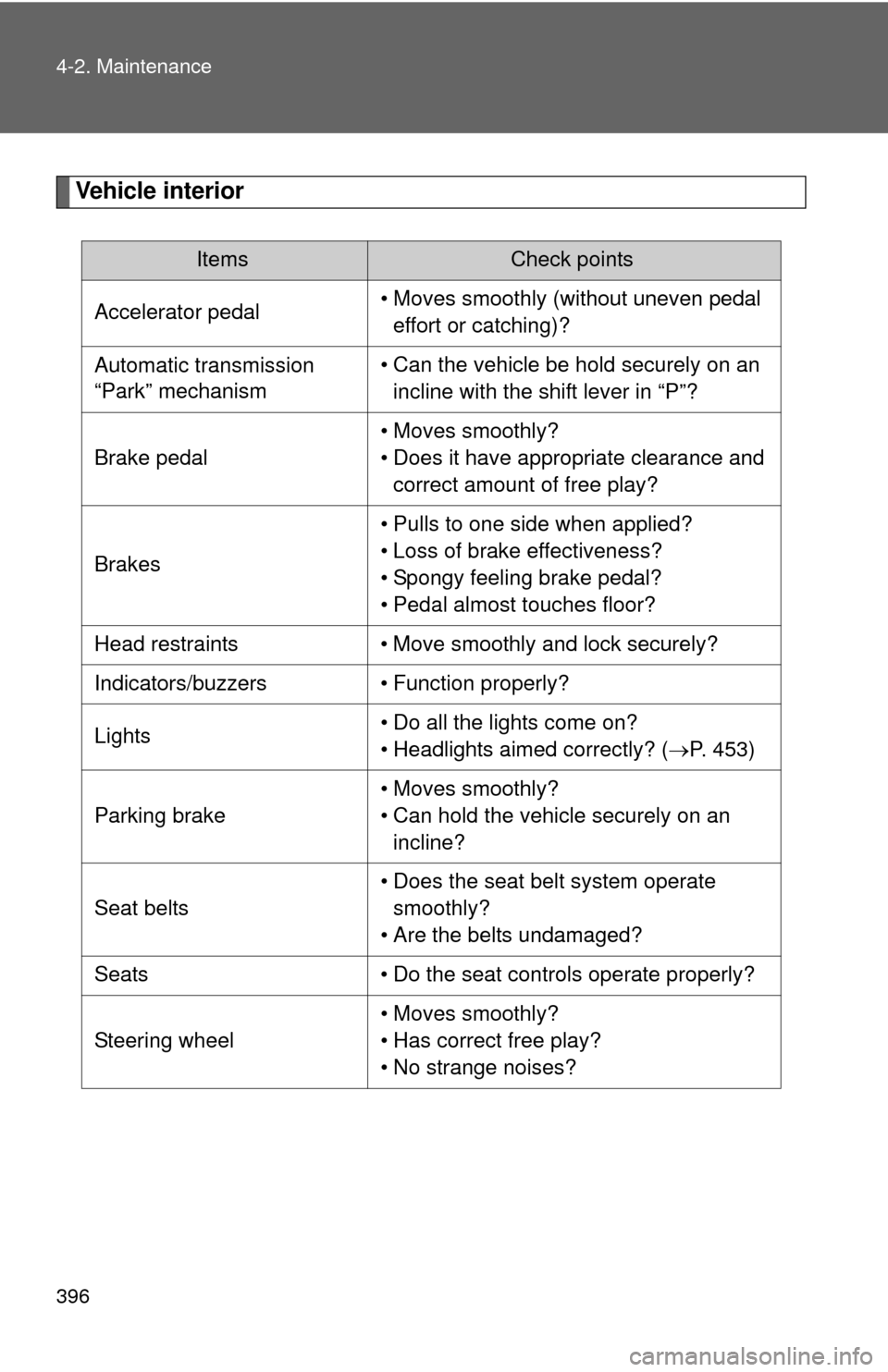
Vehicle interior
ItemsCheck points
Accelerator pedal • Moves smoothly (without uneven pedal
effort or catching)?
Automatic transmission
“Park” mechanism • Can the vehicle be hold securely on an
incline with the shift lever in “P”?
Brake pedal • Moves smoothly?
• Does it have appropriate clearance and
correct amount of free play?
Brakes • Pulls to one side when applied?
• Loss of brake effectiveness?
• Spongy feeling brake pedal?
• Pedal almost touches floor?
Head restraints • Move smoothly and lock securely?
Indicators/buzzers • Function properly?
Lights • Do all the lights come on?
• Headlights aimed correctly? (
P. 453)
Parking brake • Moves smoothly?
• Can hold the vehicle securely on an
incline?
Seat belts • Does the seat belt system operate
smoothly?
• Are the belts undamaged?
Seats • Do the seat controls operate properly?
Steering wheel • Moves smoothly?
• Has correct free play?
• No strange noises?
Page 400 of 580
400 4-3. Do-it-yourself maintenance
ItemsParts and tools
Engine oil level (P. 408)
• “Toyota Genuine Motor Oil” or
equivalent
• Rag or paper towel, funnel (used only for adding engine oil)
Fuses (P. 444)• Fuse with same amperage rating
as original
Headlight aim ( P. 453)• Phillips-head screwdriver
Power steering fluid level
(P. 415)
• Automatic transmission fluid
DEXRON® II or III
• Rag or paper towel
• Clean funnel
Radiator and condenser (P. 413)
Tire inflation pressure ( P. 430)• Tire pressure gauge
• Compressed air source
Washer fluid (P. 420)
• Water washer fluid containing anti-
freeze (for winter use)
• Funnel
Page 406 of 580
406
4-3. Do-it-yourself maintenance
Engine compar tment
Engine coolant reservoir( P. 412)
Power steering fluid
reservoir ( P. 415)
Engine oil filler cap ( P. 409)
Engine oil level dipstick ( P. 408)Brake fluid reservoir
( P. 414)
Fuse box ( P. 444)
Battery ( P. 417)
Radiator ( P. 413)
Electric cooling fans
Condenser ( P. 413)
Washer fluid tank ( P. 420)
Page 415 of 580
4
Maintenance and care
415
4-3. Do-it-yourself maintenance
Power steering fluid
■ Fluid level
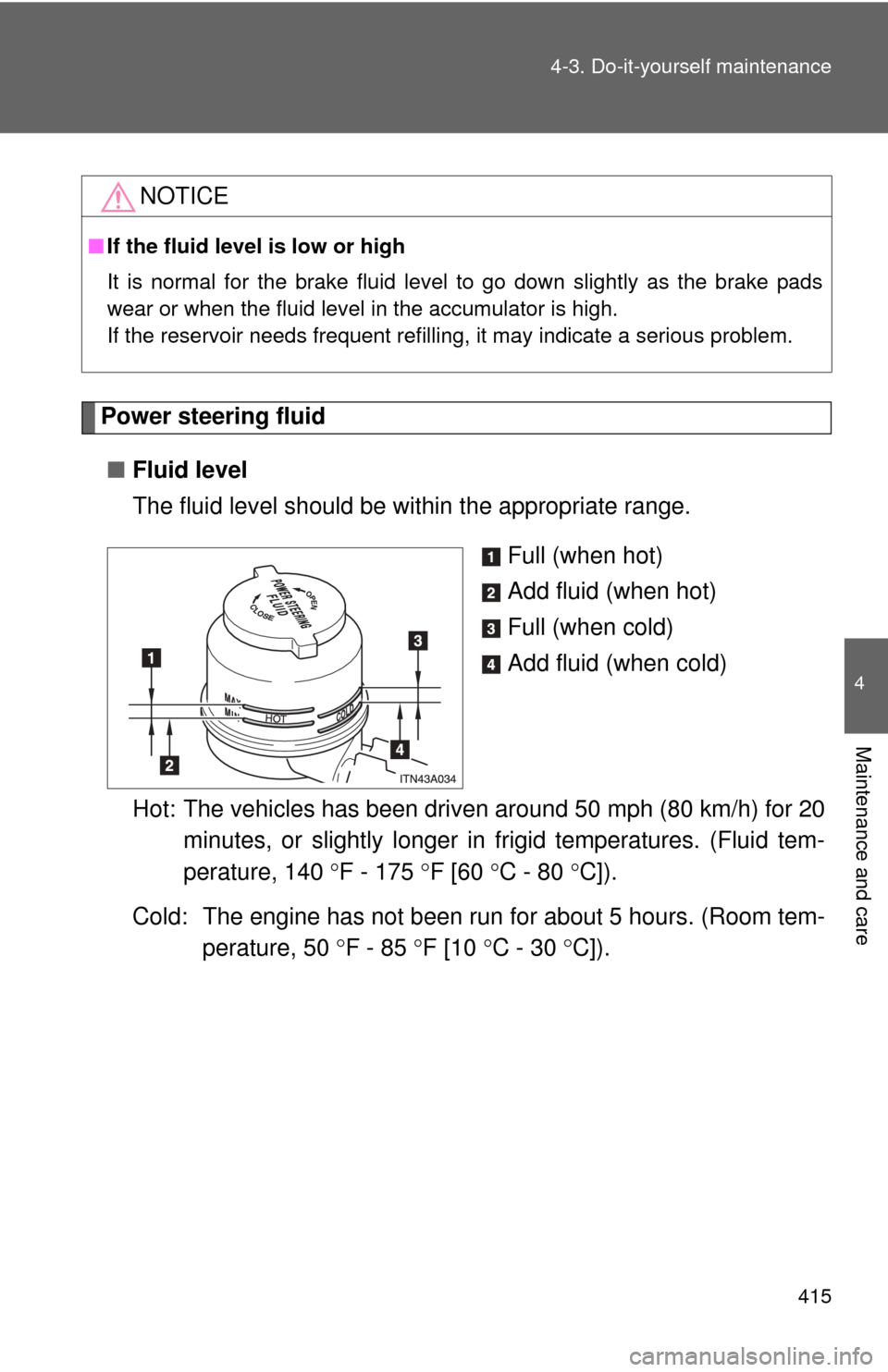
The fluid level should be within the appropriate range.
Full (when hot)
Add fluid (when hot)
Full (when cold)
Add fluid (when cold)
Hot: The vehicles has been driven around 50 mph (80 km/h) for 20 minutes, or slightly longer in frigid temperatures. (Fluid tem-
perature, 140 F - 175 F [60 C - 80 C]).
Cold: The engine has not been run for about 5 hours. (Room tem- perature, 50 F - 85 F [10 C - 30 C]).
NOTICE
■If the fluid level is low or high
It is normal for the brake fluid level to go down slightly as the brake pads
wear or when the fluid level in the accumulator is high.
If the reservoir needs frequent refilling, it may indicate a serious pro\
blem.
Page 416 of 580
416 4-3. Do-it-yourself maintenance
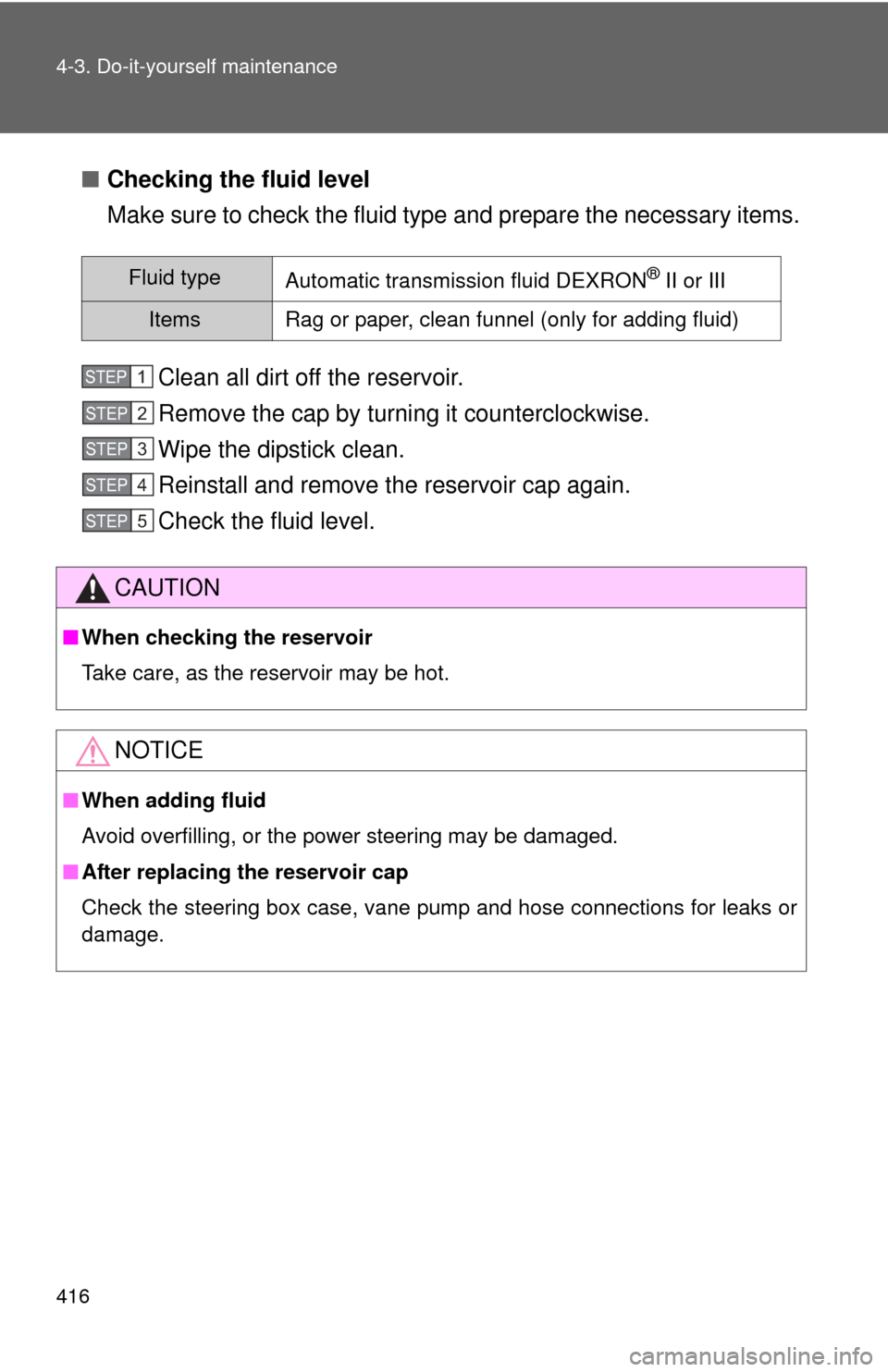
■Checking the fluid level
Make sure to check the fluid type and prepare the necessary items.
Clean all dirt off the reservoir.
Remove the cap by turning it counterclockwise.
Wipe the dipstick clean.
Reinstall and remove the reservoir cap again.
Check the fluid level.
Fluid typeAutomatic transmission fluid DEXRON® II or III
ItemsRag or paper, clean funnel (only for adding fluid)
CAUTION
■ When checking the reservoir
Take care, as the reservoir may be hot.
NOTICE
■When adding fluid
Avoid overfilling, or the power steering may be damaged.
■ After replacing the reservoir cap
Check the steering box case, vane pump and hose connections for leaks or
damage.
STEP1
STEP2
STEP3
STEP4
STEP5
Page 447 of 580
4
Maintenance and care
447
4-3. Do-it-yourself maintenance
FuseAmpereCircuit
9 STOP No.3 7.5 A Electronic controlled transmission
system, multiport fuel injection
system/sequential multiport fuel
injection system
10 INJ 15 A Multiport fuel injection system/
sequential multiport fuel injection
system
11 AM2 7.5 A Starter system
12 DOOR No.1 25 A Multiplex communication system
13 ALT-S 7.5 A Charging system
14 ETCS 10 A Multiport fuel injection system/
sequential multiport fuel injection
system
15 IG2 25 A Multiport fuel injection system/
sequential multiport fuel injection
system, electronic controlled
transmission system
16 TURN/HAZ 15 A Turn signal lights
17 AMP 30 A Audio system
18 EFI No.3 7.5 A Smart key system, electronic con-
trolled transmission system
19 STR LOCK 15 A Steering lock system
20 STOP No.1 15 A Multiplex communication system