Page 493 of 580
5
When trouble arises
493
5-2. Steps to take in an emergency
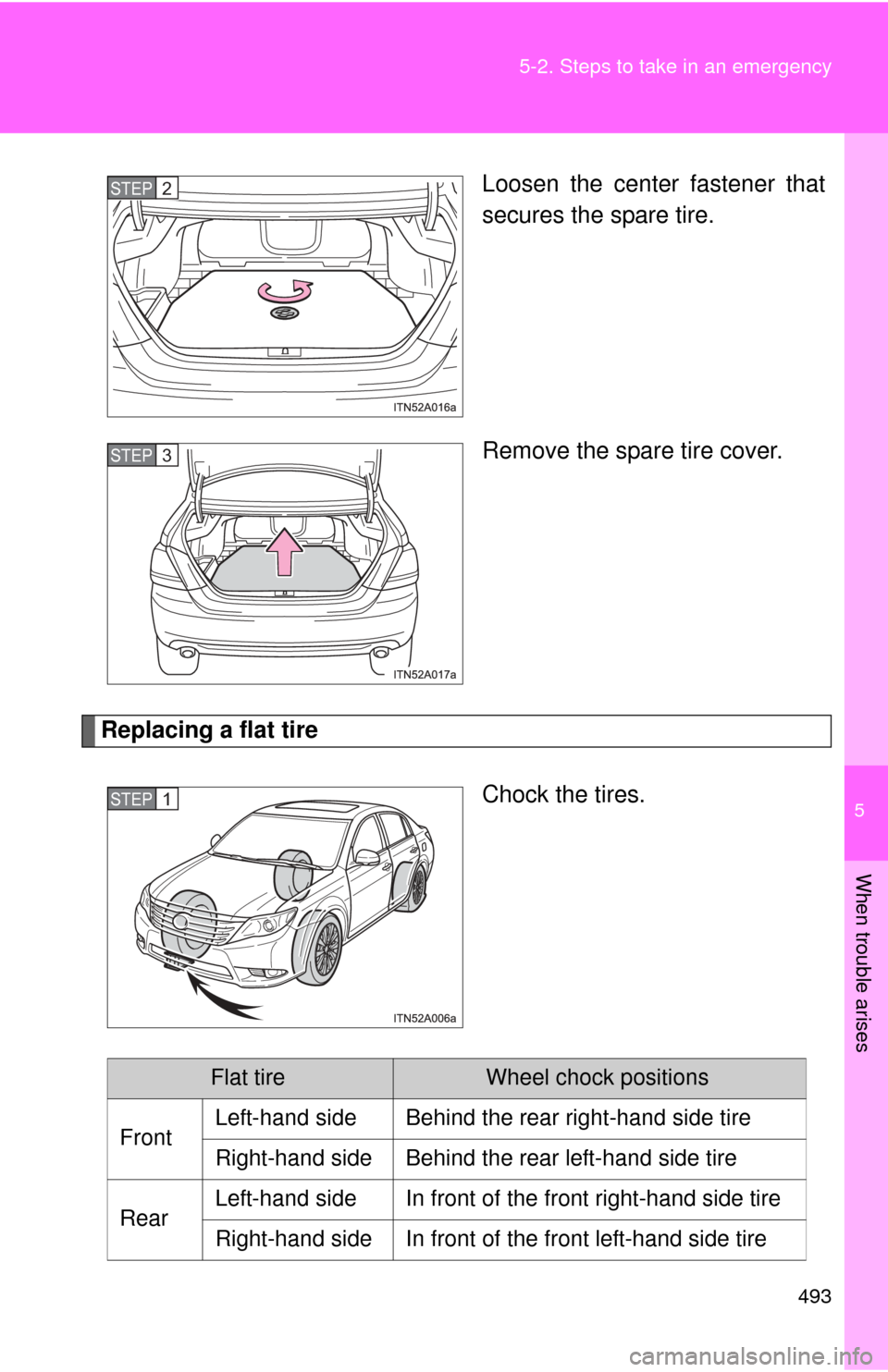
Loosen the center fastener that
secures the spare tire.
Remove the spare tire cover.
Replacing a flat tire
Chock the tires.
STEP2
STEP3
STEP1
Flat tireWheel chock positions
Front Left-hand side Behind the rear right-hand side tire
Right-hand side Behind the rear left-hand side tire
Rear Left-hand side In front of the front right-hand side tire
Right-hand side In front of the front left-hand side tire
Page 497 of 580
5
When trouble arises
497
5-2. Steps to take in an emergency
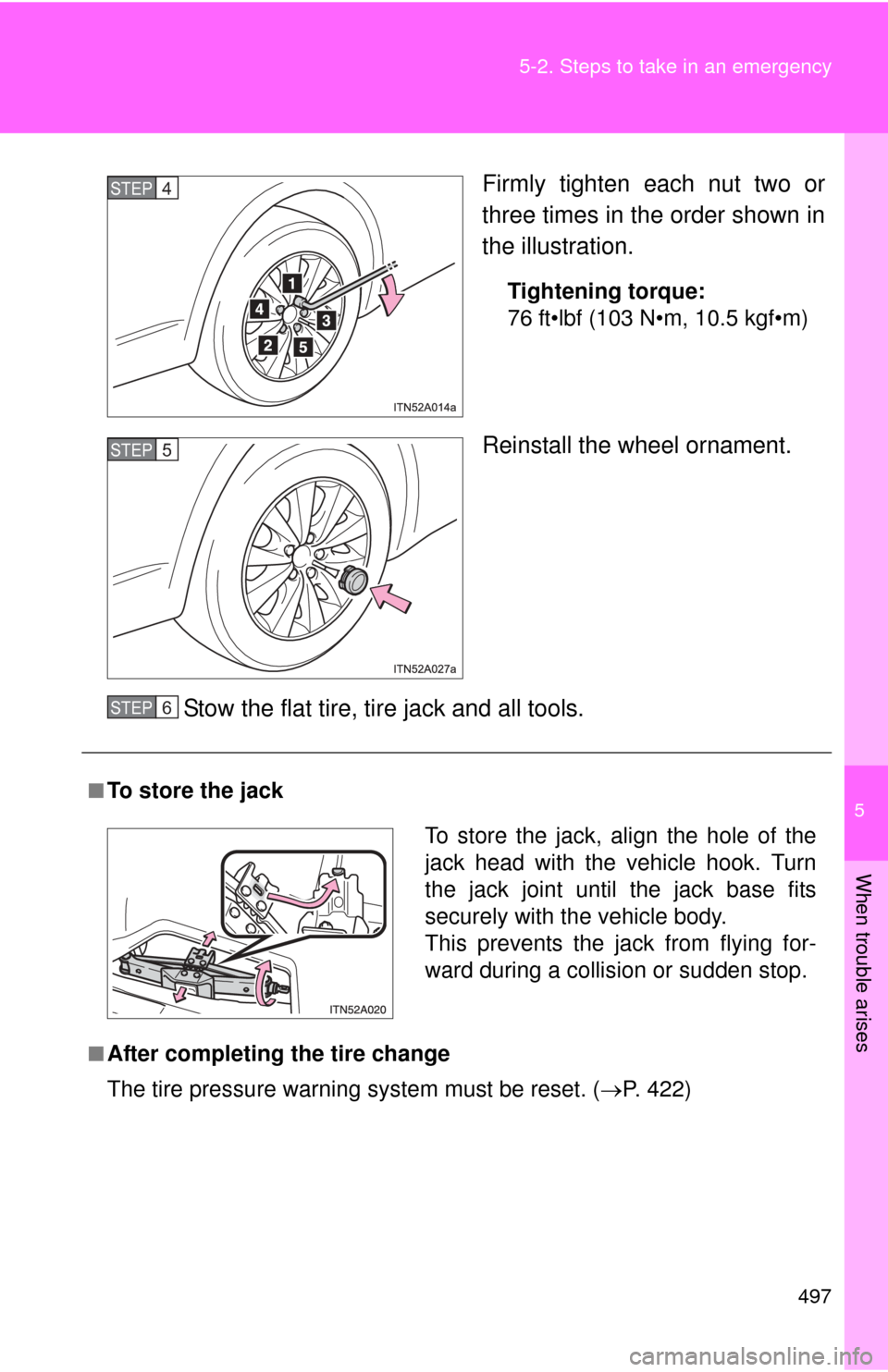
Firmly tighten each nut two or
three times in the order shown in
the illustration.
Tightening torque:
76 ft•lbf (103 N•m, 10.5 kgf•m)
Reinstall the wheel ornament.
Stow the flat tire, tire jack and all tools.
STEP4
STEP5
■To store the jack
■After completing the tire change
The tire pressure warning system must be reset. (P. 422)
STEP6
To store the jack, align the hole of the
jack head with the vehicle hook. Turn
the jack joint until the jack base fits
securely with the vehicle body.
This prevents the jack from flying for-
ward during a collisio n or sudden stop.
Page 498 of 580

498 5-2. Steps to take in an emergency
CAUTION
■Using the tire jack
Improper use of the tire jack may lead to death or injuries due to the
vehicle suddenly falling off the jack.
●Do not use the tire jack for any pu rpose other than replacing tires or
installing and removing tire chains.
●Only use the tire jack that comes with this vehicle for replacing a flat
tire.
Do not use it on other vehicles, and do not use other tire jacks for
replacing tires on this vehicle.
●Always check that the tire jack is securely set to the jack point.
●Do not raise the vehicle while someone is in it.
●When raising the vehicle, do not put an object on or under the jack.
●Do not raise the vehicle to a hei ght greater than that required to
replace the tire.
●Use a jack stand if it is necessary to get under the vehicle.
●Do not put any part of your body under the vehicle supported by a jack.
●Do not start or run the engine while your vehicle is supported by the
jack.
Take particular care when lowering the vehicle to ensure that no one
working on or near the vehicle may be injured.
Page 499 of 580
5
When trouble arises
499
5-2. Steps to take in an emergency
CAUTION
■Replacing a flat tire
Observe the following precautions to reduce the risk of death or serious
injury.
●Have the wheel nuts tightened with a torque wrench to 76 ft•lbf (103
N•m, 10.5 kgf•m) as soon as possible after changing wheels.
Failure to follow these precautions could cause the nuts to loosen and
the wheels may fall off, which could lead to an accident causing death
or serious injury.
■When installing the wheel nuts
Be sure to install the wheel nuts with the tapered end facing inward.
(
P. 435)
Page 500 of 580
500 5-2. Steps to take in an emergency
NOTICE
■Do not drive the vehicle with a flat tire
Do not continue driving with a flat tire.
Driving even a short distance with a flat tire can damage the tire and the
wheel beyond repair.
■When replacing the tires
When removing or fitting the wheels, tires or the tire pressure warning
valve and transmitter, contact your Toyota dealer as the tire pressure
warning valve and transmitter may be damaged if not handled correctly.
■To avoid damaging the tire pressure warning valves and transmit-
ters
When a tire is repaired with liquid se alants, the tire pressure warning
valve and transmitter may not operate properly. If a liquid sealant is
used, contact your Toyota dealer or other qualified service shop as soon
as possible. Make sure to replace the tire pressure warning valve and
transmitter when replacing the tire. ( P. 422)
Page 526 of 580
526 6-1. Specifications
Steering
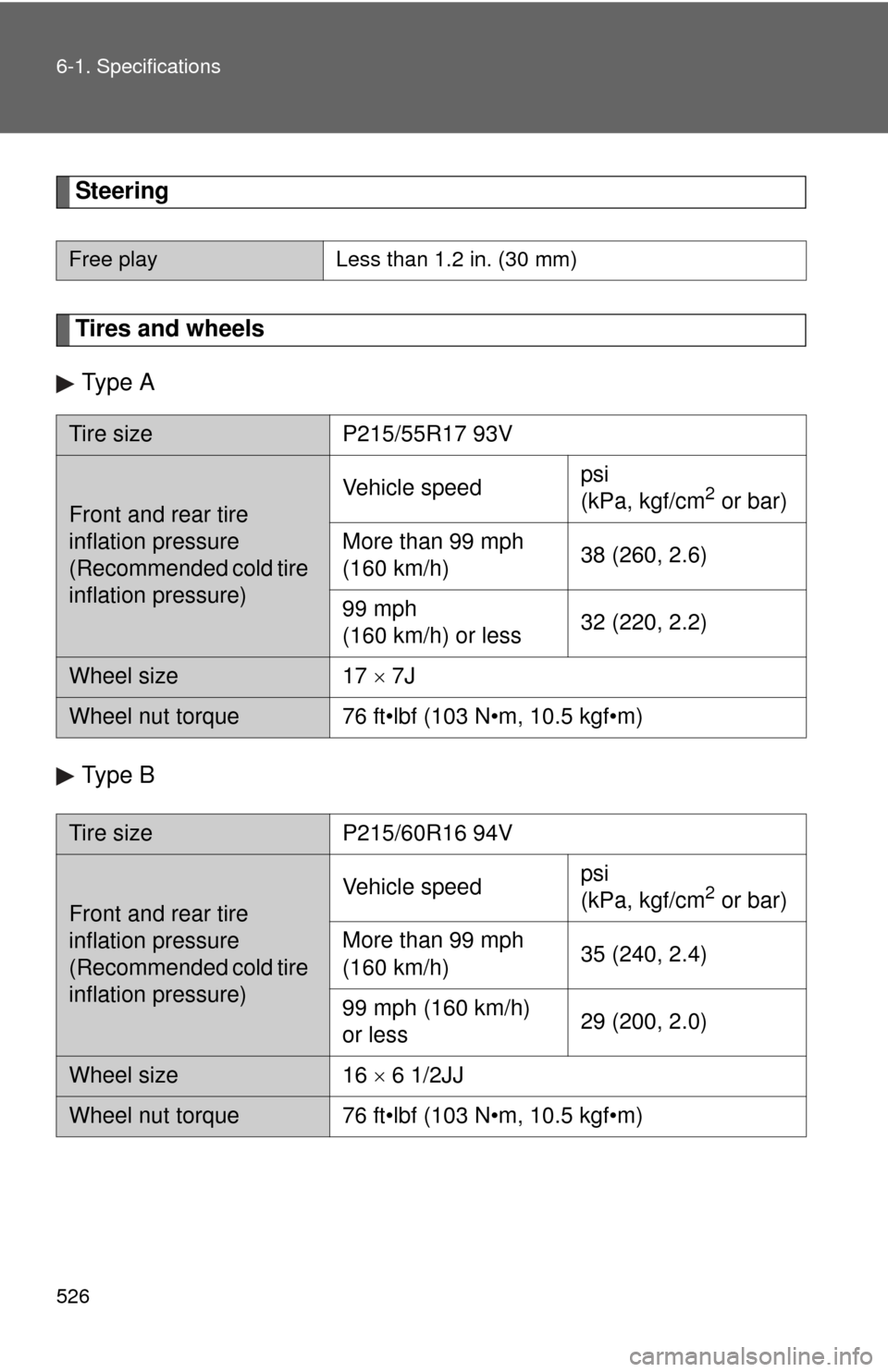
Tires and wheelsType A
Type B
Free playLess than 1.2 in. (30 mm)
Tire sizeP215/55R17 93V
Front and rear tire
inflation pressure
(Recommended cold tire
inflation pressure) Vehicle speed
psi
(kPa, kgf/cm
2 or bar)
More than 99 mph
(160 km/h) 38 (260, 2.6)
99 mph
(160 km/h) or less 32 (220, 2.2)
Wheel size
17 7J
Wheel nut torque 76 ft•lbf (103 N•m, 10.5 kgf•m)
Tire sizeP215/60R16 94V
Front and rear tire
inflation pressure
(Recommended cold tire
inflation pressure) Vehicle speed
psi
(kPa, kgf/cm
2 or bar)
More than 99 mph
(160 km/h) 35 (240, 2.4)
99 mph (160 km/h)
or less 29 (200, 2.0)
Wheel size
16 6 1/2JJ
Wheel nut torque 76 ft•lbf (103 N•m, 10.5 kgf•m)
Page 533 of 580
533
6-1. Specifications
6
Vehicle specifications
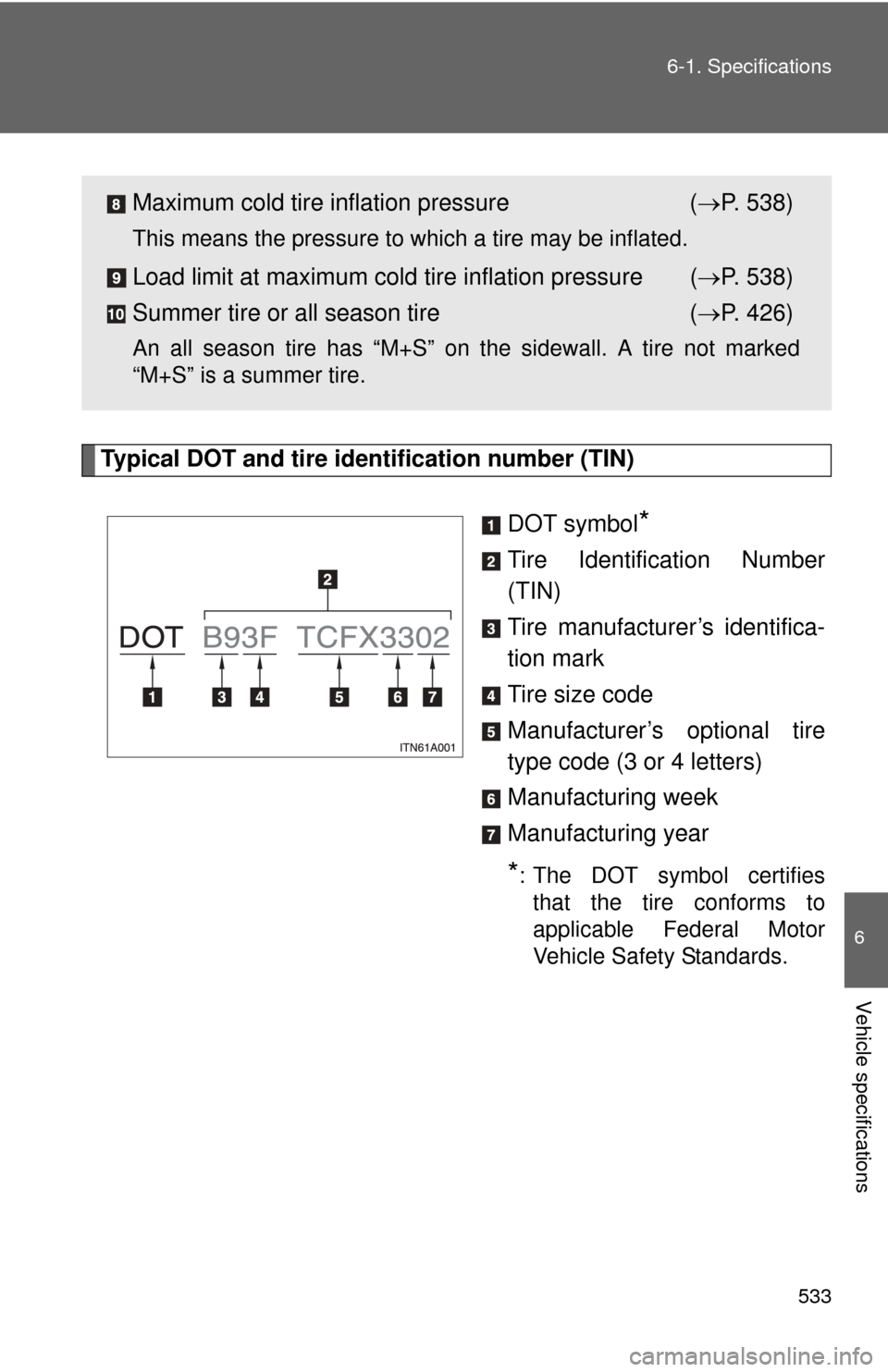
Typical DOT and tire identification number (TIN)
DOT symbol
*
Tire Identification Number
(TIN)
Tire manufacturer’s identifica-
tion mark
Tire size code
Manufacturer’s optional tire
type code (3 or 4 letters)
Manufacturing week
Manufacturing year
*: The DOT symbol certifiesthat the tire conforms to
applicable Federal Motor
Vehicle Safety Standards.
Maximum cold tire in flation pressure ( P. 538)
This means the pressure to which a tire may be inflated.
Load limit at maximum cold tire inflation pressure ( P. 538)
Summer tire or all season tire ( P. 426)
An all season tire has “M+S” on the sidewall. A tire not marked
“M+S” is a summer tire.
Page 537 of 580

537
6-1. Specifications
6
Vehicle specifications
■
Temperature A, B, C
The temperature grades are A (the highest), B, and C, represent-
ing the tire’s resistance to the generation of heat and its ability to
dissipate heat when tested under controlled conditions on a speci-
fied indoor laboratory test wheel.
Sustained high temperature can cause the material of the tire to
degenerate and reduce tire life, and excessive temperature can lead
to sudden tire failure.
The grade C corresponds to a level of performance which all passen-
ger car tires must meet under the Federal Motor Vehicle Safety Stan-
dard No. 109.
Grades B and A represent higher levels of performance on the labo-
ratory test wheel than the minimum required by law.
Warning: The temperature grades for this tire are established for a
tire that is properly inflated and not overloaded.
Excessive speed, underinflation, or excessive loading, either sepa-
rately or in combination, can caus e heat buildup and possible tire fail-
ure.