Page 499 of 580
5
When trouble arises
499
5-2. Steps to take in an emergency
CAUTION
■Replacing a flat tire
Observe the following precautions to reduce the risk of death or serious
injury.
●Have the wheel nuts tightened with a torque wrench to 76 ft•lbf (103
N•m, 10.5 kgf•m) as soon as possible after changing wheels.
Failure to follow these precautions could cause the nuts to loosen and
the wheels may fall off, which could lead to an accident causing death
or serious injury.
■When installing the wheel nuts
Be sure to install the wheel nuts with the tapered end facing inward.
(
P. 435)
Page 500 of 580
500 5-2. Steps to take in an emergency
NOTICE
■Do not drive the vehicle with a flat tire
Do not continue driving with a flat tire.
Driving even a short distance with a flat tire can damage the tire and the
wheel beyond repair.
■When replacing the tires
When removing or fitting the wheels, tires or the tire pressure warning
valve and transmitter, contact your Toyota dealer as the tire pressure
warning valve and transmitter may be damaged if not handled correctly.
■To avoid damaging the tire pressure warning valves and transmit-
ters
When a tire is repaired with liquid se alants, the tire pressure warning
valve and transmitter may not operate properly. If a liquid sealant is
used, contact your Toyota dealer or other qualified service shop as soon
as possible. Make sure to replace the tire pressure warning valve and
transmitter when replacing the tire. ( P. 422)
Page 515 of 580

5
When trouble arises
515
5-2. Steps to take in an emergency
If the vehicle becomes stuck
CAUTION
■When attempting to free a stuck vehicle
If you choose to rock the vehicle back and forth to free it, make sure the sur-
rounding area is clear, to avoid striking other vehicles, objects or persons.
The vehicle may also lunge forward or lunge back suddenly as it becomes
free. Use extreme caution.
■ When shifting the shift lever
Be careful not to shift the shift lever with the accelerator pedal depressed.
This may lead to unexpected rapid acceleration of the vehicle that may
cause an accident and result in death or serious injury.
NOTICE
■To avoid damaging the transmission and other components
●Avoid spinning the wheels and do not rev the engine.
● If the vehicle remains stuck after trying these procedures, the vehicle may
require towing to be freed.
Carry out the following procedures if the tires spin or the vehicle
becomes stuck in mud, dirt, or snow.
Stop the engine. Set the parki ng brake and shift the shift
lever in “P”.
Remove the mud, snow, or sand from around the stuck tire.
Place wood, stones or some other material to help provide
traction under the tires.
Restart the engine.
Shift the shift lever to the “D ” or “R” position and carefully
apply the accelerator to free the vehicle.STEP1
STEP2
STEP3
STEP4
STEP5
Page 517 of 580
5
When trouble arises
517
5-2. Steps to take in an emergency
CAUTION
■
If the engine has to be turned off while driving
●Power assist for the brakes and steering wheel will be lost, making the
brake pedal harder to depress and the steering wheel heavier to turn.
Decelerate as much as possible before turning off the engine.
● Vehicles without a smart key system: Never attempt to remove the key, as
doing so will lock the steering wheel.
Vehicles with a smart key sys-
tem: To stop the engine, press
and hold the “ENGINE START
STOP” switch for 3 consecu-
tive seconds or more, or press
it briefly 3 times or more in
succession.
Stop the vehicle in a safe place by the road.
Press and hold for 3 seconds or more, or press briefly 3 times or more
STEP4
STEP5
Page 520 of 580
520
6-1. Specifications
Maintenance data (fuel, oil level, etc.)
Dimensions and weight
*: Unladen vehicle
Overall length197.6 in. (5020 mm)
Overall width72.8 in. (1850 mm)
Overall height*58.5 in. (1485 mm)
Wheelbase111.0 in. (2820 mm)
TreadFront62.2 in. (1580 mm)
Rear61.6 in. (1565 mm)
Vehicle capacity weight
(occupants + luggage) 870 lb. (395 kg)
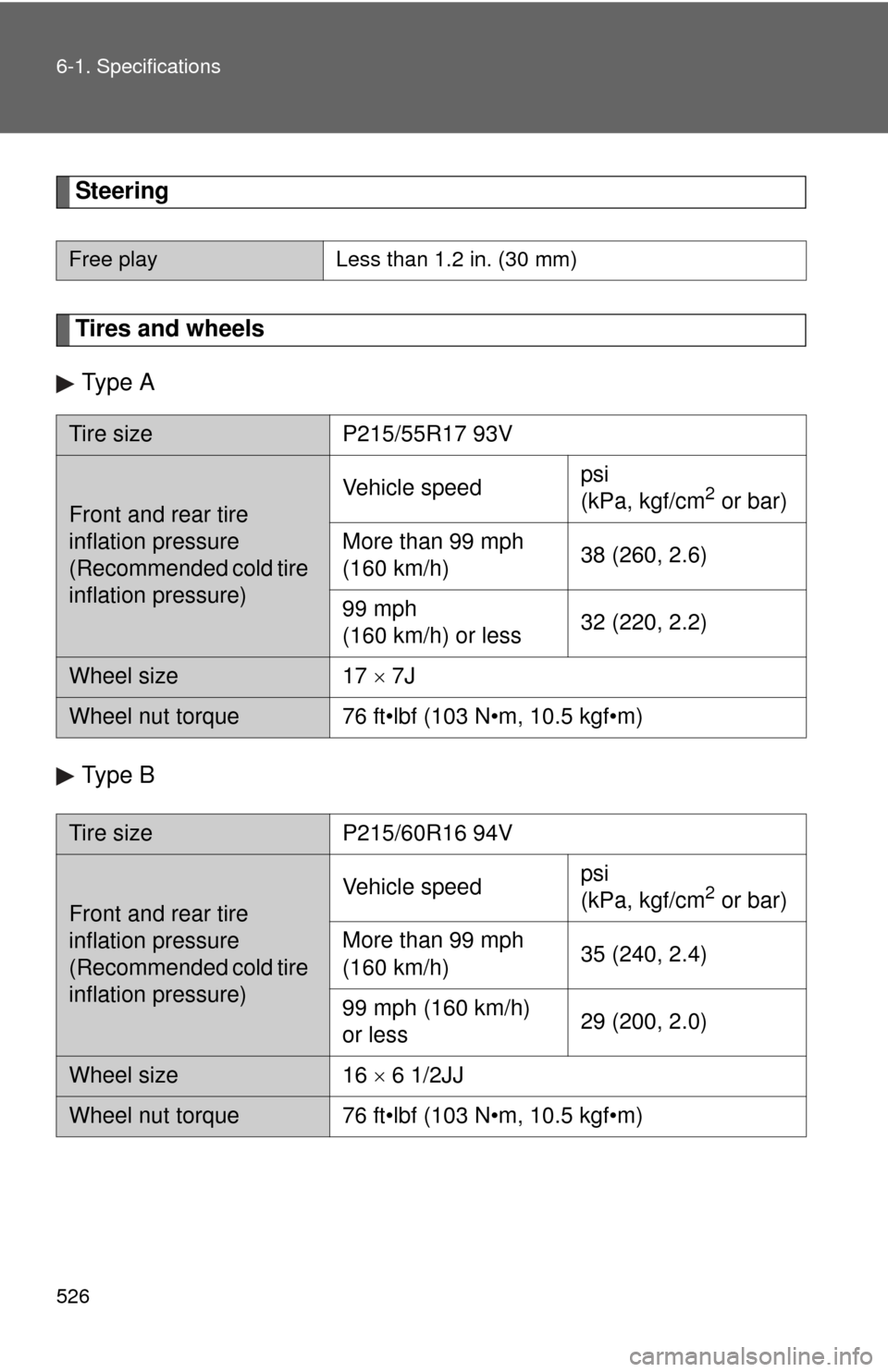
Page 526 of 580
526 6-1. Specifications
Steering
Tires and wheelsType A
Type B
Free playLess than 1.2 in. (30 mm)
Tire sizeP215/55R17 93V
Front and rear tire
inflation pressure
(Recommended cold tire
inflation pressure) Vehicle speed
psi
(kPa, kgf/cm
2 or bar)
More than 99 mph
(160 km/h) 38 (260, 2.6)
99 mph
(160 km/h) or less 32 (220, 2.2)
Wheel size
17 7J
Wheel nut torque 76 ft•lbf (103 N•m, 10.5 kgf•m)
Tire sizeP215/60R16 94V
Front and rear tire
inflation pressure
(Recommended cold tire
inflation pressure) Vehicle speed
psi
(kPa, kgf/cm
2 or bar)
More than 99 mph
(160 km/h) 35 (240, 2.4)
99 mph (160 km/h)
or less 29 (200, 2.0)
Wheel size
16 6 1/2JJ
Wheel nut torque 76 ft•lbf (103 N•m, 10.5 kgf•m)
Page 534 of 580
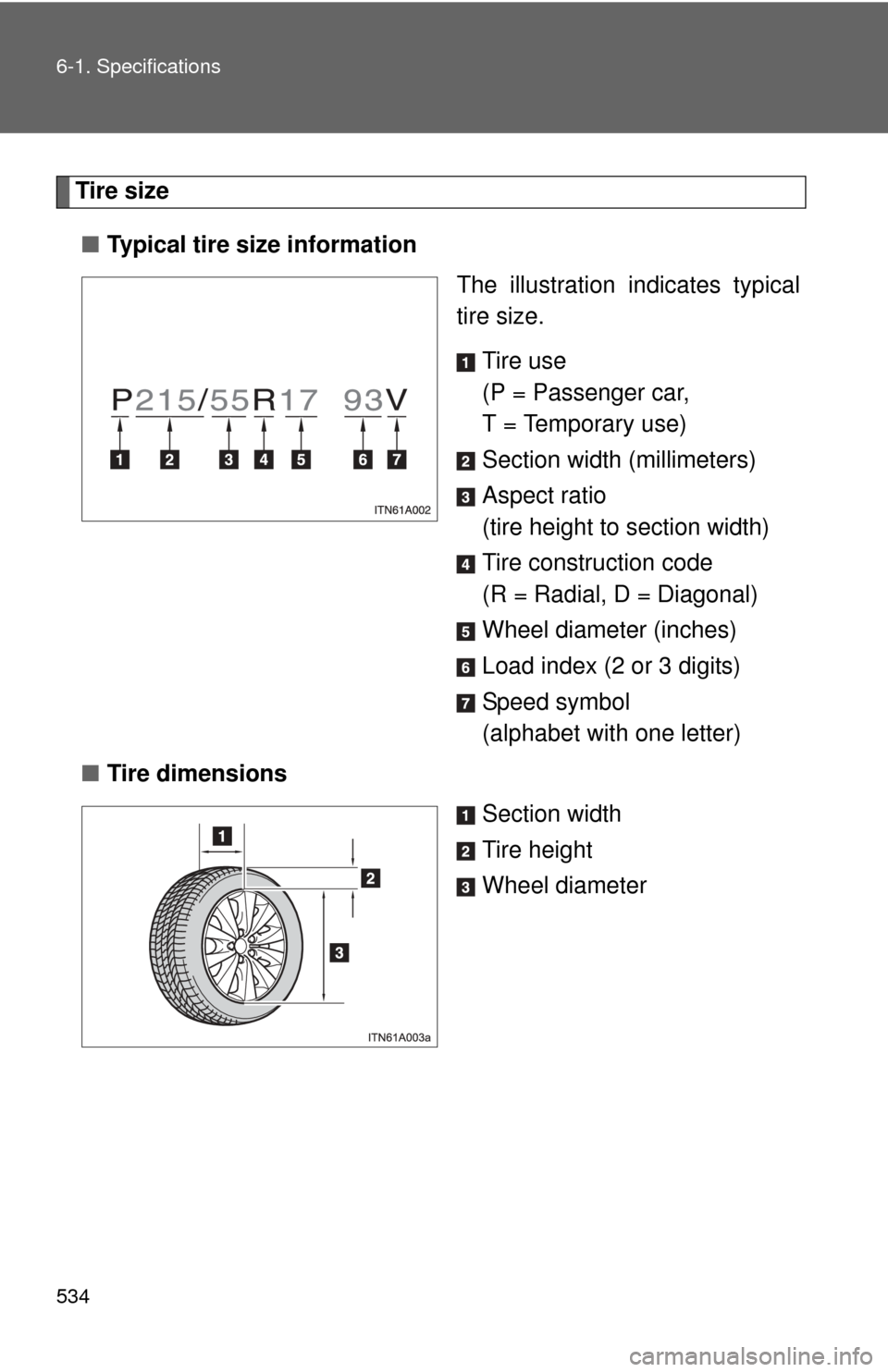
534 6-1. Specifications
Tire size■ Typical tire size information
The illustration indicates typical
tire size.
Tire use
(P = Passenger car,
T = Temporary use)
Section width (millimeters)
Aspect ratio
(tire height to section width)
Tire construction code
(R = Radial, D = Diagonal)
Wheel diameter (inches)
Load index (2 or 3 digits)
Speed symbol
(alphabet with one letter)
■ Tire dimensions
Section width
Tire height
Wheel diameter
Page 537 of 580

537
6-1. Specifications
6
Vehicle specifications
■
Temperature A, B, C
The temperature grades are A (the highest), B, and C, represent-
ing the tire’s resistance to the generation of heat and its ability to
dissipate heat when tested under controlled conditions on a speci-
fied indoor laboratory test wheel.
Sustained high temperature can cause the material of the tire to
degenerate and reduce tire life, and excessive temperature can lead
to sudden tire failure.
The grade C corresponds to a level of performance which all passen-
ger car tires must meet under the Federal Motor Vehicle Safety Stan-
dard No. 109.
Grades B and A represent higher levels of performance on the labo-
ratory test wheel than the minimum required by law.
Warning: The temperature grades for this tire are established for a
tire that is properly inflated and not overloaded.
Excessive speed, underinflation, or excessive loading, either sepa-
rately or in combination, can caus e heat buildup and possible tire fail-
ure.