Page 244 of 700

244 2-4. Using other driving systems
4RUNNER_U
When the active traction control system is operatingIf all wheels spin, the slip indica-
tor flashes to indicate that the
active traction control system
has been engaged.
CTH24AS047
■When the rear differential is locked (vehicles with a rear differential
lock system)
The active traction control system is activated only when vehicle speed is
less than 4 mph (6 km/h).
■ Sounds and vibrations caused by the active traction control system
● A sound may be heard from the engine compartment when the engine is
started or just after the vehicle begins to move. This sound does not indi-
cate that a malfunction has occurred in the system.
● Vibrations may be felt through the vehicle body and steering. This may
occur when the system is operating.
■ If the brake system overheats
The system will cease operation and a buzzer will sound to alert the driver.
At this time, the “A-TRAC” indicator will go off and the “TRAC OFF” indicator
will come on. Stop the vehicle in a safe place. (There is no problem with con-
tinuing normal driving.)
The system will be automatically restored after a short time.
CAUTION
■The active traction control system m ay not operate effectively when
Directional control and power may not be achievable while driving on slip-
pery road surfaces, even if the active traction control system is operating.
Do not drive the vehicle in conditions where stability and power may be lost.
Page 307 of 700
307
2-5. Driving information
2
When driving
4RUNNER_U
■
Break-in schedule
If your vehicle is new or equipped with any new power train components
(such as an engine, transmission, differential or wheel bearing), Toyota rec-
ommends that you do not tow a trailer until the vehicle has been driven \
for
over 500 miles (800 km).
After the vehicle has been driven for over 500 miles (800 km), you can s\
tart
towing. However, for the next 500 miles (800 km), drive the vehicle at a
speed of less than 45 mph (72 km/h) when towing a trailer, and avoid full
throttle acceleration.
■ Maintenance
● If you tow a trailer, your vehicle will require more frequent maintenance
due to the additional load. (See “Scheduled Maintenance Guide” or
“Owner’s Manual Supplement”.)
● Retighten the fixing bolts of the towing ball and bracket after approxi-
mately 600 miles (1000 km) of trailer towing.
■ If trailer sway occurs
One or more factors (crosswinds, passing vehicles, rough roads, etc.) can
adversely affect handling of your vehicle and trailer, causing instability.
● If trailer swaying occurs:
• Firmly grip the steering wheel. Steer straight ahead.
Do not try to control trailer swaying by turning the steering wheel.
• Begin releasing the accelerator pedal immediately but very gradually to reduce speed.
Do not increase speed. Do not apply vehicle brakes.
If you make no extreme correction with the steering or brakes, your vehicle
and trailer should stabilize.
Page 382 of 700
382
3-2. Using the audio system
4RUNNER_U
Using the steering wheel audio switches
: If equipped
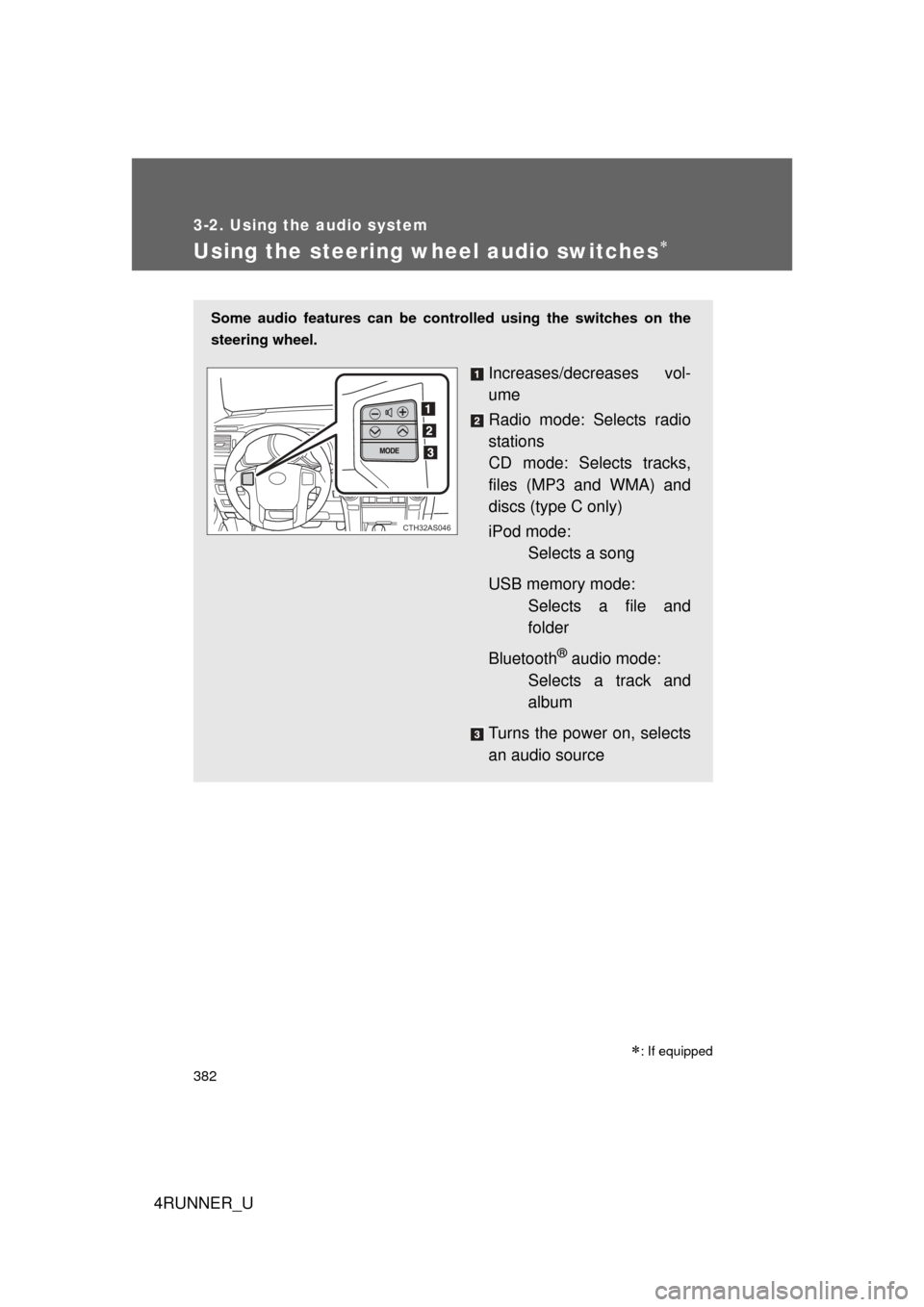
Some audio features can be controlled using the switches on the
steering wheel.
Increases/decreases vol-
ume
Radio mode: Selects radio
stations
CD mode: Selects tracks,
files (MP3 and WMA) and
discs (type C only)
iPod mode:Selects a song
USB memory mode: Selects a file and
folder
Bluetooth
® audio mode:
Selects a track and
album
Turns the power on, selects
an audio source
CTH32AS046
Page 511 of 700

511
4-2. Maintenance
4
Maintenance and care
4RUNNER_U
General maintenance
Engine compartment
ItemsCheck points
Battery Check the connections.
(P. 532)
Brake fluid Is the brake fluid at the correct
level? (
P. 528)
Engine coolant Is the engine coolant at the
correct level? (
P. 526)
Engine oil Is the engine oil at the correct
level? (
P. 522)
Exhaust system There should not be any fumes or
strange sounds.
Power steering fluid Is the power steering fluid at the
correct level? (
P. 530)
Radiator/condenser The radiator and condenser
should be free from foreign
objects. (
P. 527)
Washer fluid Is there sufficient washer fluid?
(P. 535)
Listed below are the general maintenance items that should be per-
formed at the intervals specified in the “Owner's Warranty Informa-
tion Booklet” or “Owner’s Manual Supplement/Scheduled
Maintenance Guide”. It is recommended that any problem you notice
should be brought to the attention of your Toyota dealer or qualified
service shop for advice.
Page 517 of 700
517
4-3. Do-it-yourself maintenance
4
Maintenance and care
4RUNNER_U
ItemsParts and tools
Fuses
(P. 555)• Fuse with same amperage rating
as original
Light bulbs (P. 565)
• Bulb with same number and watt-
age rating as original
• Phillips-head screwdriver
• Flathead screwdriver
• Wrench
Power steering fluid level (P. 530)
• Automatic transmission fluid
DEXRON® II or III
• Rag or paper towel
• Clean funnel
Radiator and condenser (P. 527)
Tire inflation pressure ( P. 543)• Tire pressure gauge
• Compressed air source
Washer fluid (P. 535)
• Water or washer fluid containing
antifreeze (for winter use)
• Funnel (used only for adding water or washer fluid)
Page 520 of 700
520
4-3. Do-it-yourself maintenance
4RUNNER_U
Engine compar tment
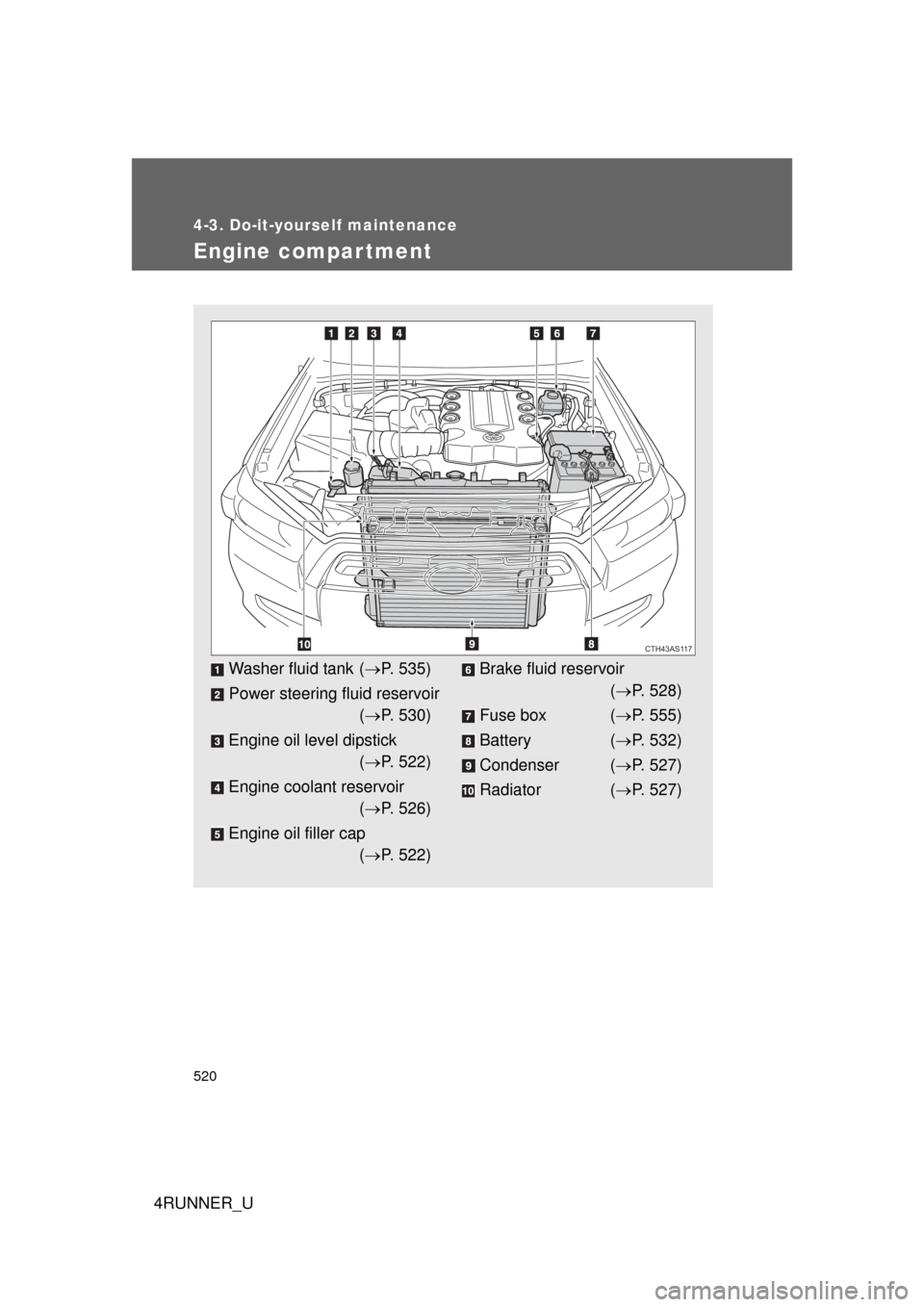
Washer fluid tank (P. 535)
Power steering fluid reservoir ( P. 530)
Engine oil level dipstick ( P. 522)
Engine coolant reservoir ( P. 526)
Engine oil filler cap ( P. 522)Brake fluid reservoir
( P. 528)
Fuse box ( P. 555)
Battery ( P. 532)
Condenser ( P. 527)
Radiator ( P. 527)
CTH43AS117
Page 530 of 700
530 4-3. Do-it-yourself maintenance
4RUNNER_U
Power steering fluid■ Fluid level
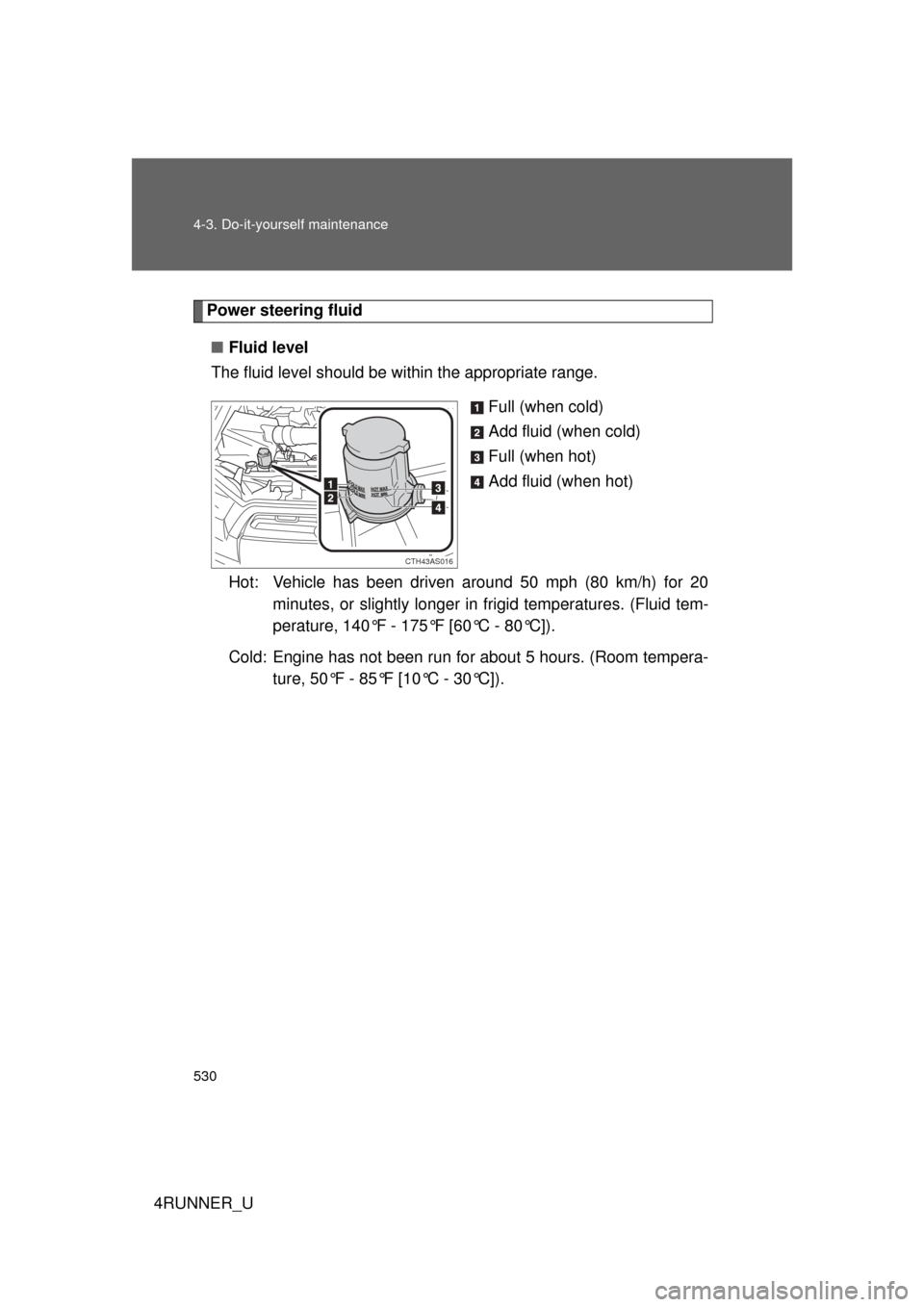
The fluid level should be within the appropriate range.
Full (when cold)
Add fluid (when cold)
Full (when hot)
Add fluid (when hot)
Hot: Vehicle has been driven around 50 mph (80 km/h) for 20 minutes, or slightly longer in frigid temperatures. (Fluid tem-
perature, 140°F - 175°F [60°C - 80°C]).
Cold: Engine has not been run for about 5 hours. (Room tempera- ture, 50°F - 85°F [10°C - 30°C]).
CTH43AS016
Page 531 of 700
531
4-3. Do-it-yourself maintenance
4
Maintenance and care
4RUNNER_U
■
Checking the fluid level
Make sure to check the fluid type and prepare the necessary items.
Clean all dirt off the reservoir.
Remove the cap by turning it counterclockwise.
Wipe the dipstick clean.
Reinstall the cap and remove it again.
Check the fluid level.
Fluid typeAutomatic transmission fluid DEXRON® II or III
ItemsRag or paper, clean funnel (only for adding fluid)
CAUTION
■When checking the reservoir
Take care as the reservoir may be hot.
NOTICE
■When adding fluid
Avoid overfilling, or the power steering may be damaged.
■ After replacing the reservoir cap
Check the steering box case, vane pump and hose connections for leaks or
damage.
STEP 1
STEP 2
STEP 3
STEP 4
STEP 5