2012 SUBARU OUTBACK tire type
[x] Cancel search: tire typePage 447 of 474

13-2Consumer information and Reporting safety defects
For U.S.A.
The following information has been
compiled according to Code of
Federal Regulations “Title 49, Part
575 ”. Tire information &
Tire labeling
Many markings (e.g. Tire size, Tire
Identification Number or TIN) are
placed on the sidewall of a tire by
tire manufacturers. These marking
can provide you with useful infor-
mation on the tire. ! Tire size
Your vehicle comes equipped with
P-Metric tire size. It is important to
understand the sizing system in
selecting the proper tire for your
vehicles. Here is a brief review of
the tire sizing system with a break-
down of its individual elements. ! P Metric
With the P-Metric system, Section
Width is measured in millimeters.
To convert millimeters into inches,
divide by 25.4. The Aspect Ratio
(Section Height divided by Section
Width) helps provide more dimen-
sional information about the tiresize. Example:
(1) P = Certain tire type used on
light duty vehicles such as passen-
ger cars
(2) Section Width in millimeters
(3) Aspect Ratio (= section height 7
section width).
(4) R = Radial Construction
(5) Rim diameter in inches ! Load and Speed Rating Descrip- tions
The load and speed rating descrip-
tions will appear following the size designation.
They provide two important facts
about the tire. First, the number
designation is its load index. Sec-
ond, the letter designation indicates
the tire ’s speed rating.
Page 448 of 474
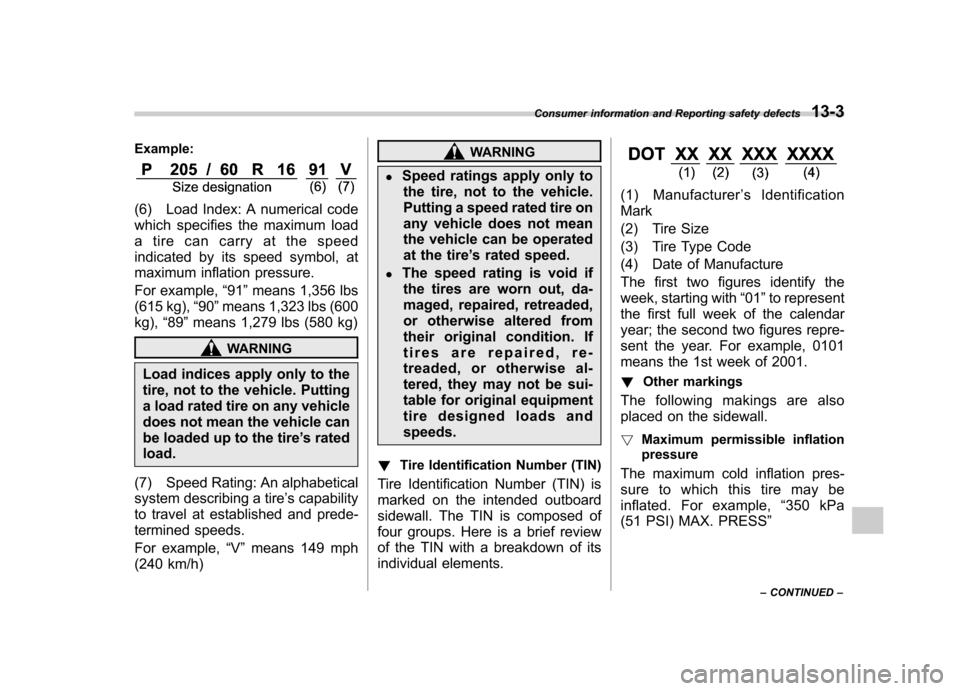
Example:
(6) Load Index: A numerical code
which specifies the maximum load
a tire can carry at the speed
indicated by its speed symbol, at
maximum inflation pressure.
For example,“91 ”means 1,356 lbs
(615 kg), “90 ”means 1,323 lbs (600
kg), “89 ”means 1,279 lbs (580 kg)
WARNING
Load indices apply only to the
tire, not to the vehicle. Putting
a load rated tire on any vehicle
does not mean the vehicle can
be loaded up to the tire ’s rated
load.
(7) Speed Rating: An alphabetical
system describing a tire ’s capability
to travel at established and prede-
termined speeds.
For example, “V ” means 149 mph
(240 km/h)
WARNING
. Speed ratings apply only to
the tire, not to the vehicle.
Putting a speed rated tire on
any vehicle does not mean
the vehicle can be operated
at the tire ’s rated speed.
. The speed rating is void if
the tires are worn out, da-
maged, repaired, retreaded,
or otherwise altered from
their original condition. If
tires are repaired, re-
treaded, or otherwise al-
tered, they may not be sui-
table for original equipment
tire designed loads andspeeds.
! Tire Identification Number (TIN)
Tire Identification Number (TIN) is
marked on the intended outboard
sidewall. The TIN is composed of
four groups. Here is a brief review
of the TIN with a breakdown of its
individual elements.
(1) Manufacturer ’s Identification
Mark
(2) Tire Size
(3) Tire Type Code
(4) Date of Manufacture
The first two figures identify the
week, starting with “01 ”to represent
the first full week of the calendar
year; the second two figures repre-
sent the year. For example, 0101
means the 1st week of 2001.
! Other markings
The following makings are also
placed on the sidewall. ! Maximum permissible inflation
pressure
The maximum cold inflation pres-
sure to which this tire may be
inflated. For example, “350 kPa
(51 PSI) MAX. PRESS ”
Consumer information and Reporting safety defects
13-3
– CONTINUED –
Page 449 of 474
13-4Consumer information and Reporting safety defects
!Maximum load rating
The load rating at the maximum
permissible weight load for this tire.
For example, “MAX. LOAD 615 kg
(1,356 LBS) @ 350 kPa (51 PSI)
MAX. PRESS. ”
WARNING
Maximum load rating applies
only to the tire, not to the
vehicle. Putting a load rated
tire on any vehicle does not
mean the vehicle can be
loaded up to the tire ’s rated
load.
! Construction type
Applicable construction of this tire.
For example, “TUBELESS STEEL
BELTED RADIAL ”
! Construction
The generic name of each cord
material used in the plies (both
sidewall and tread area) of this tire.
For example, “PLIES: TREAD 2 STEEL + 2 POLYESTER + 1
NYLON SIDEWALL 2 POLYE- STER
”
! Uniform Tire Quality Grading (UTQG)
For details, refer to “Uniform tire
quality grading standards ”F 13-14 .
& Recommended tire inflation pressure
! Recommended cold tire infla-
tion pressure
For the recommended cold tire
inflation pressure for your vehicle ’s
tires, refer to “Tires ”F 12-9 . !
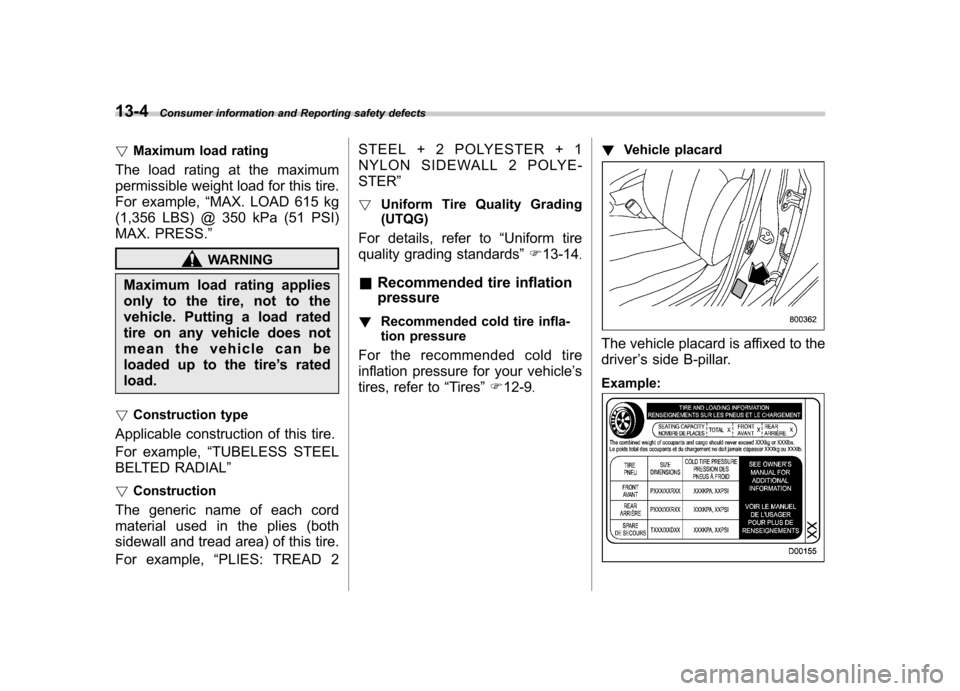
Vehicle placard
The vehicle placard is affixed to the driver ’s side B-pillar.
Example:
Page 452 of 474

sidewall, or innerliner that extends
to cord material..Outer diameter
The overall diameter of an inflated
new tire.. Overall width
The linear distance between the
exteriors of the sidewalls of an
inflated tire, including elevations
due to labeling, decorations, or
protective bands or ribs. . Passenger car tire
A tire intended for use on passen-
ger cars, multipurpose passenger
vehicles, and trucks, that have a
gross vehicle weight rating (GVWR)
of 10,000 lbs (4,535 kg) or less. . Ply
A layer of rubber-coated parallel cords.. Ply separation
A parting of rubber compound
between adjacent plies.. Pneumatic tire
A mechanical device made of rub-
ber, chemicals, fabric and steel or
other materials, that, when mounted on an automotive wheel,
provides the traction and contains
the gas or fluid that sustains the load.
. Production options weight
The combined weight of those
installed regular production options
weighing over 5.1 lbs (2.3 kg) in
excess of those standard items
which they replace, not previously
considered in curb weight or acces-
sory weight, including heavy duty
brakes, ride levelers, roof rack,
heavy duty battery, and specialtrim. . Radial ply tire
A pneumatic tire in which the ply
cords that extend to the beads are
laid at substantially 90 degrees to
the centerline of the tread.. Recommended inflation pres-
sure
The cold inflation pressure recom-
mended by a vehicle manufacturer.. Reinforced tire
A tire designed to operate at higher
loads and at higher inflation pres- sures than the corresponding stan-
dard tire. .
Rim
A metal support for a tire or a tire
and tube assembly upon which the
tire beads are seated.. Rim diameter
Nominal diameter of the bead seat.. Rim size designation
Rim diameter and width.. Rim type designation
The industry of manufacturer ’s des-
ignation for a rim by style or code. . Rim width
Nominal distance between rim flanges.. Section width
The linear distance between the
exteriors of the sidewalls of an
inflated tire, excluding elevations
due to labeling, decoration, or
protective bands. . Sidewall
That portion of a tire between the
tread and bead.. Sidewall separation
The parting of the rubber com-
Consumer information and Reporting safety defects
13-7
– CONTINUED –
Page 459 of 474

13-14Consumer information and Reporting safety defects
4.The resulting figure equals the
available amount of cargo and
luggage load capacity. For exam-
ple, if the “XXX ”amount equals
1,400 lbs (635 kg) and there will be
five- 150 lbs (68 kg) passengers in
your vehicle, the amount of avail-
able cargo and luggage load capa-
city is 650 lbs (1,400 750 (5 6
150) = 650 lbs).
5. Determine the combined weight
of luggage and cargo being loaded
on the vehicle. That weight may not
safely exceed the available cargo
and luggage load capacity calcu-
lated in Step 4. 6. If your vehicle will be towing a
trailer, load from your trailer will be
transferred to your vehicle. Consult
this manual to determine how this
reduces the available cargo and
luggage load capacity of your ve- hicle. Uniform tire quality grading standards
This information indicates the rela-
tive performance of passenger car
tires in the area of treadwear,
traction, and temperature resis-
tance. This is to aid the consumer
in making an informed choice in the
purchase of tires.
Quality grades can be found where
applicable on the tire sidewall be-
tween tread shoulder and maxi-
mum section width. For example:
Treadwear 200 Traction AA Tem-
perature A
The quality grades apply to new
pneumatic tires for use on passen-
ger cars. However, they do not
apply to deep tread, winter type
snow tires, space-saver or tempor-
ary use spare tires, tires with
nominal rim diameters of 12 inches
or less, or to some limited produc-
tion tires.
All passenger car tires must con-form to Federal Safety Require-
ments in addition to these grades. &
Treadwear
The treadwear grade is a compara-
tive rating based on the wear rate of
the tire when tested under con-
trolled conditions on a specified
government test course.
For example, a tire graded 150
would wear one and one-half (1-
1/2) times as well on the govern-
ment course as a tire graded 100.
The relative performance of tires
depends upon the actual conditions
of their use, however, and may
depart significantly from the norm
due to variations in driving habits,
service practices and differences in
road characteristics and climate. & Traction AA, A, B, C
The traction grades, from highest to
lowest, are AA, A, B and C. Those
grades represent the tire ’s ability to
stop on wet pavement as measured
under controlled conditions on spe-
Page 471 of 474

14-10Index
SRS Frontal airbag ........................................................ 1-45
SRS airbag (Supplemental Restraint System airbag) ... 4, 1-36
SRS airbag system Monitors. ............................................................... 1-62
Servicing ............................................................... 1-63
Warning light ......................................................... 3-11
Starting the engine ....................................................... 7-8
State emission testing (U.S. only) .................................. 7-6
Steering wheel Power ................................................................... 7-23
Tilt/telescopic ......................................................... 3-52
Stopping the engine ................................................... 7-10
Storage compartment ................................................... 6-5
Sun shade ................................................................ 2-29
Sun visors ................................................................... 6-4
Supplemental Restraint System airbag (SRS) ................ 1-36
Synthetic leather upholstery ........................................ 10-5
T
Tachometer ................................................................. 3-7
Temperature warning light AT OIL TEMP ........................................................ 3-14
Coolant ................................................................. 3-13
Temporary spare tire .................................................... 9-2
Tether (child restraint system) .............................. 1-30, 1-33
Tie-down hooks ......................................................... 9-14
Tire ................................................................. 11-30, 12-9 Chains .................................................................. 8-12
Inspection ............................................................ 11-32
Pressures and wear .............................................. 11-32 Replacement.
....................................................... 11-36
Rotation .............................................................. 11-35
Size and pressure .................................................. 12-9
Types .................................................................. 11-30
Tire pressure monitoring system (TPMS) ....... 7-29, 9-9, 11-30
Warning light .......................................................... 3-15
Tires and wheels ...................................................... 11-30
Tools .......................................................................... 9-3
Top tether anchorages ........................................ 1-30, 1-33
Towing ...................................................................... 9-13
All wheels on the ground ......................................... 9-16
Flat-bed truck ......................................................... 9-16
Hooks ................................................................... 9-14
Weight .................................................................. 8-20
Trailer Connecting ............................................................ 8-18
Hitch ............................................................. 8-17, 8-23
Towing .................................................................. 8-19
Towing tips ............................................................ 8-25
Trip meter ................................................................... 3-6
Trunk lid ............................................................ 2-23, 9-19
Release handle ...................................................... 2-24
Trunk light ............................................................... 11-55
Turn signal Indicator lights ........................................................ 3-22
Lever .................................................................... 3-29
U
Under-floor storage compartment .................................. 6-18
USB storage device operations .................................... 5-33