2012 SKODA ROOMSTER lock
[x] Cancel search: lockPage 49 of 194

Seats and Stowage
Front seats
ä
Introduction
This chapter contains information on the following subjects:
Adjusting the front seats 47
Front seat heating 48
The driver's seat should be adjusted in such a way that the pedals can be fully
pressed to the floor with slightly bent legs.
The seat backrest on the driver's seat should be adjusted in such a way that the
upper point of the steering wheel can be easily reached with slightly bent arms.
Correct adjustment of the seats is particularly important for:
› safely and quickly reaching the controls;
› a relaxed, fatigue-free body position;
› achieving the maximum protection offered by the seat belts and the airbag
system. WARNING
■ Only adjust the driver's seat when the vehicle is stationary - risk of accident!
■ Caution when adjusting the seat! You may suffer injuries or bruises as a re-
sult of adjusting the seat without paying proper attention. ■ The seat backrests must not be angled too far back when driving otherwise
this will affect proper operation of the seat belts and of the airbag system -
risk of injury! ■ Never carry more people than the number of seats in the vehicle.
■ Each occupant must correctly fasten the seat belt belonging to the seat.
Children must be fastened » page 115, Transporting children safely with a
suitable restraint system.
■ The front seats and the head restraints must always be adjusted to match
the body size of the seat occupant as well as the seat belts must always be
correctly fastened in order to provide an optimal protection for you and your
occupants. WARNING (Continued)
■ Always keep your feet in the footwell when the car is being driven - never
place your feet on the instrument panel, out of the window or on the surfaces
of the seats. This is particularly important for the front seat passenger. You
will be exposed to increased risk of injury if it becomes necessary to apply the
brake or in the event of an accident. If an airbag is deployed, you may suffer
fatal injuries when adopting an incorrect seated position!
■ It is important for the driver and front passenger to maintain a distance of at
least 25 cm from the steering wheel or dash panel. Not maintaining this mini-
mum distance will mean that the airbag system will not be able to properly
protect you - hazard!
■ Ensure that there are no objects in the footwell as they may get caught be-
hind the pedals when driving or applying the braking. You would then no lon-
ger be able to operate the clutch, brake or accelerate.
■ Do not transport any objects on the front passenger seat except objects
(e.g. child safety seat) provided for this purpose - risk of accident! Note
After a certain time, play can develop within the adjustment mechanism of the
backrest angle. Ð Adjusting the front seats
Fig. 35
Control elements at the seat
First read and observe the introductory information and safety warn-
ings on page 47.
Adjusting a seat in a forward/back direction
›
Pull the lever 1
» Fig. 35 up and push the seat into the desired position.
› Release the lever 1
and push the seat until the lock clicks into place.
£
ä
47
Seats and Stowage
Page 51 of 194

›
Press the locking button in direction of the arrow
» Fig. 37 - and pull the
head restraint out.
› To re-insert the head restraint, push it far enough down into the seat backrest
until the locking button clicks into place.
Best protection is achieved if the top edge of the head restraint is at the same
level as the upper part of your head.
The head restraints must be adjusted to match the size of the seat occupant. Cor-
rectly adjusted head restraints together with the seat belts offer effective protec-
tion for the occupants » page 101.WARNING
■ The head restraints must be correctly adjusted in order to offer effective
protection for the occupants in the event of an accident.
■ Never drive with the head restraints removed - risk of injury!
■ If the rear seats are occupied, the rear head restraint must not be in the
lower position. ÐRear seats
Adjusting seats in forward/back direction
Fig. 38
Releasing at the front/rear
› Pull the lever A
» Fig. 38 up in the direction of arrow 1
or on the release loop
in direction of arrow 2
and move the seat into the desired position 3
. WARNING
The following guidelines must be observed » page 102, Correct seated posi-
tion for the occupants on the rear seats . Ð Adjusting the angle of the seat backrest
Fig. 39
Adjusting the seat backrest
› Pull the lever 1
» Fig. 39 and adjust the required inclination of the seat back-
rest. WARNING
Check for yourself that the seat backrest is engaged by pulling on it. Ð Folding the seat backrest forwards and folding the seat fully
forwards
Fig. 40
Fold seat fully forwards/lock folded forward seats £
49
Seats and Stowage
Page 52 of 194

Folding the seat backrest forwards
›
Put the belt tongue into the opening on the respective side of the vehicle -
safety position.
› Remove the head restraint from the rear middle seat
» page 48, Head re-
straints.
› Push the outer rear seats towards the rear as far as they will go
» page 49,
Adjusting seats in forward/back direction .
› Pull the lever 1
» Fig. 39 on page 49 and fold the seat backrest completely for-
wards.
› Pull the lever
» Fig. 40 up before folding the seat forwards fully.
Folding seats fully forwards and locking them
› If the outer rear seat is fully folded forward, push it towards the rear as far as it
can go.
› Pull the lever A
» Fig. 40 up and fold the seat forwards fully.
› Secure the folded forward seat with the aid of the fixing belt B
to a guide rod
of the head restraint for the front seat » Fig. 40. WARNING
■ Immediately lock the folded forward seat with the aid of the fixing belt to a
guide rod of the head restraint for the front seat - risk of injury.
■ The following guidelines must be observed » page 102, Correct seated posi-
tion for the occupants on the rear seats .CAUTION
If the outer seat is not in the rear end position when folding forward, damage can
occur to the locking bolts when unlocking the seat. Ð Unlocking and removing seats
Fig. 41
Unlocking the folded forward seat/carrying handles on the seat
cushion
› Fold the seat forward
» page 49, Folding the seat backrest forwards and fold-
ing the seat fully forwards .
› Unlock the folded forward seat by pressing the seat locks A
»
Fig. 41
in direc-
tion of arrow 1
.
› Remove the seat using the carrying handles B
or C
.
WARNING
The following guidelines must be observed » page 102. Note
The outer seats are not mutually interchangeable. In the rear area the left seat is
marked with the letter L and the right seat with the letter R.Ð
50 Using the system
Page 53 of 194
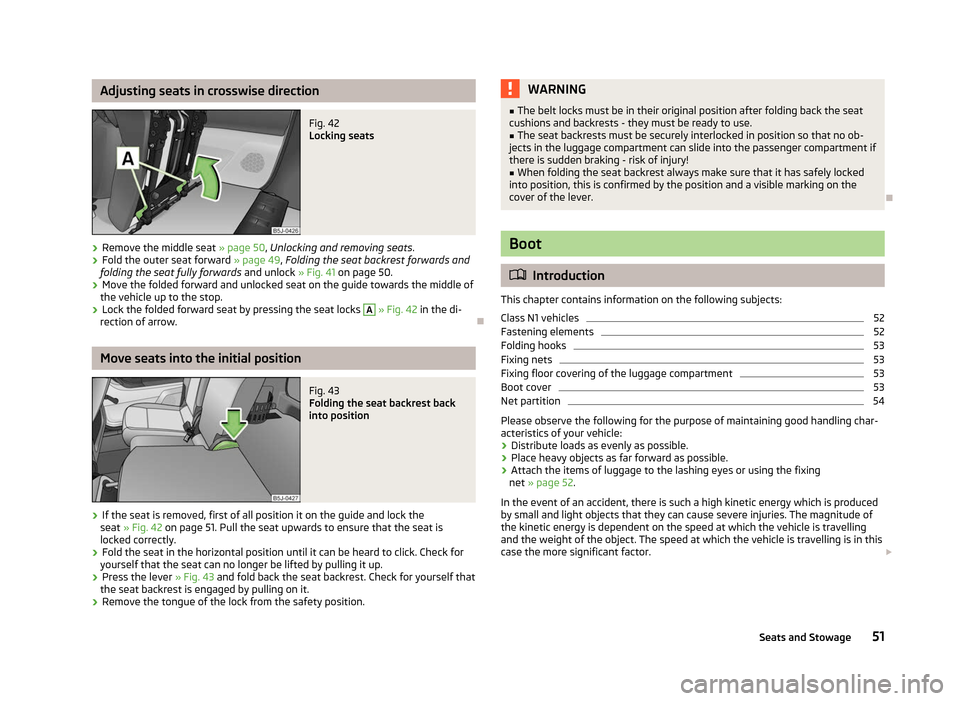
Adjusting seats in crosswise direction
Fig. 42
Locking seats
› Remove the middle seat
» page 50, Unlocking and removing seats .
› Fold the outer seat forward
» page 49, Folding the seat backrest forwards and
folding the seat fully forwards and unlock » Fig. 41 on page 50.
› Move the folded forward and unlocked seat on the guide towards the middle of
the vehicle up to the stop.
› Lock the folded forward seat by pressing the seat locks A
» Fig. 42 in the di-
rection of arrow. ÐMove seats into the initial position
Fig. 43
Folding the seat backrest back
into position
› If the seat is removed, first of all position it on the guide and lock the
seat » Fig. 42 on page 51. Pull the seat upwards to ensure that the seat is
locked correctly.
› Fold the seat in the horizontal position until it can be heard to click. Check for
yourself that the seat can no longer be lifted by pulling it up.
› Press the lever
» Fig. 43 and fold back the seat backrest. Check for yourself that
the seat backrest is engaged by pulling on it.
› Remove the tongue of the lock from the safety position. WARNING
■ The belt locks must be in their original position after folding back the seat
cushions and backrests - they must be ready to use.
■ The seat backrests must be securely interlocked in position so that no ob-
jects in the luggage compartment can slide into the passenger compartment if
there is sudden braking - risk of injury! ■ When folding the seat backrest always make sure that it has safely locked
into position, this is confirmed by the position and a visible marking on the
cover of the lever. Ð Boot
ä
Introduction
This chapter contains information on the following subjects:
Class
N1 vehicles 52
Fastening elements 52
Folding hooks 53
Fixing nets 53
Fixing floor covering of the luggage compartment 53
Boot cover 53
Net partition 54
Please observe the following for the purpose of maintaining good handling char-
acteristics of your vehicle:
› Distribute loads as evenly as possible.
› Place heavy objects as far forward as possible.
› Attach the items of luggage to the lashing eyes or using the fixing
net »
page 52 .
In the event of an accident, there is such a high kinetic energy which is produced
by small and light objects that they can cause severe injuries. The magnitude of
the kinetic energy is dependent on the speed at which the vehicle is travelling
and the weight of the object. The speed at which the vehicle is travelling is in this
case the more significant factor. £
51
Seats and Stowage
Page 57 of 194

Installing and removing the net partition behind the rear seats is carried out anal-
ogously as behind the rear seats. Use the lower fixing eyes on the carrier rails in
order to attach the carabines. To enlarge the boot, the rear seats can be removed.
Installing and removing the net partition behind the rear seats with variable load-
ing floor » page 55 is carried out analogously as behind the rear seats without
variable loading floor. To attach the carabines, use the lower eyes at the fixing
wedges on the front part of the variable loading floor.
The opening D
» Fig. 48
in the net partition is designed to feed through the
three-point seat belt » page 107, Seat belt for the rear middle seat .ÐVariable loading floor in the boot
Introductory information
The variable loading floor makes handling of bulky items of luggage easier. CAUTION
The maximum permissible load of the variable loading floor is 75 kg.Note
The room under the variable loading floor can be used to stow objects. ÐDividing the boot with variable loading floor
Fig. 49
Dividing the boot
› Lift up the part with the holder and secure it by sliding it into the grooves
marked with the arrows »
Fig. 49. Ð Removing/installing the variable loading floor
Fig. 50
Fold up variable loading floor/remove
Removing › Unhook the loops A
» Fig. 50 of the elastic partition out of the fixing points.
› Unlock the variable loading floor by turning the locking bolts B
to the left by
around 180°.
› Fold up the variable loading floor by moving it in the direction of the arrow C
.
› Fold up the variable loading floor in the direction of the arrow 1
and remove
by pulling in the direction of the arrow 2
.
Install
› Fold up the variable loading floor and place it on the carrier rails.
› Fold out the variable loading floor.
› Lock the variable loading floor by turning the locking bolts B
» Fig. 50 to the
right by around 180°.
› Secure the loops A
of the elastic partition to the fixing points.
WARNING
Ensure that the carrier rails and variable loading floor are correctly fastened
when installing the variable loading floor. If this is not the case, there is a risk
of injury for the occupants. Ð
55
Seats and Stowage
Page 59 of 194

WARNING
When transporting bicycles, ensuring the safety of the passengers is para-
mount. CAUTION
Be careful when maneuvering the bicycle - risk of damage to the vehicle. ÐInstall cross member
Fig. 53
Install cross member
First read and observe the introductory information and safety warn-
ings on page 56.
›
Remove the luggage compartment cover
» page 53.
› Fold the rear seats forward, remove
» page 50.
› Undo the securing screws C
» Fig. 53 and remove a little to unlock the holders B
.
› Place the cross member A
with the fixed part onto the right lashing eye and
then place it on the left lashing eye with the removable part of the cross mem-
ber A
.
› Press the holders B
until they latch. Tighten the securing screws C
.
› Check how well the cross member is fastened by pulling on it. Ð
ä Install bicycle carrier
Fig. 54
Install bicycle carrier
First read and observe the introductory information and safety warn-
ings on page 56.
›
Position the approved bicycle carrier on the cross member.
› Remove the screw A
» Fig. 54 a little and push the frame side rail (alu-part)
towards the cross member until the socket latches.
› Insert the screw A
into the nut.
› Undo the screw B
on the movable part of the bicycle carrier and unscrew.
› Place the movable part of the fixture, depending on the size of the vehicle, in
one of the possible positions so that the bicycle does not touch the boot lid. We
recommend to place the moveable part of the fixture in such a position that 7
holes are visible between the screw A
and the moveable part.
› Insert the screw B
into the desired position and tighten.
Ð
ä
57
Seats and Stowage
Page 66 of 194

Front armrest with storage compartment
Fig. 68
Armrest: Storage compartment/open storage compartment
Fold the armrest forwards
› Press the bottom button on the face end of the armrest
» Fig. 68 - .
› Fold the arm rest forward and release the button again.
Opening the storage compartment
› Press the top button and fold the cover of the stowage compartment up-
wards » Fig. 68 - . Note
The moving space of the arms can be restricted if the armrest is folded forwards.
In city traffic the armrest should not be folded forwards. ÐFolding table on the medium seat rest
Fig. 69
Rear seats: Armrest The medium seat rest can be used after folding the
»
page 49, Folding the seat
backrest forwards and folding the seat fully forwards armrest forward or the ta-
ble with the cup holder » Fig. 69.
Two beverage containers can be placed into the recesses. WARNING
■ Never put hot beverage containers in the cup holder. If the vehicle moves,
they may spill - risk of scalding!
■ Do not use any cups or beakers which are made of brittle material (e.g. glass,
porcelain). This could lead to injuries in the event of an accident. CAUTION
■ Do not leave open beverage containers in the cup holder during the journey.
There is a risk of spilling e.g. when braking which may cause damage to the elec-
trical components or seat upholstery.
■ If the middle rear seat backrest should be folded forward for lengthy periods,
then make sure that the belt locks are not located below it - this can warp the
upholstery or fabric. Ð Storage compartments in the doors
Fig. 70
Storage compartment: in the front door/in the rear door
A bottle holder is located in the area B
» Fig. 70 of the storage compartment for
the front doors. £
64 Using the system
Page 67 of 194

WARNING
Use the area A
» Fig. 70 of the storage compartment only for storing objects
which do not project so that the effectiveness of the side airbag is not im-
paired. ÐStorage compartments in the boot
Fig. 71
Storage compartments in the
side trim panel
Storage compartments are located on both sides of the luggage compart-
ment » Fig. 71. CAUTION
The storage compartments are designed for storing small objects of up to 1.5 kg.
in weight in total. ÐFlexible storage compartment
Fig. 72
Flexible storage compartment The flexible storage compartment
» Fig. 72 can be built into the right-hand side of
the luggage compartment.
Install
› Insert both ends of the flexible storage compartment into the openings of the
right side trim panel of the boot and push it downwards until it locks.
Removing
› Grasp the flexible storage compartment on the two upper corners.
› Press the upper corners inwards and release the storage compartment by pull-
ing upwards.
› Remove by pulling towards you. CAUTION
The storage compartment is designed for storing small objects with a maximum
total weight of 8 kg. Note
If the variable loading floor » page 55 is installed in the luggage compartment, no
flexible storage compartment can be installed. Ð Clothes hooks
The clothes hooks are located on the handle of the headliner above each of the
rear doors. WARNING
■ Ensure that any clothes hanging from the hooks do not impair your vision to
the rear.
■ Only use the hooks for hanging light items of clothing and ensure that there
are no heavy or sharp-edged objects in the pockets.
■ Do not use clothes hangers for hanging up items of clothing otherwise this
may reduce the effectiveness of head airbags. CAUTION
The maximum permissible load of the hooks is 2 kg. Ð
65
Seats and Stowage