2012 SKODA OCTAVIA service
[x] Cancel search: servicePage 105 of 222

Information about convenience consumers and the amount of fuel con-sumed » operating instructions for Infotainment , chapter Setting vehicle systems
(CAR button) .
A maximum of three convenience consumers are displayed in the Infotainment
display- the top 3 in terms of energy consumption.
You can decide to switch off the consumers or to set them to a lower level to re-duce the level of fuel consumption.
Checking tyre inflation pressures
Tyres which are correctly inflated save fuel.
Always ensure the tyre inflation pressure is correct. If the inflation pressure is too
low, the tyres must overcome a higher rolling resistance. This will not only in-
crease fuel consumption but also tyre wear and the driving behaviour will worsen.
Always check the tyre inflation pressure when the tyres are cold.
Avoid unnecessary ballast
Transporting ballast costs fuel.
Every additional kilogram in weight increases the fuel consumption. We there-
fore recommend you do not travel with any unnecessary weight.
It is particularly in town traffic, when one is accelerating quite often, that the ve-
hicle weight will have a significant effect upon the fuel consumption. A rule of
thumb here is that an increase in weight of 100 kilograms will cause an increase
in fuel consumption of about 1 litre/100 kilometres.
At a speed of 100 - 120 km/h, a vehicle fitted with a roof rack cross member with-
out a load will use about 10 % more fuel than normal due to the increased aero- dynamic drag.
Regular servicing
A poorly tuned engine uses an unnecessarily high amount of fuel.
By having your vehicle regularly maintained by a ŠKODA specialist garage, you
create the conditions needed for driving economically. The maintenance state of your vehicle has a positive effect on traffic safety and value retention.
A poorly tuned engine can result in a fuel consumption which is 10 % higher than normal!
Check the oil at regular intervals, e.g. when filling up. Oil consumption is depend-
ent to a considerable extent on the load and speed of the engine. Oil consump-
tion could be as high as 0.5 litres/1 000 km depending on your style of driving.
It is quite normal that a new engine has a higher oil consumption at first, and rea- ches its lowest level only after a certain running in time. The oil consumption of anew vehicle can therefore only be correctly assessed after driving about5 000 km.
For the sake of the environment
■ Additional improvements to the fuel economy can be made by using synthetic
high-lubricity oils.■
Regularly check the ground under the vehicle. Have your vehicle inspected by a
ŠKODA specialist garage if you find any stains caused by oil or other fluids on the
floor.
Note
We recommend that your vehicle is serviced on a regular basis by a ŠKODA Part-
ner.
Environmental compatibility
Environmental protection has played a major role in the design, selection of mate-
rials and manufacture of your new ŠKODA. Particular emphasis has been placed
on the following points:
Design measures › Joints designed to be easily detached.
› Simplified disassembly due to the modular structure system.
› Improved purity of different classes of materials.
› Identification of all plastic parts in accordance with VDA Recommendation 260.
› Reduced fuel consumption and exhaust emission CO
2.
› Minimum fuel leakage during accidents.
› Reduced noise.
Choice of materials › Extensive use of recyclable material.
› Air conditioning filled with CFC-free refrigerant.
103Driving and the Environment
Page 113 of 222

WARNING■Never use the safety eye to tow a vehicle!■The increased safety offered by the trailer stabilisation must not tempt you
to take greater risks than otherwise.■
Adapt your speed to the conditions of the road surface and to the traffic sit-
uation.
■
Improper or incorrectly connected electric cables can energise the trailer and
cause functional faults to the vehicle's entire electrical system as well as acci-
dents and severe injuries.
■
All work on the electrical system must be carried out only by ŠKODA special-
ist garages.
■
Never directly connect the trailer's electrical system with the electrical con-
nections for the tail lights or other current sources.
CAUTION
■ The trailer stabilisation need not be able to correctly detect all of driving situa-
tions.■
Trailers that sway slightly are not always detected by the trailer stabilisation
and thus are not stabilised accordingly.
■
Release the pressure on the accelerator pedal if the system is being regulated.
■
Avoid abrupt and sudden driving/braking manoeuvres.
Note
■ Contact between the breakaway cable and the safety eye can result in mechan-
ical wear on the protective surface of the eye. Such wear does not impair the
functioning of the safety eye and is not a fault. It is excluded from the warranty
coverage.■
If you tow a trailer frequently, have your car inspected between service inter-
vals too.
■
The handbrake on the towing vehicle must be put on when coupling and decou-
pling the trailer.
■
For technical reasons, trailers with rear LED lights cannot be connected to the
anti-theft alarm system.
111Towing a trailer
Page 172 of 222

WARNINGWhen working in the engine compartment, injuries, scolding, accident or fire
hazards may arise. For this reason, it is essential to comply with the warning
instructions stated below and with the general applicable rules of safety. The
engine compartment of your car is a hazardous area!■
Before beginning work in the engine compartment, please read the follow-
ing advice. ■ Turn off the engine and withdraw the ignition key.
■ Firmly apply the handbrake.
■ If the vehicle is fitted with a manual gearbox, move the gearshift lever into
Neutral, or if the vehicle is fitted with an automatic gearbox, move the se- lector lever into position P.
■ Allow the engine to cool.
■ Never open the bonnet if you can see steam or coolant flowing out of the
engine compartment – risk of scalding! Wait until the steam or coolant has stopped escaping.
■
While working in the engine compartment, please read the following advice.
■ Keep children clear of the engine compartment.
■ Never touch the radiator fan while the engine is still warm. The fan might
suddenly start running!
■ Do not touch any hot engine parts – risk of burns!
■ The coolant additive and thus all of the coolant is harmful to your health.
■ Avoid contact with the coolant.
■ Coolant vapours are harmful to health.
■ Never open the end cover of the coolant expansion reservoir while the en-
gine is still warm. The cooling system is pressurized!
■ When opening the end cover of the coolant expansion reservoir, cover it
with a cloth to protect your face, hands and arms from hot steam or hot coolant. ■ If any coolant splashes into your eyes, immediately rinse out your eyes
with clear water and contact a doctor as soon as possible.
■ Always safely store the coolant additive in its original container out of the
reach of children – risk of poisoning!
■ If coolant is swallowed - consult a doctor immediately.
■ Do not leave any items such as cloths or tools in the engine compartment.
■ Never spill fluids on the hot engine. Such fluids (e.g. the antifreeze con-
tained in the coolant) may ignite!
WARNING (Continued)■ Whenever working in the engine compartment while the engine is running,
you must pay heed to the following warning instructions. ■Pay particular attention to moving engine parts (e.g. V-ribbed belt, alterna-
tor, radiator fan) and the high-voltage ignition unit - danger to life! ■ Never touch the electric wiring on the ignition system.
■ Avoid short circuits in the electrical system – particularly on the vehicle's
battery. ■ Always make sure that no jewellery, loose clothing or long hair can get
caught in rotating engine parts – hazard! Always remove any jewellery, tie back long hair and wear tight fitting clothing before completing any work.■
The following warning instructions must be observed if work has to be car-
ried out on the fuel or electrical system. ■ Always disconnect the vehicle battery from the electrical system.
■ Do not smoke.
■ Never work near open flames.
■ Always have a functioning fire extinguisher nearby.
■
Read the information and warning instructions on the fluid containers.
■
Keep fluids in their original containers and keep out of reach of children!
■
If you wish to work under the vehicle, you must secure the vehicle from roll-
ing away and support it with suitable supporting blocks: the car jack is not
sufficient for this – risk of injury!
■
The bonnet must always be properly closed when driving. This is why after
closing the bonnet, the lock must always be checked to ensure it has engaged
properly.
■
If you notice that the lock is not properly engaged while driving, stop the ve-
hicle immediately and close the bonnet – risk of an accident!
CAUTION
■ Always top up using the correct specification of fluids. This may result in major
operating problems and also vehicle damage!■
Never open the bonnet using the locking lever.
For the sake of the environment
In view of the environmentally friendly disposal of fluids, the specials tools and
knowledge required for such work, we recommend that fluids are changed by a
Škoda Partner as part of the inspection service. 170General Maintenance
Page 175 of 222

We recommend maintaining the oil level within the range A, but not above , if
the engine has been operating at high loads, for example, during a lengthy motor-
way trip during the summer months, towing a trailer or negotiating a high moun- tain pass.
The warning light in the instrument cluster will indicate whether the oil level is too low » page 15 . Check the oil level using the dipstick as soon as possible. Add
oil accordingly.WARNINGDo not continue your journey if for some reason it is not possible to top up
the engine oil under the prevailing conditions! Switch off the engine and seek
assistance from a ŠKODA specialist garage.
CAUTION
The oil level must on no account extend beyond the range A » Fig. 149 - Risk of
damaging the exhaust system!
Replenishing the engine oil
First read and observe the introductory information and safety warn-
ings
on page 169.
›
Check the engine oil level » page 172.
›
Unscrew the cap of the engine oil filler opening » Fig. 148 on page 172.
›
Replenish the oil in portions of 0.5 litres in accordance with the correct specifi-
cations » page 209 .
›
Check the oil level » page 172.
›
Carefully screw on the oil filler opening cap and push the dipstick in fully.
Changing engine oil
First read and observe the introductory information and safety warn-
ings
on page 169.
The engine oil must be changed at the intervals stated in the Service schedule or
according to the service interval indicator » page 11.
CAUTION
Do not pour any additives into the engine oil - Risk of serious engine damage!
Damage, which results from such product, are excluded from the warranty.
Note
If your skin has come into contact with oil, it must be washed thoroughly.
Coolant
First read and observe the introductory information and safety warn-ings
on page 169.
The coolant consists of water with a concentration of coolant additive. This mix-
ture guarantees antifreeze protection, protects the cooling/heater system
against corrosion and prevents the formation of scale.
Vehicles exported to countries with a mild climate are already factory-filled with
a coolant which offers antifreeze protection down to about -25 ℃. In these coun-
tries the concentration of coolant additive should be at least 40 %.
Vehicles exported to countries with a cold climate are already factory-filled with a
coolant which offers antifreeze protection down to about -35 °C. In these coun-
tries the concentration of coolant additive should be at least 50 %.
If a higher concentration of antifreeze is required for climatic reasons, the amount
of coolant additive can only be increased up to a maximum of 60 % (antifreeze
protection down to approx. -40 °C).
When refilling, only use the same antifreeze written on the antifreeze expansion tank » Fig. 150 on page 174.
173Inspecting and replenishing
Page 178 of 222

Brake fluid changeFirst read and observe the introductory information and safety warn-
ings
on page 169.
Brake fluid absorbs moisture. Over time it therefore absorbs moisture from the
environment.
Excessive water in the brake fluid may be the cause of corrosion in the brake sys-
tem.
The water content lowers the boiling point of the brake fluid.
The brake fluid must comply with the following standards or specifications: › VW 50114;
› FMVSS 116 DOT4.
WARNINGDo not use used brake fluid - the function of the brake system may be im-
paired - risk of accident!
CAUTION
Brake fluid damages the paintwork of the vehicle.
Note
The brake fluid is replaced as part of a proscribed Inspection service carried out by
a ŠKODA Partner.
Windscreen washer system
Fig. 152
Engine compartment: Wind-
screen washer fluid reservoirFirst read and observe the introductory information and safety warn-
ings on page 169.
The windscreen washer fluid reservoir is located in the engine compartment and
contains the cleaning fluid for the windscreen or rear window and for the head-
light cleaning system.
The capacity of the reservoir is about 3 litres or about 4.7 litres on vehicles that
have a headlight cleaning system.
Clear water is not sufficient to intensively clean the windscreen and headlights.
We recommend using clean washing water together with the screen cleaner from
the range of ŠKODA Original Accessories (in winter additionally with antifreeze)
which is capable of removing stubborn dirt.
In Winter, the washing water should always be mixed with antifreeze even if the
vehicle has heated windscreen washer nozzles.
Under exceptional circumstances, methylated spirits can also be used if no screen
cleaner with antifreeze is available. The concentration of methylated spirits must
not be more than 15 %. The freeze protection at this concentration is sufficient
only to -5 °C.
CAUTION
■ Under no circumstances must radiator antifreeze or other additives be added to
the windscreen washer fluid.■
If the vehicle is fitted with a headlight cleaning system, only cleaning products
which do not attack the polycarbonate coating of the headlights must be added
to the windscreen washer fluid.
■
Do not remove the filter from the windscreen washer fluid reservoir when re-
plenishing it with liquid otherwise the liquid transportation system can be conta-
minated, which can cause the windscreen washer system to malfunction.
Vehicle battery
Introduction
This chapter contains information on the following subjects:
Battery cover
178
Checking the battery electrolyte level
179
Charging a vehicle battery
179
176General Maintenance
Page 181 of 222

Checking the battery electrolyte levelFig. 154
Vehicle battery: Electrolyte level
indicator
First read and observe the introductory information and safety warn-
ings on page 176.
On vehicles with a vehicle battery fitted with a colour indicator, the so-called magic eye » Fig. 154, the electrolyte level can be determined by looking at the
change in colour.
Air bubbles can influence the colour of the indicator. For this reason carefully
knock on the indicator before carrying out the check.
› Black colour – electrolyte level is correct.
› Colourless or light yellow colour – electrolyte level too low, the battery must be
replaced.
For technical reasons, on vehicles with the description “AGM”, the electrolyte lev- el cannot be checked.
Vehicles with a START-STOP system are fitted with a battery control unit for checking the energy level for the recurring engine start.
We recommend you have the electrolyte level checked by a ŠKODA specialist ga-
rage from time to time, especially in the following cases.
› High external temperatures.
› Longer day trips.
› After each charge.
Winter time
The vehicle battery only has a proportion of the starting power in lower tempera- tures. A discharged vehicle battery may already freeze at temperatures just be-
low 0 °C .
We therefore recommend that you have the battery checked and, if necessary, re-
charged by a ŠKODA Partner before the start of the winter.
NoteThe battery electrolyte level is periodically checked by a ŠKODA Partner as part of
the Inspection Service.
Charging a vehicle battery
First read and observe the introductory information and safety warn-ings
on page 176.
A properly charged vehicle battery is essential for reliably starting the engine.
›
Switch off the ignition and all of the electrical components.
›
Only when performing a “quick-charge”, disconnect both battery cables (first of
all “negative”, then “positive”).
›
Attach the terminal clamps of the charger to the battery terminals (red = “posi-
tive”, black = “negative”).
›
Plug the mains cable of the charger into the power socket and switch on thedevice.
›
After charging has been successful: Switch off the charger and remove themains cable from the power socket.
›
Only then disconnect the charger's terminal clamps.
›
Reconnect the cables to the battery (first of all “positive”, then “negative”).
It is not necessary to disconnect the cables of the battery if you recharge the ve- hicle battery using low amperages (for example from a mini-charger). Refer to the
instructions of the charger manufacturer .
A charging current of 0.1 multiple of the total vehicle battery capacity (or lower) must be used until full charging is achieved.
It is necessary to disconnect both cables before charging the battery with high
amperages, so-called “ quick-charging”.
The vent plugs of the vehicle battery should not be opened for charging.
Replacing the vehicle battery
When replacing a battery, the new vehicle battery must have the same capacity,
voltage, amperage and be the same size. Suitable types of vehicle batteries can
be purchased from a ŠKODA Partner.
We recommend that the battery is replaced by a ŠKODA Partner, where the new
vehicle battery will be installed properly and the original battery will be disposed
of in accordance with national regulations.
179Inspecting and replenishing
Page 209 of 222
Technical data
Technical data
Introductory information
The details given in the vehicle's technical documentation always take prece-
dence over the details in the Owner's Manual. It can be found in the official vehi-
cle registration documents or you can find out from a ŠKODA Partner what engine
the vehicle is fitted with.
The listed performance values were determined without performance-reducing
equipment, e.g. air conditioning system.
Vehicle identification data
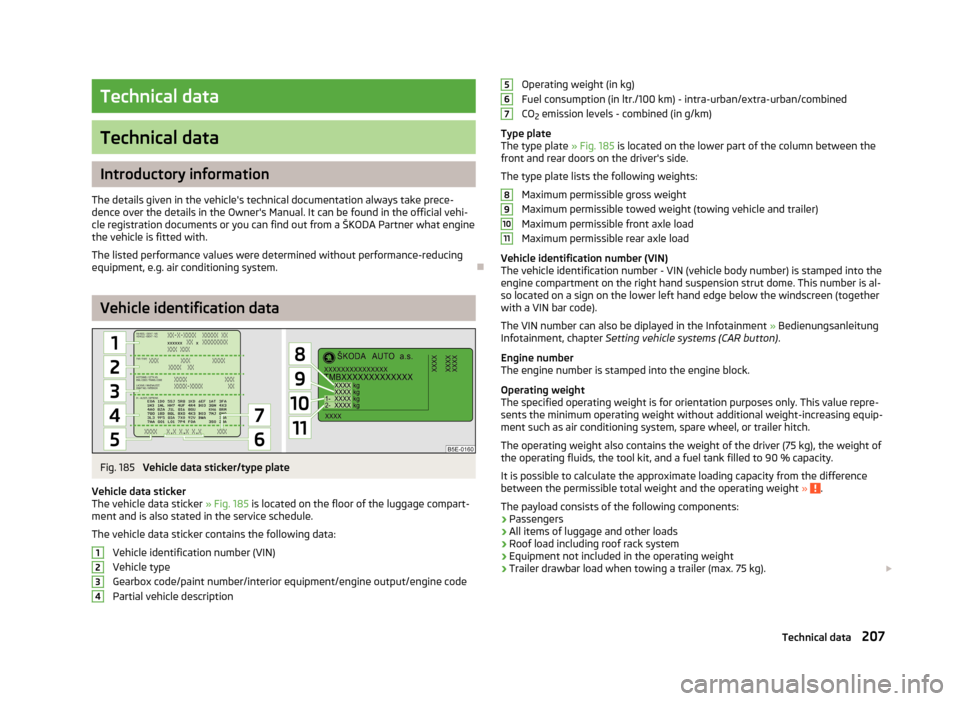
Fig. 185
Vehicle data sticker/type plate
Vehicle data sticker
The vehicle data sticker » Fig. 185 is located on the floor of the luggage compart-
ment and is also stated in the service schedule.
The vehicle data sticker contains the following data: Vehicle identification number (VIN)
Vehicle type
Gearbox code/paint number/interior equipment/engine output/engine code Partial vehicle description
1234Operating weight (in kg)
Fuel consumption (in ltr./100 km) - intra-urban/extra-urban/combined
CO 2 emission levels - combined (in g/km)
Type plate
The type plate » Fig. 185 is located on the lower part of the column between the
front and rear doors on the driver's side.
The type plate lists the following weights: Maximum permissible gross weight
Maximum permissible towed weight (towing vehicle and trailer)
Maximum permissible front axle load
Maximum permissible rear axle load
Vehicle identification number (VIN)
The vehicle identification number - VIN (vehicle body number) is stamped into the engine compartment on the right hand suspension strut dome. This number is al-
so located on a sign on the lower left hand edge below the windscreen (together
with a VIN bar code).
The VIN number can also be diplayed in the Infotainment » Bedienungsanleitung
Infotainment, chapter Setting vehicle systems (CAR button) .
Engine number
The engine number is stamped into the engine block.
Operating weight
The specified operating weight is for orientation purposes only. This value repre- sents the minimum operating weight without additional weight-increasing equip- ment such as air conditioning system, spare wheel, or trailer hitch.
The operating weight also contains the weight of the driver (75 kg), the weight of
the operating fluids, the tool kit, and a fuel tank filled to 90 % capacity.
It is possible to calculate the approximate loading capacity from the difference
between the permissible total weight and the operating weight »
.
The payload consists of the following components: › Passengers
› All items of luggage and other loads
› Roof load including roof rack system
› Equipment not included in the operating weight
› Trailer drawbar load when towing a trailer (max. 75 kg).
567891011207Technical data
Page 211 of 222

Specifications and engine oil capacity
The engine has been factory-filled with a high-grade oil that can be use through-
out the year - except in extreme climate zones.
The engine oils are undergoing continuous further development. Thus the infor-
mation stated in this Owner's Manual is only correct at the time of publication.
ŠKODA Partners are informed about the latest changes by ŠKODA. We therefore
recommend that the oil change is completed by a ŠKODA Partner.
The specifications (VW standards) stated in the following can be indicated sepa-rately or together with other specifications on the bottle.
The oil capacities include oil filter change. Check the oil level when filling; do notover fill. The oil level must be between the markings » page 172.
Specifications and capacity (in l) for vehicles with flexible service intervalsPetrol enginesSpecificationCapacities (in li- tres)1.2 ltr./63 kW TSI
VW 504 004.01.4 ltr./103 kW TSI1.8 ltr./132 kW TSI5.2Diesel enginesSpecificationCapacities (in li-tres)1.6 ltr./77 kW TDIVW 507 004.62.0 ltr./110 kW TDI
Specifications and capacity (in l) for vehicles with fixed service intervals
Petrol enginesSpecificationCapacities (in li-tres)1.2 ltr./63 kW TSI
VW 502 004.01.4 ltr./103 kW TSI1.8 ltr./132 kW TSI5.2Diesel enginesSpecificationCapacities (in li-tres)1.6 ltr./77 kW TDIVW 507 004.62.0 ltr./110 kW TDICAUTION■If the above engine oils are not available, a different engine oil can be used in
an emergency. To prevent damage to the engine, a max. 0.5 l only of the follow-
ing engine oils may be used until the next oil change: ■ For petrol engine models: ACEA A3/ACEA B4 or API SN/API SM;
■ For diesel engine models: ACEA C3 or API CJ-4.
Note
■Before a long drive we recommend that you purchase and carry with you engine
oil which complies with the specification for your vehicle.■
We recommend that you use oils from ŠKODA Original Accessories.
209Technical data