2012 SKODA FABIA lock
[x] Cancel search: lockPage 168 of 196
›
Attach the other end 4
to a solid metal part which is connected firmly to the
engine block, or to the engine block itself.
Starting engine
› Start the engine on the vehicle providing the power and allow it to idle.
› Now start the engine of the vehicle with the discharged battery.
› If the engine does not start, terminate the attempt to start the engine after
10 seconds and wait for about 30 seconds before repeating the process.
› Disconnect the cables in exactly the
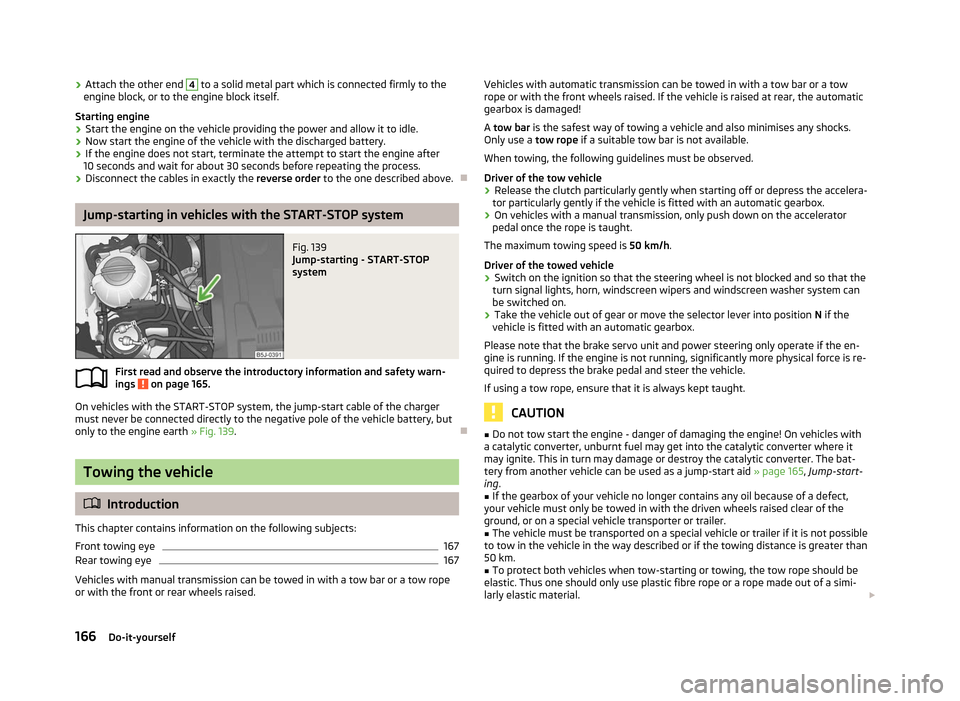
reverse order to the one described above. ÐJump-starting in vehicles with the START-STOP system
Fig. 139
Jump-starting - START-STOP
system
First read and observe the introductory information and safety warn-
ings on page 165.
On vehicles with the START-STOP system, the jump-start cable of the charger
must never be connected directly to the negative pole of the vehicle battery, but
only to the engine earth » Fig. 139. ÐTowing the vehicle
ä
Introduction
This chapter contains information on the following subjects:
Front towing eye 167
Rear towing eye 167
Vehicles with manual transmission can be towed in with a tow bar or a tow rope
or with the front or rear wheels raised.
ä Vehicles with automatic transmission can be towed in with a tow bar or a tow
rope or with the front wheels raised. If the vehicle is raised at rear, the automatic
gearbox is damaged!
A tow bar
is the safest way of towing a vehicle and also minimises any shocks.
Only use a tow rope if a suitable tow bar is not available.
When towing, the following guidelines must be observed.
Driver of the tow vehicle
› Release the clutch particularly gently when starting off or depress the accelera-
tor particularly gently if the vehicle is fitted with an automatic gearbox.
› On vehicles with a manual transmission, only push down on the accelerator
pedal once the rope is taught.
The maximum towing speed is 50 km/h.
Driver of the towed vehicle
› Switch on the ignition so that the steering wheel is not blocked and so that the
turn signal lights, horn, windscreen wipers and windscreen washer system can
be switched on.
› Take the vehicle out of gear or move the selector lever into position
N if the
vehicle is fitted with an automatic gearbox.
Please note that the brake servo unit and power steering only operate if the en-
gine is running. If the engine is not running, significantly more physical force is re-
quired to depress the brake pedal and steer the vehicle.
If using a tow rope, ensure that it is always kept taught. CAUTION
■ Do not tow start the engine - danger of damaging the engine! On vehicles with
a catalytic converter, unburnt fuel may get into the catalytic converter where it
may ignite. This in turn may damage or destroy the catalytic converter. The bat-
tery from another vehicle can be used as a jump-start aid » page 165, Jump-start-
ing .
■ If the gearbox of your vehicle no longer contains any oil because of a defect,
your vehicle must only be towed in with the driven wheels raised clear of the
ground, or on a special vehicle transporter or trailer.
■ The vehicle must be transported on a special vehicle or trailer if it is not possible
to tow in the vehicle in the way described or if the towing distance is greater than
50 km. ■ To protect both vehicles when tow-starting or towing, the tow rope should be
elastic. Thus one should only use plastic fibre rope or a rope made out of a simi-
larly elastic material. £
166 Do-it-yourself
Page 172 of 196

No. Power consumer
32 High pressure fuel pump, pressure valve
33 Engine control unit
34 Engine control unit, vacuum pump 35 Power supply of ignition lock
36 Main beam 37 Rear fog light, DC/DC converter START-STOP
38 Fog lights 39 Air blower for heating
40-41 Not assigned 42 Rear window heater
43 Horn
44 Windscreen wipers 45 Central control unit for convenience system
46 Engine control unit, fuel pump 47 Cigarette lighter, power socket in the luggage compartment
48 ABS, START-STOP (DC/DC) converter ESP 49 Turn signal lights, brake lights50 START-STOP (DC/DC) converter infotainment, radio 51 Electrical power window (front and rear) - left side
52 Electrical power window (front and rear) - right side
53 Parking light = left side, electrical sliding/tilting roof
54 START-STOP (instrument cluster), alarm 55 Control unit for automatic gearbox
56 Headlight cleaning system, parking light - right side 57 Left low beam, headlight range adjustment
58 Low beam on the right Ð Fuses in the engine compartment
Fig. 144
Vehicle battery: Distribution board cover. Fig. 145
Schematic representation of
fuse box in engine compartment
First read and observe the introductory information and safety warn-
ings on page 168.
›
Press together the circlips in the fuse box cover at the same time in the direc-
tion of arrow A
» Fig. 144
and remove the cover in the direction of arrow B
.
› Release the fixtures in the openings C
using a flat screwdriver and fold the
cover upwards in direction of arrow D
.
Fuse assignment in engine compartment No. Power consumer
1 Generator
2 Not assigned
3 Interior
4 Electrical auxiliary heating system 5 Interior £ ä
170 Do-it-yourself
Page 174 of 196

Headlights
Fig. 146
Bulb arrangement: Halogen headlights/halogen projector head-
lights
First read and observe the introductory information and safety warn-
ings on page 171.
Bulb arrangement in the Halogen headlamp
A
- low beam, main beam and side lights
B
- front turn signal light
Bulb arrangement in the Halogen projector headlights 1
- low beam/low and main beam
2
- Parking light/parking and main beam lights
3
- front turn signal light
Ð
ä Replacing a bulb for low beam and main beam (halogen
headlights)
Fig. 147
Removing bulbs for low and
main beam
First read and observe the introductory information and safety warn-
ings on page 171.
›
Remove the rubber cover A
» Fig. 146 on page 172.
› Remove the connector on the bulb, unlock the circlip, and remove the light
bulb » Fig. 147 .
› Insert a new light bulb in such a way that the fixing lugs of the bulb socket fit in
the recesses of the reflector.
› Lock the circlip and insert the connector in the bulb.
› Insert the rubber cover. Ð
ä
172 Do-it-yourself
Page 175 of 196

Replacing a bulb for low beam and main beam Halogen
projector headlights)
Fig. 148
Removing bulbs for low beam/
low and main beam
First read and observe the introductory information and safety warn-
ings on page 171.
›
Remove the rubber cover 1
» Fig. 146 on page 172.
› Turn the connector with the bulb in
anti-clockwise direction up to the
stop » Fig. 148 and remove it.
› Replace the lamp, insert the connector with the new bulb and turn
clockwise
up to the stop.
› Insert the rubber cover. ÐReplacing the bulb for the main beam (Halogen projector
headlights)
Fig. 149
Removing the bulb for the main
beam
First read and observe the introductory information and safety warn-
ings on page 171.ä
ä ›
Remove the rubber cover 2
» Fig. 146 on page 172.
› Turn the connector with the bulb in
anti-clockwise direction up to the
stop » Fig. 149 and remove it.
› Replace the lamp, insert the connector with the new bulb and turn
clockwise
up to the stop.
› Insert the rubber cover. Ð Changing the bulb for the front turn signal light
First read and observe the introductory information and safety warn-
ings on page 171.
›
Remove the socket B
» Fig. 146
on page 172 or the socket 3
up to the stop
in
an anti-clockwise direction and remove along with the bulb for the turn signal
light.
› Replace the bulb, insert the socket with the new bulb and turn
clockwise up to
the stop. Ð Changing the light bulb for the front parking light
First read and observe the introductory information and safety warn-
ings on page 171.
›
Remove the rubber cover A
» Fig. 146 on page 172 and 2
. 2
.
› Grasp the lamp holder and remove it from the bulb housing.
› Replace the light bulb and insert the lamp holder back into the headlamp with
the bulb.
› Insert the rubber cover. Ð
ä
ä
173
Fuses and light bulbs
Page 176 of 196

Fog lights and daytime running lights
Fig. 150
Front bumper: Protective grille/removing the fog light
First read and observe the introductory information and safety warn-
ings on page 171.
Bulb arrangement
» Fig. 150.A
- Bulb for daylight driving light
B
- Light bulb for fog lights
Removing the cap
› Grasp the protective grille in the areas marked by the arrows
» Fig. 150 - and
remove the cover.
Replacing light bulbs for fog lights/daytime running lights
› Insert your hand into the opening in the protective grille and press the
catch » Fig. 150 - in the direction of the arrow.
› Remove the front fog lamp.
› Turn the connector with the bulb in
counter-clockwise up to the stop and re-
move.
› Replace the lamp, insert the connector with the new bulb and turn
clockwise
up to the stop.
› To re-install the fog light, first of all place the fog light with the lug on the side
opposite the licence plate.
› Press in the fog lamp on the side closest to the licence plate.
› Insert the cap, beginning with the lug on the side opposite the license plate.
› Press in the cap on the side facing the license plate. The cap must engage firm-
ly. Ð
ä Fog lights Fabia Scout, Fabia RS
Fig. 151
Front bumper: Fabia Scout/Fabia RS Fig. 152
Front bumper: Fog lights/fog lights: Replacing the light bulb
First read and observe the introductory information and safety warn-
ings on page 171.
Removing the cap and fog light
›
Guide the wire clamp into the opening above the fog light
» Fig. 151 - (Fabia
Scout) » page 158 , Vehicle tool kit and remove the cover.
› Insert a finger into the opening next to the foglight
» Fig. 151 - (Fabia RS) and
remove the cap.
› Use the screwdriver
» page 158, Vehicle tool kit to remove the screws » Fig. 152
- .
› Remove the front fog lamp.
£
ä
174 Do-it-yourself
Page 177 of 196

Changing light bulbs and installing fog lights
›
Press the locking button 1
» Fig. 152 of the plug A
and remove the plug from
the socket B
.
› Turn the socket B
with the bulb counter-clockwise
up to the stop and remove.
› Replace the bulb, insert the socket with the new bulb and turn
clockwise up to
the stop.
› Insert the plug A
into the socket B
.
› Retighten the screws and insert the cap. The cap must engage firmly. ÐLicence plate light
Fig. 153
Boot lid: Licence plate light
First read and observe the introductory information and safety warn-
ings on page 171.
›
Insert a flat screwdriver into the opening in the area of the arrow
» Fig. 153 and
carefully press towards the centre of the lamp, by doing so the lamp jumps out
slightly.
› Remove the lamp.
› Remove the faulty bulb from the holder and insert a new one.
› Replace the glass cover and push in until the stop. Make sure that you install
the glass cover in the correct position. Ð
ä Tail lamp assembly
Fig. 154
Remove the rear light/install the tail light assembly: Fig. 155
Tail light assembly: Bulb ar-
rangement
First read and observe the introductory information and safety warn-
ings on page 171.
Bulb arrangement in the tail light assembly
» Fig. 155 1
- Rear fog light/Reversing light
2
- Turn signal lights
3
- Brake lights
4
- parking lights
Removing and installing the tail light
› Open the boot lid.
› Hold the tail light assembly in the installation position with one hand, and re-
move the plastic nut » Fig. 154 -
with the other. £
ä
175
Fuses and light bulbs
Page 178 of 196

›
Grip the tail lamp assembly and carefully remove it by pulling it back at an angle
with loosening movements. Do not pull the grommet with the cables out of the
bodywork.
› To re-install the tail light assembly, first of all guide it with the screw A
into
the opening of the bodywork » Fig. 154.
› Carefully press the tail light assembly into the bodywork so that the bolts B
latch with the mounts in the body.
› Hold the tail light assembly with one hand, and attach and tighten the
nuts » Fig. 154 - with the other hand.
Replacing the bulbs in the tail lamp assembly
› To replace the bulb, turn the bulb holder
anti-clockwise up to the stop and re-
move it from the housing » Fig. 155.
› Replace the bulb, insert the holder with the bulb into the housing and turn
in a
clockwise direction to the the stop.Note
For slackening and tightening the plastic nut use a coin or similar object. Ð
176 Do-it-yourself
Page 179 of 196

Technical data
Technical data
Introductory information
The details given in the vehicle's technical documentation always take prece-
dence over the details in the Owner's Manual. Please refer to the official vehicle
registration documents or consult a
ŠKODA Service Partner to determine which
engine your vehicle is equipped with.
The listed performance values were determined without performance-reducing
equipment, e.g. air conditioning system.
Vehicle identification number (VIN)
The vehicle identification number - VIN (vehicle body number) is stamped into the
engine compartment on the right hand suspension strut dome. This number is al-
so located on a sign on the lower left hand edge below the windscreen (together
with a VIN bar code).
Engine number
The engine number is stamped into the engine block. ÐData on the vehicle sticker and the type plate
Fig. 156
Vehicle data sticker/type plate Vehicle data sticker
The vehicle data sticker » Fig. 156 is located on the floor of the boot and is also
stated in the service schedule.
The vehicle data sticker contains the following data:
Vehicle identification number (VIN)
Vehicle type
Gearbox code/paint number/interior equipment/engine output/engine code
Partial vehicle description
Operating weight (in
kg)
Fuel consumption (in ltr./100 km) - intra-urban/extra-urban/combined
CO 2 emission levels - combined (in g/km)
Type plate
The type plate » Fig. 156 is located on the lower part of the column between the
front and rear doors on the front passenger's side.
The type plate lists the following weights: Maximum permissible gross weight
Maximum permissible towed weight (towing vehicle and trailer)
Maximum permissible front axle load
Maximum permissible rear axle load
Operating weight
The specified operating weight is for orientation purposes only. This value repre-
sents the minimum operating weight without additional weight-increasing equip-
ment such as air conditioning system, spare wheel, or trailer hitch.
The operating weight also contains the weight of the driver (75 kg), the weight of
the operating fluids, the tool kit, and a fuel tank filled to 90 % capacity.
It is possible to calculate the approximate loading capacity from the difference
between the permissible total weight and the operating weight » .
The payload consists of the following components:
› Passengers
› All items of luggage and other loads
› Roof load including roof rack system
› Equipment not included in the operating weight
› Trailer drawbar load when towing a trailer (max. 50 kg).
Measuring fuel consumption according to ECE standards and EU guidelines
The measurement of the intra-urban cycle begins with a cold start of the engine.
Afterwards urban driving is simulated. £ 1
2
3
4
5
6
7
8
9
10
11
177
Technical data