2012 SKODA CITIGO mirror
[x] Cancel search: mirrorPage 9 of 157

Using the system
Cockpit
Overview
Electrical power window in the driver's door 26
Central locking system 23
Electric exterior mirror adjustment 36
Air outlet vents 52
Lever for the multifunction switch:
› Turn signal lights and main beam, headlight flasher 31
› Speed regulating system 63
Steering wheel:
› With horn
› With driver’s front airbag 83
Instrument cluster: Instruments and warning lights 8
Lever for the multifunction switch:
› Multifunction display 11
› Windscreen wiper and wash system 33
Regulator for left seat heating 39
Depending on equipment fitted:
› Operating controls for the heating 52
› Operating controls for the air conditioning system 53
Socket for the cradle for the multifunction device Move & Fun 72
Warning light for the deactivated front seat passenger airbag 86
Switch for hazard warning lights 31
Storage compartment on the front passenger side 48
Front passenger airbag 83
Air outlet vents 52
Light switch 29
Bonnet release lever 108
Regulator for headlamp beam adjustment for the headlights 30
Lever for adjusting the steering wheel 57
Ignition lock 581
2
3
4
5
6
7
8
9
10
11
12
13
14
15
16
17
18
19
20
21 Radio
Button for
City Safe Drive system 66
Depending on equipment fitted:
› Gearshift lever (manual gearbox) 61
› Selector lever (automated gearbox) 70
Storage compartment 49
Regulator for right seat heating 39
Note
■ Cars with factory-fitted radio are supplied with separate instructions for operat-
ing such equipment. ■ The arrangement of the controls and switches and the location of some items
on right-hand drive models may differ from that shown in » Fig. 1. The symbols on
the controls and switches are the same as for left-hand drive models. Ð 22
23
24
25
26
7
Cockpit
Page 28 of 157
Unlocking with the remote control key
›
Press the
button in the vehicle key until the luggage compartment lid un-
locks.
Opening
› Open the luggage compartment lid by pressing the
» Fig. 16 - button.
Closing
› Reach into the recesses
» Fig. 16 - and pull the luggage compartment lid
down.
› Close the lid with a slight swing. ÐEmergency unlocking
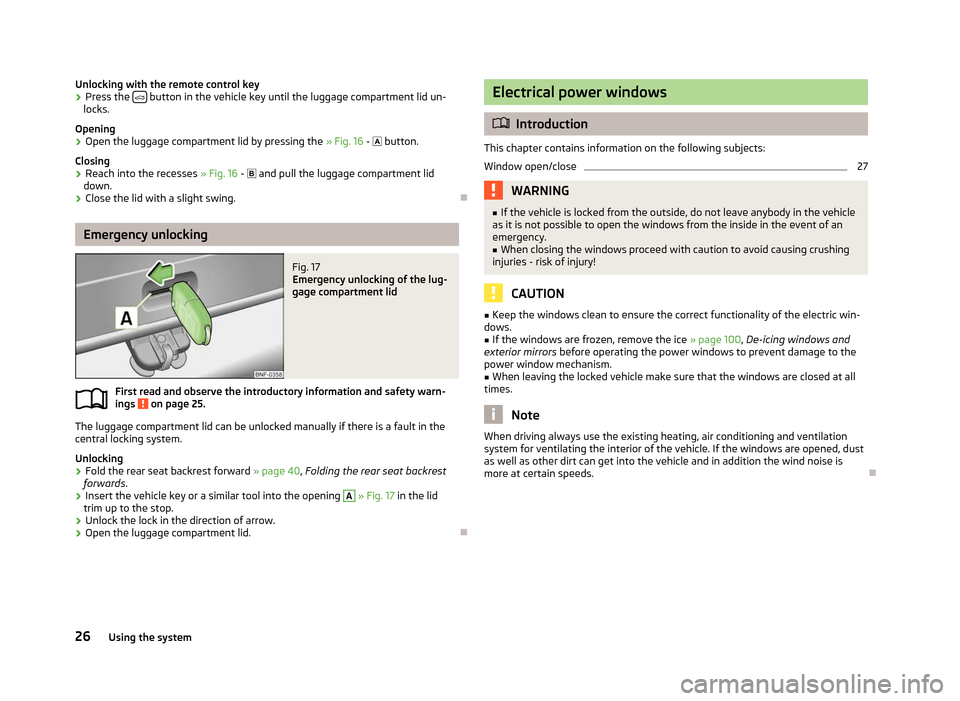
Fig. 17
Emergency unlocking of the lug-
gage compartment lid
First read and observe the introductory information and safety warn-
ings on page 25.
The luggage compartment lid can be unlocked manually if there is a fault in the
central locking system.
Unlocking
›
Fold the rear seat backrest forward
» page 40, Folding the rear seat backrest
forwards.
› Insert the vehicle key or a similar tool into the opening A
»
Fig. 17 in the lid
trim up to the stop.
› Unlock the lock in the direction of arrow.
› Open the luggage compartment lid. Ð
ä Electrical power windows
ä
Introduction
This chapter contains information on the following subjects:
Window open/close 27
WARNING
■ If the vehicle is locked from the outside, do not leave anybody in the vehicle
as it is not possible to open the windows from the inside in the event of an
emergency.
■ When closing the windows proceed with caution to avoid causing crushing
injuries - risk of injury! CAUTION
■ Keep the windows clean to ensure the correct functionality of the electric win-
dows. ■ If the windows are frozen, remove the ice » page 100, De-icing windows and
exterior mirrors before operating the power windows to prevent damage to the
power window mechanism.
■ When leaving the locked vehicle make sure that the windows are closed at all
times. Note
When driving always use the existing heating, air conditioning and ventilation
system for ventilating the interior of the vehicle. If the windows are opened, dust
as well as other dirt can get into the vehicle and in addition the wind noise is
more at certain speeds. Ð
26 Using the system
Page 35 of 157

Visibility
Rear window heater
Fig. 28
Switch for rear window heater
› The rear window heater is switched on or off by pressing the switch
» Fig. 28
the warning light in the switch comes on or goes out.
The rear window heater only operates when the engine is running.
The rear window heater switches off automatically after 10 minutes. For the sake of the environment
The heating should be switched off as soon as the window is de-iced or free from
mist. The reduced current consumption will have a favourable effect on fuel econ-
omy. Note
If the on-board voltage drops, the rear window heater switches off automatically,
in order to provide sufficient electrical energy for the engine control »
page 118,
Automatic load deactivation . Ð Sun visors
Fig. 29
Sun visor
Adjustment options of the sun visors for the driver and front passenger
› Fold the sun visor towards the windscreen.
› Pull the sun visor from the holder and swing it towards the door in the direction
of the arrow » Fig. 29.
The front passenger sun visor has a vanity mirror. Ð Windscreen wipers and washers
ä
Introduction
This chapter contains information on the following subjects:
Activating the windscreen wipers and washers 34
Replacing the windscreen wiper blades 35
Replacing the rear window wiper blade 35
The windscreen wipers and the windscreen washer system only operate if the ig-
nition is switched on.
The rear window is wiped once if the windscreen wipers are on when reverse
gear is selected.
Top up with windscreen wiper fluid » page 114. £
33
Lights and visibility
Page 37 of 157

›
Release the lever. The washer system stops and the wiper continues for anoth-
er 1-3 wiper strokes (depending on the duration of the spraying process). The
lever will stay in position after releasing it 6
.
Switching windscreen wipers off
› Move the lever back into the home position 0
» Fig. 30.
ÐReplacing the windscreen wiper blades
Fig. 31
Windscreen wiper blade
First read and observe the introductory information and safety warn-
ings on page 33.
Before replacing the windscreen wiper blade, put the windscreen wiper arms into
the service position.
Service position for changing wiper blades
›
Closing the bonnet.
› Switch the ignition off and on again.
› Press the windscreen wiper lever into position 4
» Fig. 30 on page 34, the
windscreen wiper arms will move into the service position.
Removing the wiper blade
› Raise the windscreen wiper arm from the rear window and slightly tilt the
windscreen wiper blade towards the wiper arm, arrow A
»
Fig. 31.
› Hold the windscreen wiper arm at the top end.
› Unlock the locking button 1
and remove the wiper blade in the direction of ar-
row B
.
Attaching the wiper blade
› Push the windscreen wiper blade until the stop and it locks in place.
› Check that the wiper blade is correctly attached.
› Fold the wiper arm back to the windscreen.
ä ›
Turn on the ignition and press the windscreen wiper lever into position 4
» Fig. 30 on page 34, the windscreen wiper arms move to the home position.
Ð Replacing the rear window wiper blade
Fig. 32
Rear window wiper blade
First read and observe the introductory information and safety warn-
ings on page 33.
Removing the wiper blade
›
Raise the windscreen wiper arm from the rear window and slightly tilt the
windscreen wiper blade towards the wiper arm, arrow A
»
Fig. 32.
› Hold the windscreen wiper arm at the top end.
› Unlock the locking button 1
and remove the wiper blade in the direction of ar-
row B
.
Attaching the wiper blade
› Push the windscreen wiper blade until the stop and it locks in place.
› Check that the wiper blade is correctly attached.
› Fold the wiper arm back to the windscreen. Ð Rear window
Interior mirror
Basic setting
› Pull the lever on the bottom edge of the mirror forward.
Dimming mirror
› Push the lever on the bottom edge of the mirror backwards. Ð
ä
35
Lights and visibility
Page 38 of 157

Additional rear-view mirror
Fig. 33
Additional interior mirror
The additional interior mirror allows the driver a wider field of view of the rear
seats.
Adjusting the angle › Adjust the mirror in direction of arrow to the desired position. WARNING
Concentrate fully at all times on your driving! As the driver you are fully re-
sponsible for the operation of your vehicle. Use the additional interior mirror
only to such an extent that you are in full control of your vehicle at any time. ÐExterior mirror
Fig. 34
in the door, control knob/rotary knob: for the mechanical exterior
mirror/electrical exterior mirrors Adjust the rear mirror before commencing to drive so that there is a clear view to
the rear.
Mechanically-adjustable mirrors
› Use the control knob to adjust the surface of the mirror into the desired posi-
tion » Fig. 34 - . The movement of the mirror surface is identical to the move-
ment of the control knob.
Heating of the external mirror
› Place the rotary knob into the position
» Fig. 34 - .
The exterior mirror heater only operates when the engine is running and up to an
outside temperature of +20 °C.
Adjusting the left-hand exterior mirror
› Place the rotary knob into the position
» Fig. 34 - . The movement of the
mirror surface is identical to the movement of the rotary knob.
Adjusting the right-hand exterior mirror
› Place the rotary knob into the position
. The movement of the mirror surface is
identical to the movement of the rotary knob.
Switching off operating control
› Place the rotary knob into the position
.
Folding in the exterior mirrors
› Carefully fold in the entire body of the exterior mirror toward the side window,
fold it back from the side window until it audibly latches. WARNING
■ Convex (curved outward) or a spherical exterior mirrors increase the vision
field. They do, however, make objects appear smaller in the mirror. These mir-
rors are therefore only of limited use for estimating distances to the following
vehicles.
■ Whenever possible use the interior mirror for estimating the distances to
the following vehicles. £
36 Using the system
Page 39 of 157
Note
■ Do not touch the surface of the exterior mirrors if the exterior mirror heater is
switched on. ■ If the power setting function fails at any time, the exterior mirrors can be set by
hand by pressing on the edge of the mirror surface.
■ Contact your ŠKODA specialist garage if there is a fault with the power setting
of the exterior mirrors. Ð 37
Lights and visibility
Page 76 of 157

Safety
Passive Safety
General information
ä
Introduction
This chapter contains information on the following subjects:
Safety equipment 74
Before setting off 74
What influences the driving safety? 75
In this section you will find important information, tips and notes on the subject
of passive safety in your vehicle. We have combined everything here which you
should be familiar with, for example, regarding seat belts, airbags, child seats and
safety of children. It is therefore important, in particular, to comply with the notes
and warnings in this section for your own interest and in the interest of those
travelling with you. WARNING
■ This chapter contains important information on how to use the vehicle for
the driver and his occupants. You will find further information on safety, which
concerns you and those travelling with you, in the following chapters of this
Owner's Manual.
■ The complete on-board literature should always be in the vehicle. This ap-
plies in particular, if you rent out or sell the vehicle. ÐSafety equipment
First read and observe the introductory information and safety warn-
ings on page 74.
The following list contains part of the safety equipment in your vehicle:
› three-point seat belts for all the seats;
› belt force limiters for the front seats;
ä ›
belt tensioners for front seats;
› Front airbag for the driver and the front seat passenger;
› Head-Thorax
- driver and front seat passenger side airbag with head restraint
function;
› anchoring points for child seat using the ISOFIX system;
› anchoring points for child seat using the TOP TETHER system;
› rear head restraints adjustable for height;
› steering column adjustable for height.
The specified safety equipment works together, in order to optimally protect you
and those travelling with you in accident situations. The safety equipment does
not protect you or the people travelling with you, if you or your occupants adopt
an incorrect seated position or the equipment is not correctly adjusted or used. Ð Before setting off
First read and observe the introductory information and safety warn-
ings on page 74.
For your own safety and the safety of the people travelling with you, please pay
attention to the following points before setting off.
›
Ensure that the lighting and the turn signal system are functioning properly.
› Check the tyre inflation pressure.
› Ensure that all of the windows offer good visibility to the outside.
› Secure all items of luggage
» page 41, Luggage compartment.
› Ensure that no objects can obstruct the pedals.
› Adjust the rear mirror and the front seat to your body size.
› Advise your passengers on the back seats to adjust the head restraints to their
body size.
› Protect children in suitable child seats with correctly fastened seat
belts
» page 87, Transporting children safely .
› Adopt the correct seated position
» page 75, Correct seated position . Tell your
passengers to assume the correct seated position.
› Correctly fasten the seat belt. Also inform passengers to fasten the seat belt
correctly » page 80 , Fastening and unfastening seat belts .Ð
ä
74 Safety
Page 99 of 157
General Maintenance
Taking care of and cleaning the vehicle
Taking care of your vehicle
ä
Introduction
This chapter contains information on the following subjects:
Washing the vehicle 98
Automatic car wash systems 98
Washing by hand 98
Washing with a high-pressure cleaner 98
Preserving and polishing the vehicle paintwork 99
Chrome parts 99
Paint damage 99
Plastic parts 99
De-icing windows and exterior mirrors 100
Radio reception 100
Headlight lenses 100
Rubber seals 100
Door lock cylinders 100
Wheels 101
Underbody protection 101
Protection of hollow spaces 101
Artificial leather and materials 101
Fabric covers on electrically heated seats 102
Natural leather 102
Seat belts 103
Regular and proper care help to retain the efficiency and value of your vehicle. It
may also be one of the requirements for the acceptance of warranty claims relat-
ing to corrosion damage and paint defects on the bodywork.
We recommend using care products from
ŠKODA Original Accessories that are
available from ŠKODA Service Partners. The instructions for use on the package
must be observed. WARNING
■ Care products may be harmful to your health if not used according to the in-
structions.
■ Always store care products in a safe place, out of the reach of children – risk
of poisoning! ■ When washing your vehicle in the winter: Water and ice in the brake system
can affect the braking efficiency – risk of accident! ■ Only wash the vehicle when the ignition is switched off – risk of accident!
■ Protect your hands and arms from sharp-edged metal parts when cleaning
the underfloor, the inside of the wheel housings or the wheel trims – risk of
cuts!
■ Air fresheners and scents can be hazardous to heath when the temperature
inside the vehicle is high. CAUTION
■ Be sure to check clothing for colourfastness to avoid any damage or visible
stains on the material (leather), panels and textiles.
■ Cleaners containing solvents can damage the material being cleaned.
■ Do not wash your vehicle in bright sunlight – risk of paint damage.
■ If washing the vehicle in the winter using a hose or high-pressure cleaner, en-
sure that the jet of water is not aimed directly at the locking cylinders or the
door/panel joints – risk of freezing!
■ Do not use any insect sponges, rough kitchen sponges or similar cleaning prod-
ucts – risk of damaging the surface of paintwork. ■ Do not stick any stickers on the inside of the rear windows, in the vicinity of the
heating elements. These may get damaged.
■ Do not clean the inside of the rear window with sharp-edged objects or corro-
sive and acidic cleaning agents – risk of damaging the heating elements.
■ Do not attach scents and air fresheners to the dashboard – risk of damage to
the dashboard.
■ To avoid damaging the parking aid sensors while cleaning with high-pressure
cleaners or steam jets, the sensors must only be directly sprayed for short periods
while a minimum distance of 10
cm must be observed.
■ Do not clean the roof trim with a brush – risk of damage to the trim surface. For the sake of the environment
■ Used cans of vehicle care products represent a special type of hazardous waste.
These must be disposed of in accordance with national legal regulations. ■ Only wash the vehicle at washing bays intended for this purpose. £
97
Taking care of and cleaning the vehicle