2012 SKODA CITIGO maintenance
[x] Cancel search: maintenancePage 106 of 157

Inspecting and replenishing
Fuel
ä
Introduction
This chapter contains information on the following subjects:
Refuelling 104
Unleaded petrol 105
Vehicles running on CNG (compressed natural gas) » page 106.
The correct type of fuel for your vehicle and the tyre size and inflation pressure
are specified on the inside of the fuel filler flap » Fig. 95 on page 104
.WARNING
The national legal requirements must be observed if carrying a spare canister
in the vehicle. We do not recommend carrying any fuel canisters in your vehi-
cle for safety reasons. In the event of an accident, the canister might be dam-
aged and fuel may leak out – risk of fire! CAUTION
■ Never drive until the fuel tank is completely empty! The irregular supply of fuel
can cause misfiring, which can result in considerable damage to parts of the en-
gine and exhaust system. ■ Immediately remove any fuel that has spilled onto the vehicle's paintwork – risk
of paint damage! Ð Refuelling
Fig. 95
Filler flap with tank cap screwed
on
First read and observe the introductory information and safety warn-
ings on page 104.
Open fuel filler flap
›
Open the fuel filler flap with one hand
» Fig. 95.
› Hold the fuel filler cap on the fuel filler tube with one hand and unlock it by
moving it to the left with the vehicle key.
› Unscrew the filler cap by turning it to the left and place the cap onto the top of
the fuel filler flap » Fig. 95.
Closing the filler cap
› Turn the filler cap to the right until it clicks into place.
› Hold the fuel filler cap on the fuel filler tube with one hand and lock it by turn-
ing the vehicle key to the right and remove the key.
› Close the filler cap. CAUTION
The fuel tank is full just as soon as the pump nozzle switches off for the first
time, provided the nozzle has been operated properly. Do not continue filling the
fuel tank otherwise the expansion volume is filled up. Note
The fuel tank has a capacity of about 35 litres, containing a reserve of approx.
4 litres. Ð
ä
104 General Maintenance
Page 108 of 157

Vehicle running on CNG (compressed natural gas)
ä
Introduction
This chapter contains information on the following subjects:
Refuelling 106
Automatically switching over from CNG mode to petrol mode 107
Natural gas as fuel 107
Regular inspections of gas systems 108
Safe natural gas 108
Natural gas quality and consumption 108
WARNING
■ When operating a CNG-powered vehicle, the national legal requirements
must be observed.
■ If a fault occurs or a leak in the natural gas system is suspected or if you
smell gas, proceed as follows: ■Stop immediately and switch off the ignition (this will close the solenoid
valves on the natural gas tanks automatically);
■ Open the doors to ventilate the vehicle sufficiently;
■ Immediately extinguish cigarettes, and remove and switch off other spark-
or fire-causing objects from the vehicle immediately.
■ Seek help from a ŠKODA
specialist garage to correct the fault on the gas
system.
■ The following is considered faults on the gas system:
■ Gas leakage from any part of the gas system as well as an error on the
ventilation system.
■ Continuous gas venting through the safety valves.
■ Cracks or damage that could result in a gas leak.
■ Fault in the reduction device, the pressure regulator, gas mixer or in the
injection valves, the pressure gauge, the shut-off or check valves and tank
fixtures.
■ If gas flows into the gas mixer or into the injection valves though the en-
gine is stopped.
■ Exceeding the permissible limits for contaminants in the exhaust gas. WARNING (Continued)
■ A natural gas-powered vehicle must be shut down if no periodic testing of
pressure accumulators is performed or an approved component has been re-
placed by a non-approved component. The vehicle owner is responsible for
properly conducted tests.
■ The natural gas tanks must not be exposed to a heat source.
■ Always switch off the ignition in case of an accident or vehicle fire!
■ It is prohibited to drive into enclosed storage places, garages and similar
areas where it is specifically not allowed to enter with CNG-powered vehicles. Ð Refuelling
Fig. 96
Fuel filler
First read and observe the introductory information and safety warn-
ings on page 106.
The gas filler tube for refuelling with natural gas is located behind the fuel filler
flap next to the petrol filler tube.
The filling couplings of the natural gas refuelling systems may differ in handling.
When refuelling with natural gas at unfamiliar refuelling systems, you should
seek help from trained fuel station staff. If unsure, have the refuelling done by
trained fuel station staff.
The operating instructions of the refuelling system must always be followed.
Open fuel filler flap
›
Open the fuel filler flap with one hand.
› Remove the cap 1
» Fig. 96
from the gas filler tube 2
.
› Plug the filling coupling of the refuelling system on the gas filler tube 2
.
£
ä
106 General Maintenance
Page 110 of 157

Regular inspections of gas systems
First read and observe the introductory information and safety warn-
ings on page 106.
Every two years, the following inspections must be carried out:
› Check solenoid valves on the gas tanks for proper function.
› Check natural gas tank and lines for leaks and fixing, if necessary look for dam-
ages.
› Check the condition of fuel filler cap, filler tube and sealing ring, clean sealing
ring if necessary. ÐSafe natural gas
First read and observe the introductory information and safety warn-
ings on page 106.
The safety concept of the natural gas system ensures safe operation. It is equip-
ped with the following security features.
› At each natural gas tank, there is a solenoid valve that closes automatically af-
ter turning off the ignition or when running in petrol mode.
› A thermal fuse prevents uncontrolled rise in pressure in the natural gas tank in
case of fire.
› A flow limiter prevents sudden emptying of the natural gas tank in case the
pressure system is damaged.
› All the attachment points and materials are designed for maximum safety. ÐNatural gas quality and consumption
First read and observe the introductory information and safety warn-
ings on page 106.
Natural gas is divided into quality groups H-gas and L-gas. The two types of gas
are subdivided according to their calorific value and nitrogen and carbon dioxide
contents. H-gas has a higher calorific value and lower nitrogen or carbon dioxide
content than L-gas.ä
ä
ä The higher the calorific value of natural gas, the lower is the consumption. How-
ever, the calorific value and the nitrogen and carbon dioxide contents can vary
within a quality group. Therefore, the consumption of the vehicle may even vary
when driving with only one natural gas quality (either only H-gas or L-gas).
The engine control of your vehicle automatically adjusts to the different natural
gas qualities. Therefore both natural gas qualities can be mixed in the fuel tank. It
is therefore not necessary to run the natural gas tank completely empty to fill up
another quality. Ð Engine compartment
ä
Introduction
This chapter contains information on the following subjects:
Opening and closing the bonnet 110
Engine compartment overview 110
Checking the engine oil level 111
Replenishing the engine oil 111
Changing engine oil 112
Coolant 112
Checking the coolant level 112
Replenishing the coolant 113
Radiator fan 113
Checking the brake fluid 113
Changing the brake fluid 114
Windscreen washer system 114
There is a risk of injuries, scalding, accidents and fire when working in the en-
gine compartment, e.g. inspecting and replenishing oil and other fluids. For this
reason, it is essential to comply with the warning instructions stated below and
with the general applicable rules of safety. The vehicle's engine compartment is
a hazardous area . £
108 General Maintenance
Page 112 of 157

Opening and closing the bonnet
Fig. 97
Unlocking the bonnet Fig. 98
Securing the bonnet
First read and observe the introductory information and safety warn-
ings on page 108.
Opening
›
Pull the release lever under the dash panel 1
» Fig. 97 in the direction of the
arrow.
Before opening the bonnet, ensure that the arms of the windscreen wipers are
correctly in place against the windscreen otherwise the paintwork could be dam-
aged.
› Press the release lever in the direction of the arrow 2
» Fig. 97 and the bonnet
is unlocked.
› Grab hold of the bonnet and lift.
ä ›
Take the bonnet support out of its holder 3
in the direction if the ar-
row » Fig. 98 and secure the opened bonnet by inserting the end of the support
in the opening 4
designed for it.
Closing
› Lift the bonnet slightly and unhook the bonnet support. Press the bonnet sup-
port into the holder 3
designed to hold it.
› Let the bonnet drop into the lock carrier lock from a height of around 20
cm –
do not push it in .
› Check that the bonnet is closed properly. Ð Engine compartment overview
Fig. 99
1.0 ltr./55 kW MPI Petrol engine
First read and observe the introductory information and safety warn-
ings on page 108.
Engine oil dipstick 111
Engine oil filler opening 111
Coolant expansion reservoir 112
Brake fluid reservoir 113
Vehicle battery 115
Windscreen washer fluid reservoir 114
Ð
ä 1
2
3
4
5
6
110
General Maintenance
Page 114 of 157

Changing engine oil
First read and observe the introductory information and safety warn-
ings on page 108.
The engine oil must be changed at the intervals stated in the Service schedule or
according to the service interval indicator
» page 10, Service Interval Display.CAUTION
Additives must not be added to the engine oil – risk of causing considerable dam-
age to parts of the engine! Damage, which results from such product, are exclu-
ded from the warranty. Note
If your skin has come into contact with oil, it must be washed thoroughly. ÐCoolant
First read and observe the introductory information and safety warn-
ings on page 108.
The cooling system is filled with a coolant in the factory.
The coolant consists of water with a concentration of coolant additive of 40 %.
This mixture provides antifreeze protection down to -25
°C and also protects the
cooling and heating system from corrosion. It also prevents the formation of scale
and significantly increases the boiling point of the coolant.
The concentration of coolant must therefore not be reduced by adding water dur-
ing the summer months or in countries with a warm climate. The concentration of
coolant additive in the coolant must be at least 40 %.
If a higher concentration of antifreeze is required for climatic reasons, the amount
of coolant additive can only be increased up to 60 % (antifreeze protection down
to approx. -40 °C). The antifreeze protection tails off above that concentration.
Vehicles exported to countries with a cold climate are already factory-filled with a
coolant which offers antifreeze protection down to about -35 °C. In these coun-
tries the concentration of coolant additive should be at least 50 %.
When refilling, we only recommend you use the same antifreeze written on the
antifreeze expansion tank » Fig. 101 on page 112.
ä
ä
Coolant capacity
Petrol engines Capacities (in litres)
1.0 ltr./44 kW MPI 4.2
1.0 ltr./55 kW MPI 4.2
1.0 l/50 kW - CNG 4.2 CAUTION
■ Other coolant additives that do not comply with the correct specifications can
above all significantly reduce the anticorrosion effect.
■ Any faults resulting from corrosion may cause a loss of coolant and can conse-
quently result in major engine damage! Ð Checking the coolant level
Fig. 101
Engine compartment: Coolant
expansion reservoir
First read and observe the introductory information and safety warn-
ings on page 108.
The coolant expansion bottle is located in the engine compartment.
›
Switch off the engine.
› Open the bonnet
» page 110.
› Check the level of coolant in the coolant expansion bottle
» Fig. 101. The cool-
ant level when the engine is cold must lie between the
“MIN” and “MAX” mark-
ings. The level may also rise slightly above the “MAX” marking when the engine
is warm.
If the coolant level in the coolant expansion tank is too low, this is indicated by
the warning light lighting up in the instrument cluster » page 16, Coolant tem-
perature/coolant level . We still recommend inspecting the coolant level directly
at the reservoir from time to time. £
ä
112 General Maintenance
Page 116 of 157
There may be an indication of a leak in the brake system, however, if the fluid lev-
el drops significantly within a short time or if it drops below the
“MIN” marking. If
the brake fluid level is too low, this is indicated by the warning light lighting up
in the instrument cluster » page 15, Brake system .WARNING
If the fluid level has dropped below the MIN marking, do not continue your
journey – risk of accident! Seek help from a
ŠKODA specialist garage.ÐChanging the brake fluid
First read and observe the introductory information and safety warn-
ings on page 108.
Brake fluid absorbs moisture. Over time it therefore absorbs moisture from the
environment. Excessive water in the brake fluid may be the cause of corrosion in
the brake system. The water content also lowers the boiling point of the brake
fluid.
The brake fluid must comply with the following standards or specifications:
› VW 50114;
› FMVSS 116 DOT4. WARNING
Using old brake fluid can result in severe stress on the brakes because of the
formation of vapour bubbles in the brake system. This greatly impairs the
braking efficiency and thus also the safety of your vehicle. CAUTION
Brake fluid damages the paintwork of the vehicle. Ð
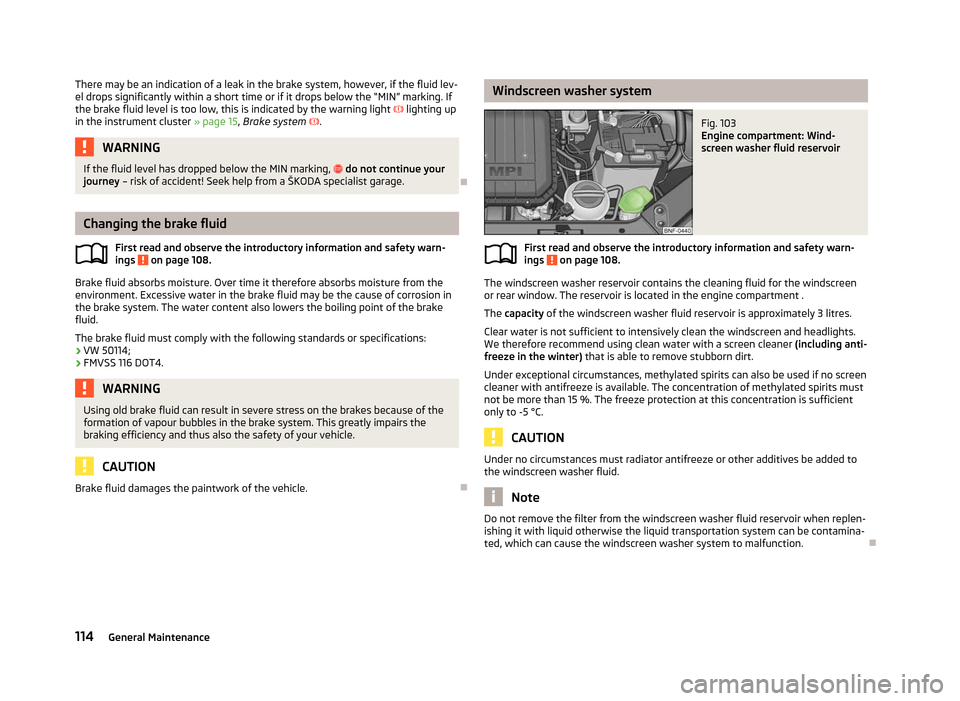
ä Windscreen washer system
Fig. 103
Engine compartment: Wind-
screen washer fluid reservoir
First read and observe the introductory information and safety warn-
ings on page 108.
The windscreen washer reservoir contains the cleaning fluid for the windscreen
or rear window. The reservoir is located in the engine compartment .
The capacity
of the windscreen washer fluid reservoir is approximately 3
litres.
Clear water is not sufficient to intensively clean the windscreen and headlights.
We therefore recommend using clean water with a screen cleaner (including anti-
freeze in the winter) that is able to remove stubborn dirt.
Under exceptional circumstances, methylated spirits can also be used if no screen
cleaner with antifreeze is available. The concentration of methylated spirits must
not be more than 15 %. The freeze protection at this concentration is sufficient
only to -5 °C. CAUTION
Under no circumstances must radiator antifreeze or other additives be added to
the windscreen washer fluid. Note
Do not remove the filter from the windscreen washer fluid reservoir when replen-
ishing it with liquid otherwise the liquid transportation system can be contamina-
ted, which can cause the windscreen washer system to malfunction. Ð
ä
114 General Maintenance
Page 118 of 157

CAUTION
■ The vehicle battery must only be disconnected if the ignition is switched off,
otherwise the vehicle's electrical system (electronic components) can be dam-
aged. When disconnecting the battery from the electrical system, first of all dis-
connect the negative terminal
(-) of the battery. Then disconnect the positive ter-
minal (+).
■ When connecting the battery to the electrical system, first connect the positive
terminal (+) of the battery. Then connect the negative terminal
(-). Under no cir-
cumstances must the battery cables be connected incorrectly – risk of a cable fire.
■ Ensure that battery acid does not come into contact with the bodywork – risk of
damage to the paintwork.
■ Do not place the battery in direct daylight in order to protect the vehicle battery
housing from the effects of ultra-violet light.
■ If the vehicle has not been driven for more than 3 to 4 weeks, the battery will
discharge. This is because certain electrical components consume electricity (e.
g.
control units) also in idle state. Prevent the battery from discharging by discon-
necting the battery's negative terminal or continuously charging the battery with
a very low charging current.
■ If the vehicle is frequently used for making short trips, the vehicle battery will
not have time to charge up sufficiently and may discharge. For the sake of the environment
A vehicle battery that has been removed is a special type of hazardous waste.
These must be disposed of in accordance with national legal regulations. Note
You should replace batteries older than 5 years. Ð Checking the battery electrolyte level
Fig. 104
Vehicle battery: Electrolyte level
indicator
First read and observe the introductory information and safety warn-
ings on page 115.
We recommend you have the electrolyte level checked by a ŠKODA specialist ga-
rage from time to time, especially in the following cases.
› High outside temperatures.
› Long daily drives
› After each charge
» page 117.
On vehicles with a vehicle battery fitted with a colour indicator, the so-called
magic eye » Fig. 104 , the electrolyte level can be determined by looking at the
change in colour.
Air bubbles can influence the colour of the indicator. For this reason carefully
knock on the indicator before carrying out the check.
› Black colour – electrolyte level is correct.
› Colourless or light yellow colour – electrolyte level too low, the battery must be
replaced. Note
■ The battery electrolyte level is periodically checked by a
ŠKODA Service Partner
as part of the Inspection Service. ■ For technical reasons, on vehicles with the description “AGM”, the electrolyte
level cannot be checked. ■ Vehicles with a START-STOP system are fitted with a battery control unit for
checking the energy level for the recurring engine start. Ð
ä
116 General Maintenance
Page 120 of 157

We recommend that the battery is replaced by a ŠKODA Service Partner, where
the new vehicle battery will be installed properly and the original battery will be
disposed of in accordance with national regulations.
ÐAutomatic load deactivation
First read and observe the introductory information and safety warn-
ings on page 115.
An intelligent vehicle power management system automatically takes various
measures at high loads on the vehicle battery to prevent discharging of the bat-
tery: This manifests itself by the following:
› The idling speed is raised to allow the generator to deliver more electricity to
the electrical system.
› Where appropriate large consumers of power, e.g. seat heaters, rear window
heaters, voltage supply to the 12V power socket, have their power limited or in
case of emergency shut off completely. Note
Despite such intervention by the vehicle electric system management, the vehicle
battery may be drained. For example, when the ignition is switched on a long time
with the engine turned off or the side or parking lights are turned on during lon-
ger parking. Driving comfort is not put at risk by any shutting off of consumers.
Often the driver is not aware of it having taken place. Ðä
118 General Maintenance