2012 Seat Toledo lock
[x] Cancel search: lockPage 169 of 249

168Care of the vehicle and cleaning
Note
● Make sure, when washing the vehicle, that the least amount of water
possible enters the lock cylinders.
● We recommend the use of products from the selection of SEAT Original
Accessories to care for the door lock cylinder.
Wheels
Wheel trims
If you wash the vehicle regularly, you must also thoroughly wash the wheel
trims. Regularly remove any brake abrasion residue and road salt from the
wheels, otherwise the wheel material could be damaged. Repair any dam-
age to the wheel paintwork immediately.
Alloy wheels
After thorough washing, treat the wheels with a protective product for alloy
wheels. Do not use abrasive products to care for the wheels.
WARNING
Moisture, ice and road salt may affect braking efficiency. Risk of acci-
dent!
CAUTION
Heavy dirt on the wheels could lead to their misalignment. This could result
in vibrations being transmitted to the steering wheel that under certain con-
ditions may cause premature steering wear. This dirt must be removed.
Note
We recommend you leave paint damage repairs to a SEAT Authorised Serv-
ice. Underbody sealant
The underside of the vehicle is coated to permanently protect it from chemi-
cal and mechanical agents.
Given that damage to the
protective coating during driving cannot be com-
pletely ruled out, we recommend you check the condition of the protective
coating on the underbody and suspension at regular intervals, preferably
before the start and end of the coldest season of the year.
Authorised SEAT dealers have suitable special products and the necessary
facilities and are aware of the techniques required for their application. We
therefore recommend all touch-up work or additional anti-corrosion meas-
ures be performed by an authorised SEAT dealer.
WARNING
Do not apply underseal or anti-corrosion coatings to the exhaust pipes,
catalytic converter, particulate filter or heat shields on the exhaust sys-
tem. Once the engine has reached operating temperature, these substan-
ces could catch fire. Risk of fire!
Cavity waxing
All cavities on the vehicle exposed to corrosion are permanently factory-pro-
tected by a wax solution .
This wax solution does not need to be checked or touched up. Should wax
run out of the cavities at high ambient temperatures, remove it using a plas-
tic scraper and clean away any stains using lighter fluid.
Page 171 of 249

170Care of the vehicle and cleaning
CAUTION
● Avoid exposing leather to direct sunlight for long periods so that it does
not lose its colour. If the car is left for a prolonged period outdoors, cover
the leather so that it does not lose its colour.
● Sharp-edged objects on clothing, such as zips, rivets or belts can leave
permanent scratches and rough marks on the surface of the leather.
● Use of the mechanical steering wheel lock can damage the leather sur-
face of the steering wheel.
Note
● Use a suitable impregnating cream with ultra-violet protection at regular
intervals and after cleaning. The cream will nourish and moisturise the
leather, keep it supple and able to breathe. In addition, it will also help to
protect the surface of the leather.
● Clean the leather every 2 to 3 months and remove fresh dirt as necessa-
ry.
● Preserve the colour of the leather. A special coloured cream for leather
will renew the colour of more heavily worn areas as required.
● Leather is a natural material with specific properties. During vehicle use,
parts of the leather covers may change in appearance, such as folds or wrin-
kles, as a result of their use.
Seat belts
Keep the seat belts clean!
Wash soiled seat belts with mild, soapy water, removing any heavier dirt
with a soft brush.
Check the condition of all seat belts at regular intervals.
Very soiled belts may not retract properly.
WARNING
● The seat belts should never be removed from the vehicle for cleaning.
● Never clean using chemical products, as chemical detergents destroy
the fabric. Ensure that the seat belts do not come into contact with corro-
sive fluids such as acids, etc.
● If you find any damage to the belt webbing, belt fittings, the belt re-
tractor or the buckle, the belt in question must be replaced by an Official
Service.
● Make sure that the inertia reel seat belts are completely dry before
allowing them to retract.
Page 172 of 249

171
Checking and refilling levels
Checking and refilling levels Fuel
Introduction
The correct type of fuel for your vehicle is indicated on a sticker on the in-
side of the fuel tank flap, along with the tyre size and pressure. ⇒ Fig. 115
.
The scraper ⇒ Fig. 115 to remove snow and ice from windows and mirrors
⇒ page 167, Windows and exterior mirrors is located on the inside of the
fuel tank flap.
WARNING
Observe all relevant statutory regulations on transporting spare fuel can-
isters. For safety reasons, we do not recommend carrying a spare canister
in the vehicle. The canister could be damaged in an accident and fuel
may leak. Risk of fire!
CAUTION
● Never completely empty the tank! If there is an irregular fuel supply, mis-
firing can occur that can cause damage to many of the engine parts and the
exhaust system.
● If any fuel is spilt onto the paintwork of the vehicle, it should be re-
moved immediately. Risk of damage to paintwork! Refuelling
Fig. 115 Vehicle as seen from the rear right: Fuel tank flap/fuel tank flap with tank un-
screwed cap attached
Opening the tank cap
– Press the flap in the direction of the arrow 1
⇒ Fig. 115.
– Open the cover in the direction indicated by the arrow 2
.
– Hold onto the fuel tank cap with one hand and unlock it using
the ignition key, turning it anti-clockwise.
– Unscrew the tank cap anti-clockwise and place it on top of the
tank flap ⇒ Fig. 115 .
Closing the tank cap
– Screw the tank cap clockwise until it clicks into place.
– Hold onto the fuel tank cap with one hand and lock it using the
ignition key, turning it clockwise
Safety FirstOperating instructionsPractical TipsTechnical specifications
Page 182 of 249

181
Checking and refilling levels
Brake fluid Checking brake fluid level
Fig. 120 Engine com-
partment: Brake fluid res-
ervoir
The brake fluid reservoir is located in the engine compartment of
the vehicle.
– Switch the ignition off.
– Open the bonnet ⇒ page 173.
– Check the brake fluid level in the reservoir ⇒ Fig. 120. It should
be between the “MIN” and “MAX” marks.
The fluid level drops slightly after a period of time due to automatic com-
pensation for brake pad wear. This is quite normal.
However, if the level goes down noticeably in a short time, or drops below
the “MIN” mark, there may be a leak in the brake system. If the brake fluid
level in the reservoir is too low, this will be indicated by the warning lamp in
the instrument panel
⇒ page 66, Brake system .
WARNING
If the fluid level has dropped below the MIN mark, do not drive on.
Risk of accident! Seek professional help.
Changing brake fluid
Brake fluid absorbs moisture. Therefore, it gradually absorbs moisture from
the atmosphere. If the water content in the brake fluid is too high, the brake
system could corrode. The water content also reduces the boiling point of
the brake fluid.
The brake fluid must comply with one of the following standards or specifi-
cations:
● VW 50114
● FMVSS 116 DOT4
WARNING
Heavy use of the brakes may cause a vapour lock if the brake fluid is left
in the brake system for too long. This would seriously affect the efficien-
cy of the brakes and the safety of the vehicle.
CAUTION
Brake fluid damages the vehicle paintwork.
Safety FirstOperating instructionsPractical TipsTechnical specifications
Page 187 of 249

186Checking and refilling levels
FunctionInstallationSetting the clock⇒ page 58The multifunction display data is deleted⇒ page 59
Note
We recommend having the vehicle checked by an authorised SEAT dealer to
guarantee the correct working order of all electrical systems.
Changing the battery
A replacement battery must have the same capacity, voltage, current rating
and size as the original. The appropriate types of battery can be acquired
from authorised SEAT dealers.
We recommend having the battery changed by an authorised SEAT dealer,
where the new battery will be correctly installed and the original disposed
of in line with regulations.
Automatic disconnection of electrical equipment
When heavily-charging a battery, the programme selected by the electrical
system control unit prevents the battery from automatically discharging.
This may result in the following:
● Increase in idling speed so that the alternator can supply more current
to the electrical system.
● The performance of certain electrical components could be limited or
some may switch off temporarily, e.g. the heated seats, the heated rear win-
dow, the 12V power socket.
Note
Despite any measures taken by the control unit, the battery could drain. e.g.
with the engine is switched off, the key is turned in the ignition for a long
period or the side lights or parking lights are switched on. The switching off
of certain electrical components does not impair driving comfort and the
driver will often not even realise.
Page 195 of 249

194Wheels and tyres
Rim sizeRim offsetTyre size5J x 14a)35 mm175/706J x 15b)38 mm185/606J x 15b)38 mm195/55a)
Only use snow chains with fine-pitch links and lock no greater than 9 mm.
b) Only use snow chains with fine-pitch links and lock no greater than 13 mm.
Remove the wheel trims before fitting snow chains.
CAUTION
Chains must be removed when roads are free of snow. Otherwise they will
impair handling, damage the tyres and wear out very quickly.
Page 199 of 249
198Self-help
Vehicle tool kit*
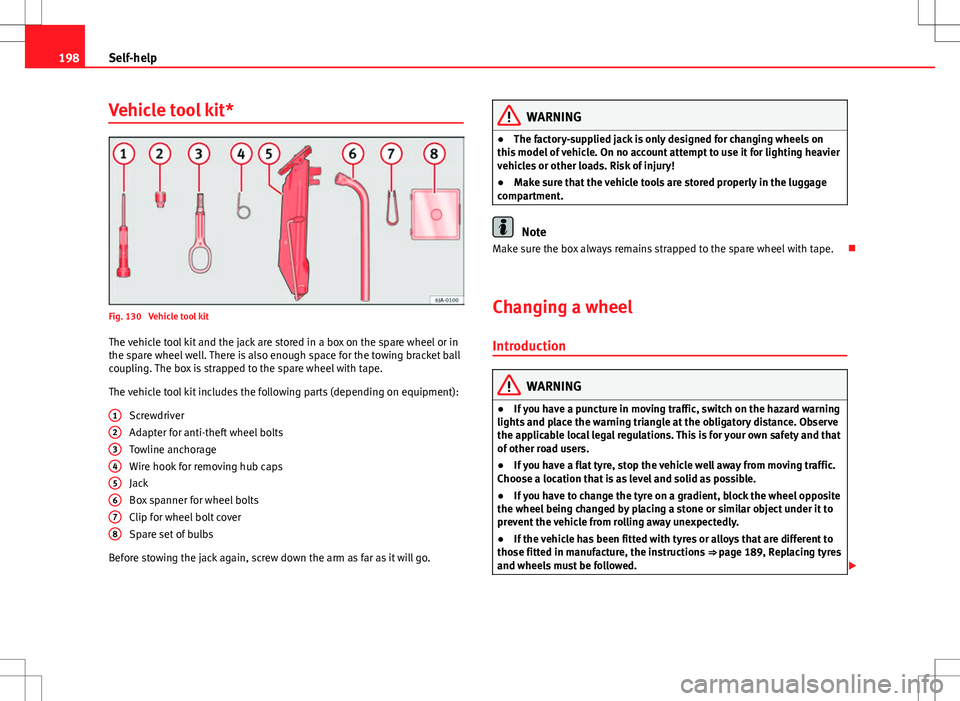
Fig. 130 Vehicle tool kit
The vehicle tool kit and the jack are stored in a box on the spare wheel or in
the spare wheel well. There is also enough space for the towing bracket ball
coupling. The box is strapped to the spare wheel with tape.
The vehicle tool kit includes the following parts (depending on equipment):
Screwdriver
Adapter for anti-theft wheel bolts
Towline anchorage
Wire hook for removing hub caps
Jack
Box spanner for wheel bolts
Clip for wheel bolt cover
Spare set of bulbs
Before stowing the jack again, screw down the arm as far as it will go. 1
2345678
WARNING
● The factory-supplied jack is only designed for changing wheels on
this model of vehicle. On no account attempt to use it for lighting heavier
vehicles or other loads. Risk of injury!
● Make sure that the vehicle tools are stored properly in the luggage
compartment.
Note
Make sure the box always remains strapped to the spare wheel with tape.
Changing a wheel Introduction
WARNING
● If you have a puncture in moving traffic, switch on the hazard warning
lights and place the warning triangle at the obligatory distance. Observe
the applicable local legal regulations. This is for your own safety and that
of other road users.
● If you have a flat tyre, stop the vehicle well away from moving traffic.
Choose a location that is as level and solid as possible.
● If you have to change the tyre on a gradient, block the wheel opposite
the wheel being changed by placing a stone or similar object under it to
prevent the vehicle from rolling away unexpectedly.
● If the vehicle has been fitted with tyres or alloys that are different to
those fitted in manufacture, the instructions ⇒ page 189, Replacing tyres
and wheels must be followed.
Page 201 of 249

200Self-help
–Lower the vehicle.
– Tighten the wheel bolts firmly in diagonal sequence with the
box spanner and then the anti-theft wheel bolt ⇒ page 200.
– Replace the hub cap and/or the bolt covers.
Note
● All bolts must be clean and turn easily.
● Never grease or oil the wheel bolts!
● Note the direction of rotation when putting on a tyre with directional
tread pattern ⇒ page 187.
After changing a wheel
Tasks that must be carried out after changing a wheel.
– Place the wheel with the defective tyre in the spare wheel well
and secure it using a special bolt ⇒ page 190.
– Put the vehicle tools back in their storage location.
– Check the tyre pressure of the newly fitted spare wheel as soon
as possible.
– Have the tightening torque of the wheel bolts checked as soon
as possible with a torque wrench.
– Have the flat tyre replaced or ask an Official Service about the
possibility of repair.
Note
● If you notice that the wheel bolts are rusty and difficult to turn when
changing a wheel, they must be replaced before having the tightening tor-
que checked.
● Drive carefully and at moderate speeds until the tightening torque of the
wheel bolts has been checked.
Loosening and tightening wheel bolts
Fig. 131 Changing a
wheel: Loosening wheel
bolts
Loosening wheel bolts
– Fit the box spanner as far as it will go over the wheel bolt 1)
.
– Grip the end of the box spanner and turn the wheel bolt about
one turn anti-clockwise ⇒ Fig. 131.
Tightening wheel bolts
– Fit the box spanner as far as it will go over the wheel bolt 1)
.
1)
The corresponding adapter is required to unscrew or tighten the anti-theft wheel bolts
⇒ page 202.