2012 Seat Toledo weight
[x] Cancel search: weightPage 48 of 249

47
Child safety
Child seats
Categorisation of child seats into groups
Use only child seats that are officially approved and suitable
for the child. Child seats are subject to the regulation ECE-R 44. ECE-R stands for: Regula-
tions of the European Economic Commission
The child seats are grouped into 5 categories: Group 0: children up to 10 kg
Group 0+: children up to 13 kg
Group 1: from 9 to 18 kg
Group 2: from 15 to 25 kg
Group 3: from 22 to 36 kg
Child seats that have been tested and approved under the ECE R44 stand-
ard bear the test mark on the seat (the letter E in a circle with the test num-
ber below it). Group 0 and 0+ child seats
A suitable child seat and a correctly adjusted seat belt can
help you to protect your child.
Fig. 25 A group 0 rear-
facing child seat fitted on
the rear seat
Group 0: For babies up to about 9 months old and 10 kg in weight, the most
suitable seats are those appearing in the figure ⇒ Fig. 25.
Group 0+: For babies up to about 18 months old and 13 kg in weight the
most suitable seats are those appearing in the illustration.
Follow the manufacturer's instructions and observe any statutory require-
ments when installing and using child seats.
We recommend you to always include the manufacturer's Child Seat Instruc-
tion Manual together with the on-board documentation.
WARNING
Read and always observe information and warnings concerning the use
of child seats ⇒ page 45.
Safety FirstOperating instructionsPractical TipsTechnical specifications
Page 51 of 249
50Child safety
Securing child seats
Ways to secure a child seat
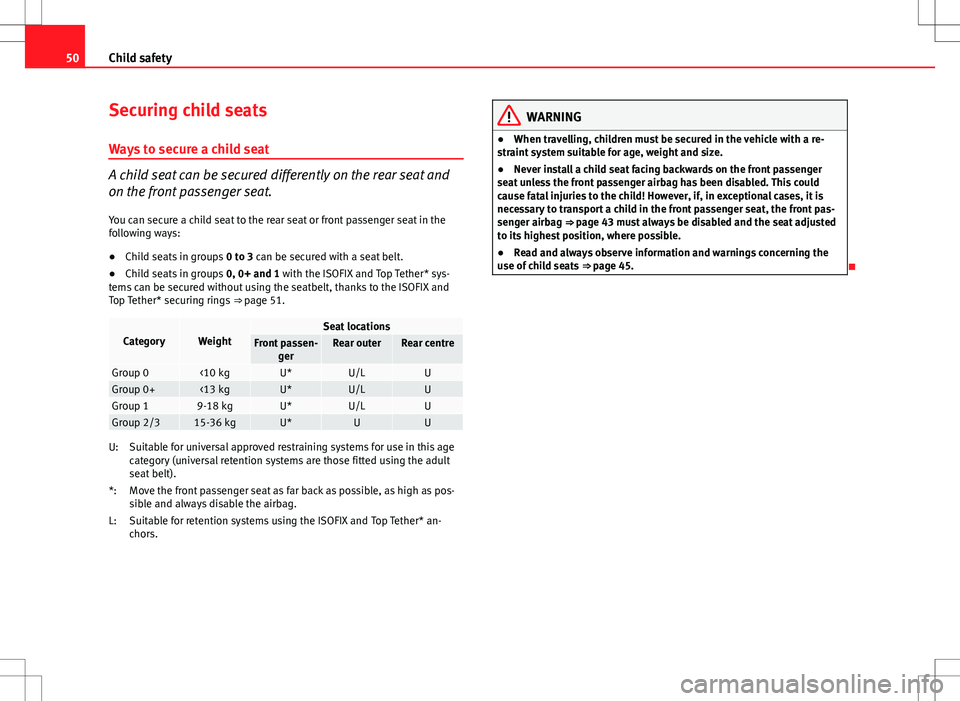
A child seat can be secured differently on the rear seat and
on the front passenger seat. You can secure a child seat to the rear seat or front passenger seat in the
following ways:
● Child seats in groups 0 to 3 can be secured with a seat belt.
● Child seats in groups 0, 0+ and 1 with the ISOFIX and Top Tether* sys-
tems can be secured without using the seatbelt, thanks to the ISOFIX and
Top Tether* securing rings ⇒ page 51.
CategoryWeightSeat locationsFront passen-
gerRear outerRear centre
Group 0<10 kgU*U/LUGroup 0+<13 kgU*U/LUGroup 19-18 kgU*U/LUGroup 2/315-36 kgU*UU
Suitable for universal approved restraining systems for use in this age
category (universal retention systems are those fitted using the adult
seat belt).
Move the front passenger seat as far back as possible, as high as pos-
sible and always disable the airbag.
Suitable for retention systems using the ISOFIX and Top Tether* an-
chors.
U:
*:
L:
WARNING
● When travelling, children must be secured in the vehicle with a re-
straint system suitable for age, weight and size.
● Never install a child seat facing backwards on the front passenger
seat unless the front passenger airbag has been disabled. This could
cause fatal injuries to the child! However, if, in exceptional cases, it is
necessary to transport a child in the front passenger seat, the front pas-
senger airbag ⇒ page 43 must always be disabled and the seat adjusted
to its highest position, where possible.
● Read and always observe information and warnings concerning the
use of child seats ⇒ page 45.
Page 109 of 249

108Seats and storage
Adjusting the front seats
Fig. 70 Seat adjustment
controls/Adjustment con-
trols for a sports seat
Adjusting the seat forwards and backwards
– Lift the lever 1
⇒ Fig. 70 (the central part) and move the seat
forwards or backwards.
– Then release the lever 1
and move the seat further until the
catch engages.
Adjusting seat height
– To raise, pump the lever 2
⇒ Fig. 70 (several times if required)
upwards to the required seat position.
– To lower, pump the lever 2
(several times if required) down-
wards to the required seat position.
Adjusting the backrest angle
– Take your weight off the backrest and pull the lever 3
⇒ Fig. 70
backwards, pressing on the backrest to the required angle.
– When the lever 3
is released, the backrest will remain in the
set position. Armrest on front seats with inner storage
Fig. 71 Armrest/Opening and closing the storage compartment
Adjusting armrest height
– Lift the armrest as far as it will go and then fold it downwards.
– Raise the armrest until it engages in one of the 5 positions.
Opening storage compartment
– Press the button located on the front of the armrest ⇒ Fig. 71 -
.
– Lift the storage compartment lid ⇒ Fig. 71 - .
Page 113 of 249

112Seats and storage
Luggage compartment
Introduction
Please observe the following points to ensure the vehicle handles
well at all times:
– Distribute the load as evenly as possible.
– Place heavy objects as far forward in the luggage compartment
as possible.
– Secure luggage using the fastening rings or retaining net
⇒ page 113.
During an accident, even small and light objects can have so much kinetic
energy that they can cause very severe injuries. The amount of kinetic ener-
gy depends on the speed of the vehicle and the weight of the object. How-
ever, the speed of the vehicle is the most important factor.
Example: An unsecured object weighing 4.5 kg produces energy corre-
sponding to 20 times its weight in a frontal collision at 50 km/h (31 mph).
This means that its weight “reaches” around 90 kg. You can imagine the se-
verity of the injuries that might be sustained if this “projectile” strikes an
occupant as it flies through the vehicle interior.
WARNING
● Store objects in the luggage compartment and secure to the fastening
points.
● In an accident or sudden manoeuvre, loose objects in the interior can
be flung forwards and possibly injure vehicle occupants or others. This
risk is increased if the flying objects hit and trigger an airbag. In this
case, any rebounding objects could injure vehicle occupants. Risk of fatal
injuries!
● Take into account that transporting heavy objects changes the centre
of gravity that could also cause changes in vehicle handling. Risk of acci-
dent! Therefore, always adjust your speed and driving style to suit these
circumstances.
● Securing the load to the rings using unsuitable or damage straps
could lead to injuries in the event of an accident or sudden braking ma-
noeuvre. Secure suitable straps safely to the rings to ensure this does
not happen.
● Position the load so that it cannot moved forwards during a sudden
braking manoeuvre. Risk of injuries!
● If transporting sharp or dangerous objects in the space provided
when the rear seats are folded, ensure the safety of the occupant of the
remaining rear seat ⇒ page 13.
● If the rear seat located alongside a folding seat is occupied, ensure
safety by placing the load so that it stops the seat from folding back-
wards in the event of a collision, for example.
● Never drive with the rear lid open or half-closed, as exhaust gases
can be drawn into the interior. Risk of intoxication!
● Never exceed the allowed axle loads or allowed maximum weight.
Risk of accident!
● Never transport passengers in the luggage compartment!
Page 117 of 249

116Seats and storage
Roof carrier*
Introduction
WARNING
● The load on the roof carrier must be properly secured. Risk of acci-
dent!
● Always secure the load using retaining straps in good condition.
● Distribute the load evenly.
● When transporting heavy or large objects on the roof, any change in
the normal vehicle behaviour due to a change in the centre of gravity or
an increased wind resistance must be taken into account. Risk of acci-
dent! For this reason, a suitable speed and driving style must be used.
● Avoid sudden manoeuvres and braking.
● Adjust your driving style to suit visibility, the weather and road and
traffic conditions.
● Never exceed the allowed axle loads or allowed maximum weight.
Risk of accident!
CAUTION
● Only use SEAT-authorised roof carriers.
● Where roof carriers from other systems are used or where they are not
fitted properly, any damage caused to the vehicle will not be covered by the
warranty. Therefore, carefully follow the Instruction Manual for installation
of the roof carrier.
● On vehicles fitted with a sliding sunroof, make sure it does not hit the
load on the roof when opened
● Remember that the rear lid must not hit the roof load.
● The total height of the vehicle increases according to the roof load. Com-
pare the height of the vehicle with the heights of bridges or, for example,
the size of the garage door. ●
Do not forget to remove the roof carrier before entering an automatic
carwash.
● Take into account that the load must not damage the aerial located on
the roof.
For the sake of the environment
The increased air resistance means that the vehicle uses more fuel.
Attachment points
Fig. 82 Basic roof carrier attachment points
Location of the basic roof carrier attachment points ⇒ Fig. 82.
rear attachment points
front attachment points
Install and remove following the instructions given.
CAUTION
Follow the instructions given in the manual.
A
B
Page 118 of 249

117
Seats and storage
Roof load
The maximum permissible roof load (including the support system) of 75 kg
and the total authorised weight of the vehicle must not be exceeded.
It will not be possible to carry the full maximum load if the roof carrier you
are using is rated for a load which is less than this figure. In this case, you
can only load the roof carrier to the maximum load permitted in your instal-
lation manual.
Drink holder
Introduction
WARNING
● Do not put hot drinks in the drink holders. They could spill while the
vehicle is moving. Risk of scalding!
● Do not use cups or glasses made of fragile materials (e.g. glass or chi-
na). These could cause injury in the event of an accident.
CAUTION
Avoid putting open drinks containers in the drink holder while the vehicle is
moving. They could spill (e.g. on braking) and cause damage to the electri-
cal equipment or the seat covers. Drink holder in centre console
Fig. 83 Centre console: drink holder
Front drink holder in the centre console
Rear drink holder in the centre console
Drink holder in the rear armrest
Fig. 84 Rear seats arm-
rest: drink holder
Two drinks can be placed in the drink holder.
A
B
Safety FirstOperating instructionsPractical TipsTechnical specifications
Page 123 of 249

122Seats and storage
WARNING
Do not place heavy objects in the pockets. Risk of injury!
CAUTION
Do not place overly large objects in the pockets (e.g. bottles) or objects with
sharp edges. Risk of damage to the pockets and the upholstery.
Net pockets on back of front backrests
Fig. 91 Front seats
backrests: net pockets
There are net pockets on the inside part of the front seats backrests
⇒ Fig. 91.
These pockets are designed to hold lightweight objects such as a mobile
phone or an mp3 player.
WARNING
● Do not exceed the maximum load that the net pockets can support.
Heavy objects cannot be safely secured. Risk of injuries!
CAUTION
● The net pockets support a maximum load of 150 g.
● Do not place overly large objects in the pockets (e.g. bottles) or objects
with sharp edges. Risk of damage to the pockets.
Storage compartment for (sun)glasses
Fig. 92 Close-up of roof
panel: storage compart-
ment for (sun)glasses
– Press the compartment lid and it will drop down ⇒ Fig. 92.
WARNING
This compartment must only remain open when removing or replacing
(sun)glasses.
CAUTION
● Do not place heat-sensitive objects in the compartment as they could be
damaged.
● The side compartment supports a maximum load of 0.25 kg.
Page 125 of 249

124Seats and storage
Storage compartment in luggage compartment
Fig. 96 Luggage com-
partment: storage
The lid from the side storage compartment can be removed to in-
crease the size of the luggage compartment.
– Hold onto the top of the lid and pull it out in the direction indi-
cated by the arrow ⇒ Fig. 96.
CAUTION
● The compartments are designed to hold small objects with a total
weight of 1.5 kg.
● Make sure you do not damage the storage compartment or the luggage
compartment trim when using the compartment.
Coat hooks*
The coat hooks are located on the B-pillars and on the handles on the interi-
or lining above each rear door.
WARNING
● Make sure that any items of clothing hanging from the coat hooks do
not obstruct your view to the rear.
● Only use the coat hooks for light items of clothing and make sure that
there are no heavy or sharp objects in the pockets.
● Do not use clothes hangers to hang up the clothing, as this could in-
terfere with the function of the head-protection airbags.
CAUTION
The side hooks support a maximum load of 2 kg.