2012 Seat Leon 5D battery
[x] Cancel search: batteryPage 188 of 289

187
Intelligent technology
If the warning lamp remains on and the driver indication appears, the power
steering could be faulty.
Do not continue driving. Seek specialist assistance. (in yellow) Steering: System fault! You may continue driving.
If the warning lamp comes on, the steering could react with more difficultly
or more sensitivity than normal. In addition, when driving in a straight line
the steering wheel may be off-centre.
Drive slowly to a specialised workshop and have the fault repaired. (in yellow) Steering lock: fault! Go to an Official Service
The electronic steering lock is malfunctioning.
Go to a specialised workshop as soon as possible and have the fault re-
paired.
WARNING
Take it immediately to a specialised workshop and have the fault re-
paired: risk of accident!
Note
If a red or yellow warning lamp come on briefly, you can continue driv-
ing. Power Management
This system helps to ensure reliable starting
The power management controls the distribution of electri-
cal energy and thus helps to ensure that there is always
enough power available to start the engine.
If a vehicle with a conventional electrical system is left parked for a long
time, the battery will gradually lose its charge because certain electrical
equipment (such as the electronic gearbox lock) continues to draw current
even when the ignition is off. In some cases there may not be enough power
available to start the engine.
Your vehicle is equipped with an intelligent power management system to
control the distribution of electrical energy. This significantly improves relia-
bility when starting the engine, and also prolongs the useful life of the bat-
tery.
The main functions incorporated in the power management system are bat-
tery diagnosis , residual current management and dynamic power manage-
ment.
Battery diagnosis
The battery diagnosis function constantly registers the condition of the bat-
tery. Sensors detect the battery voltage, battery current and battery temper-
ature. This enables the system to calculate the current power level and
charge condition of the battery.
Residual current management
The residual current management reduces power consumption while the ve-
hicle is parked. It controls the supply of power to the various electrical com-
ponents while the ignition is switched off. The system takes the battery di-
agnosis data into consideration.
Safety FirstOperating instructionsPractical TipsTechnical specifications
Page 189 of 289

188Intelligent technology
Depending on the power level of the battery, the individual electrical com-
ponents are switched off one after the other to prevent the battery from los-
ing too much charge and to ensure that the engine can be started reliably.
Dynamic power management
While the vehicle is moving, this function distributes the available power to
the various electrical components and systems according to their require-
ments. The power management ensures that on-board systems do not con-
sume more electrical power than the alternator can supply, and thus main-
tains the maximum possible battery power level.
Note
● The power management system is not able to overcome the given physi-
cal limits. Please remember that the power and useful life of the battery are
limited.
● When there is a risk that the vehicle will not start, the alternator power
failure or low battery charge level warning lamp will be shown
⇒ page 69.
Note carefully
Starting ability has first priority. Short trips, city traffic and low temperatures all place a heavy load on the
battery. In these conditions a large amount of power is consumed, but only
a small amount is supplied. The situation is also critical if electrical equip-
ment is in use when the engine is not running. In this case power is con-
sumed when none is being generated.
In these situations you will be aware that the power management system is
intervening to control the distribution of electrical power. When the vehicle is parked for long periods
If you do not drive your vehicle for a period of several days or weeks, the
power management will gradually shut off the on-board systems one by
one, or reduce the amount of current they are using. This limits the amount
of power consumed and helps to ensure reliable starting even after a long
period. Some convenience functions, such as remote vehicle opening, may
not be available under certain circumstances. These functions will be re-
stored when you switch on the ignition and start the engine.
With the engine switched off
For example, if you listen to the sound system with the engine switched off
the battery will run down.
If the energy consumption means there is a risk that the engine will not
start, a text will appear in vehicles with a driver information system*.
This driver indicator tells you that you must start the engine so that the bat-
tery can recharge.
When the engine is running
Although the alternator generates electrical power, the battery can still be-
come discharged while the vehicle is being driven. This can occur when a
lot of power is being consumed but only a small amount supplied, especial-
ly if the battery is not fully charged initially.
To restore the necessary energy balance, the system will then temporarily
shut off the electrical components that are using a lot of power, or reduce
the current they are consuming. Heating systems in particular use a large
amount of electrical power. If you notice, for instance, that the seat heating*
or the heated rear window is not working, they may have been temporarily
switched off or regulated to a lower heat output. These systems will be
available again as soon as sufficient electrical power is available.
You may also notice that the engine runs at a slightly faster idling speed.
This is quite normal, and no cause for concern. The increased idling speed
allows the alternator to meet the greater power requirement and charge the
battery at the same time.
Page 210 of 289

209
Checking and refilling levels
Note
Diesel vehicles are fitted with a protective device that prevents the insertion
of the wrong fuel hose 1)
. It is only possible to refuel with Diesel nozzles.
● If the pump nozzle is worn, damaged, or if it is very small, it is possible
that it will not be able to open the protective device. Before trying to insert
the pump nozzle by turning it, try a different pump or request specialist
help.
● If you fill the tank from a reserve fuel canister, the protective device will
not open. One way to resolve this is to pour the fuel in very slowly.
Bonnet
Working on components in the engine compartment
Extra caution is necessary when working on components in
the engine compartment. Always be aware of the danger of injury and scalding as well as the risk of
accident or even fire when working in the engine compartment (e.g. when
checking and refilling fluids). Always observe the warnings listed below
and follow all general safety precautions. The engine compartment of the
vehicle is a potentially hazardous area ⇒
.
WARNING
● Switch the ignition off.
● Remove the ignition key.
WARNING (Continued)
● Apply the handbrake.
● If the vehicle has a manual gearbox, place the lever in neutral; if it
has an automatic gearbox, place the selector lever in position P.
● Wait for the engine to cool down.
● Keep children away from the engine compartment.
● Never spill liquids used for vehicle operation on the engine compart-
ment, as these may catch fire (e.g. the antifreeze in coolant).
● Take care not to cause short circuits in the electrical system, especial-
ly when working on the battery.
● If working inside the engine compartment, remember that, even when
the ignition is switched off, the radiator fan may start up automatically,
and therefore there is a risk of injury.
● Do not unscrew the cap on the coolant expansion tank when the en-
gine is hot. The cooling system is under pressure.
● Protect face, hands and arms by covering the cap with a large, thick
rag to protect against escaping coolant and steam.
● If it is necessary to work in the engine compartment while the engine
is running, the rotating components (for example, poly-V belt, alternator,
radiator fan) and the high voltage ignition system are an additional haz-
ard.
● Observe the following additional warnings if work on the fuel system
or the electrical system is necessary:
–Always disconnect the battery from the on-board network.
– Do not smoke.
– Never work near naked flames.
– Always keep an approved fire extinguisher immediately available.
1)
according to the country
Safety FirstOperating instructionsPractical TipsTechnical specifications
Page 218 of 289

217
Checking and refilling levels
Brake fluid
Fig. 111 Engine com-
partment: brake fluid res-
ervoir, lid
Checking the brake fluid level
The brake fluid level must be between the MIN and MAX markings.
However, if the brake fluid level goes down noticeably in a short time, or
drops below the MIN mark, there may be a leak in the brake system. Seek
specialist assistance. A warning light on the instrument panel display moni-
tors the brake fluid level ⇒ page 69.
In right-hand drive vehicles the brake fluid reservoir is on the other side of
the engine compartment.
Changing brake fluid
The regular intervals at which the brake fluid should be replaced are listed
in the Service Plan. We recommend you have the brake fluid replaced at a
SEAT Official Service, during an Inspection Service.
WARNING
● Brake fluid should be stored in the closed original container in a safe
place out of reach of children. Risk of poisoning!
● If the brake fluid is left in the system for too long and the brakes are
subjected to heavy use, vapour bubbles may form in the brake system.
This would seriously affect the efficiency of the brakes and the safety of
the vehicle. This may cause an accident.
CAUTION
Brake fluid should not come into contact with the vehicle paintwork, as it is
abrasive.
Battery General information
The battery is located in the engine compartment and is almost mainte-
nance-free. It is checked as part of the Inspection Service. Nevertheless,
check the terminals are clean and have the correct tightening torque, espe-
cially in summer and winter.
Disconnecting the battery
The battery should only be disconnected in exceptional cases. When the
battery is disconnected, some of the vehicles functions are "lost" ( ⇒ table
on page 218). These functions will require resetting after the battery is re-
connected.
Deactivate the anti-theft alarm* before you disconnect the battery Other-
wise the alarm will be triggered.
Safety FirstOperating instructionsPractical TipsTechnical specifications
Page 219 of 289
218Checking and refilling levels
FunctionReprogrammingOne-touch function of the electric
windows⇒ page 101, One-touch opening and
closing*
Remote control keyIf the vehicle does not respond to the
key, they should be synchronised
⇒ page 90
Digital clock⇒ page 63
ESC warning lampAfter driving for a few metres, the
warning lamp goes out again.
If the vehicle is not used for long periods
The vehicle has a system for monitoring the current consumption when the
engine is left unused for long periods of time ⇒ page 187. Some functions,
such as the interior lights, or the remote door opening, may be temporarily
disabled to prevent the battery from running flat. These functions will come
back on as soon as the ignition is switched on and the engine started.
Winter conditions
During the winter, the starting power may be reduced, and if necessary, the
battery should be charged ⇒
in Important safety warnings for handling a
vehicle battery on page 218
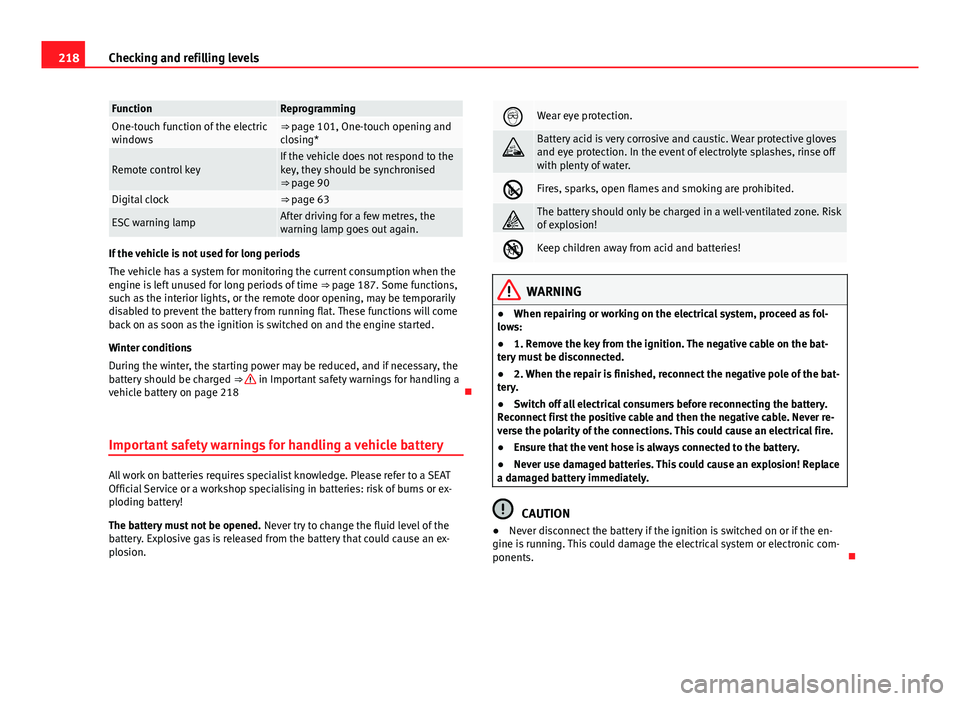
Important safety warnings for handling a vehicle battery
All work on batteries requires specialist knowledge. Please refer to a SEAT
Official Service or a workshop specialising in batteries: risk of burns or ex-
ploding battery!
The battery must not be opened. Never try to change the fluid level of the
battery. Explosive gas is released from the battery that could cause an ex-
plosion.
Wear eye protection.
Battery acid is very corrosive and caustic. Wear protective gloves
and eye protection. In the event of electrolyte splashes, rinse off
with plenty of water.
Fires, sparks, open flames and smoking are prohibited.
The battery should only be charged in a well-ventilated zone. Risk
of explosion!
Keep children away from acid and batteries!
WARNING
● When repairing or working on the electrical system, proceed as fol-
lows:
● 1. Remove the key from the ignition. The negative cable on the bat-
tery must be disconnected.
● 2. When the repair is finished, reconnect the negative pole of the bat-
tery.
● Switch off all electrical consumers before reconnecting the battery.
Reconnect first the positive cable and then the negative cable. Never re-
verse the polarity of the connections. This could cause an electrical fire.
● Ensure that the vent hose is always connected to the battery.
● Never use damaged batteries. This could cause an explosion! Replace
a damaged battery immediately.
CAUTION
● Never disconnect the battery if the ignition is switched on or if the en-
gine is running. This could damage the electrical system or electronic com-
ponents.
Page 220 of 289
219
Checking and refilling levels
Charging the battery
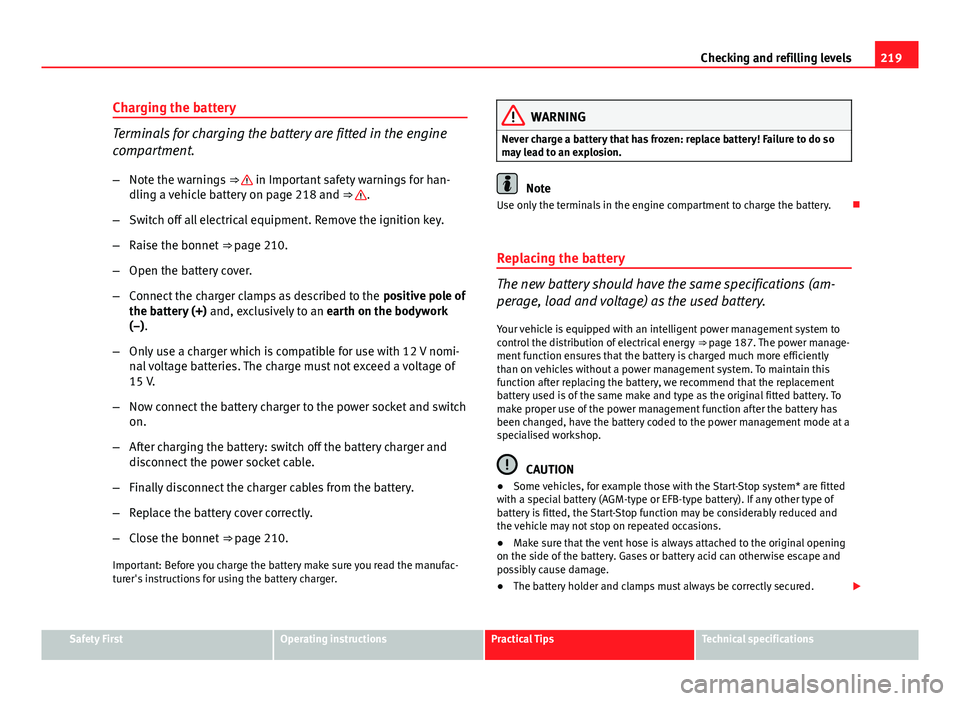
Terminals for charging the battery are fitted in the engine
compartment.
– Note the warnings ⇒
in Important safety warnings for han-
dling a vehicle battery on page 218 and ⇒ .
– Switch off all electrical equipment. Remove the ignition key.
– Raise the bonnet ⇒ page 210.
– Open the battery cover.
– Connect the charger clamps as described to the positive pole of
the battery (+) and, exclusively to an earth on the bodywork
(–).
– Only use a charger which is compatible for use with 12 V nomi-
nal voltage batteries. The charge must not exceed a voltage of
15 V.
– Now connect the battery charger to the power socket and switch
on.
– After charging the battery: switch off the battery charger and
disconnect the power socket cable.
– Finally disconnect the charger cables from the battery.
– Replace the battery cover correctly.
– Close the bonnet ⇒ page 210.
Important: Before you charge the battery make sure you read the manufac-
turer's instructions for using the battery charger.
WARNING
Never charge a battery that has frozen: replace battery! Failure to do so
may lead to an explosion.
Note
Use only the terminals in the engine compartment to charge the battery.
Replacing the battery
The new battery should have the same specifications (am-
perage, load and voltage) as the used battery.
Your vehicle is equipped with an intelligent power management system to
control the distribution of electrical energy ⇒ page 187. The power manage-
ment function ensures that the battery is charged much more efficiently
than on vehicles without a power management system. To maintain this
function after replacing the battery, we recommend that the replacement
battery used is of the same make and type as the original fitted battery. To
make proper use of the power management function after the battery has
been changed, have the battery coded to the power management mode at a
specialised workshop.
CAUTION
● Some vehicles, for example those with the Start-Stop system* are fitted
with a special battery (AGM-type or EFB-type battery). If any other type of
battery is fitted, the Start-Stop function may be considerably reduced and
the vehicle may not stop on repeated occasions.
● Make sure that the vent hose is always attached to the original opening
on the side of the battery. Gases or battery acid can otherwise escape and
possibly cause damage.
● The battery holder and clamps must always be correctly secured.
Safety FirstOperating instructionsPractical TipsTechnical specifications
Page 221 of 289

220Checking and refilling levels
● Before starting any work on the battery, always observe the warnings lis-
ted under ⇒ page 218, Important safety warnings for handling a vehicle
battery.
● Do not forget to replace the battery coverings, where applicable. This
helps to protect against excess temperatures. This in turn extends the vehi-
cle service life.
For the sake of the environment
Batteries contain toxic substances including sulphuric acid and lead. They
must be disposed of appropriately and must not be disposed of with ordi-
nary household waste. Make sure disconnected batteries cannot tip over.
Sulphuric acid could be spilt!
Windscreen washer reservoir and wiper
blades
Windscreen washer
Fig. 112 Engine com-
partment: Windscreen
washer reservoir top The windscreen washer reservoir contains the cleaning fluid for the wind-
screen, the rear window and the headlight washer system* ⇒ Fig. 112. Res-
ervoir capacity: ⇒ page 276.
To prevent the nozzles from becoming blocked with chalk deposits, fill res-
ervoir with water with a low calcium content (distilled water). Always add
washer fluid to the water (with anti-freeze additive in winter).
CAUTION
● Never put radiator anti-freeze or other additives into the windscreen
washer fluid.
● Never use washer fluid which contains paint thinners or solvents as it
can damage the paintwork.
Page 242 of 289

241
Emergencies
– Take out the temporary spare wheel.
Chains
For technical reasons, snow chains must not be used on the temporary
spare wheel.
If you have a puncture on one of the front wheels when using snow chains,
fit the temporary spare wheel in place of one of the rear wheels. Fit the snow
chains on the rear wheel that you have removed and replace the punctured
front wheel with this wheel.
WARNING
● After fitting the temporary spare wheel, check the tyre pressures as
soon as possible. Failure to do so may cause an accident. The tyre pres-
sures are listed on the inside of the fuel tank flap.
● Do not drive at over 80 km/h (50 mph) when the temporary spare
wheel is fitted on the vehicle: risk of accident!
● Avoid heavy acceleration, hard braking and fast cornering: risk of ac-
cident!
● Never use more than one temporary spare wheel at the same time,
risk of accident.
● No other type of tyre (normal summer or winter tyre) may be fitted on
the compact temporary spare wheel rim.
Jump starting
Jump leads
The jump lead must have a sufficient wire cross section.
If the engine fails to start because of a discharged battery, the battery can
be connected to the battery of another vehicle to start the engine.
Jump leads
Jump leads must comply with standard DIN 72553 (see cable manufactur-
er's instructions). The wire cross section must be at least 25 mm 2
for petrol
engines and at least 35 mm 2
for diesel engines.
Note
● The vehicles must not touch each other, otherwise electricity could flow
as soon as the positive terminals are connected.
● The discharged battery must be properly connected to the on-board net-
work.
Safety FirstOperating instructionsPractical TipsTechnical specifications