2012 Seat Ibiza ST light
[x] Cancel search: lightPage 5 of 282

Table of Contents
Manual structure . . . . . . . . . . . . . . . . . . . . 5
Content . . . . . . . . . . . . . . . . . . . . . . . . . . . . . . . . 6
Safety First . . . . . . . . . . . . . . . . . . . . . . . . . . . . 7
Safe driving . . . . . . . . . . . . . . . . . . . . . . . . . . . . . . . 7
Brief introduction . . . . . . . . . . . . . . . . . . . . . . . . . 7
Proper sitting position for occupants . . . . . . . . . 10
Pedal area . . . . . . . . . . . . . . . . . . . . . . . . . . . . . . . 16
Storing objects . . . . . . . . . . . . . . . . . . . . . . . . . . . 16
Seat belts . . . . . . . . . . . . . . . . . . . . . . . . . . . . . . . . . 19
Brief introduction . . . . . . . . . . . . . . . . . . . . . . . . . 19
Why wear seat belts? . . . . . . . . . . . . . . . . . . . . . . 21
Seat belts . . . . . . . . . . . . . . . . . . . . . . . . . . . . . . . 25
Belt tensioners* . . . . . . . . . . . . . . . . . . . . . . . . . . 28
Airbag system . . . . . . . . . . . . . . . . . . . . . . . . . . . . . 30
Brief introduction . . . . . . . . . . . . . . . . . . . . . . . . . 30
Front airbags . . . . . . . . . . . . . . . . . . . . . . . . . . . . . 34
Side airbags . . . . . . . . . . . . . . . . . . . . . . . . . . . . . 38
Deactivating airbags* . . . . . . . . . . . . . . . . . . . . . . 41
Child safety . . . . . . . . . . . . . . . . . . . . . . . . . . . . . . . 43
Brief introduction . . . . . . . . . . . . . . . . . . . . . . . . . 43
Child seats . . . . . . . . . . . . . . . . . . . . . . . . . . . . . . . 45
Securing child seats . . . . . . . . . . . . . . . . . . . . . . . 48
Operating Instructions . . . . . . . . . . . . . 55
Cockpit . . . . . . . . . . . . . . . . . . . . . . . . . . . . . . . . . . . 55
Overview . . . . . . . . . . . . . . . . . . . . . . . . . . . . . . . . 55
Instruments . . . . . . . . . . . . . . . . . . . . . . . . . . . . . . 57 LPG system* . . . . . . . . . . . . . . . . . . . . . . . . . . . . . 58
Digital instrument panel display . . . . . . . . . . . . . 59
Warning lamps . . . . . . . . . . . . . . . . . . . . . . . . . . . 65
Steering column controls* . . . . . . . . . . . . . . . . . 78
General information . . . . . . . . . . . . . . . . . . . . . . . 78
Audio Control . . . . . . . . . . . . . . . . . . . . . . . . . . . . . 79
Audio + Telephone Control . . . . . . . . . . . . . . . . . . 80
Opening and closing . . . . . . . . . . . . . . . . . . . . . . 82
Central locking . . . . . . . . . . . . . . . . . . . . . . . . . . . 82
Keys . . . . . . . . . . . . . . . . . . . . . . . . . . . . . . . . . . . . 87
Radio frequency remote control* . . . . . . . . . . . . . 88
Anti-theft alarm system* . . . . . . . . . . . . . . . . . . . 90
Rear lid . . . . . . . . . . . . . . . . . . . . . . . . . . . . . . . . . . 93
Windows . . . . . . . . . . . . . . . . . . . . . . . . . . . . . . . . 95
Panoramic tilting sunroof* . . . . . . . . . . . . . . . . . . 98
Lights and visibility . . . . . . . . . . . . . . . . . . . . . . . . 100
Lights . . . . . . . . . . . . . . . . . . . . . . . . . . . . . . . . . . . 100
Interior lights . . . . . . . . . . . . . . . . . . . . . . . . . . . . . 107
Visibility . . . . . . . . . . . . . . . . . . . . . . . . . . . . . . . . . 108
Windscreen wipers . . . . . . . . . . . . . . . . . . . . . . . . 109
Rear view mirrors . . . . . . . . . . . . . . . . . . . . . . . . . . 112
Seats and storage compartments . . . . . . . . . . 115
The importance of correct seat adjustment . . . . . 115
Head restraints . . . . . . . . . . . . . . . . . . . . . . . . . . . 116
Front seats . . . . . . . . . . . . . . . . . . . . . . . . . . . . . . . 118
Rear seats . . . . . . . . . . . . . . . . . . . . . . . . . . . . . . . 120
Storage compartment . . . . . . . . . . . . . . . . . . . . . . 122
Ashtrays, cigarette lighter and power socket . . . 125
First-aid kit, warning triangle, fire extinguisher . 128
Luggage compartment . . . . . . . . . . . . . . . . . . . . . 129
Roof rack* . . . . . . . . . . . . . . . . . . . . . . . . . . . . . . . 132
Air conditioning . . . . . . . . . . . . . . . . . . . . . . . . . . . 134
Heating . . . . . . . . . . . . . . . . . . . . . . . . . . . . . . . . . 134
Air conditioning* . . . . . . . . . . . . . . . . . . . . . . . . . . 137 Climatronic . . . . . . . . . . . . . . . . . . . . . . . . . . . . . . 140
General notes . . . . . . . . . . . . . . . . . . . . . . . . . . . . 142
Driving . . . . . . . . . . . . . . . . . . . . . . . . . . . . . . . . . . . . 144
Steering . . . . . . . . . . . . . . . . . . . . . . . . . . . . . . . . . 144
Safety . . . . . . . . . . . . . . . . . . . . . . . . . . . . . . . . . . . 145
Ignition lock . . . . . . . . . . . . . . . . . . . . . . . . . . . . . . 145
Starting and stopping the engine . . . . . . . . . . . . 147
Start-Stop function* . . . . . . . . . . . . . . . . . . . . . . . 150
Manual gearbox . . . . . . . . . . . . . . . . . . . . . . . . . . 153
Automatic gearbox* . . . . . . . . . . . . . . . . . . . . . . . 154
Handbrake . . . . . . . . . . . . . . . . . . . . . . . . . . . . . . . 161
Acoustic parking aid system* . . . . . . . . . . . . . . . 163
Cruise speed* (Cruise control system) . . . . . . . . 164
Practical Tips . . . . . . . . . . . . . . . . . . . . . . . . . 168
Intelligent technology . . . . . . . . . . . . . . . . . . . . . 168
Brakes . . . . . . . . . . . . . . . . . . . . . . . . . . . . . . . . . . 168
Anti-lock brake system and traction control ABS 169
Electronic Stability Control (ESC)* . . . . . . . . . . . . 170
Driving and the environment . . . . . . . . . . . . . . . 173
Running-in . . . . . . . . . . . . . . . . . . . . . . . . . . . . . . . 173
Exhaust gas purification system . . . . . . . . . . . . . 174
Economical and environmentally friendly driving 176
Driving abroad . . . . . . . . . . . . . . . . . . . . . . . . . . . . 178
Trailer towing . . . . . . . . . . . . . . . . . . . . . . . . . . . . . 178
Vehicle maintenance and cleaning . . . . . . . . . 181
General notes . . . . . . . . . . . . . . . . . . . . . . . . . . . . 181
Care of the vehicle exterior . . . . . . . . . . . . . . . . . . 182
Vehicle interior maintenance . . . . . . . . . . . . . . . . 187
3
Table of Contents
Page 6 of 282

Accessories, replacement of parts and
modifications . . . . . . . . . . . . . . . . . . . . . . . . . . . . . 190
Accessories and spare parts . . . . . . . . . . . . . . . . 190
Technical modifications . . . . . . . . . . . . . . . . . . . . 190
Roof aerial* . . . . . . . . . . . . . . . . . . . . . . . . . . . . . . 191
Mobile telephones and two-way radios . . . . . . . . 191
Fitting a towing bracket* . . . . . . . . . . . . . . . . . . . 192
Checking and refilling levels . . . . . . . . . . . . . . . 194
Refuelling . . . . . . . . . . . . . . . . . . . . . . . . . . . . . . . 194
LPG system* . . . . . . . . . . . . . . . . . . . . . . . . . . . . . 196
Petrol . . . . . . . . . . . . . . . . . . . . . . . . . . . . . . . . . . . 199
Diesel . . . . . . . . . . . . . . . . . . . . . . . . . . . . . . . . . . . 199
Working in the engine compartment . . . . . . . . . . 200
Engine oil . . . . . . . . . . . . . . . . . . . . . . . . . . . . . . . . 203
Coolant . . . . . . . . . . . . . . . . . . . . . . . . . . . . . . . . . 207
Washer fluid and windscreen wiper blades . . . . 209
Brake fluid . . . . . . . . . . . . . . . . . . . . . . . . . . . . . . . 213
Vehicle battery . . . . . . . . . . . . . . . . . . . . . . . . . . . 214
Wheels . . . . . . . . . . . . . . . . . . . . . . . . . . . . . . . . . . 216
If and when . . . . . . . . . . . . . . . . . . . . . . . . . . . . . . . 223
Vehicle tools, spare wheel . . . . . . . . . . . . . . . . . . 223
Wheel change . . . . . . . . . . . . . . . . . . . . . . . . . . . . 224
Tyre repair kit (Tyre-Mobility-System)* . . . . . . . . . 229
Fuses . . . . . . . . . . . . . . . . . . . . . . . . . . . . . . . . . . . 231
Bulb change . . . . . . . . . . . . . . . . . . . . . . . . . . . . . 234
Single headlight bulb change . . . . . . . . . . . . . . . 236
Double headlight bulb change . . . . . . . . . . . . . . . 238
Changing the bulbs of AFS headlights . . . . . . . . 242
Changing the fog light bulbs . . . . . . . . . . . . . . . . 243
Changing the rear lights (on the wing) . . . . . . . . 244
Changing the rear lights (on the rear lid) . . . . . . 245
Side turn signal bulbs . . . . . . . . . . . . . . . . . . . . . . 246
Number plate light . . . . . . . . . . . . . . . . . . . . . . . . 247
Interior light and front reading lights . . . . . . . . . 247
Additional brake lights* . . . . . . . . . . . . . . . . . . . . 248
Luggage compartment light . . . . . . . . . . . . . . . . . 248 Jump-starting . . . . . . . . . . . . . . . . . . . . . . . . . . . . . 248
Towing and tow-starting . . . . . . . . . . . . . . . . . . . . 252
Technical Specifications . . . . . . . . . . . 255
Description of specifications . . . . . . . . . . . . . . . 255
Important information . . . . . . . . . . . . . . . . . . . . . 255
Information on fuel consumption . . . . . . . . . . . . 257
Towing a trailer . . . . . . . . . . . . . . . . . . . . . . . . . . . 257
Wheels . . . . . . . . . . . . . . . . . . . . . . . . . . . . . . . . . . 258
Technical specifications . . . . . . . . . . . . . . . . . . . . 259
Checking fluid levels . . . . . . . . . . . . . . . . . . . . . . . 259
Petrol engine 1.2 51 kW (70 PS) . . . . . . . . . . . . . 260
Petrol engine 1.2 TSI 63 kW (85 PS) . . . . . . . . . . 261
Petrol engine 1.4 63 kW (85 PS) . . . . . . . . . . . . . 262
Petrol engine 1.2 TSI 77 kW (105 PS) . . . . . . . . . 263
Petrol engine 1.2 TSI 77 kW (105 PS) Start-Stop 264
Petrol engine 1.4 TSI 110 kW (150 PS) automatic . .265
Diesel engine 1.2 TDI CR 55 kW (75 PS) DPF
Start-Stop Ecomotive . . . . . . . . . . . . . . . . . . . . . . 266
Diesel engine 1.2 TDI CR 55 kW (75 PS) DPF . . . . 267
Diesel engine 1.6 TDI CR 66 kW (90 PS) DPF . . . . 268
Diesel engine 1.6 TDI CR 77 kW (105 PS) with/
without DPF . . . . . . . . . . . . . . . . . . . . . . . . . . . . . . 269
Dimensions and capacities . . . . . . . . . . . . . . . . . 270
Index . . . . . . . . . . . . . . . . . . . . . . . . . . . . . . . . . . . 271
4Table of Contents
Page 10 of 282

8Safe driving
you and your passengers can achieve the greatest possible benefit from the
safety equipment fitted. This manual includes important warnings that you
and your passengers should note in order to reduce the risk of injury.
Safety is everyone's business!
Before setting off
The driver is always responsible for the safety of the passen-
gers and the safe operation of the vehicle.
For your own safety and the safety of your passengers, always note
the following points before every trip:
– Make sure that the vehicle's lights and turn signals are working
properly.
– Check tyre pressure.
– Ensure that all windows provide a clear and good view of the
surroundings.
– Secure all baggage. ⇒ page 16.
– Make sure that no objects can interfere with the pedals.
– Adjust front seat, head restraint and rear vision mirrors properly
according to your size.
– Ensure that the passenger in the central rear seat always has
the head restraint in the correct position for use.
– Instruct passengers to adjust the head restraints according to
their height. –
Protect children with appropriate child seats and properly ap-
plied seat belts ⇒ page 43.
– Assume the correct sitting position. Instruct your passengers al-
so to assume a proper sitting position. ⇒ page 10.
– Fasten your seat belt securely. Instruct your passengers also to
fasten their seat belts properly. ⇒ page 19.
What affects driving safety?
Driving safety is largely determined by your driving style
and the personal behaviour of all vehicle occupants.
As a driver, you are responsible for yourself and your passengers.
When your concentration or driving safety is affected by any cir-
cumstance, you endanger yourself as well as others on the road
⇒
, for this reason:
– Always pay attention to traffic and do not get distracted by pas-
sengers or telephone calls.
– Never drive when your driving ability is impaired (e.g. by medi-
cation, alcohol, drugs).
– Observe traffic laws and speed limits.
– Always reduce your speed as appropriate for road, traffic and
weather conditions.
– When travelling long distances, take breaks regularly - at least
every two hours.
– If possible, avoid driving when you are tired or stressed.
Page 12 of 282
10Safe driving
Proper sitting position for occupants
Correct sitting position for driver
The correct sitting position for the driver is important for
safe and relaxed driving.
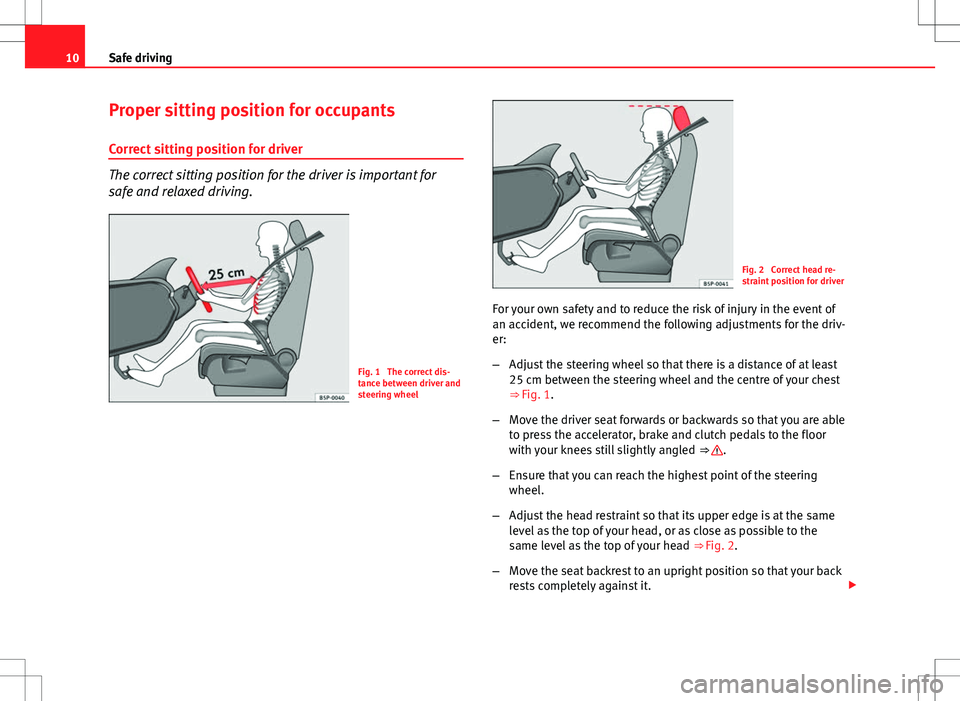
Fig. 1 The correct dis-
tance between driver and
steering wheel
Fig. 2 Correct head re-
straint position for driver
For your own safety and to reduce the risk of injury in the event of
an accident, we recommend the following adjustments for the driv-
er:
– Adjust the steering wheel so that there is a distance of at least
25 cm between the steering wheel and the centre of your chest
⇒ Fig. 1.
– Move the driver seat forwards or backwards so that you are able
to press the accelerator, brake and clutch pedals to the floor
with your knees still slightly angled ⇒
.
– Ensure that you can reach the highest point of the steering
wheel.
– Adjust the head restraint so that its upper edge is at the same
level as the top of your head, or as close as possible to the
same level as the top of your head ⇒ Fig. 2.
– Move the seat backrest to an upright position so that your back
rests completely against it.
Page 19 of 282

17
Safe driving
– Distribute the load evenly in the luggage compartment.
– Place heavy objects as far forward as possible in the luggage
compartment.
– Place the heavy objects first.
WARNING
● Loose luggage and other objects in the luggage compartment could
cause serious injuries.
● Always put objects in the luggage compartment.
● During sudden manoeuvres or accidents, loose objects can be thrown
forward, injuring vehicle occupants or even third parties. This increased
risk of injury will be further increased if a loose object is struck by an in-
flating airbag. If this happens, objects can be transformed into “mis-
siles”. Risk of fatal injury.
● Please note that the centre of gravity may shift when transporting
heavy objects; this may affect vehicle handling and lead to an accident.
Therefore, it is essential to adjust your speed and driving style accord-
ingly, to avoid accidents.
● Never exceed the allowed axle weights or allowed maximum weight.
If the allowed axle load or the allowed total weight is exceeded, the driv-
ing characteristics of the vehicle may change, leading to accidents, inju-
ries and damage to the vehicle.
● Never leave your vehicle unattended, especially when the rear lid is
open. Children could climb into the luggage compartment, closing the
door behind them; they will be trapped and run the risk of death.
● Never allow children to play in or around the vehicle. Close and lock
all the doors and rear lid when you leave the vehicle. Before you lock the
vehicle, make sure that there are no adults or children in the vehicle.
● Never transport passengers in the luggage compartment. All vehicle
occupants must have their seat belt fastened ⇒ page 19.
Note
● Air circulation in the vehicle helps reduce fogging of the windows. Used
air escapes through ventilation slits in the side trim of the luggage compart-
ment. Ensure that the ventilation slits are never covered.
Fastening rings
There can be four fastening rings in the luggage compart-
ment for fastening luggage and other objects.
– Always use suitable and undamaged straps to secure luggage
and other objects to the fastening rings ⇒
in Loading the lug-
gage compartment on page 17.
– Pull up the fastening rings to attach the straps.
During a collision or an accident, even small and light objects can build up
so much energy that they can cause very severe injuries. The amount of ki-
netic energy depends on the speed of the vehicle and the weight of the ob-
ject. The most significant factor, however, is the speed of the vehicle.
Example: An object weighing 4.5 kg is lying unsecured in the vehicle. Dur-
ing a frontal collision at a speed of 50 km/h (30 mph), this object generates
a force corresponding to 20 times its weight. That means that the effective
weight of the object increases to about 90 kg. You can imagine the severity
of the injuries which might be sustained if this object strikes an occupant as
it flies through the interior of the vehicle. This increased risk of injury will be
further increased if a loose object is struck by an inflating airbag.
Safety FirstOperating InstructionsPractical TipsTechnical Specifications
Page 22 of 282

20Seat belts
Seat belt warning lamp*
The control lamp acts as a reminder to the driver to fasten
the seat belt.
Before starting the vehicle:
– Fasten your seat belt securely.
– Instruct your passengers to fasten their seat belts properly be-
fore driving off.
– Protect children by using a child seat according to the child's
height and weight.
The control lamp in the instrument panel lights up 1)
if the driver or pas-
senger seat belt is not fastened 1)
when the ignition is switched on. More-
over, an audible warning 1)
is heard on exceeding 25 km/h (15 mph). This
acoustic signal stops when the seat belt is fastened.
The warning lamp* is switched off if the driver seat belt is fastened while
the ignition is switched on.
1)
Depending on the model version
Page 30 of 282

28Seat belts
Incorrectly fastened seat belts
Incorrectly worn seat belts can cause severe or even mortal
injuries.
Seat belts can provide optimal protection only if the belt web is
properly worn. The seat belts must be fastened exactly in the order
described in this chapter. An incorrect sitting position impairs sub-
stantially the protection a seat belt offers and can lead to severe or
fatal injuries. The risk of severe or fatal injuries is especially in-
creased when a deploying airbag strikes a vehicle occupant who
has assumed an incorrect sitting position. As the driver, you are re-
sponsible for yourself and all passengers, especially children.
Therefore:
– Never allow anyone to wear the seat belt incorrectly while the
vehicle is moving ⇒
.
WARNING
● An incorrectly worn seat belt increases the risk of severe injuries.
● Before every trip, instruct your passengers to adjust their seat belts
properly and to wear them for the whole journey.
● Read and always observe information and warnings concerning the
use of seat belts ⇒ page 23.
Belt tensioners*
Function of the seat belt tensioner
During a frontal collision, the seat belts on the front seats
are retracted automatically.
The seat belts for the occupants in the front seats are equipped with belt
tensioners. Sensors will trigger the belt tensioners during severe head-on,
lateral and rear collisions only if the seat belt is being worn. This retracts
and tightens the seat belts, reducing the forward motion of the occupants.
The seat belt tensioner can be triggered only once.
The belt tensioners will not be triggered in the event of light frontal and side
collisions, if the vehicle overturns, or in situations where no large forces act
on the front, side or rear of the vehicle.
Note
● If the seat belt tensioners are triggered, a fine dust is produced. This is
normal and it is not an indication of fire in the vehicle.
● The relevant safety requirements must be observed when the vehicle or
components of the system are scrapped. Specialised workshops are famili-
ar with these regulations, which are also available to you.
Service and disposal of belt tensioners
The belt tensioners are components of the seat belts that are installed in
the seats of your vehicle. If you work on the belt tensioners or remove and
install parts of the system when performing other repair work, the seat belt
may be damaged. The consequence may be that, in the event of an acci-
dent, the belt tensioners function incorrectly or not at all.
Page 34 of 282
32Airbag system
Monitoring of airbag and belt tensioner system
Both the airbag and belt tensioner systems operation is constantly moni-
tored electronically. The control lamp will light up for a few seconds every
time the ignition is switched on (self-diagnosis).
The system must be checked when the control lamp :
● does not light up when the ignition is switched on
● turns off after 4 seconds after the ignition is switched on
● turns off and then lights up again after the ignition is switched on
● lights up or flashes while the vehicle is moving
In the event of a malfunction, the warning lamp remains on continuously.
Have the airbag system inspected immediately by a specialised workshop.
If any of the airbags are disabled by a Technical Service, the warning lamp
lights for several seconds more after the verification and will turn off if there
is no fault.
WARNING
● If there is a malfunction, the airbag and belt tensioner system cannot
properly perform its protective function.
● If a malfunction occurred, have the system checked immediately by a
specialised workshop. Otherwise, in the event of an accident, the airbag
system and belt tensioners may not be triggered, or may not be triggered
correctly.
Repairs, maintenance and disposal of airbags
The parts of the airbag system are installed in various places in your vehi-
cle. If work is carried out on the airbag system or parts have to be removed
and fitted on the system when performing other repair work, parts of the air- bag system may be damaged. In the event of an accident this could cause
the airbag to inflate incorrectly or not inflate at all.
The relevant safety requirements must be observed when the vehicle or
components of the airbag are
scrapped. Specialised workshops and vehicle
disposal centres are familiar with these requirements.
WARNING
● If repairs are not carried out by a professional, or if the airbags are
used incorrectly, the risk of severe or fatal injuries is increased. The air-
bags may fail to inflate, or could inflate in the wrong circumstances.
● Do not cover or stick anything on the steering wheel hub or the sur-
face of the airbag unit on the passenger side of the dash panel, and do
not obstruct or modify them in any way.
● It is important not to attach any objects such as cup holders or tele-
phone mountings to the surfaces covering the airbag units.
● To clean the steering wheel or dash panel, you may use only a dry or a
water-moistened cloth. Never clean the dash panel and the airbag mod-
ule surface with cleaners containing solvents. Solvents cause the surface
to become porous. If the airbag triggered, plastic parts could become de-
tached and cause injuries.
● Never attempt to repair, adjust, remove or install parts of the airbag
system.
● Any work on the airbag system or removal and installation of the air-
bag components for other repairs (such as repairs to the steering wheel)
should be performed only by a specialised workshop. Specialised work-
shops have the necessary tools, repair information and qualified person-
nel.
● We strongly recommend you to go to a specialised workshop for all
work on the airbag system.
● Never attempt to alter the front bumper or the body.
● The airbags provide protection for just one accident; replace them
once they have deployed.