2012 Seat Ibiza 5D brake sensor
[x] Cancel search: brake sensorPage 66 of 280
64Cockpit
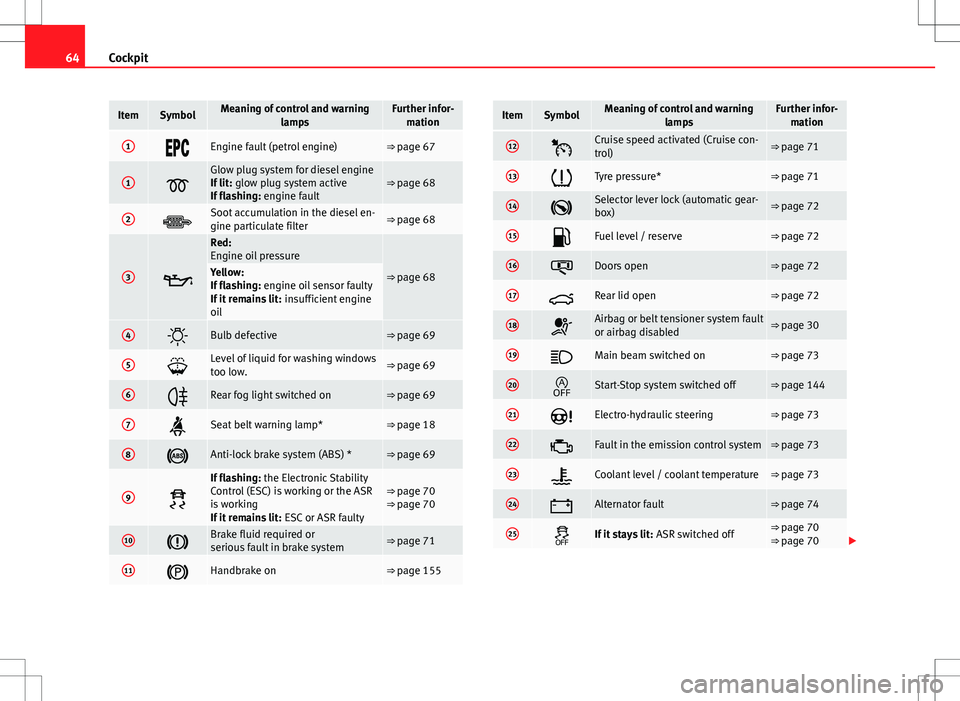
ItemSymbolMeaning of control and warning
lampsFurther infor-mation
1Engine fault (petrol engine)⇒ page 67
1
Glow plug system for diesel engine
If lit: glow plug system active
If flashing: engine fault⇒ page 68
2Soot accumulation in the diesel en-
gine particulate filter⇒ page 68
3
Red:
Engine oil pressure
⇒ page 68Yellow:
If flashing: engine oil sensor faulty
If it remains lit: insufficient engine
oil
4Bulb defective⇒ page 69
5Level of liquid for washing windows
too low.⇒ page 69
6Rear fog light switched on⇒ page 69
7Seat belt warning lamp*⇒ page 18
8Anti-lock brake system (ABS) *⇒ page 69
9
If flashing: the Electronic Stability
Control (ESC) is working or the ASR
is working
If it remains lit: ESC or ASR faulty⇒ page 70
⇒ page 70
10Brake fluid required or
serious fault in brake system⇒ page 71
11Handbrake on⇒ page 155
ItemSymbolMeaning of control and warning
lampsFurther infor-mation
12Cruise speed activated (Cruise con-
trol)⇒ page 71
13Tyre pressure*⇒ page 71
14Selector lever lock (automatic gear-
box)⇒ page 72
15Fuel level / reserve⇒ page 72
16Doors open⇒ page 72
17Rear lid open⇒ page 72
18Airbag or belt tensioner system fault
or airbag disabled⇒ page 30
19Main beam switched on⇒ page 73
20Start-Stop system switched off⇒ page 144
21Electro-hydraulic steering⇒ page 73
22Fault in the emission control system⇒ page 73
23Coolant level / coolant temperature⇒ page 73
24Alternator fault⇒ page 74
25If it stays lit: ASR switched off⇒ page 70
⇒ page 70
Page 159 of 280
157
Driving
WARNING
● If you do not start the vehicle immediately after taking your foot off
the brake pedal, the vehicle may start to roll back under certain condi-
tions. Depress the brake pedal or use the handbrake immediately.
● If the engine stalls, depress the brake pedal or use the handbrake im-
mediately.
● When following a line of traffic uphill, if you want to prevent the vehi-
cle from rolling back accidentally when starting off, hold the brake pedal
down for a few seconds before starting off.
Note
The Official Service or a specialised workshop can tell you if your vehicle is
equipped with this system.
Acoustic parking aid system* Rear parking aid
The parking aid system will use an audible warning to indi-
cate of the approach of any object towards the rear of the ve-
hicle. Description
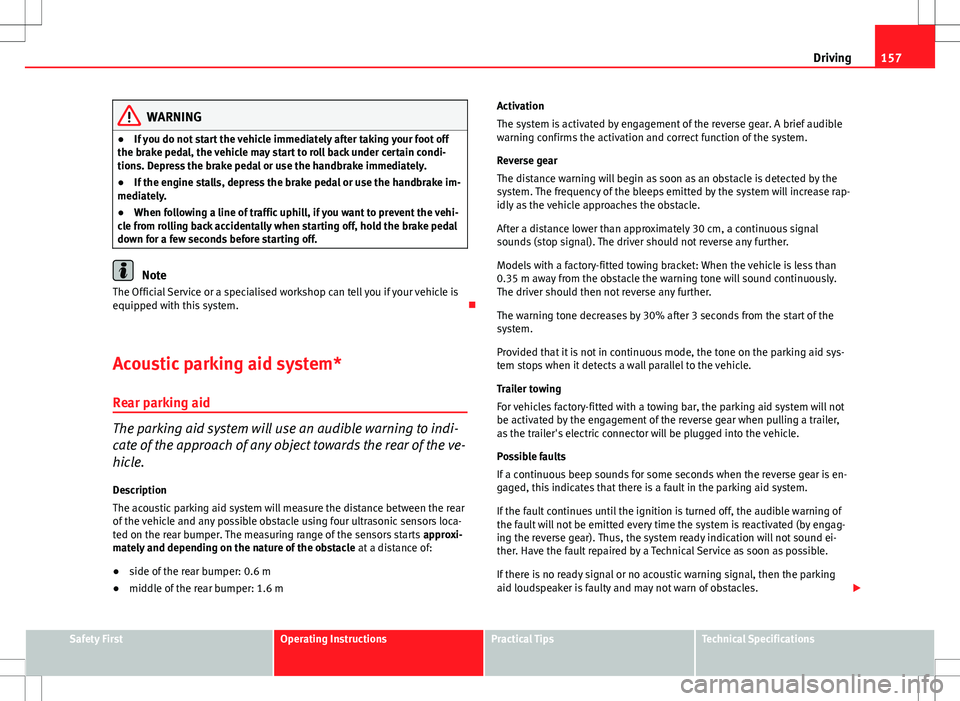
The acoustic parking aid system will measure the distance between the rear
of the vehicle and any possible obstacle using four ultrasonic sensors loca-
ted on the rear bumper. The measuring range of the sensors starts approxi-
mately and depending on the nature of the obstacle at a distance of:
● side of the rear bumper: 0.6 m
● middle of the rear bumper: 1.6 m Activation
The system is activated by engagement of the reverse gear. A brief audible
warning confirms the activation and correct function of the system.
Reverse gear
The distance warning will begin as soon as an obstacle is detected by the
system. The frequency of the bleeps emitted by the system will increase rap-
idly as the vehicle approaches the obstacle.
After a distance lower than approximately 30 cm, a continuous signal
sounds (stop signal). The driver should not reverse any further.
Models with a factory-fitted towing bracket: When the vehicle is less than
0.35 m away from the obstacle the warning tone will sound continuously.
The driver should then not reverse any further.
The warning tone decreases by 30% after 3 seconds from the start of the
system.
Provided that it is not in continuous mode, the tone on the parking aid sys-
tem stops when it detects a wall parallel to the vehicle.
Trailer towing
For vehicles factory-fitted with a towing bar, the parking aid system will not
be activated by the engagement of the reverse gear when pulling a trailer,
as the trailer's electric connector will be plugged into the vehicle.
Possible faults
If a continuous beep sounds for some seconds when the reverse gear is en-
gaged, this indicates that there is a fault in the parking aid system.
If the fault continues until the ignition is turned off, the audible warning of
the fault will not be emitted every time the system is reactivated (by engag-
ing the reverse gear). Thus, the system ready indication will not sound ei-
ther. Have the fault repaired by a Technical Service as soon as possible.
If there is no ready signal or no acoustic warning signal, then the parking
aid loudspeaker is faulty and may not warn of obstacles.
Safety FirstOperating InstructionsPractical TipsTechnical Specifications
Page 167 of 280

165
Intelligent technology
The ASR helps the car to start moving, accelerate and climb a gradient in
slippery conditions, where this may otherwise be difficult or even impossi-
ble.
The ASR automatically switches on when the engine is started. If necessary,
it may be turned on or off by briefly pushing the ESC button on the centre
console.
When the ASR is off, the warning lamp is lit. The ASR should normally be
left on. Only in exceptional circumstances, when the slipping of the wheels
is required, can they be disconnected using the ESC button, for example.
● With compact temporary spare wheel.
● When using the snow chains.
● When driving in deep snow or on loose surfaces
● When the vehicle is bogged-down, to free it by rocking.
The ASR should be switched on again as soon as possible.
WARNING
● Remember that not even the ASR can defy the laws of physics. This
should be kept in mind, particularly on slippery and wet roads and when
towing a trailer.
● Always adapt your driving style to suit the condition of the roads and
the traffic situation. The greater safety provided by the ASR should not
encourage you to run any risks.
CAUTION
● To ensure that the ASR works correctly, identical tyres should be fitted
on all four wheels. Any differences in the rolling radius of the tyres can
cause the system to reduce engine power when this is not desired.
● Any modifications made to the vehicle (for example, to the engine,
brake system, running gear or to the combination of wheels and tyres) may
affect the operation of the ABS and ASR. XDS*
Driveshaft differential
When taking a bend, the driveshaft differential mechanism allows the outer
wheel to turn at a higher speed than the inner wheel. In this way, the wheel
that is turning faster (outer wheel) receives less drive torque than the inner
wheel. This may mean that in certain situations the torque delivered to the
inner wheel is too high, causing the wheels to spin. On the other hand, the
outer wheel is receiving a lower drive torque than it could transmit. This
causes an overall loss of lateral grip on the front axle, resulting in under-
steer or “lengthening” of the trajectory.
The XDS system can detect and correct this effect via the sensors and sig-
nals of the ESC.
Via the ESC, the XDS will brake the inside wheel and counter the excess
driving torque of that wheel. This means that the driver's desired trajectory
is much more precise,
The XDS system works in combination with the ESC and is always active,
even when the ASR traction control is disconnected.
Electronic Stability Control (ESC)*
General notes
The Electronic Stability Control increases the vehicle's stabil-
ity on the road. The Electronic Stability Control helps reduce the danger of skidding.
The Electronic Stability Control (ESC) includes the systems ABS, EDL and
ASR
Safety FirstOperating InstructionsPractical TipsTechnical Specifications
Page 168 of 280
166Intelligent technology
Electronic Stability Control (ESC)*
The ESC reduces the risk of skidding by braking the wheels individually.
The system uses the steering wheel angle and road speed to calculate the
changes of direction desired by the driver, and constantly compares them
with the actual behaviour of the vehicle. When irregularities occur, for exam-
ple, if the vehicle begins to skid, the ESC brakes the appropriate wheel au-
tomatically.
The forces acting on the braked wheel bring the vehicle back to a stable
condition. If the vehicle tends to oversteer, the system will act on the front
wheel on the outside of the turn.
WARNING
● Remember that not even the ESC can defy the laws of physics. This
should be kept in mind, particularly on slippery and wet roads and when
towing a trailer.
● Always adapt your driving style to suit the condition of the roads and
the traffic situation. The greater safety provided by the ESC should not
encourage you to run any risks.
CAUTION
● To ensure that the ESC works correctly, all four wheels must be fitted
with the same tyres. Any differences in the rolling radius of the tyres can
cause the system to reduce engine power when this is not desired.
● Any modifications made to the vehicle (for example, to the engine,
brake system, running gear or to the combination of wheels and tyres) may
affect the operation of the ABS, EDL, ESC and ASR. Anti-lock brake system (ABS)
The anti-lock brake system prevents the wheels locking during braking
⇒ page 164
Electronic differential lock (EDL)*
The electronic differential lock helps prevent the loss of trac-
tion caused if one of the driven wheels starts spinning.
EDL helps the vehicle to start moving, accelerate and climb a gradient in
slippery conditions where this may otherwise be difficult or even impossi-
ble.
The system will control the revolutions of the driven wheels using the ABS
sensors (in case of an EDL fault the warning lamp for ABS lights up)
⇒ page 69.
At speeds of up to approximately 80 km/h (50 mph), it is able to balance
out differences in the speed of the driven wheels of approximately 100 rpm
caused by a slippery road surface on one side of the vehicle. It does this by
braking the wheel which has lost traction and distributing more driving
force to the other driven wheel via the differential.
To prevent the disc brake of the braking wheel from overheating, the EDL
cuts out automatically if subjected to excessive loads. The vehicle will con-
tinue to function normally without EDL. For this reason, the driver is not in-
formed that the EDL has been switched off.
The EDL will switch on again automatically when the brake has cooled
down.
Page 229 of 280
227
If and when
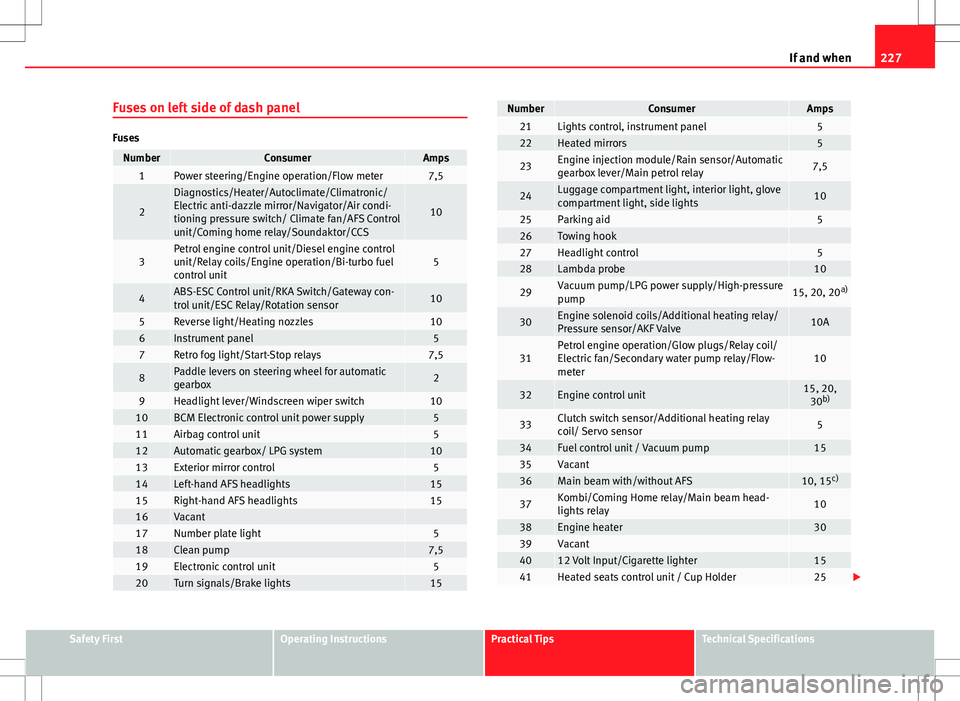
Fuses on left side of dash panel
Fuses
NumberConsumerAmps1Power steering/Engine operation/Flow meter7,5
2
Diagnostics/Heater/Autoclimate/Climatronic/
Electric anti-dazzle mirror/Navigator/Air condi-
tioning pressure switch/ Climate fan/AFS Control
unit/Coming home relay/Soundaktor/CCS
10
3Petrol engine control unit/Diesel engine control
unit/Relay coils/Engine operation/Bi-turbo fuel
control unit5
4ABS-ESC Control unit/RKA Switch/Gateway con-
trol unit/ESC Relay/Rotation sensor10
5Reverse light/Heating nozzles106Instrument panel57Retro fog light/Start-Stop relays7,5
8Paddle levers on steering wheel for automatic
gearbox2
9Headlight lever/Windscreen wiper switch1010BCM Electronic control unit power supply511Airbag control unit512Automatic gearbox/ LPG system1013Exterior mirror control514Left-hand AFS headlights1515Right-hand AFS headlights1516Vacant 17Number plate light518Clean pump7,519Electronic control unit520Turn signals/Brake lights15
NumberConsumerAmps21Lights control, instrument panel522Heated mirrors5
23Engine injection module/Rain sensor/Automatic
gearbox lever/Main petrol relay7,5
24Luggage compartment light, interior light, glove
compartment light, side lights10
25Parking aid526Towing hook 27Headlight control528Lambda probe10
29Vacuum pump/LPG power supply/High-pressure
pump15, 20, 20 a)
30Engine solenoid coils/Additional heating relay/
Pressure sensor/AKF Valve10A
31Petrol engine operation/Glow plugs/Relay coil/
Electric fan/Secondary water pump relay/Flow-
meter10
32Engine control unit15, 20,
30 b)
33Clutch switch sensor/Additional heating relay
coil/ Servo sensor5
34Fuel control unit / Vacuum pump1535Vacant 36Main beam with/without AFS10, 15 c)
37Kombi/Coming Home relay/Main beam head-
lights relay10
38Engine heater3039Vacant 4012 Volt Input/Cigarette lighter1541Heated seats control unit / Cup Holder25
Safety FirstOperating InstructionsPractical TipsTechnical Specifications
Page 276 of 280
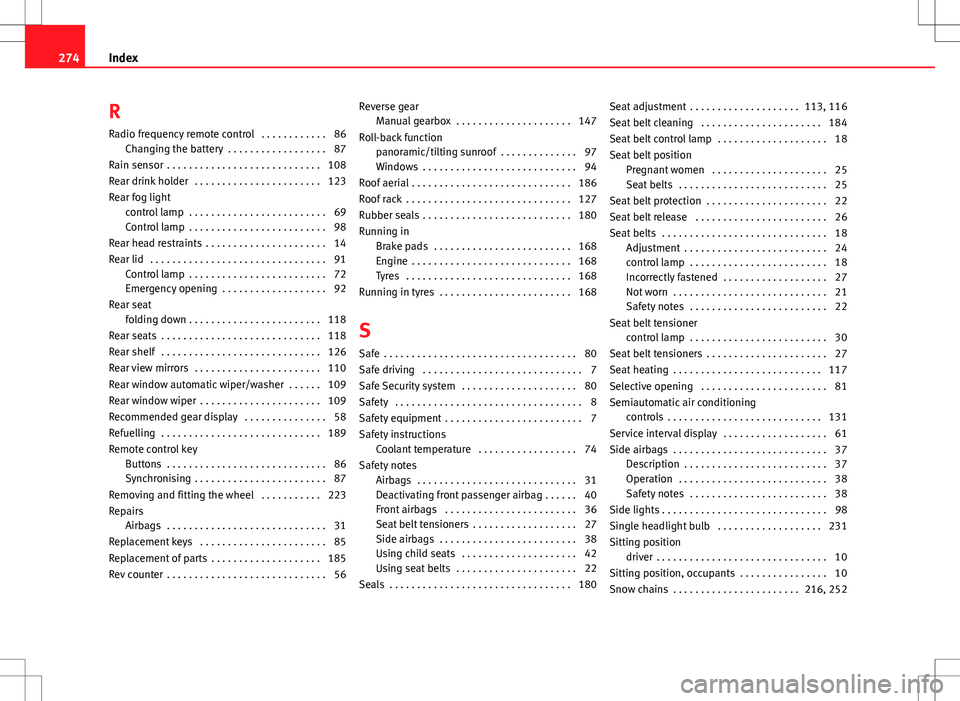
RRadio frequency remote control . . . . . . . . . . . . 86 Changing the battery . . . . . . . . . . . . . . . . . . 87
Rain sensor . . . . . . . . . . . . . . . . . . . . . . . . . . . . 108
Rear drink holder . . . . . . . . . . . . . . . . . . . . . . . 123
Rear fog light control lamp . . . . . . . . . . . . . . . . . . . . . . . . . 69
Control lamp . . . . . . . . . . . . . . . . . . . . . . . . . 98
Rear head restraints . . . . . . . . . . . . . . . . . . . . . . 14
Rear lid . . . . . . . . . . . . . . . . . . . . . . . . . . . . . . . . 91 Control lamp . . . . . . . . . . . . . . . . . . . . . . . . . 72
Emergency opening . . . . . . . . . . . . . . . . . . . 92
Rear seat folding down . . . . . . . . . . . . . . . . . . . . . . . . 118
Rear seats . . . . . . . . . . . . . . . . . . . . . . . . . . . . . 118
Rear shelf . . . . . . . . . . . . . . . . . . . . . . . . . . . . . 126
Rear view mirrors . . . . . . . . . . . . . . . . . . . . . . . 110
Rear window automatic wiper/washer . . . . . . 109
Rear window wiper . . . . . . . . . . . . . . . . . . . . . . 109
Recommended gear display . . . . . . . . . . . . . . . 58
Refuelling . . . . . . . . . . . . . . . . . . . . . . . . . . . . . 189
Remote control key Buttons . . . . . . . . . . . . . . . . . . . . . . . . . . . . . 86
Synchronising . . . . . . . . . . . . . . . . . . . . . . . . 87
Removing and fitting the wheel . . . . . . . . . . . 223
Repairs Airbags . . . . . . . . . . . . . . . . . . . . . . . . . . . . . 31
Replacement keys . . . . . . . . . . . . . . . . . . . . . . . 85
Replacement of parts . . . . . . . . . . . . . . . . . . . . 185
Rev counter . . . . . . . . . . . . . . . . . . . . . . . . . . . . . 56 Reverse gear
Manual gearbox . . . . . . . . . . . . . . . . . . . . . 147
Roll-back function panoramic/tilting sunroof . . . . . . . . . . . . . . 97
Windows . . . . . . . . . . . . . . . . . . . . . . . . . . . . 94
Roof aerial . . . . . . . . . . . . . . . . . . . . . . . . . . . . . 186
Roof rack . . . . . . . . . . . . . . . . . . . . . . . . . . . . . . 127
Rubber seals . . . . . . . . . . . . . . . . . . . . . . . . . . . 180
Running in Brake pads . . . . . . . . . . . . . . . . . . . . . . . . . 168
Engine . . . . . . . . . . . . . . . . . . . . . . . . . . . . . 168
Tyres . . . . . . . . . . . . . . . . . . . . . . . . . . . . . . 168
Running in tyres . . . . . . . . . . . . . . . . . . . . . . . . 168
S Safe . . . . . . . . . . . . . . . . . . . . . . . . . . . . . . . . . . . 80
Safe driving . . . . . . . . . . . . . . . . . . . . . . . . . . . . . 7
Safe Security system . . . . . . . . . . . . . . . . . . . . . 80
Safety . . . . . . . . . . . . . . . . . . . . . . . . . . . . . . . . . . 8
Safety equipment . . . . . . . . . . . . . . . . . . . . . . . . . 7
Safety instructions Coolant temperature . . . . . . . . . . . . . . . . . . 74
Safety notes Airbags . . . . . . . . . . . . . . . . . . . . . . . . . . . . . 31
Deactivating front passenger airbag . . . . . . 40
Front airbags . . . . . . . . . . . . . . . . . . . . . . . . 36
Seat belt tensioners . . . . . . . . . . . . . . . . . . . 27
Side airbags . . . . . . . . . . . . . . . . . . . . . . . . . 38
Using child seats . . . . . . . . . . . . . . . . . . . . . 42
Using seat belts . . . . . . . . . . . . . . . . . . . . . . 22
Seals . . . . . . . . . . . . . . . . . . . . . . . . . . . . . . . . . 180 Seat adjustment . . . . . . . . . . . . . . . . . . . . 113, 116
Seat belt cleaning . . . . . . . . . . . . . . . . . . . . . . 184
Seat belt control lamp . . . . . . . . . . . . . . . . . . . . 18
Seat belt position
Pregnant women . . . . . . . . . . . . . . . . . . . . . 25
Seat belts . . . . . . . . . . . . . . . . . . . . . . . . . . . 25
Seat belt protection . . . . . . . . . . . . . . . . . . . . . . 22
Seat belt release . . . . . . . . . . . . . . . . . . . . . . . . 26
Seat belts . . . . . . . . . . . . . . . . . . . . . . . . . . . . . . 18 Adjustment . . . . . . . . . . . . . . . . . . . . . . . . . . 24
control lamp . . . . . . . . . . . . . . . . . . . . . . . . . 18
Incorrectly fastened . . . . . . . . . . . . . . . . . . . 27
Not worn . . . . . . . . . . . . . . . . . . . . . . . . . . . . 21
Safety notes . . . . . . . . . . . . . . . . . . . . . . . . . 22
Seat belt tensioner control lamp . . . . . . . . . . . . . . . . . . . . . . . . . 30
Seat belt tensioners . . . . . . . . . . . . . . . . . . . . . . 27
Seat heating . . . . . . . . . . . . . . . . . . . . . . . . . . . 117
Selective opening . . . . . . . . . . . . . . . . . . . . . . . 81
Semiautomatic air conditioning controls . . . . . . . . . . . . . . . . . . . . . . . . . . . . 131
Service interval display . . . . . . . . . . . . . . . . . . . 61
Side airbags . . . . . . . . . . . . . . . . . . . . . . . . . . . . 37 Description . . . . . . . . . . . . . . . . . . . . . . . . . . 37
Operation . . . . . . . . . . . . . . . . . . . . . . . . . . . 38
Safety notes . . . . . . . . . . . . . . . . . . . . . . . . . 38
Side lights . . . . . . . . . . . . . . . . . . . . . . . . . . . . . . 98
Single headlight bulb . . . . . . . . . . . . . . . . . . . 231
Sitting position driver . . . . . . . . . . . . . . . . . . . . . . . . . . . . . . . 10
Sitting position, occupants . . . . . . . . . . . . . . . . 10
Snow chains . . . . . . . . . . . . . . . . . . . . . . . 216, 252
274 Index