2012 Seat Alhambra checking oil
[x] Cancel search: checking oilPage 287 of 388

285
Checking and refilling levels
Checking the engine oil level and topping up
Fig. 170 Marked engine
oil dipstick.
Fig. 171 In the engine
compartment: Engine oil
filler cap. Preparations
●
Park the vehicle on flat ground so that the engine oil reading is correct.
● Stop the engine and wait a few minutes for the oil to drain back into the
sump. When the engine has cooled down, immediately check the oil level
and top up if necessary.
● Open the bonnet ⇒ page 279.
● The engine oil filler opening can be recognised by the symbol on the
cap ⇒ fig. 171 and the dipstick by its coloured handle.
Checking the engine oil level
● Pull out the dipstick and wipe it on a clean cloth.
● Replace the dipstick, pushing it in as far as it will go. If the dipstick has a
mark, when you reintroduce it this mark should slot into the corresponding
groove located on the upper end of the tube.
● Remove the dipstick again and check the engine oil level ⇒ table on
page 285.
● After reading the oil level, replace the dipstick in the tube completely.
Engine oil topping up ranges
fig. 170Operations required depending on the engine oil topping
up level:
Area ADo not top up oil
⇒ .
Area BAdd approximately 0.5 L of oil (1/2 quarter of a gallon).
The oil level can be in the zone A, but never above A.
Area C:It is
essential to add oil (approximately 1 litre or quarter of
a gallon). Ensure that the level is around the centre of the
zone B
after adding oil.
Adding oil after checking the level
Only add engine oil in small quantities and in steps.
Safety FirstOperating instructionsPractical tipsTechnical Specifications
Page 288 of 388

286Checking and refilling levels
● Unscrew the cap from engine oil filler opening on the cylinder head
⇒ fig. 171. If you are not sure where the cap is, request help from a special-
ist.
● Only refill using engine oil expressly approved by SEAT and in small
quantities (not more than 0.5 l or 1/2 a quarter of a gallon at a time)
⇒ page 284.
● To avoid adding too much oil, each time you add a quantity, wait until
the oil has flowed into the crankcase so that it can be measured with the
dipstick.
● Check the oil level before adding any more oil. Do not top up with too
much engine oil ⇒
.
● When the oil level is in at least the ⇒ fig. 170 B zone, insert the dip-
stick into the tube fully to avoid engine oil escaping when the engine is run-
ning.
● After topping up the oil, ensure that the cap is screwed on to the filler
mouth correctly.
WARNING
Oil could catch fire if it comes into contact with hot engine components.
This could lead to a fire, explosion and severe injuries.
● Always ensure that after topping of oil, the engine oil filler cap is cor-
rectly tightened. This will avoid engine oil spilling onto hot engine parts
when the engine is running.
CAUTION
● If the oil level is above the area A do not start the engine. You should
obtain professional assistance. Otherwise catalytic converter and engine
damage may occur.
● When refilling or changing service liquids, ensure that you put the liq-
uids into the right tank. Making a mistake when refilling could cause seri-
ous malfunctions and damage the engine!
For the sake of the environment
The oil level must never be above area A. Otherwise oil can be drawn in
through the crankcase breather and escape into the atmosphere via the ex-
haust system.
Engine oil consumption
The consumption of engine oil can be different from one engine to another
and can vary during the useful life of the engine.
Depending on driving style and the conditions of use, the consumption of
engine oil can reach 1 litre every 2000 km (one quarter of a gallon every
1200 miles); for new vehicles, this could be higher for the first 5000 km
(3000 miles). For this reason the engine oil level must be checked at regular
intervals, preferably when filling the tank and before a journey.
When the engine is working hard, for instance during sustained high-speed
motorway cruising in summer, when towing a trailer or climbing mountain
passes, the oil level should preferably be kept within area ⇒ fig. 170 A
.
Changing the engine oil
The engine oil must be changed regularly according to the specifications of
the Maintenance Programme.
Due to the problems linked with disposing of used oil and the need for suit-
able tools and special knowledge, always visit a Technical Service to have
the engine oil and filter changed. SEAT recommends visiting a Technical
Service.
Detailed information on the service intervals are shown in the Maintenance
Programme.
Page 289 of 388

287
Checking and refilling levels
Engine oil additives make new oil darker after the engine has been running
for a short period. This is normal and does not mean more frequent oil
changes are required.
WARNING
If, in exceptional circumstances, you must change the engine oil yourself,
please note the following:
● Wear eye protection.
● Always wait until the engine has completely cooled to avoid being
burned.
● Always keep your arms horizontal when unscrewing the oil drainage
bolt so that the oil does not run down your arms when it begins to drain.
● Use a suitable and large enough container to collect all of the used oil
in the engine.
● Never collect engine oil in empty food containers, cans, bottles and
other containers as not all people are able to identify engine oil.
● Oil is toxic and must be kept out of the reach of children.
For the sake of the environment
Before changing the engine oil, find a suitable location or service for proper
disposal.
For the sake of the environment
Always dispose of engine oil with the utmost respect for the environment.
Never dispose of used engine oil in places such as a garden, woods, drains,
roads, paths, rivers and drainage systems. Engine coolant
Introduction
Never work on the engine cooling system or if you are not familiar with the
operations to be carried out, the applicable safety standards and especially
if you do not have the instruments, liquids and tools necessary ⇒
! Have
the work carried out by a specialised workshop if you are uncertain. SEAT
recommends visiting a Technical Service.
Negligent work can cause serious injury.
Additional information and warnings:
● Towing mode ⇒ page 237
● Working in the engine compartment ⇒ page 279
● Accessories, parts replacement, repairs and modifications ⇒ page 261
WARNING
Engine coolant is toxic!
● Only keep engine coolant in its original container, tightly shut and in
a safe place.
● Never store engine coolant in empty food containers or bottles as
other people may accidentally drink it.
● Always keep engine coolant out of reach of children.
● Ensure that the proportion of engine coolant additive corresponds to
the lowest outside temperature to which the vehicle will be exposed.
● If the outside temperature is extremely low, the engine coolant could
freeze causing the vehicle to stop. As this would also cause the heating
to stop working, passengers without sufficient clothing could freeze.
Safety FirstOperating instructionsPractical tipsTechnical Specifications
Page 291 of 388

289
Checking and refilling levels
WARNING
If the warning lamps and messages are ignored, the vehicle may stall in
traffic, or may cause accidents and severe injuries.
● Always observe any lit warning lamps and text messages.
● Never ignore the warning lamps or text messages.
● Stop the vehicle safely as soon as possible.
CAUTION
Failure to heed the warning lamps and text messages when they appear
may result in faults in the vehicle.
Engine coolant specifications
The engine cooling system comes with a special mixture of water and at
least 40% G 12 plus-plus (TL-VW 774 G) or G 12 plus (TL-VW 774 F) engine
coolant additive. Both are easily recognisable because they are purple in
colour.
This mixture gives the necessary frost protection down to -25 °C (-13 °F) and
protects the alloy parts of the cooling system against corrosion. It also pre-
vents scaling and raises the boiling point of the coolant.
To protect the engine cooling system, the proportion of additive must al-
ways be at least 40%, even if frost protection is not required in countries
with a warm climate.
If greater frost protection is required in very cold climates, the proportion of
additive can be increased. However, the percentage of additive should not
exceed 60 %, as this would reduce the frost protection and, in turn, de-
crease the cooling capacity. When adding coolant, a mixture of
distilled water and at least 40 % of the
additive G 12 plus-plus must be use to ensure optimum rust protection
⇒
.
WARNING
In the event of insufficient antifreeze protection in the engine cooling
system, the engine could be damaged and severe injuries caused.
● Ensure that the proportion of engine coolant additive corresponds to
the lowest outside temperature to which the vehicle will be exposed.
● If the outside temperature is extremely low, the engine coolant could
freeze causing the vehicle to stop. As this would also cause the heating
to stop working, passengers without sufficient clothing could freeze.
CAUTION
Never mix genuine additives with other additives that are not approved by
SEAT. Otherwise, you run the risk of causing severe damage to the engine
and the engine cooling system.
● The engine coolant G 12 plus-plus can be mixed with G 12 plus and
G 11.
● If the fluid in the expansion reservoir is not purple but, for example,
brown, this means that you have mixed G 12 plus-plus or G 12 plus with an-
other coolant. The coolant must be changed as soon as possible if this is
the case! Using the wrong fluids could cause serious malfunctions and en-
gine damage!
For the sake of the environment
Coolants and additives can contaminate the environment. Collect any spilt
fluids in suitable containers and dispose of in accordance with legislation
and with the utmost respect for the environment.
Safety FirstOperating instructionsPractical tipsTechnical Specifications
Page 354 of 388
352Technical specifications
Technical specifications
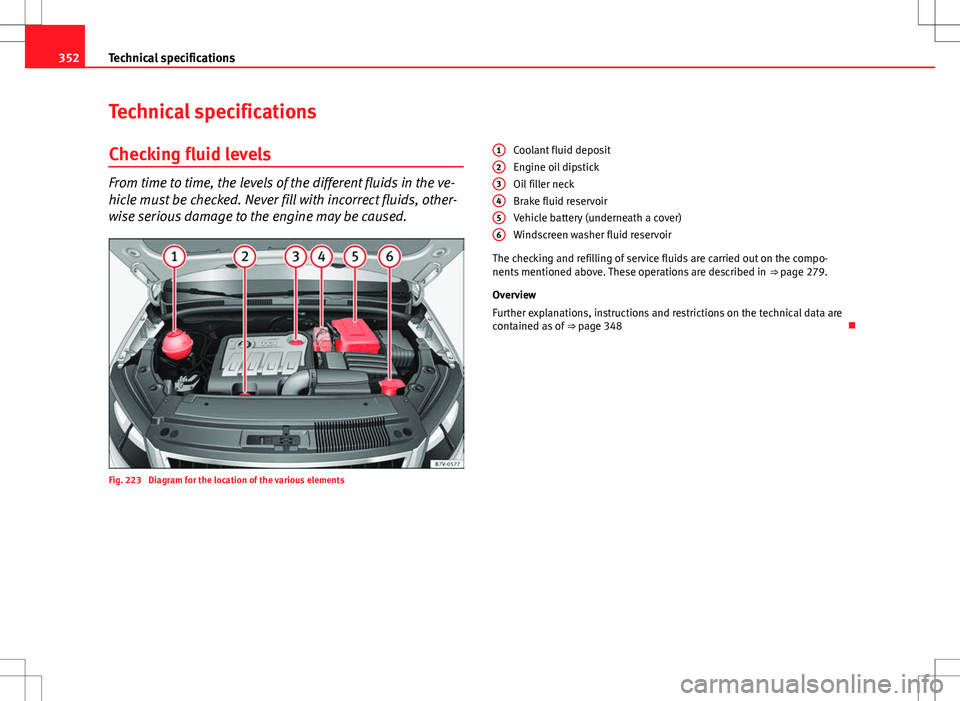
Checking fluid levels
From time to time, the levels of the different fluids in the ve-
hicle must be checked. Never fill with incorrect fluids, other-
wise serious damage to the engine may be caused.
Fig. 223 Diagram for the location of the various elements Coolant fluid deposit
Engine oil dipstick
Oil filler neck
Brake fluid reservoir
Vehicle battery (underneath a cover)
Windscreen washer fluid reservoir
The checking and refilling of service fluids are carried out on the compo-
nents mentioned above. These operations are described in ⇒ page 279.
Overview
Further explanations, instructions and restrictions on the technical data are
contained as of ⇒ page 348
1
23456
Page 373 of 388

Brake assist systems . . . . . . . . . . . . . . . . . . . . 191
Brake assist system (BAS) . . . . . . . . . . . . . . . . 192
Brake fluid . . . . . . . . . . . . . . . . . . . . . . . . . . . . 193Specification . . . . . . . . . . . . . . . . . . . . . . . . 194
Brakes Brake assist systems . . . . . . . . . . . . . . . . . 191
Brake fluid . . . . . . . . . . . . . . . . . . . . . . . . . 193
Brake fluid level . . . . . . . . . . . . . . . . . . . . . 194
Brake pads . . . . . . . . . . . . . . . . . . . . . . . . . 189
Changing the brake fluid . . . . . . . . . . . . . . 194
Control lamp . . . . . . . . . . . . . . . . . . . . . . . . 186
Emergency brake indicator in case of sud-den braking . . . . . . . . . . . . . . . . . . . . . . . 317
Running-in brake pads . . . . . . . . . . . . . . . . 189
Warning lamp . . . . . . . . . . . . . . . . . . . . . . . 186
Brake servo . . . . . . . . . . . . . . . . . . . . . . . . 189, 191
Brake system Malfunction . . . . . . . . . . . . . . . . . . . . . . . . 189
Brake systems . . . . . . . . . . . . . . . . . . . . . . . . . 191
Braking assist . . . . . . . . . . . . . . . . . . . . . . . . . . 192 Brake assist system (BAS) . . . . . . . . . . . . . 192
Breakdown Securing the vehicle . . . . . . . . . . . . . . . . . 316
Bulb fault See changing bulbs . . . . . . . . . . . . . . . . . . 330
C
Card compartments . . . . . . . . . . . . . . . . . . . . . 145
Care See "Care of your vehicle" . . . . . . . . . . . . . 246
Vehicle interior . . . . . . . . . . . . . . . . . . . . . . 253 Care of your vehicle
Exterior . . . . . . . . . . . . . . . . . . . . . . . . . . . . 246
Caring for paintwork . . . . . . . . . . . . . . . . . . . . . 251
Carrier system . . . . . . . . . . . . . . . . . . . . . . . . . . 139
Catalytic converter . . . . . . . . . . . . . . . . . . . . . . 233 Malfunction . . . . . . . . . . . . . . . . . . . . . . . . 233
Warning lamp . . . . . . . . . . . . . . . . . . . . . . . 232
CD changer . . . . . . . . . . . . . . . . . . . . . . . . 142, 149
Central locking . . . . . . . . . . . . . . . . . . . . . . . 74, 77 Antitheft alarm . . . . . . . . . . . . . . . . . . . . . . . 78
Locking/unlocking the vehicle . . . . . . . . . . 76
Central locking system After airbag deployment . . . . . . . . . . . . . . . 75
Description . . . . . . . . . . . . . . . . . . . . . . . . . . 75
Opening doors individually . . . . . . . . . . . . . 75
Centre armrest . . . . . . . . . . . . . . . . . . . . . . . . . 126
Changing Windscreen wiper blades . . . . . . . . . . . . . 250
Changing a wheel . . . . . . . . . . . . . . . . . . . . . . 309 Changing a wheel . . . . . . . . . . . . . . . . . . . 315
Preparations . . . . . . . . . . . . . . . . . . . . . . . . 310
Raising the vehicle . . . . . . . . . . . . . . . . . . . 313
Wheel bolts . . . . . . . . . . . . . . . . . . . . . . . . . 311
Changing bulbs . . . . . . . . . . . . . . . . . . . . . . . . 330 Bodywork . . . . . . . . . . . . . . . . . . . . . . . . . . 337
Checklist . . . . . . . . . . . . . . . . . . . . . . . . . . . 331
Front bumper . . . . . . . . . . . . . . . . . . . . . . . 335
Halogen headlights . . . . . . . . . . . . . . . . . . 332
Indicator . . . . . . . . . . . . . . . . . . . . . . . . . . . 330
Initial operations . . . . . . . . . . . . . . . . . . . . 331
Number plate light . . . . . . . . . . . . . . . . . . . 339
Sea changing bulbs . . . . . . . . . . . . . . . . . . 330 Tailgate . . . . . . . . . . . . . . . . . . . . . . . . . . . . 336
Tail lights . . . . . . . . . . . . . . . . . . . . . . 336, 337
Xenon headlights . . . . . . . . . . . . . . . . . . . . 334
Changing gear . . . . . . . . . . . . . . . . . . . . . . . . . 176 Automatic gearbox . . . . . . . . . . . . . . . . . . . 180
Engaging gears (manual gearbox) . . . . . . 179
Manual gearbox . . . . . . . . . . . . . . . . . . . . . 179
Manually unlocking the gear selection lev-er . . . . . . . . . . . . . . . . . . . . . . . . . . . . . . . 323
Selecting gears (automatic gearbox) . . . . 180
Warning and control lamps . . . . . . . . . . . . 177
Changing gears Gear recommendation . . . . . . . . . . . . . . . . 184
Tiptronic . . . . . . . . . . . . . . . . . . . . . . . . . . . 182
Changing the battery of the vehicle key . . . . . . . . . . . . . . . . . . . . . 73
Changing the wheel After changing the wheel . . . . . . . . . . . . . . 315
Checking Tyre pressures . . . . . . . . . . . . . . . . . . . . . . . 302
Checking the oil level . . . . . . . . . . . . . . . . . . . . 285
Check list . . . . . . . . . . . . . . . . . . . . . . . . . . . . . . . 7
Checklist Before working in the engine compart-ment . . . . . . . . . . . . . . . . . . . . . . . . . . . . . 281
Changing bulbs . . . . . . . . . . . . . . . . . . . . . 331
In case of an emergency . . . . . . . . . . . . . . 316
Check list Preparations for changing a wheel . . . . . . 310
Raising the vehicle with the jack . . . . . . . . 314
Checklist Refilling precautions . . . . . . . . . . . . . . . . . 271
Seat belts . . . . . . . . . . . . . . . . . . . . . . . . . . . 21
371
Index
Page 376 of 388

Economic . . . . . . . . . . . . . . . . . . . . . . . . . . 229
Fuel gauge . . . . . . . . . . . . . . . . . . . . . . . . . 269
Fuel level to low . . . . . . . . . . . . . . . . . . . . . 270
Parking downhill . . . . . . . . . . . . . . . . . . . . 188
Parking uphill . . . . . . . . . . . . . . . . . . . . . . . 188
Tips . . . . . . . . . . . . . . . . . . . . . . . . . . . . . . . . . 7
Towing . . . . . . . . . . . . . . . . . . . . . . . . . . . . . 347
Trailer . . . . . . . . . . . . . . . . . . . . . . . . . . . . . 241
Undercarriage guard . . . . . . . . . . . . . . . . . . . 7
Driving abroad Check list . . . . . . . . . . . . . . . . . . . . . . . . . . . . 8
Headlights . . . . . . . . . . . . . . . . . . . . . . . . . 100
Driving advice For a loaded vehicle . . . . . . . . . . . . . . . . . . . 13
Driving in winter Fuel consumption . . . . . . . . . . . . . . . . . . . . 231
Snow chains . . . . . . . . . . . . . . . . . . . . . . . . 305
Tread depth . . . . . . . . . . . . . . . . . . . . . . . . . 303
Tyre pressures . . . . . . . . . . . . . . . . . . . . . . . 301
Windscreen washer bottle . . . . . . . . . . . . . 249
Winter tyres . . . . . . . . . . . . . . . . . . . . . . . . . 304
Driving through water . . . . . . . . . . . . . . . . . . . . . 9
Driving with a trailer . . . . . . . . . . . . . . . . . . . . . 237 Extinguisher . . . . . . . . . . . . . . . . . . . . . . . . 238
Technical requirements . . . . . . . . . . . . . . . 237
DSG . . . . . . . . . . . . . . . . . . . . . . . . . . . . . . . . . . 182
DSG automatic gearbox See "Automatic gearbox" . . . . . . . . . . . . . . 182
DSG Automatic gearbox Malfunction . . . . . . . . . . . . . . . . . . . . . . . . 183
Dynamic headlight range control . . . . . . . . . . 101 Dynamic headlight range control . . . . . . . 101 E
Ecological driving . . . . . . . . . . . . . . . . . . . . . . . 229
Economic driving . . . . . . . . . . . . . . . . . . . . . . . 229
EDL
See "Brake assist systems" . . . . . . . . . . . . 192
Electrical components . . . . . . . . . . . . . . . 154, 317
Electrical consumers . . . . . . . . . . . . . . . . 154, 168
Electrical sockets . . . . . . . . . . . . . . . . . . . . . . . 153
Electric child safety lock . . . . . . . . . . . . . . . . . . 83
Electric devices . . . . . . . . . . . . . . . . . . . . . . . . . 240
Electric sliding doors Opening and closing . . . . . . . . . . . . . . . . . . 82
Rollback anti-trap function . . . . . . . . . . . . . 82
Electric sockets Trailer . . . . . . . . . . . . . . . . . . . . . . . . . . . . . 240
Electric windows . . . . . . . . . . . . . . . . . . . . . . . . . 88 Anti-trap function . . . . . . . . . . . . . . . . . . . . . 90
Automatic one-touch operation . . . . . . . . . 89
Closing . . . . . . . . . . . . . . . . . . . . . . . . . . . . . 89
Convenience closing . . . . . . . . . . . . . . . . . . 90
Convenience opening . . . . . . . . . . . . . . . . . 90
Fault . . . . . . . . . . . . . . . . . . . . . . . . . . . . . . . 90
One-touch opening/closing . . . . . . . . . . . . 89
Opening . . . . . . . . . . . . . . . . . . . . . . . . . . . . 89
Electronic differential lock system (EDL and XDS) . . . . . . . . . . . . . . . . . . . . . . . . . . . . . . . . 192
Electronic immobiliser . . . . . . . . . . . . . . . . . . . 176
Electronic parking brake . . . . . . . . . . . . . . . . . 187
Electronic Stability Control (ESC) . . . . . . . . . . 191 Emergencies
Fire extinguishers . . . . . . . . . . . . . . . . . . . . 318
First aid kit . . . . . . . . . . . . . . . . . . . . . . . . . 318
Hazard warning triangle . . . . . . . . . . . . . . 318
Emergency brake indicator . . . . . . . . . . . . . . . 317
Emergency braking function . . . . . . . . . . . . . . 188
Emergency locking and unlocking . . . . . . . . . 318 Driver's door . . . . . . . . . . . . . . . . . . . . . . . . 319
Manually unlocking the gear selection lev-er . . . . . . . . . . . . . . . . . . . . . . . . . . . . . . . 323
Panoramic sliding roof . . . . . . . . . . . . . . . . 322
Passenger side door . . . . . . . . . . . . . . . . . 320
Sliding doors . . . . . . . . . . . . . . . . . . . . . . . 320
Tailgate . . . . . . . . . . . . . . . . . . . . . . . . . . . . 321
Engine Noises . . . . . . . . . . . . . . . . . . . . . . . . . . . . . 175
Running-in . . . . . . . . . . . . . . . . . . . . . . . . . 229
Engine and ignition . . . . . . . . . . . . . . . . . 172, 175 12 Volt sockets . . . . . . . . . . . . . . . . . . . . . . 153
Ignition lock . . . . . . . . . . . . . . . . . . . . . . . . 173
Immobiliser . . . . . . . . . . . . . . . . . . . . . . . . . 176
Pre-heating . . . . . . . . . . . . . . . . . . . . . . . . . 174
Starting the engine . . . . . . . . . . . . . . . . . . 174
Unauthorised vehicle key . . . . . . . . . . . . . 173
Engine compartment . . . . . . . . . . . . . . . . . . . . 279 Engine coolant . . . . . . . . . . . . . . . . . . . . . . 287
Engine oil . . . . . . . . . . . . . . . . . . . . . . . . . . 283
Preparation . . . . . . . . . . . . . . . . . . . . . . . . . 281
Vehicle battery . . . . . . . . . . . . . . . . . . . . . . 292
Water box . . . . . . . . . . . . . . . . . . . . . . . . . . 253
Engine coolant . . . . . . . . . . . . . . . . . . . . . . . . . 287 Checking the level . . . . . . . . . . . . . . . . . . . 290
Filler . . . . . . . . . . . . . . . . . . . . . . . . . . . . . . . 290
374 Index
Page 377 of 388

G 12 plus-plus . . . . . . . . . . . . . . . . . . . . . . 289
Refilling . . . . . . . . . . . . . . . . . . . . . . . . . . . . 290
Specifications . . . . . . . . . . . . . . . . . . . . . . . 289
Engine fault . . . . . . . . . . . . . . . . . . . . . . . . . . . 232
Engine management . . . . . . . . . . . . . . . . . . . . 232 Warning lamp . . . . . . . . . . . . . . . . . . . . . . . 232
Engine oil . . . . . . . . . . . . . . . . . . . . . . . . . . . . . 283 changing . . . . . . . . . . . . . . . . . . . . . . . . . . . 286
Checking the oil level . . . . . . . . . . . . . . . . . 285
Consumption . . . . . . . . . . . . . . . . . . . . . . . 286
Dipstick . . . . . . . . . . . . . . . . . . . . . . . . . . . . 285
Filler opening . . . . . . . . . . . . . . . . . . . . . . . 285
Indicator . . . . . . . . . . . . . . . . . . . . . . . . . . . 283
Specifications . . . . . . . . . . . . . . . . . . . . . . . 284
Topping up . . . . . . . . . . . . . . . . . . . . . . . . . 285
ESC See "Assisted braking systems" . . . . . . . . 191
Event Data Recorder . . . . . . . . . . . . . . . . . . . . . 265
Exhaust gas purification system . . . . . . . . . . . 232 Warning lamp . . . . . . . . . . . . . . . . . . . . . . . 232
Exterior aerial . . . . . . . . . . . . . . . . . . . . . . . . . . 264
Exterior mirrors . . . . . . . . . . . . . . . . . . . . . . . . . 112 Automatically folding exterior mirrors . . . 112
Controlling function . . . . . . . . . . . . . . . . . . 113
Synchronised mirror adjustment . . . . . . . . 112
Vehicle care . . . . . . . . . . . . . . . . . . . . . . . . 249
Extinguisher Driving with a trailer . . . . . . . . . . . . . . . . . . 238
F
Fastening rings . . . . . . . . . . . . . . . . . . . . . . . . . 134 Fault
Electric windows . . . . . . . . . . . . . . . . . . . . . . 90
Park assist system . . . . . . . . . . . . . . . . . . . 205
Parking sensor system . . . . . . . . . . . . . . . . 201
Rear assist . . . . . . . . . . . . . . . . . . . . . . . . . 211
Fault memory Connector . . . . . . . . . . . . . . . . . . . . . . . . . . 265
Faults Air conditioner . . . . . . . . . . . . . . . . . . . . . . 162
Panorama sliding sunroof . . . . . . . . . . . . . . 92
Filling capacity AdBlue tank . . . . . . . . . . . . . . . . . . . . . . . . 276
Filling the tank . . . . . . . . . . . . . . . . . . . . . . . . . 268 Control lamp . . . . . . . . . . . . . . . . . . . . . . . . 269
Diesel . . . . . . . . . . . . . . . . . . . . . . . . . . . . . 270
Fuel . . . . . . . . . . . . . . . . . . . . . . . . . . . . . . . 270
Fuel gauge . . . . . . . . . . . . . . . . . . . . . . . . . 269
Petrol . . . . . . . . . . . . . . . . . . . . . . . . . . . . . . 270
Refilling precautions . . . . . . . . . . . . . . . . . 271
Filter pre-heater . . . . . . . . . . . . . . . . . . . . . . . . 273
Fire extinguisher . . . . . . . . . . . . . . . . . . . . . . . . 318
Fire extinguishers . . . . . . . . . . . . . . . . . . . . . . . 318
First-aid kit Storage . . . . . . . . . . . . . . . . . . . . . . . . . . . . 318
First aid kit . . . . . . . . . . . . . . . . . . . . . . . . . . . . 318
Fitting Tow hitch . . . . . . . . . . . . . . . . . . . . . . . . . . . 243
Floor mats . . . . . . . . . . . . . . . . . . . . . . . . . . . . . 178
Fluids . . . . . . . . . . . . . . . . . . . . . . . . . . . . . . . . 262
Fog light . . . . . . . . . . . . . . . . . . . . . . . . . . . . . . . 98
Folding down rear seats Load space . . . . . . . . . . . . . . . . . . . . . . . . . 128 Folding in exterior mirrors . . . . . . . . . . . . . . . . 112
Folding table . . . . . . . . . . . . . . . . . . . . . . . . . . . 148
Folding the backrest of the front passenger
seat . . . . . . . . . . . . . . . . . . . . . . . . . . . . . . . . 121
Four-wheel-drive Towing . . . . . . . . . . . . . . . . . . . . . . . . . . . . . 345
Front airbags See "Airbag system" . . . . . . . . . . . . . . . . . . 33
Front passenger airbag Deactivating using the key switch . . . . . . . . 35
See "Airbag system" . . . . . . . . . . . . . . . . . . 31
Fuel . . . . . . . . . . . . . . . . . . . . . . . . . . . . . . . . . . 271 Depending on the engine . . . . . . . . . . . . . 272
Diesel . . . . . . . . . . . . . . . . . . . . . . . . . . . . . 273
Filling the tank . . . . . . . . . . . . . . . . . . . . . . 270
Information on consumption . . . . . . . . . . . 274
Petrol . . . . . . . . . . . . . . . . . . . . . . . . . . . . . . 272
Type of fuel . . . . . . . . . . . . . . . . . . . . . . . . . 272
Fuel consumption Economic driving . . . . . . . . . . . . . . . . . . . . 229
Why does fuel consumption increase? . . . 233
Fuel gauge . . . . . . . . . . . . . . . . . . . . . . . . . . . . 269 Control lamp . . . . . . . . . . . . . . . . . . . . . . . . 269
Fuel tank flap Closure . . . . . . . . . . . . . . . . . . . . . . . . . . . . 270
Opening . . . . . . . . . . . . . . . . . . . . . . . . . . . 270
Function control Tow hitch . . . . . . . . . . . . . . . . . . . . . . . . . . . 240
Fuses . . . . . . . . . . . . . . . . . . . . . . . . . . . . . . . . . 326 Fuse box . . . . . . . . . . . . . . . . . . . . . . . . . . . 327
Identification using colours . . . . . . . . . . . . 327
Identifying blown fuses . . . . . . . . . . . . . . . 328
375
Index