2012 RENAULT TWINGO wheel
[x] Cancel search: wheelPage 61 of 220

steering wheeladjustment ....................................................... (current page)
1.55
ENG_UD24726_4
Volant de direction (X44 - Renault)
ENG_NU_952-4_X44_Renault_1
Steering wheel
sTEERING WhEEL
Adjusting the steering wheel
Depending on the vehicle, the steering
wheel position is adjustable.
Hold the steering wheel with one hand,
lift lever 1 and position the steering
wheel as desired. Lower the lever to
lock the steering wheel.
Make sure that the steering wheel is
correctly locked.
For safety reasons, only
adjust the steering wheel
when the vehicle is station-
ary.
Never leave the steering wheel on
full lock when the vehicle is station-
ary.
With the engine switched off, or if
there is a system fault, it is still pos-
sible to turn the steering wheel. The
force required will be greater.
Never switch off the igni -
tion when travelling down -
hill, and avoid doing so in
normal driving (assistance
is not provided).
1
Page 74 of 220

engine immobiliser (switch) .................. (up to the end of the DU)
ignition switch ....................................... (up to the end of the DU)
starting the engine ................................ (up to the end of the DU)
running in .............................................. (up to the end of the DU)
driving ................................................... (up to the end of the DU)
2.2
ENG_UD30504_4
Rodage (X44 - Renault)
ENG_NU_952-4_X44_Renault_2
Running in - Ignition switch
Petrol version
Up to 600 miles (1 000 km) , do not
exceed 78 mph (130 km/h) in top gear
or 3,000 to 3,500 rpm.
You may only expect top performance
from your vehicle after approximately
1,800 miles (3 000 km).
S e r v i c e i n t e r v a l s : r e f e r t o t h e
Maintenance Service Booklet for your
vehicle.
Diesel version
For the first 1,000 miles (1,500 km),
do not exceed 80 mph (130 km/h) in
the highest gear, or 2,500 rpm. After
completing this mileage you may drive
faster, although it is only after approxi -
mately 3,600 miles (6,000 km) have
been covered that you may reasonably
expect full performance.
During the running in period, do not ac-
celerate hard while the engine is still
cold and do not let the engine over-rev.
S e r v i c e i n t e r v a l s : r e f e r t o t h e
Maintenance Service Booklet for your
vehicle.
RUNNING IN/IGNItIoN SwItch
Stop and steering lock
position St
To lock: remove the key and turn the
steering wheel until the steering column
locks.
To unlock: turn the key and the steering
wheel slightly.
Accessories position A
When the ignition is switched off, any
accessories (radio, etc.) will continue to
function.
Ignition on position M
The ignition is switched on:
– petrol version: you can start the ve-
hicle;
– diesel version: the engine is pre -
heating.
Start position D
If the engine fails to start at the first
attempt, the key must be turned back
before the starter can be activated
again. Release the key as soon as the
engine starts.
Note: on diesel versions, several sec -
onds may pass between turning the
key and the engine starting to allow for
engine preheating.
Special note on vehicles with a
Quickshift gearbox
Depress the brake pedal with the lever
in the N position.
Note: If a gear other than neutral is dis-
played, it flashes; starting is not pos -
sible unless you depress the brake
pedal, while holding the key in the start-
ing position.
Page 81 of 220

JauneNoirNoir texte
2.9
ENG_UD27029_5
Conseils antipollution, économies de carburant, conduite (X44 - E33 - Renault)
ENG_NU_952-4_X44_Renault_2
ADvIce: antipollution, fuel economy and driving (2/3)
Driving
– Drive carefully for the first few miles
until the engine reaches its normal
operating temperature, rather than
let it warm up while the vehicle is sta-
tionary.
– Speed is expensive.
exhaust gas monitoring
system
The exhaust gas monitoring system will
detect any operating faults in the vehi-
cle’s antipollution system.
If this system malfunctions, toxic sub -
stances may be released into the at -
mosphere or damage may occur.
ÄThis warning light on the in -
strument panel will indicate if
there are any faults in the system:
This lights up when the ignition is
switched on and goes out when the
engine is started.
– If it lights up continuously, consult
your approved dealer as soon as
possible;
– if it flashes, reduce the engine speed
until the light stops flashing. Contact
an approved dealer as soon as pos-
sible. –
Sporty driving uses a lot of fuel: drive
with a light right foot.
– Brake as little as possible. If you an-
ticipate an obstacle or bend in ad -
vance, you may then simply release
the accelerator pedal.
– Avoid sudden acceleration.
– Do not overrev the engine in the in-
termediate gears.
Always use the highest gear possi -
ble without labouring the engine.
On versions with an automatic gear-
box, it is preferable to keep the gear
lever in position D.
– Do not try to maintain the same
speed up a hill, accelerate no more
than you would on the level. Keep
your foot in the same position on the
accelerator pedal.
– Double declutching and accelerating
before switching off are unnecessary
in modern vehicles.
– Bad weather, flooded roads:
Do not drive through floods
if the depth of water is
above the lower edge of the
wheel rims.
Driving problems
On the driver’s side, only use mats adapted to the vehicle that attach to
the pre-installed parts, and regularly check their mounting. Do not place
several mats on top of each other.
Risk of pedals jamming .
Page 84 of 220

ABS ...................................................... (up to the end of the DU)
anti-lock braking system: ABS ..............(up to the end of the DU)
ESP: Electronic Stability Program ........ (up to the end of the DU)
ASR (traction control) ........................... (up to the end of the DU)
traction control: ASR .............................(up to the end of the DU)
Electronic Stability Program: ESP ........ (up to the end of the DU)
emergency brake assist ........................(up to the end of the DU)
emergency braking ............................... (up to the end of the DU)
traction control: ASR .............................................. (current page)
driving ................................................... (up to the end of the DU)
2.12
ENG_UD25058_2
Dispositifs de correction de conduite (X44 - Renault)
ENG_NU_952-4_X44_Renault_2
Jaune NoirNoir texte
Driving correction devices
DRIvING coRRectIoN DevIce
Depending on the vehicle, this is com-
posed of:
– ABS (anti-lock braking system);
– electronic stability program (eSP)
with understeer control and trac -
tion control (ASR);
– emergency brake assist.
In an emergency, apply firm and
continuous pressure to the brake
pedal. There is no need to pump
it repeatedly. The ABS will modu -
late the force applied in the braking
system.
These functions are an ad-
ditional aid in the event of
critical driving conditions,
enabling the vehicle behav -
iour to be adapted to suit the driving
conditions.
However, the functions do not take
the place of the driver. they do
not increase the vehicle’s limits
and should not encourage you
to drive more quickly. Therefore,
they can under no circumstances
replace the vigilance or responsibil -
ity of the driver when manoeuvring
the vehicle (the driver must always
be ready for sudden incidents which
may occur when driving).
Yo u r b r a k i n g s y s t e m s
are partially operational.
However, it is dangerous
to brake suddenly and
it is essential to stop immediately,
as soon as traffic conditions allow.
Contact an approved dealer.
operating faults:
– If indicator lights
x and © light up on the instrument panel,
braking is still operational but
without ABS;
– If indicator lights
x, û,
© and D are displayed on
the instrument panel when driving,
this indicates there is a fault with
the braking system and ABS.
In both cases, consult an approved
Dealer.
ABS (Anti-lock Braking
System)
Under heavy braking, the ABS prevents
the wheels from locking, allowing the
stopping distance to be managed and
keeping control of the vehicle.
Under these circumstances, the vehi -
cle can be steered to avoid an obstacle
whilst braking. In addition, this system
can increase stopping distances, par -
ticularly on roads with low surface grip
(wet ground, etc.).
You will feel a pulsation through the
brake pedal each time the system is
activated. The ABS does not in any way
improve the vehicle’s physical perform-
ance relating to the road surface and
roadholding. It is still essential to follow
the rules of good driving practice (such
as driving at a safe distance from the
vehicle in front).
Page 85 of 220

JauneNoirNoir texte
2.13
ENG_UD25058_2
Dispositifs de correction de conduite (X44 - Renault)
ENG_NU_952-4_X44_Renault_2
DRIvING coRRectIoN DevIce (continued)
electronic stability program
(eSP) with understeer control
and traction control (ASR)
Warning light on the instrument
panel flashes when the function starts
operating. electronic Stability Program (eSP)
This system helps you to keep control
of the vehicle in critical driving condi
-
tions (avoiding an obstacle, loss of grip
on a bend, etc.).
operating principle
A sensor in the steering wheel detects
the direction selected by the driver.
Other sensors throughout the vehicle
measure the actual direction.
The system compares the direction se-
lected by the driver and the actual di -
rection of the vehicle and corrects this
as necessary by applying the brakes
selectively and/or acting on the engine
power.
Understeer control
This system optimises the action of the
ESP in the case of pronounced unders-
teering (loss of front axle road holding). t
raction control (ASR)
This system helps to limit wheelspin of
the drive wheels and to control the ve-
hicle when pulling away accelerating or
decelerating.
operating principle
Using the wheel sensors, the system
measures and compares the speed of
the drive wheels at all times and slows
down their over-rotation. If a wheel is
starting to slip, the system brakes au -
tomatically until the drive supplied be -
comes compatible with the level of grip
under the wheel again.
The system also adjusts the engine
speed to the grip available under the
wheels, independently of the pressure
exerted on the accelerator pedal.
Page 86 of 220

2.14
ENG_UD25058_2
Dispositifs de correction de conduite (X44 - Renault)
ENG_NU_952-4_X44_Renault_2
emergency brake assist
This is an additional system to ABS
which helps reduce vehicle stopping
distances.
operating principle
The system detects an emergency
braking situation. In this case, the brak-
ing assistance immediately develops
maximum power and may trigger ABS
regulation.
ABS braking is maintained as long as
the brake pedal is not released.
hazard warning lights switching on
Depending on the vehicle, these may
light up in the event of sudden decel -
eration.
DRIvING coRRectIoN DevIce (continued)
Special note on vehicles with a
Quickshift gearbox
When driving on some roads with low
surface grip (grass, snow, mud, etc.),
the system may reduce the engine
output to limit wheelspin. If this is not
required, it is recommended to switch
to manual mode on the Quickshift gear-
box (using the gear lever).
operating faults
When the system detects an operat -
ing fault the warning lights
and
© appear on the instrument panel.
In this situation, ESP and ASR are de-
activated.
Consult an approved dealer.
Page 98 of 220

2.26
ENG_UD24716_6
Boîte de vitesses Quickshift (X44 - Renault)
ENG_NU_952-4_X44_Renault_2
QUIcKShIFt GeARBoX (5/5)
t owing the vehicle
If the gearbox is stuck in a gear:
– Switch on the ignition;
– select neutral with the brake pedal
depressed;
– check that the gearbox is in neutral
(by pushing the vehicle, for exam -
ple).
If you cannot find neutral you must tow
the vehicle with the front wheels raised.
the vehicle should always be towed
with the ignition switched off.operating faults
ÒWhen driving, if this warning
light comes on together with
warning light
©, this indicates a
system fault. In most cases, you may
still drive the vehicle, although it will not
function perfectly. Contact an approved
dealer as soon as possible.
the vehicle will not start
If you cannot start the engine and if the
battery is not discharged (display lit up):
– Switch on the ignition;
– select neutral;
– push the vehicle or roll it down a suf-
ficiently steep slope. Then push the
selector lever forwards.
The optimum gear for starting the
engine will then be automatically se -
lected.
Note: never attempt this manoeuvre in
reverse.
Page 101 of 220
JauneNoirNoir texte
3.3
ENG_UD26883_3
Aérateurs: sorties d’air (X44 - Renault)
ENG_NU_952-4_X44_Renault_3
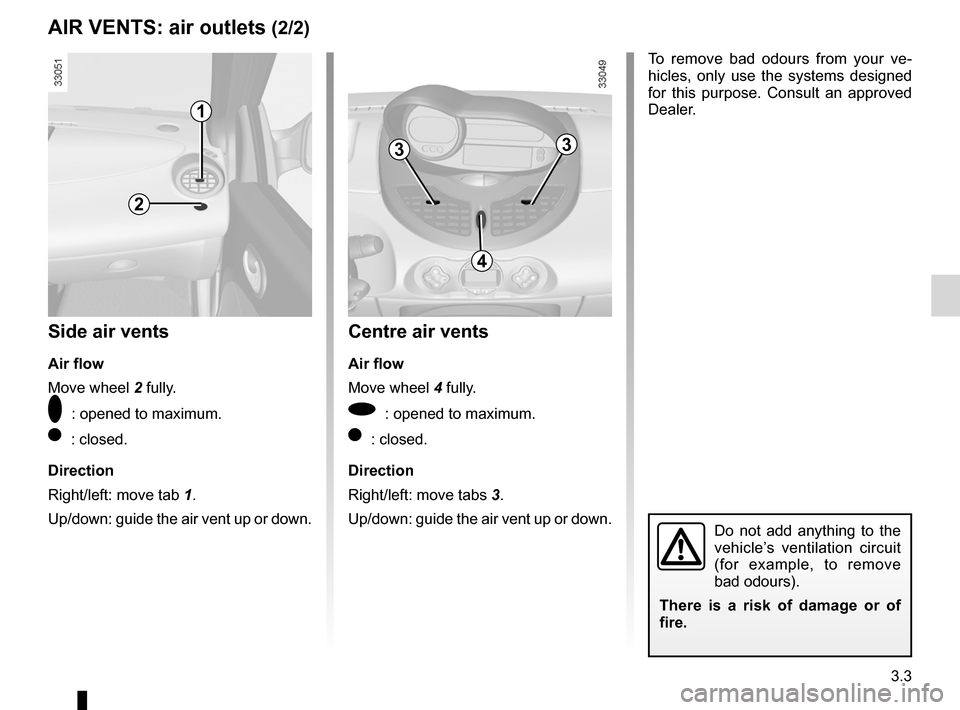
1
2
33
4
Side air vents
Air flow
Move wheel 2 fully.
: opened to maximum.
: closed.
Direction
Right/left: move tab 1.
Up/down: guide the air vent up or down.
Centre air vents
Air flow
Move wheel 4 fully.
: opened to maximum.
: closed.
Direction
Right/left: move tabs 3.
Up/down: guide the air vent up or down. To remove bad odours from your ve
-
hicles, only use the systems designed
for this purpose. Consult an approved
Dealer.
Do not add anything to the
vehicle’s ventilation circuit
(for example, to remove
bad odours).
There is a risk of damage or of
fire.
AIR VENTS: air outlets (2/2)