2012 RENAULT MEGANE RS light
[x] Cancel search: lightPage 99 of 239

JauneNoirNoir texte
2.13
ENG_UD18947_5
Conseils antipollution, économie de carburant, conduite (X45 - H45 -\
X85 - B85 - C85 - S85 - X83 - X61 - F61 - K61 - K85 - X95 - B95 - D95 -\
J95 - R95 - L38 - X61 BUp
ENG_NU_837-6_BDK95_Renault_2
ADVICE: antipollution, fuel economy and driving (2/3)
– Brake as little as possible. If you an-
ticipate an obstacle or bend in ad -
vance, you may then simply release
the accelerator pedal.
– Avoid sudden acceleration.
– Do not overrev the engine in the in-
termediate gears.
Always use the highest gear possi -
ble without labouring the engine.
On versions with an automatic gear-
box, it is preferable to keep the gear
lever in position D.
– Do not try to maintain the same
speed up a hill, accelerate no more
than you would on the level. Keep
your foot in the same position on the
accelerator pedal.
– Double declutching and accelerating
before switching off are unnecessary
in modern vehicles.
– Bad weather, flooded roads:
Do not drive through floods
if the water is above the
lower edge of the wheel
rims.
Driving
– Drive carefully for the first few miles
until the engine reaches its normal
operating temperature, rather than
let it warm up while the vehicle is sta-
tionary.
– Speed is expensive.
– Sporty driving uses a lot of fuel: drive
with a light right foot.
Exhaust gas monitoring
system
The exhaust gas monitoring system will
detect any operating faults in the vehi-
cle’s antipollution system.
If this system malfunctions, toxic sub -
stances may be released into the at -
mosphere or damage may occur.
ÄThis warning light on the in -
strument panel will indicate if
there are any faults in the system:
This lights up when the ignition is
switched on and goes out when the
engine is started.
– If it lights up continuously, consult an
approved Dealer as soon as possi -
ble;
– if it flashes, reduce the engine speed
until the light stops flashing. Contact
your approved dealer as soon as
possible.
Page 100 of 239

2.14
ENG_UD18947_5
Conseils antipollution, économie de carburant, conduite (X45 - H45 -\
X85 - B85 - C85 - S85 - X83 - X61 - F61 - K61 - K85 - X95 - B95 - D95 -\
J95 - R95 - L38 - X61 BUp
ENG_NU_837-6_BDK95_Renault_2
ADVICE: antipollution, fuel economy and driving (3/3)
Advice on use
– Electricity is fuel; switch off all the
electrical components which are
not really needed. However (safety
first), keep your lights on when the
visibility is bad (“see and be seen”).
– Use the air vents. Driving with the
windows open at 60 mph (100 km/h)
will increase fuel consumption by
4%.
– Avoid using the car for door-to-door
calls (short journeys with long waits
in between) because the engine
never reaches its normal operating
temperature.
Tyres
– An underinflated tyre increases fuel
consumption.
– The use of non-recommended tyres
can increase fuel consumption.
–
In vehicles fitted with air condi -
tioning, it is normal to observe an
increase in fuel consumption (es -
pecially in urban conditions) when
it is used. For vehicles fitted with
manual air conditioning, switch off
the system when it is not required.
Advice for reducing consumption
and therefore helping to preserve
the environment:
If the vehicle has been parked in the
sun, open the doors for a few mo -
ments to let the hot air escape before
starting the engine.
– Never fill the fuel tank right to the
brim to avoid overflow.
– Do not leave an empty roof rack
fitted to the vehicle.
– It is better to fit a trailer for bulky ob-
jects.
– When towing a caravan, fit a wind
deflector and adjust it carefully.
Page 103 of 239

ENG_NU_837-6_BDK95_Renault_2
Display
Display 1 on the instrument panel")
JauneNoirNoir texte
2.17
ENG_UD6303_1
Système de surveillance de pression des pneumatiques (X95 - B95 - D9\
5 - Renault)
ENG_NU_837-6_BDK95_Renault_2
Display
Display 1 on the instrument panel and
trip computer and warning system 2 in-
forms you of any tyre pressure faults
(flat tyre, punctured tyre, system fault,
etc.).
TyRE PRESSURE MONITOR (2/3)
1“Puncture”
Wheel F indicates that the wheel con -
cerned is punctured or severely un -
derinflated. Replace it or contact an
approved dealer if it is punctured. Top
up the tyre pressure if the wheel is de-
flated,
This message appears along with the
® warning light.
“Tyre pressure sensors absent ” or
“Check tyre pressure sensors ”
One wheel E disappears, indicating
that the sensor on this wheel is missing
or faulty (e.g. if the emergency spare
wheel is fitted).
“Adjust tyre pressure
”
A shaded wheel F indicates a deflated
tyre.
“Inflate tyres for motorway”
All four wheels F become full, the tyre
pressure is not adapted to the driving
speed. Slow down or inflate all four
tyres to “motorway pressure” (refer to
the label located on the label on the
edge of the driver’s door).
E
F
2
Page 106 of 239

2.20
ENG_UD14885_2
Dispositifs de correction de conduite (X95 - B95 - D95 - Renault)
ENG_NU_837-6_BDK95_Renault_2
Jaune NoirNoir texte
DRIVER CORRECTION DEVICES/AIDS (2/4)
Electronic stability program
(E.S.P.) with understeer
control and traction control
(A.S.R.)
Electronic stability program (E.S.P.)
This system helps you to keep control
of the vehicle in critical driving condi -
tions (avoiding an obstacle, loss of grip
on a bend, etc.).
Operating principle
A sensor in the steering wheel detects
the direction selected by the driver.
Other sensors throughout the vehicle
measure the actual direction.
The system compares driver input to
the actual trajectory of the vehicle and
corrects the trajectory if necessary by
controlling the braking of certain wheels
and/or engine power. In the event that
the system is engaged, indicator light
ù flashes on the instrument panel. Understeer control
This system optimises the action of
the E.S.P. in the case of pronounced
understeering (loss of front axle road
holding).
Traction control (A.S.R.)
This system helps to limit wheelspin of
the drive wheels and to control the ve-
hicle when pulling away accelerating or
decelerating.
Operating principle
Using the wheel sensors, the system
measures and compares the speed of
the drive wheels at all times and slows
down their over-rotation. If a wheel is
starting to slip, the system brakes au
-
tomatically until the drive supplied be -
comes compatible with the level of grip
under the wheel again.
The system also adjusts the engine
speed to the grip available under the
wheels, independently of the pressure
exerted on the accelerator pedal. Operating faults
When the system detects an operating
fault the message “Check ESP” and the
indicator light
© appears on the in-
strument panel. In this case, the E.S.P.
and A.S.R. are deactivated.
Consult an approved dealer.
Page 107 of 239

JauneNoirNoir texte
2.21
ENG_UD14885_2
Dispositifs de correction de conduite (X95 - B95 - D95 - Renault)
ENG_NU_837-6_BDK95_Renault_2
Traction control (A.S.R.) offers addi -
tional safety; it is recommended that
you do not drive with the function disa-
bled. Correct this as soon as possible
by pressing switch 1 again.
Note: the function is reactivated auto -
matically when the ignition is switched
on or when a speed of approximately
24 mph (40 km/h) is exceeded.
Emergency brake assist
This system supplements the ABS
and helps reduce vehicle stopping dis-
tances.
Operating principle
The system is for detecting an emer -
gency braking situation. In this case,
the braking assistance immediately de-
velops maximum power and may trig -
ger ABS regulation.
ABS braking is maintained as long as
the brake pedal is applied.
Hazard warning lights switching on
Depending on the vehicle, these may
light up in the event of sudden decel -
eration.
Operating faults
When the system detects an operat -
ing fault the message “ Check brak-
ing system” appears on the instrument
panel along with the
© warning
light.
Consult an approved dealer.
braking anticipation
Depending on the vehicle, when you
rapidly release the accelerator, the
system anticipates the braking ma -
noeuvre in order to reduce stopping
distances.
Special cases
When using the cruise control:
– if you use the accelerator, when you
release it, the system may be trig -
gered;
– if you do not use the accelerator, the
system will not be triggered.
DRIVER CORRECTION DEVICES/AIDS (3/4)
Disabling the A.S.R. function
In some situations (driving on very wet
ground: snow, mud, etc. or driving with
snow chains fitted), the system may
reduce the engine output to limit wheel -
spin. If this is not required, it is possible
to deactivate the function by pressing
switch 1.
The message “ Traction control off ” is
displayed on the instrument panel to
inform you.
1
Page 109 of 239
speed limiter ......................................... (up to the end of the DU)
cruise control-speed limiter................... (up to the end of the DU)
cruise control ........................................ (up to the end of the DU)
driving ................................................... (up to the end of the DU)
2.23
ENG_UD18934_2
Régulateur-limiteur de vitesse : fonction limiteur (X95 - B95 - D95 \
- Renault)
ENG_NU_837-6_BDK95_Renault_2
Speed limiter
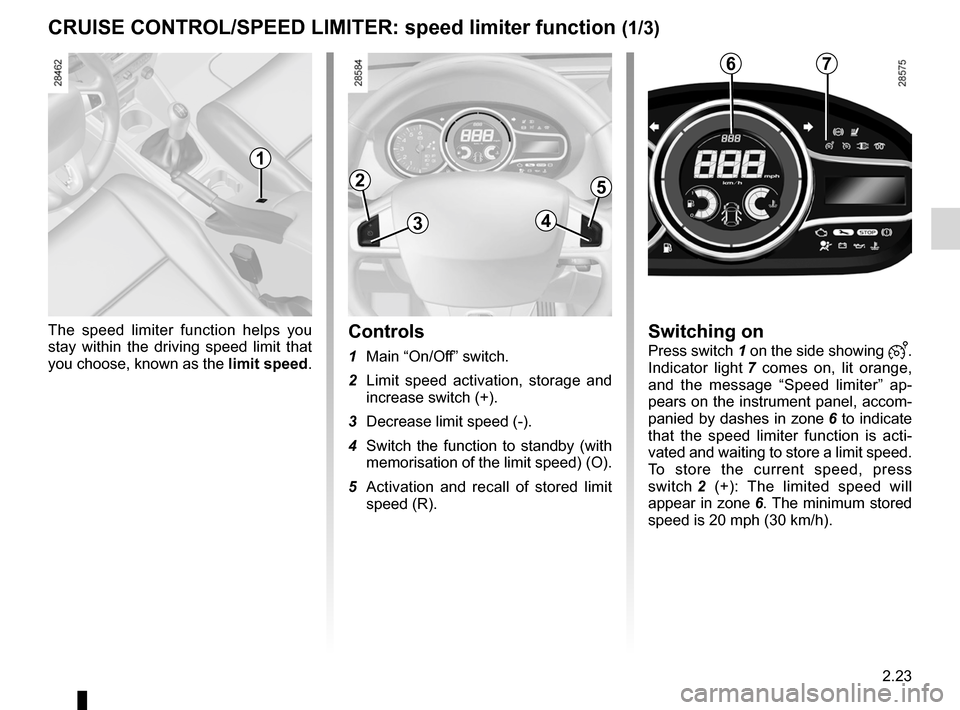
CRUISE CONTROL/SPEED LIMITER: speed limiter function (1/3)
The speed limiter function helps you
stay within the driving speed limit that
you choose, known as the limit speed.Controls
1 Main “On/Off” switch.
2 Limit speed activation, storage and
increase switch (+).
3 Decrease limit speed (-).
4 Switch the function to standby (with
memorisation of the limit speed) (O).
5 Activation and recall of stored limit
speed (R).
Switching on
Press switch 1 on the side showing .
Indicator light 7 comes on, lit orange,
and the message “ Speed limiter” ap-
pears on the instrument panel, accom-
panied by dashes in zone 6 to indicate
that the speed limiter function is acti -
vated and waiting to store a limit speed.
To store the current speed, press
switch 2 (+): The limited speed will
appear in zone 6. The minimum stored
speed is 20 mph (30 km/h).
2
3
5
4
76
1
Page 110 of 239

ENG_NU_837-6_BDK95_Renault_2
Jaune NoirNoir texte
Driving
When a limited speed has been stored
and")
2.24
ENG_UD18934_2
Régulateur-limiteur de vitesse : fonction limiteur (X95 - B95 - D95 \
- Renault)
ENG_NU_837-6_BDK95_Renault_2
Jaune NoirNoir texte
Driving
When a limited speed has been stored
and this speed is not reached, driving is
similar to driving a vehicle without the
speed limiter function.
Once you have reached the stored
speed, no effort on the accelera -
tor pedal will allow you to exceed
the programmed speed except in an
emergency (refer to information on
“Exceeding the limit speed”).
Varying the limit speed
The limit speed may be changed by re-
peatedly pressing:
– switch 2 (+) to increase the speed;
– switch 3 (-) to decrease the speed.
Exceeding the limit speed
It is possible to exceed the limit speed
at any moment. To do this: press the
accelerator pedal firmly and fully
(beyond the kickdown point).
While the speed is being exceeded, the
limit speed flashes on the instrument
panel and area C lights up red.
Then, as far as is possible, release
the accelerator pedal: the speed lim -
iter function will return as soon as you
reach a speed lower than the stored
speed.
Limited speed cannot be maintained
If driving up or down a steep gradient,
the system is unable to maintain the
limit speed: the stored speed on the
instrument panel will flash and zone C
will light up in red to inform you of this
situation.
The speed limiter function is
in no way linked to the brak-
ing system.
C
2
3
5
4
CRUISE CONTROL/SPEED LIMITER: speed limiter function (2/3)
Page 111 of 239

ENG_NU_837-6_BDK95_Renault_2
Recalling the limit speed
If a speed has been stor")
JauneNoirNoir texte
2.25
ENG_UD18934_2
Régulateur-limiteur de vitesse : fonction limiteur (X95 - B95 - D95 \
- Renault)
ENG_NU_837-6_BDK95_Renault_2
Recalling the limit speed
If a speed has been stored, it can be re-
called by pressing switch 5 (R).
CRUISE CONTROL/SPEED LIMITER: speed limiter function (3/3)
Putting the function on
standby
The speed limiter function is sus -
pended when you press switch 4 (O).
In this case, the limit speed will remain
stored and is no longer displayed in
zone 6 and the message “ Memorised”
along with the stored speed will appear
on the display.
1
When the speed limiter is put on
standby, pressing switch 2 (+) re -
activates the function without taking
into account the stored speed: it is
the speed at which the vehicle is
moving that is taken into account.
Switching off the function
The speed limiter function is deacti -
vated if you press switch 1: in this case
a speed is no longer stored. The in -
strument panel orange indicator light 7
goes out to confirm that the function is
deactivated.
6
2
3
5
4
7