2012 RENAULT MEGANE RS heating
[x] Cancel search: heatingPage 121 of 239

JauneNoirNoir texte
2.35
ENG_UD14762_4
Boîte automatique (X95 - B95 - D95 - Renault)
ENG_NU_837-6_BDK95_Renault_2
When setting off, if the lever is locked
in position P even though you are de -
pressing the brake pedal and pressing
unlocking button 2, the lever can be re-
leased manually. To do this, press the
button by inserting an object into the
hole 10 and simultaneously press un -
locking button 2 located on the lever.
AUTOMATIC TRANSMISSION (3/3)
Operating faults
– When driving , if the message
“ Check auto gearbox ” appears on
the instrument panel, this indicates
there is a fault.
Contact your approved Dealer as
soon as possible.
– When driving , if the message “Auto
gearbox overheating” appears on the
instrument panel, stop the vehicle to
allow the gearbox to cool down.
Contact your approved Dealer as
soon as possible.
– If a vehicle with an automatic
gearbox breaks down, refer to the
information on “Towing” in Section 5.
10
2
Page 126 of 239
heating system ..................................... (up to the end of the DU)
air conditioning ..................................... (up to the end of the DU)
ventilation ............................................. (up to the end of the DU)
air conditioning ..................................... (up to the end of the DU)
3.4
ENG_UD6312_1
Air conditionné (X95 - B95 - D95 - Renault)
ENG_NU_837-6_BDK95_Renault_3
Jaune NoirNoir texte
Manual air conditioning
MANuAl AIR coNDITIoNINg (1/2)
1234
56
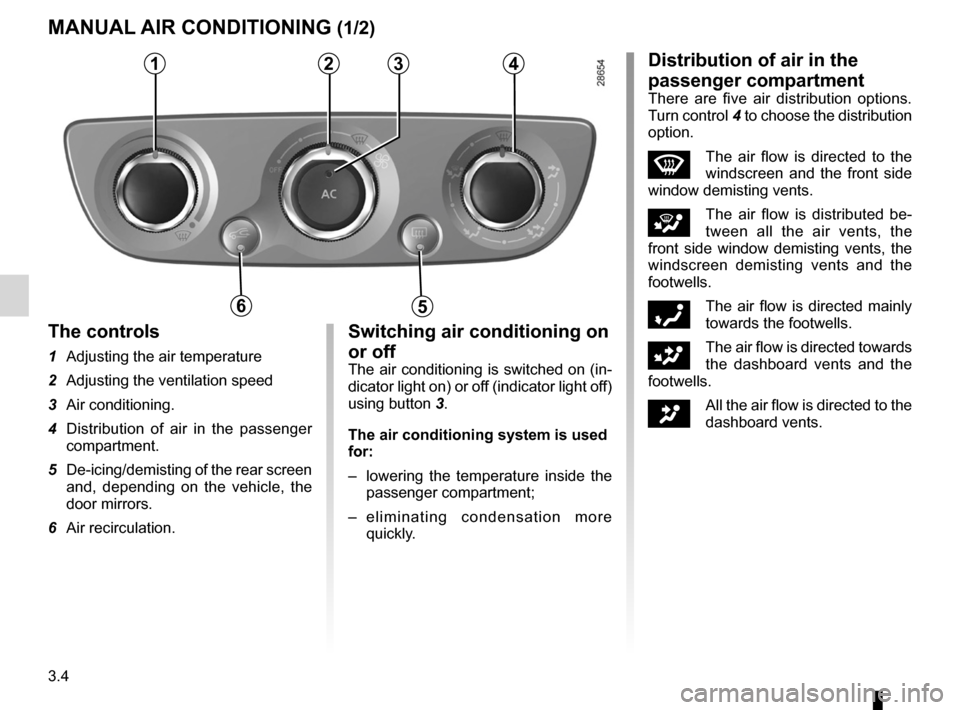
The controls
1 Adjusting the air temperature
2 Adjusting the ventilation speed
3 Air conditioning.
4 Distribution of air in the passenger
compartment.
5 De-icing/demisting of the rear screen
and, depending on the vehicle, the
door mirrors.
6 Air recirculation.
Switching air conditioning on
or off
The air conditioning is switched on (in-
dicator light on) or off (indicator light off)
using button 3.
The air conditioning system is used
for:
– lowering the temperature inside the
passenger compartment;
– e l i m i n a t i n g c o n d e n s a t i o n m o r e
quickly.
Distribution of air in the
passenger compartment
There are five air distribution options.
Turn control 4 to choose the distribution
option.
WThe air flow is directed to the
windscreen and the front side
window demisting vents.
iThe air flow is distributed be -
tween all the air vents, the
front side window demisting vents, the
windscreen demisting vents and the
footwells.
óThe air flow is directed mainly
towards the footwells.
GThe air flow is directed towards
the dashboard vents and the
footwells.
JAll the air flow is directed to the
dashboard vents.
Page 128 of 239

air conditioning ..................................... (up to the end of the DU)
heating system ..................................... (up to the end of the DU)
temperature regulation ......................... (up to the end of the DU)
ventilation ............................................. (up to the end of the DU)
air conditioning ..................................... (up to the end of the DU)
3.6
ENG_UD14525_3
Air conditionné automatique (X95 - B95 - D95 - L38 - X38 - X32 - B32\
- Renault)
ENG_NU_837-6_BDK95_Renault_3
Jaune NoirNoir texte
Automatic climate control
AuToMATIc clIMATE coNTRol (1/5)
Automatic mode
The automatic climate control system
guarantees comfort in the passen -
ger compartment and good visibility
(except in the event of extreme condi -
tions), whilst optimising consumption.
The system controls the ventilation
speed, air distribution, air recircula -
tion, and starting and stopping the air
conditioning and air temperature. This
mode consists of a choice of three pro-
grammes:
A uTo : allows the selected comfort
level to be best attained, depending on
the exterior conditions. Press button 3.
SoFT: gently brings the temperature to
the desired comfort level. The comfort
level is then maintained gently and si -
lently. Press button 2.
FAST: increases the operation of the
system to reach the desired comfort
level more quickly. Use this programme
when you have passengers in the rear.
Press button 4.
12
4
9 De-icing/demisting of the rear screen
and, depending on the vehicle, the
door mirrors.
10 “Clear View” function.
11 Air recirculation.
12 Ventilation speed.
13 Display.
16
7891011
32
The controls
1 and 6 Air temperature.
2, 3 and 4 Automatic programmes.
5 Distribution of air in the passenger
compartment.
7 Off button.
8 Air conditioning.
13
5
Page 130 of 239

ENG_NU_837-6_BDK95_Renault_3
Jaune NoirNoir texte
The displayed temperature values
show a comfo")
3.8
ENG_UD14525_3
Air conditionné automatique (X95 - B95 - D95 - L38 - X38 - X32 - B32\
- Renault)
ENG_NU_837-6_BDK95_Renault_3
Jaune NoirNoir texte
The displayed temperature values
show a comfort level.
When starting the engine, increas -
ing or decreasing the value dis -
played will not allow the com -
fort level to be reached any more
quickly. The system will always op-
timise the temperature increase or
decrease (the ventilation system
does not start instantly at maximum
speed: it gradually increases). This
may take several minutes.
Generally speaking, unless there is
a particular reason not to, the dash-
board air vents should remain open.
You are recommended to use automatic mode by selecting one of the auto-
matic programmes AuT o, SoFT or FAST.
In automatic mode (indicator light for button 3 on), all heating and air conditioning
functions are controlled by the system.
You can also change the system selection, in this case, indicator light for button 3
will go out and the changed function, which is no longer controlled by the system,
is shown on display 13.
To return to automatic mode, press one of the AuTo, SoFT or FAST programmes .
AuToMATIc clIMATE coNTRol (3/5)
Switching air conditioning on
or off
In automatic mode, the system switches
the air conditioning system on or off,
depending on the climate conditions.
Press switch 8 to switch off the air
conditioning; the integrated indicator
comes on and “AC OFF” is shown on
the display 13.
3
813
Page 133 of 239

air conditioning ..................................... (up to the end of the DU)
heating and air conditioning system ...................... (current page)
air conditioning ..................................... (up to the end of the DU)
3.11
ENG_UD10081_2
Air conditionné : informations et conseils d’utilisation (X91 - B\
91 - K91 - Renault)
ENG_NU_837-6_BDK95_Renault_3
Air conditioning: information and advice on use
AIR coNDITIoNINg: information and advice on use
Fuel consumption
You will normally notice an increase
in fuel consumption (especially
when driving in town) when the air
conditioning is operating.
For vehicles fitted with manual air
conditioning, switch off the system
when it is not required.
Advice for reducing
consumption and therefore
helping to preserve the
environment:
Drive with the air vents open and
the windows closed.
If the vehicle has been parked in
the sun, open the doors for a few
moments to let the hot air escape
before starting the engine.
Maintenance
Refer to the Maintenance Service
Booklet for your vehicle for the in -
spection frequency.operating faults
As a general rule, contact your ap-
proved Dealer in the event of an op-
erating fault:
– reduction in de-icing, demist -
ing or air conditioning perform-
ance. This may be caused by the
passenger compartment filter
cartridge becoming clogged;
– no cold air is being produced.
Check that the controls are set
correctly and that the fuses are
sound. Otherwise, switch off the
system.
Advice on use
In some situations, (air conditioning
off, air recirculation activated, venti-
lation speed at zero or low, etc.) you
may notice that condensation starts
to form on the windows and wind -
screen.
If there is condensation, use the
“clear View” function to remove it,
then use the air conditioning in auto-
matic mode to stop it forming again.
If the condensation does not clear,
use the FAST programme.
Do not open the refriger -
ant fluid circuit. The fluid
may damage eyes or skin.
Note
Presence of water under the ve -
hicle. After prolonged use of the air
conditioning system, it is normal for
water to be present under the ve -
hicle. This is caused by condensa -
tion.
Page 202 of 239

wiper blades ......................................... (up to the end of the DU)
wipers blades ............................................. (up to the end of the DU)
5.30
ENG_UD17365_2
Balais d’essuie-vitres (X95 - B95 - D95 - L38 - X38 - X32 - B32 - Re\
nault)
ENG_NU_837-6_BDK95_Renault_5
Wipers (replacing blades)
wInDscreen wIPer BlaDes
replacing windscreen wiper
blades 1
w ith the ignition on and engine
switched off, lower the windscreen
wiper stalk completely: they stop
slightly away from the bonnet.
Lift wiper arm 3 , pull tab 2 (move -
ment A) and push the blade upwards.
t o refit
Slide the blade along the arm until it
clips on. Make sure that the blade is
correctly locked in position. Return the
windscreen wiper stalk to the park po-
sition.
1
2
3
Check the condition of the wiper
blades. You are responsible for their
service life:
– clean the blades, windscreen and
rear screen regularly with soapy
water;
– do not use them when the wind -
screen or rear screen are dry;
– free them from the windscreen or
rear screen when they have not
been used for a long time.
rear screen wiper blade 4
– Lift wiper arm 6;
– pivot blade 4 until some resistance is
met (movement C);
– depending on the vehicle, press
tab 5, then remove the blade by pull -
ing it (movement B).
t o refit
To refit the wiper blade, proceed in re-
verse order to removal. Make sure that
the blade is correctly locked in position.
4
5
B
c
a
6
– In frosty weather, make
sure that the wiper blades
are not stuck by ice (to
avoid the risk of the motor
overheating).
– Check the condition of the wiper
blades.
Replace the wiper blades as soon
as they begin to lose efficiency
(approximately once a year).
Whilst changing the blade, take care
not to drop the arm onto the window
after it has been removed as this
may break the window.
Page 208 of 239

5.36
ENG_UD17369_3
Anomalies de fonctionnement (X95 - B95 - D95 - Renault)
ENG_NU_837-6_BDK95_Renault_5
Jaune NoirNoir texte
OPeratIng F aults (4/5)
On the road POssIBle causeswhat tO DO
Steering becomes heavy. Assistance overheating.Consult an approved dealer.
The engine overheats. The coolant
temperature indicator is in the warn -
ing zone and warning light
®
comes on. Engine cooling fan not working.
Stop the vehicle, switch off the engine and
contact an approved dealer.
Coolant leaks. Check the coolant reservoir: it should con-
tain fluid. If there is no coolant, consult an
approved dealer as soon as possible.
Vibrations. Tyres not inflated to correct pres-
sures, incorrectly balanced or dam -
aged. Check the tyre pressures: if this is not the
problem, have them checked by an ap
-
proved dealer.
radiator: If there is a significant lack of coolant, remember that it must never be topped up using cold coolant while
the engine is very warm. After any procedure on the vehicle which has involved even partial draining of the cooling
system, it must be refilled with a new mixture prepared in the correct proportions. Reminder: only products approved
by our Technical Department may be used for this purpose.
Page 234 of 239
7.2
FRA_UD19033_8
Index (X95 - B95 - D95 - Renault)
ENG_NU_837-6_BDK95_Renault_7
Jaune NoirNoir texte
AlphAbeticAl index (2/5)
driving position
settings ............................................................ 1.22 → 1.24
e
electric beam height adjustment ........................................ 1.74
electric windows .................................................... 3.12 → 3.14
electronic parking brake .......................................... 2.9 → 2.11
Electronic Stability Program: ESP .........................2.19 → 2.22
emergency brake assist ......................................... 2.19 → 2.22
emergency braking ................................................ 2.19 → 2.22
emergency key ........................................................... 1.2 – 1.3
emergency spare wheel ............................................... 5.2, 5.6
engine oil .......................................................... 1.52, 4.3 → 4.6
engine oil capacity ...................................................... 4.5 – 4.6
engine oil level ........................................................... 4.3 → 4.6
engine start/stop button ............................................. 2.3 → 2.5
environment ....................................................................... 2.15
ESP: Electronic Stability Program .........................2.19 → 2.22
external temperature ......................................................... 1.68
F
faults operating faults ................................................ 5.33 → 5.37
filter air filter ........................................................................... 4.9
diesel filter ...................................................................... 4.9
oil filter .................................................................... 4.6, 4.9
particle filter ................................................................. 1.51
passenger compartment filter ........................................ 4.9
fitting a radio ...................................................................... 5.28
fittings .................................................................... 3.17 → 3.20
fog lights ........................................................................\
.... 5.14
front passenger air bag deactivation ................................. 1.43
front seat driver’s position memory .............................................. 1.20
front seat adjustment .............................................. 1.17 – 1.18front seats
adjustment ..........................1.15, 1.17 – 1.18, 1.22 → 1.24
with electric controls .................................................... 1.19
with manual controls .................................................... 1.17
fuel advice on fuel economy ............................................... 2.12
capacity ........................................................................ 1.78
filling ......................................................... 1.50, 1.78 – 1.79
grade ................................................................. 1.78 – 1.79
fuel economy ......................................................... 2.12 → 2.14
fuel filler cap ........................................................... 1.78 – 1.79
fuel level ........................................................................\
.... 1.54
fuel tank capacity ............................................................. 1.78 – 1.79
fuel tank capacity .................................................... 1.78 – 1.79
fuses ....................................................................... 5.23 – 5.24
G
gear lever ........................................................................\
..... 2.8
glove box ........................................................................\
... 3.19
h
handbrake ................................................................... 1.50, 2.8
hands-free telephone integrated control ............................ 3.36
hazard warning lights signal ................................... 1.70 – 1.71
headlight beam adjustment ............................................... 1.74
headlight flashers .............................................................. 1.70
headlight washer ............................................................... 1.76
headrest .................................................................. 1.15 – 1.16
heating and air conditioning system .................................. 3.11
heating system ........................................................ 3.4 → 3.10
hill start ........................................................................\
...... 2.22
Hill Start Assistance (HSA) ................................................ 2.22
horn ........................................................................\
........... 1.70
horn: flash ............................................................................. 1.70