2012 RENAULT LAGUNA light
[x] Cancel search: lightPage 93 of 241

gear lever............................................................... (current page)
changing gear ....................................... (up to the end of the DU)
reverse gear selecting .......................................... (up to the end of the DU)
driving ................................................... (up to the end of the DU)
handbrake ............................................. (up to the end of the DU)
2.11
ENG_UD20298_1
Levier de vitesses/frein à main (X91 - B91 - K91 - Renault)
ENG_NU_936-5_BK91_Renault_2
Gear lever
Handbrake
GeaR LeveR/haNDbRake
Gear lever
Selecting reverse gear
v ehicles with manual gearbox: follow
the grid drawn on knob 1, and depend -
ing on the vehicle, lift ring 4 against the
gear lever knob to select reverse.
v ehicle with automatic gearbox: refer
to the information on the “Automatic
gearbox” in Section 2. The reversing lights will come on as
soon as reverse gear is selected with
the ignition on.
handbrake
t
o release:
Pull lever 3 up slightly, press button 2
and then lower the lever to the floor.
t o apply:
Pull upwards, check that the vehicle is
properly immobilised.
Make sure that the hand -
brake is properly released
when driving (red indicator
light off), otherwise over -
heating may occur.
When stationary and de -
pending on the slope and/or
vehicle load, it may be nec-
essary to pull up the hand -
brake at least two extra notches and
engage a gear (1
st or reverse gear)
for vehicles with a manual gearbox
or position P for vehicles with an au-
tomatic transmission.
An impact to the underside
of the vehicle (e.g.: striking
a post, raised kerb or other
street furniture) may result
in damage to the vehicle (e.g.: de -
formation of an axle).
To avoid any risk of accident, have
your vehicle checked by an ap -
proved Dealer.
1
2
3
4
Page 94 of 241

2.12
ENG_UD9635_3
Frein de parking assisté (X91 - B91 - K91 - Renault)
ENG_NU_936-5_BK91_Renault_2
Jaune NoirNoir texte
Electronic parking brake
Before leaving the vehicle,
check that the electronic
parking brake is fully ap -
plied. Indicator light 2 on
switch 3 and indicator light
}
on the instrument panel light up to
show that the parking brake is ap -
plied but go out when the doors are
locked.
Note:
The message “apply parking brake” ap-
pears on the instrument panel and a
beep sounds to indicate that the elec -
tronic parking brake is applied or re -
leased: This message may appear:
– with the engine running: when the
driver’s door is opened;
– with the engine switched off (e.g.
when the engine stalls): when a front
door is opened.
In this case, pull and release switch 3 to
apply the electronic parking brake.
The brake will be released as soon as
the vehicle starts and accelerates.
automatic operation
The electronic parking brake en -
sures vehicle immobilisation when the
engine is stopped and engine Start/
Stop button 1 is pressed.
For certain country-specific model ver-
sions, the automatic brake application
function is not activated. Refer to the in-
formation on “Manual operation”.
aSSISteD P aRkING bRake
To confirm that the electronic parking
brake is applied, the message “parking
brake applied” and indicator light
}
on the instrument panel and indicator
light 2 on switch 3 light up.
Indicator light 2 goes out several min -
utes after the electronic parking brake
has been applied and indicator light
} goes out when the vehicle is
locked.
12
3
Page 95 of 241
JauneNoirNoir texte
2.13
ENG_UD9635_3
Frein de parking assisté (X91 - B91 - K91 - Renault)
ENG_NU_936-5_BK91_Renault_2
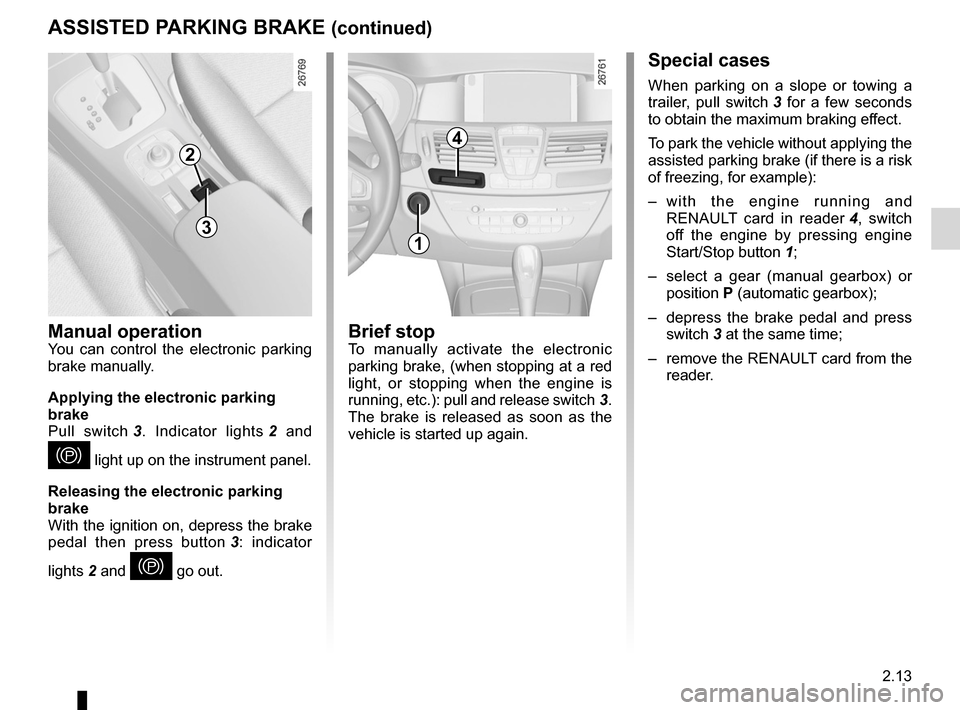
Special cases
When parking on a slope or towing a
trailer, pull switch 3 for a few seconds
to obtain the maximum braking effect.
To park the vehicle without applying the
assisted parking brake (if there is a risk
of freezing, for example):
– w i t h t h e e n g i n e r u n n i n g a n d
RENAULT card in reader 4 , switch
off the engine by pressing engine
Start/Stop button 1;
– select a gear (manual gearbox) or
position P (automatic gearbox);
– depress the brake pedal and press
switch 3 at the same time;
– remove the RENAULT card from the
reader.
brief stopTo manually activate the electronic
parking brake, (when stopping at a red
light, or stopping when the engine is
running, etc.): pull and release switch 3.
The brake is released as soon as the
vehicle is started up again.
aSSISteD P aRkING bRake (continued)
4
13
Manual operationYou can control the electronic parking
brake manually.
applying the electronic parking
brake
Pull switch 3 . Indicator lights 2 and
} light up on the instrument panel.
Releasing the electronic parking
brake
With the ignition on, depress the brake
pedal then press button 3 : indicator
lights 2 and
} go out.
2
Page 96 of 241

2.14
ENG_UD9635_3
Frein de parking assisté (X91 - B91 - K91 - Renault)
ENG_NU_936-5_BK91_Renault_2
operating faults
– If there is a fault, the © warning
light illuminates on the instrument
panel accompanied by the “Check
parking brake” message and, in
some cases, the
} warning
light.
Contact an approved Dealer as soon
as possible.
aSSISteD P aRkING bRake (continued)
It is therefore essential to
immobilise the vehicle by
engaging first gear (manual
gearbox) or position P (au -
tomatic gearbox). If the slope re -
quires it, chock the vehicle.
v ersions with an automatic
gearbox
For safety reasons, automatic release
is deactivated when the driver’s door
is open or not shut properly and the
engine is running (in order to prevent
the vehicle from moving without the
driver). The “release manually” mes -
sage appears on the instrument panel
when the driver depresses the accel -
erator.
Never leave your vehicle
without moving the selec -
tor lever to position P or N.
This is because when the
vehicle is stationary with the engine
running and a gear engaged, the
vehicle may begin to move if you
accelerate.
there is a risk of accidents.
– If there is an electronic parking brake
fault, the
® warning lights illu -
minate accompanied by the “Parking
brake fault” message, a beep and in
some cases the
} warning light.
This means that you must stop as
soon as traffic conditions allow.
If no lights or sounds are
apparent, this indicates
a fault in the instrument
panel. This indicates that it
is essential to stop immediately
(as soon as traffic conditions
allow). Ensure that the vehicle is
correctly immobilised and contact
an approved Dealer.
Page 97 of 241

driving ................................................... (up to the end of the DU)
fuel economy ........................................ (up to the end of the DU)
advice on antipollution .......................... (up to the end of the DU)
antipollution advice .............................................................. (current page)
fuel advice on fuel economy ................................... (current page)
2.15
ENG_UD19886_6
Conseils antipollution, économie de carburant, conduite (X45 - H45 - X85 - B85 - C85 - S85 - X91 - X83 - X61 - F61 - K61 - K85 - X95 - B95 - D95 - J95 - R95 - L38 - X61
ENG_NU_936-5_BK91_Renault_2
Advice: antipollution and fuel economy
aDvICe: antipollution, fuel economy and driving (1/3)
Your vehicle complies with criteria for
recycling and recovering vehicles at the
end of their service life which will come
into force in 2015.
Some parts of your vehicle have there-
fore been designed to facilitate future
recycling.
These parts are easy to remove so
that they can be recovered and reproc-
essed by recycling companies.
By virtue of its design, moderate fuel
consumption and initial settings, your
vehicle also conforms to current anti-
pollution regulations. The manufac -
turer is actively striving to reduce pol -
lutant exhaust gas emissions and to
save energy. But the fuel consumption
of your vehicle and the level of pollutant
exhaust gas emissions are also your
responsibility. Ensure that it is main -
tained and used correctly.aiding fuel economy
Depending on the vehicle, in order to
optimise consumption, an indicator light
on the instrument panel will inform you
of the best moment to upshift or down -
shift gears:
\ shift up a gear;
[ shift down a gear.
Maintenance
It is important to remember that failure to
respect antipollution regulations could
lead to legal action being taken against
the vehicle owner. In addition, replacing
engine, fuel supply system and exhaust
components with parts other than those
originally recommended by the manu -
facturer may alter your vehicle so that
it no longer complies with antipollution
regulations. Have your vehicle adjusted and
checked by an approved Dealer, in ac-
cordance with the instructions given in
your maintenance schedule: they will
have all the equipment necessary for
ensuring that your vehicle is maintained
to its original standard.
engine adjustments–
ignition: this does not require ad -
justment.
– spark plugs: for optimum fuel econ-
omy, efficiency and performance
the specifications laid down by our
Design Department must be strictly
applied.
If the spark plugs have to be
changed, use the make, type and
gap specified for your vehicle’s
engine. Contact an approved dealer
for this.
– idle: this does not require adjust -
ment.
– air filter, diesel filter: a clogged ele-
ment reduces performance. It must
be replaced.
Page 98 of 241

2.16
ENG_UD19886_6
Conseils antipollution, économie de carburant, conduite (X45 - H45 - X85 - B85 - C85 - S85 - X91 - X83 - X61 - F61 - K61 - K85 - X95 - B95 - D95 - J95 - R95 - L38 - X61
ENG_NU_936-5_BK91_Renault_2
Jaune NoirNoir texte
aDvICe: antipollution, fuel economy and driving (2/3)
– Avoid sudden acceleration.
– Brake as little as possible. If you an-
ticipate an obstacle or bend in ad -
vance, you may then simply release
the accelerator pedal.
– Do not try to maintain the same
speed up a hill, accelerate no more
than you would on the level. Keep
your foot in the same position on the
accelerator pedal.
– Double declutching and accelerating
before switching off are unnecessary
in modern vehicles.
– Bad weather, flooded roads:
Do not drive through floods
if the water is above the
lower edge of the wheel
rims.
Driving– Drive carefully for the first few miles
until the engine reaches its normal
operating temperature, rather than
let it warm up while the vehicle is sta-
tionary.
– Speed is expensive.
– Sporty driving uses a lot of fuel: drive
with a light right foot.
– Do not overrev the engine in the in-
termediate gears.
Always use the highest gear possi -
ble without labouring the engine.
On versions with an automatic gear-
box, it is preferable to keep the gear
lever in position D.
exhaust gas monitoring
system
The exhaust gas monitoring system will
detect any operating faults in the vehi-
cle’s antipollution system.
If this system malfunctions, toxic sub -
stances may be released into the at -
mosphere or damage may occur.
ÄThis warning light on the in -
strument panel will indicate if
there are any faults in the system:
This lights up when the ignition is
switched on and goes out when the
engine is started.
– If it lights up continuously, consult an
approved Dealer as soon as possi -
ble;
– if it flashes, reduce the engine speed
until the light stops flashing. Contact
your approved dealer as soon as
possible.
obstructions to the driver
On the driver ’s side, only
use mats adapted to the ve-
hicle that attach to the pre-
installed parts, and regularly check
their mounting. Do not place several
mats on top of each other.
Risk of pedals jamming
Page 99 of 241

JauneNoirNoir texte
2.17
ENG_UD19886_6
Conseils antipollution, économie de carburant, conduite (X45 - H45 - X85 - B85 - C85 - S85 - X91 - X83 - X61 - F61 - K61 - K85 - X95 - B95 - D95 - J95 - R95 - L38 - X61
ENG_NU_936-5_BK91_Renault_2
aDvICe: antipollution, fuel economy and driving (3/3)
advice on use
– Electricity is fuel; switch off all the
electrical components which are
not really needed. however (safety
first), keep your lights on when the
visibility is bad (“see and be seen”).
– Use the air vents. Driving with the
windows open at 60 mph (100 km/h)
will increase fuel consumption by
4%.
– Avoid using the car for door-to-door
calls (short journeys with long waits
in between) because the engine
never reaches its normal operating
temperature.
tyres
– An underinflated tyre increases fuel
consumption.
– The use of non-recommended tyres
can increase fuel consumption.
–
In vehicles fitted with air condi -
tioning, it is normal to observe an
increase in fuel consumption (es -
pecially in urban conditions) when
it is used. For vehicles fitted with
manual air conditioning, switch off
the system when it is not required.
advice for reducing consumption
and therefore helping to preserve
the environment:
If the vehicle has been parked in the
sun, open the doors for a few mo -
ments to let the hot air escape before
starting the engine.
– Never fill the fuel tank right to the
brim to avoid overflow.
– Do not leave an empty roof rack
fitted to the vehicle.
– It is better to fit a trailer for bulky ob-
jects.
– When towing a caravan, fit a wind
deflector and adjust it carefully.
Page 102 of 241

2.20
ENG_UD22198_5
Système de surveillance de pression des pneumatiques (X91 - B91 - K91 - Renault)
ENG_NU_936-5_BK91_Renault_2
Jaune NoirNoir texte
Display
Display 1 on the instrument panel in -
forms you of any tyre pressure faults
(flat tyre, punctured tyre, system fault,
etc.).
tyRe PReSSURe MoNItoR (2/3)
1
“Check tyre pressure”
A shaded wheel B indicates a deflated
tyre.
“Inflate tyres to motorway pressure”
The tyre pressure is not suitable for the
speed of travel. Slow down or inflate all
four tyres to motorway pressure (refer
to the information on “Tyre pressures”).
“Puncture”
Wheel B indicates that the tyre con -
cerned is punctured or severely un -
derinflated. Replace it or contact an
approved dealer if it is punctured. Top
up the tyre pressure if the wheel is de-
flated.
This message appears along with the
® warning light.
“t
yre sensors absent” or “check
tyre sensors”
One wheel A disappears, indicating
that the sensor on this wheel is missing
or faulty (e.g. if the emergency spare
wheel is fitted).
a
b