2012 RENAULT LAGUNA COUPE lock
[x] Cancel search: lockPage 85 of 221

JauneNoirNoir texte
2.7
ENG_UD28949_4
Fonction Stop and Start (X91 - B91 - K91 - D91 - Renault)
ENG_NU_939-3_D91_Renault_2
StoP aND StaRt function (2/3)
Special cases
– While the system is operating, and
the engine is stopped (traffic jam,
traffic lights, etc.), if the driver gets
out of their seat or unfastens their
seat belt and opens the driver ’s
door, the ignition will be switched off
and, depending on the vehicle, the
electronic parking brake will be ac -
tivated automatically. To restart and
reactivate the Stop and Start system,
press the start button (please see
“Starting, stopping the engine”).
– In the event of the engine stalling,
if the system is operational, press
down the clutch pedal as far as it will
go to restart.
Deactivate the Stop and
Start function for any opera -
tion performed in the engine
compartment.
Conditions preventing the
standby of the engine
Certain conditions prevent the system
from using the engine standby function,
including when:
– reverse gear is engaged;
– the bonnet is not locked;
– the driver’s door is not closed;
– the driver’s seatbelt is not fastened;
– the outdoor temperature is too low or
too high (less than around 0 °C or
higher than around 30 °C);
– the battery is not sufficiently charged;
– the difference between the vehicle
interior temperature and the auto -
matic climate control instruction is
too high; –
the “Clear View” function is activated
(please see “Automatic Climate
Control” in Section 3);
– the engine coolant temperature is
too low;
– automatic particle filter cleaning is
underway;
or
– ...
To fill up with fuel, the engine must
be stopped (and not on standby):
always stop the engine by pressing
the engine stop button (please see
“Starting, stopping the engine)”.
Page 90 of 221

driving ................................................... (up to the end of the DU)
electronic parking brake ....................... (up to the end of the DU)
2.12
ENG_UD11986_3
Frein de parking assisté (X91 - D91 - Renault)
ENG_NU_939-3_D91_Renault_2
Jaune NoirNoir texte
Electronic parking brake
Before leaving the vehicle,
check that the electronic
parking brake is fully ap -
plied. Indicator light 2 on
switch 3 and indicator light
}
on the instrument panel light up to
show that the parking brake is ap -
plied but go out when the doors are
locked.
Note:
The message “apply parking brake” ap-
pears on the instrument panel and a
beep sounds to indicate that the elec -
tronic parking brake is applied or re -
leased: This message may appear:
– with the engine running: when the
driver’s door is opened;
– with the engine switched off (e.g.
when the engine stalls): when a door
is opened.
In this case, pull and release switch 3 to
apply the electronic parking brake.
The brake will be released as soon as
the vehicle starts and accelerates.
automatic operation
The electronic parking brake en -
sures vehicle immobilisation when the
engine is stopped and engine Start/
Stop button 1 is pressed.
In all other instances, e.g. engine stall-
ing, the electronic parking brake is not
applied automatically. Manual mode
must be used.
For certain country-specific model ver-
sions, the automatic brake application
function is not activated. Refer to the in-
formation on “Manual operation”.
aSSISteD P aRKING BRaKe
To confirm that the electronic parking
brake is applied, the message “parking
brake applied” and indicator light
}
on the instrument panel and indicator
light 2 on switch 3 light up.
Indicator light 2 goes out several min -
utes after the electronic parking brake
has been applied and indicator light
} goes out when the vehicle is
locked.
12
3
Page 100 of 221

ABS ...................................................... (up to the end of the DU)
anti-lock braking system: ABS ..............(up to the end of the DU)
emergency brake assist ........................(up to the end of the DU)
emergency braking ............................... (up to the end of the DU)
driving ................................................... (up to the end of the DU)
ASR (traction control) ........................... (up to the end of the DU)
traction control: ASR .............................(up to the end of the DU)
traction control system: ASR ................(up to the end of the DU)
electronic stability control: ESC ............ (up to the end of the DU)
ESC: electronic stability control ............ (up to the end of the DU)
Hill Start Assist...................................... (up to the end of the DU)
2.22
ENG_UD27695_10
Dispositifs de correction et d’assistance à la de conduite (X91 -\
B91 - K91 - D91 - Renault)
ENG_NU_939-3_D91_Renault_2
Jaune NoirNoir texte
aBS (anti-lock braking
system)
Under heavy braking, the ABS prevents
the wheels from locking, allowing the
stopping distance to be managed and
keeping control of the vehicle.
Under these circumstances, the vehi -
cle can be steered to avoid an obstacle
whilst braking. In addition, this system
can increase stopping distances, par -
ticularly on roads with low surface grip
(wet ground etc.).
You will feel a pulsation through the
brake pedal each time the system is
activated. The ABS does not in any way
improve the vehicle's physical perform-
ance relating to the road surface and
roadholding. It is still essential to follow
the rules of good driving practice (such
as driving at a safe distance from the
vehicle in front etc.).
Driver correction devices and aids
DRIVeR CoRReCtIoN DeVICeS aND aIDS (1/5)
Depending on the vehicle, they may
comprise:
– t h e aB S ( a n t i - l o c k b r a k i n g
system);
– eSC (electronic stability program)
with understeer control and a SR
traction control;
– emergency brake assist with, de -
pending on the vehicle, braking
anticipation;
– rear wheel steering.
In an emergency, apply firm and
continuous pressure to the brake
pedal. There is no need to pump
it repeatedly. The ABS will modu -
late the force applied in the braking
system.
These functions are an ad-
ditional aid in the event of
critical driving conditions,
enabling the vehicle behav -
iour to be adapted to suit the driving
conditions.
However, the functions do not take
the place of the driver. they do
not increase the vehicle’s limits
and should not encourage you
to drive more quickly. Therefore,
they can under no circumstances
replace the vigilance or responsibil -
ity of the driver when manoeuvring
the vehicle (the driver must always
be ready for sudden incidents which
may occur when driving).
Yo u r b r a k i n g s y s t e m s
are partially operational.
However, it is dangerous
to brake suddenly and
it is essential to stop immediately,
as soon as traffic conditions allow.
Contact an approved dealer.
operating faults:
–
© and x lit up on the in -
strument panel alongside mes -
sages “Check ABS”, “Check braking
system” and “Check ESC”: indicates
the ABS, ESC and emergency brake
assist are deactivated. Braking is
always enabled;
–
x, D, © and ® lit
up on the instrument panel alongside
the message “Braking system fault”:
this indicates a fault in the braking
system.
In both cases, consult an approved
dealer.
Page 115 of 221
automatic gearbox (use) ....................... (up to the end of the DU)
automatic gearbox selector lever ..........(up to the end of the DU)
changing gear ....................................... (up to the end of the DU)
reverse gear selecting .......................................... (up to the end of the DU)
driving ................................................... (up to the end of the DU)
2.37
ENG_UD27633_9
Boîte de vitesses automatique (X91 - B91 - K91 - D91 - Renault)
ENG_NU_939-3_D91_Renault_2
Automatic gearbox
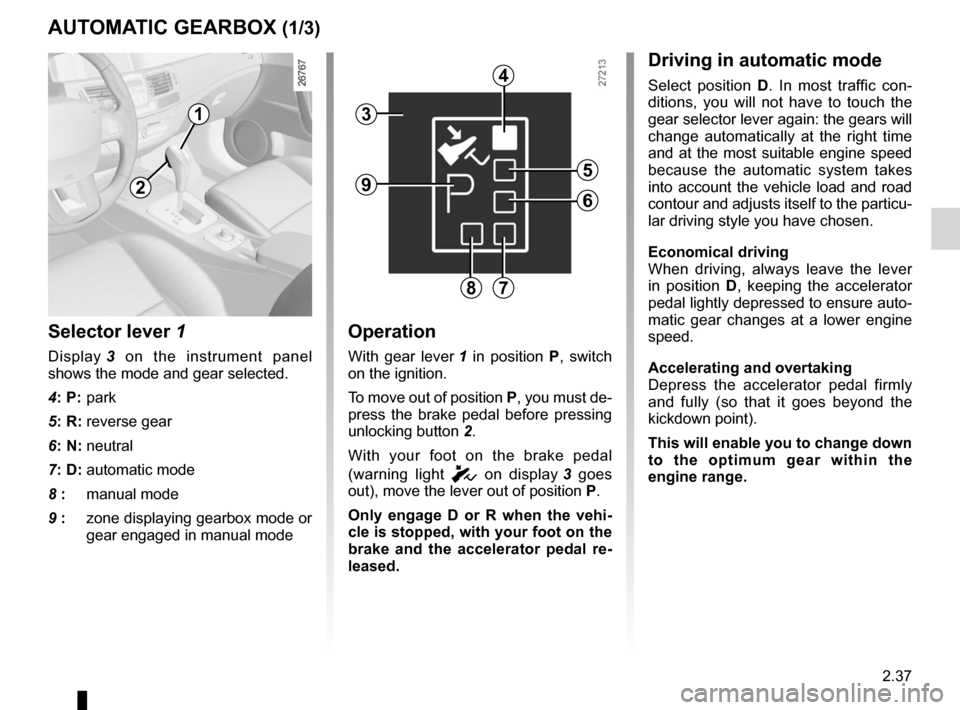
Selector lever 1
Display 3 on the instrument panel
shows the mode and gear selected.
4: P: park
5: R: reverse gear
6: N: neutral
7: D: automatic mode
8 : manual mode
9 : zone displaying gearbox mode or
gear engaged in manual mode
operation
With gear lever 1 in position P, switch
on the ignition.
To move out of position P, you must de-
press the brake pedal before pressing
unlocking button 2.
With your foot on the brake pedal
(warning light
c on display 3 goes
out), move the lever out of position P.
o nly engage D or R when the vehi -
cle is stopped, with your foot on the
brake and the accelerator pedal re -
leased.
aUtoMatIC GeaRBox (1/3)
Driving in automatic mode
Select position D. In most traffic con -
ditions, you will not have to touch the
gear selector lever again: the gears will
change automatically at the right time
and at the most suitable engine speed
because the automatic system takes
into account the vehicle load and road
contour and adjusts itself to the particu-
lar driving style you have chosen.
economical driving
When driving, always leave the lever
in position D, keeping the accelerator
pedal lightly depressed to ensure auto-
matic gear changes at a lower engine
speed.
accelerating and overtaking
Depress the accelerator pedal firmly
and fully (so that it goes beyond the
kickdown point).
this will enable you to change down
to the optimum gear within the
engine range.
3
2
1
4
5
6
78
9
Page 116 of 221
2.38
ENG_UD27633_9
Boîte de vitesses automatique (X91 - B91 - K91 - D91 - Renault)
ENG_NU_939-3_D91_Renault_2
Jaune NoirNoir texte
Parking the vehicle
When the vehicle is stopped, move the
lever to position P while keeping your
foot on the brake pedal: the gearbox is
in neutral and the drive wheels are me-
chanically locked by the driveshaft.
a pply the handbrake or, depending
on the vehicle, ensure that the elec-
tronic parking brake is applied.
Special circumstances
– If the road contours and bends
do not allow you to stay in auto -
matic mode (e.g.: in the mountains),
we recommend that you change to
manual mode.
This will prevent the automatic gear-
box from changing gears repeatedly
when climbing, and permit engine
braking on long descents.
– In cold weather , to prevent the
engine from stalling, wait a few mo-
ments before shifting the selector
lever from position P or N and en -
gaging D or R.
– Vehicles not fitted with traction
control: on a slippery surface or
surface with a low level of adhe -
sion, change to manual mode and
select second gear before starting
the engine to avoid wheelspin when
starting.
Driving in manual mode
With the selector lever in position D,
move the lever to the left. Shifting the
lever repeatedly allows you to change
gears manually:
– To move down through the gears,
push the lever backwards;
– To move up through the gears, push
the lever forwards.
The gear selected is displayed on the
instrument panel.
Special cases
Under certain driving conditions (e.g.
engine protection, electronic stability
program (ESP) operational etc.: ESC),
the “automatic system” may change
gear automatically.
Likewise, to prevent incorrect manoeu -
vres, a gear change may be refused by
the automatic system: in this case the
gear display flashes for a few seconds
as a warning.
aUtoMatIC GeaRBox (2/3)
An impact to the underside
of the vehicle (e.g.: striking
a post, raised kerb or other
street furniture) may result
in damage to the vehicle (e.g.: de -
formation of an axle).
To avoid any risk of accident, have
your vehicle checked by an ap -
proved Dealer.
In very cold weather, the system
may prevent the gears from being
shifted in manual mode until the
gearbox reaches the right tempera-
ture.
Page 117 of 221

JauneNoirNoir texte
2.39
ENG_UD27633_9
Boîte de vitesses automatique (X91 - B91 - K91 - D91 - Renault)
ENG_NU_939-3_D91_Renault_2
aUtoMatIC GeaRBox (3/3)
operating faults
– When driving , if the message
“ Check auto gearbox ” and the
© warning light appear on the
instrument panel, this indicates a
fault.
Contact your approved Dealer as
soon as possible.
– When driving, if the message “gear-
box overheating ” accompanied by
© warning light appears on the
instrument panel, stop the vehicle to
allow the gearbox to cool down.
Contact your approved Dealer as
soon as possible.
– If a vehicle with an automatic
gearbox breaks down , refer to the
information on “Towing” in Section 5.
10
When setting off, if the lever is locked
in position P even though you are de -
pressing the brake pedal and pressing
unlocking button 2, the lever can be re-
leased manually. To do this, press the
button by inserting an object into the
hole 10 and simultaneously press un -
locking button 2 located on the lever.
2
Page 129 of 221

electric windows ................................... (up to the end of the DU)
child safety ............................................................. (current page)
children (safety) .................................... (up to the end of the DU)
3.11
ENG_UD22219_4
Lève-vitres électriques (X91 - D91 - Renault)
ENG_NU_939-3_D91_Renault_3
Electric windows
ElEcTRIc WINDoWS (1/2)
With the ignition on, press the switch
for the window concerned to lower it to
the desired height.
Lift the switch to raise the window to the
desired height.
From the driver’s seat
Operate the switches as follows:
1 for the driver’s side;
2 for the passenger side.
From the front passenger seat
Press switch 3.
1
23
one-touch windows
The one-touch mode works in addition
to the operation of the electric windows
described previously.
– Fully press down (beyond the
notch) on the relevant switch: the
window will open completely.
– Fully lift (beyond the notch) the
relevant switch up: the window will
close completely.
Pressing the switch again while the
window is moving will stop its move -
ment.
Note: If the window detects resistance
when closing (e.g.: fingers, branch of
a tree, etc.) it stops and then lowers
again by a few centimetres.
These systems operate up to approxi -
mately 5 minutes after the engine is
switched off or until a door is opened.
If any part of the body be -
comes trapped, reverse the
direction of the window im -
mediately by pressing the
relevant switch.
Driver’s responsibility
Never leave your vehicle
with the RENAULT card
inside and never leave a
child (or a pet) unsupervised, even
for a short while.
They may pose a risk to themselves
or to others by starting the engine,
activating equipment such as the
electric windows or by locking the
doors.
Risk of serious injury.
Page 130 of 221
3.12
ENG_UD22219_4
Lève-vitres électriques (X91 - D91 - Renault)
ENG_NU_939-3_D91_Renault_3
Remote control window
closing
When you lock the doors from the out-
side, press the locking button on the
RENA ulT card twice in quick suc -
cession, or on the driver's door in
hands-free mode, and all the windows
will close automatically.
It is recommended that the user only
operates the system when the vehi -
cle can be seen clearly and no one is
inside.
ElEcTRIc WINDoWS (2/2)
operating faults
In case of a fault when closing a
window, the system reverts to normal
mode: pull the switch concerned up as
often as necessary to fully close the
window, then hold the switch (still on
the closure side) for three seconds then
lower and raise the window fully to rein-
itialise the system.
If necessary, contact an approved
Dealer.
If there is a fault with the battery or
electric windows , refer to the informa-
tion on “Opening/Closing the doors” in
Section 1.
Closing windows can cause
serious injury.
If the vehicle is equipped
with this function, this action
will activate deadlocking.
Check that there is no-one
still inside the vehicle
Avoid resting any objects against a
half-open window: there is a risk that
the electric window winder could be
damaged.