2012 RENAULT LAGUNA COUPE warning lights
[x] Cancel search: warning lightsPage 74 of 221

lights:fog lights .......................................................... (current page)
1.68
ENG_UD19986_4
Éclairages et signalisations extérieurs (X91 - D91 - Renault)
ENG_NU_939-3_D91_Renault_1
EXTERIOR LIgHTINg ANd sIgNALs (3/3)
When driving in fog or snow, or
when transporting objects which are
higher than the roof, the headlights
do not come on automatically.
Switching on the fog lights remains
the responsibility of the driver: the
indicator lights on the instrument
panel inform you whether the fog
lights are lit (indicator light on) or not
(indicator light not on).
5
6
fRear fog light
Turn centre ring 5 on the stalk
until the symbol faces mark 6, then re-
lease it.
Operation of the fog lights depends on
the exterior lighting selected, and an in-
dicator light will light up on the instru -
ment panel.
To avoid inconveniencing other road
users, remember to switch off the rear
fog light when it is no longer needed.
Lights-on reminder buzzer
If the lights are on after the engine is
switched off, a warning beep sounds
when the driver ’s door is opened to
warn you that the lights are still on.
switching off the lights
Turn the ring 5 again to align marker 6
with the symbol. The corresponding in-
dicator light on the instrument panel
goes out.
The fog lights switch off when the exte-
rior lights are switched off.
Page 78 of 221

1.72
ENG_UD29086_2
Réservoir carburant (X91 - D91 - Renault)
ENG_NU_939-3_D91_Renault_1
No modifications what -
soever are permitted on
any part of the fuel supply
system (computers, wiring,
fuel circuit, injector, protection
covers, etc.) as this may be danger-
ous (such work must be undertaken
by qualified Network personnel).
fUEL TANK (2/2)
persistent smell of
fuel
If you notice a persistent
smell of fuel you should:
– stop the vehicle as soon as traf-
fic conditions allow and switch off
the ignition;
– switch on the hazard warning
lights and ask your passengers
to leave the vehicle and to keep
away from traffic;
– contact an approved Dealer.
filling with fuel
With the ignition off, insert the nozzle to
open valve A and insert it fully before
turning it on to fill the fuel tank (risk of
splashing).
Keep the nozzle in this position through -
out the entire filling operation.
When the pump cuts out automatically
at the end of the filling procedure, a
maximum of two further filling attempts
may be made, as there must be suffi -
cient space in the fuel tank to allow for
expansion.
Make sure that no water enters the fuel
tank during filling. The valve A and its
surround must remain clean.
petrol versions
Using leaded petrol will damage the
antipollution system and may lead to a
loss of warranty.
To ensure that the fuel tank is not filled
with leaded petrol, the fuel tank filler
neck contains a restrictor fitted with a
foolproof system which only allows
the nozzle for unleaded petrol to be
used (at the pump).
v ehicle fitted with the stop and
start function
To fill up with fuel, the engine must
be stopped (and not on standby):
stop the engine by pressing the
engine stop button 1 (please refer
to the information on “Starting and
Stopping the engine” in Section 2).
1
Page 86 of 221

2.8
ENG_UD28949_4
Fonction Stop and Start (X91 - B91 - K91 - D91 - Renault)
ENG_NU_939-3_D91_Renault_2
operating faults
When the message “ Check Stop &
Start” appears on the instrument panel
and the integrated warning light 2 lights
up on the switch 1, the system is deac-
tivated.
Please consult an authorised dealer.
Deactivating, activating the
function
Press 1 to deactivate the function. The
message “Stop & Start deactivated ” will
appear on the instrument panel and the
integrated warning light 2 on the switch
will light up.
Pressing again will reactivate the
system. The message “Stop & Start ac-
tivated ” will appear on the instrument
panel and the integrated warning light 2
on switch 1 will go out.
StoP aND StaRt function (3/3)
The system is automatically reactivated
each time the vehicle is started using
the start button (please see “Starting,
stopping the engine)”.
Before getting out of the
vehicle, you must switch
off the ignition by pressing
the engine stop (please see
“Starting, stopping the engine”).
2
1
In the event of an emer -
gency, the engine can be
restarted by pressing on the
clutch pedal if the Stop and
Start function is activated.
Page 92 of 221

2.14
ENG_UD11986_3
Frein de parking assisté (X91 - D91 - Renault)
ENG_NU_939-3_D91_Renault_2
– If there is an electronic parking brake
fault, warning lights
®, D
and
} light up accompanied by
the “Parking brake fault” message
and beep.
This indicates that it is essential to
stop immediately (as soon as traffic
conditions allow).
operating faults
– If there is a fault, warning lights
} and © light up on the in-
strument panel accompanied by the
“Check parking brake” message.
Contact an approved Dealer as soon
as possible.
aSSISteD P aRKING BRaKe (continued)
It is therefore essential to
immobilise the vehicle by
engaging first gear (manual
gearbox) or position P (au -
tomatic gearbox). If the slope re -
quires it, chock the vehicle.
Versions with an automatic
gearbox
For safety reasons, automatic release
is deactivated when the driver’s door
is open or not shut properly and the
engine is running (in order to prevent
the vehicle from moving without the
driver). A beep draws your attention to
this and the message “release manu -
ally” is displayed on the instrument
panel.
If no lights or sounds are
apparent, this indicates
a fault in the instrument
panel. This indicates that it
is essential to stop immediately
(as soon as traffic conditions
allow). Ensure that the vehicle is
correctly immobilised and contact
an approved Dealer.Never leave your vehicle
without moving the selec -
tor lever to position P or N.
This is because when the
vehicle is stationary with the engine
running and a gear engaged, the
vehicle may begin to move if you
accelerate.
there is a risk of accidents.
Page 94 of 221

2.16
ENG_UD19886_6
Conseils antipollution, économie de carburant, conduite (X45 - H45 -\
X85 - B85 - C85 - S85 - X91 - X83 - X61 - F61 - K61 - K85 - X95 - B95 -\
D95 - J95 - R95 - L38 - X61
ENG_NU_939-3_D91_Renault_2
Jaune NoirNoir texte
aDVICe: antipollution, fuel economy and driving (2/3)
– Avoid sudden acceleration.
– Brake as little as possible. If you an-
ticipate an obstacle or bend in ad -
vance, you may then simply release
the accelerator pedal.
– Do not try to maintain the same
speed up a hill, accelerate no more
than you would on the level. Keep
your foot in the same position on the
accelerator pedal.
– Double declutching and accelerating
before switching off are unnecessary
in modern vehicles.
– Bad weather, flooded roads:
Do not drive through floods
if the water is above the
lower edge of the wheel
rims.
Driving– Drive carefully for the first few miles
until the engine reaches its normal
operating temperature, rather than
let it warm up while the vehicle is sta-
tionary.
– Speed is expensive.
– Sporty driving uses a lot of fuel: drive
with a light right foot.
– Do not overrev the engine in the in-
termediate gears.
Always use the highest gear possi -
ble without labouring the engine.
On versions with an automatic gear-
box, it is preferable to keep the gear
lever in position D.
exhaust gas monitoring
system
The exhaust gas monitoring system will
detect any operating faults in the vehi-
cle’s antipollution system.
If this system malfunctions, toxic sub -
stances may be released into the at -
mosphere or damage may occur.
ÄThis warning light on the in -
strument panel will indicate if
there are any faults in the system:
This lights up when the ignition is
switched on and goes out when the
engine is started.
– If it lights up continuously, consult an
approved Dealer as soon as possi -
ble;
– if it flashes, reduce the engine speed
until the light stops flashing. Contact
your approved dealer as soon as
possible.
obstructions to the driver
On the driver ’s side, only
use mats adapted to the ve-
hicle that attach to the pre-
installed parts, and regularly check
their mounting. Do not place several
mats on top of each other.
Risk of pedals jamming
Page 103 of 221

ENG_NU_939-3_D91_Renault_2
Disabling the aSR function
In som")
JauneNoirNoir texte
2.25
ENG_UD27695_10
Dispositifs de correction et d’assistance à la de conduite (X91 -\
B91 - K91 - D91 - Renault)
ENG_NU_939-3_D91_Renault_2
Disabling the aSR function
In some situations (driving on very wet
ground: snow, mud, etc. or driving with
snow chains fitted), the system may
reduce the engine output to limit wheel -
spin. If this is not required, it is possible
to deactivate the function by pressing
switch 1.
The message “ Traction control off ” is
displayed on the instrument panel to
inform you.
Traction control (ASR) offers additional
safety; it is recommended that you do
not drive with the function disabled.
Correct this as soon as possible by
pressing switch 1 again.
Note: The function is reactivated auto-
matically when the ignition is switched
on or when a speed of approximately
24 mph (40 km/h) is exceeded.
emergency brake assist
This system supplements the ABS
and helps reduce vehicle stopping dis-
tances.
operating principle
The system is for detecting an emer -
gency braking situation. In this case,
the braking assistance immediately de-
velops maximum power and may trig -
ger ABS regulation.
ABS braking is maintained as long as
the brake pedal is applied.
DRIVeR CoRReCtIoN DeVICeS aND aIDS (4/5)
1
hazard warning lights switching on
Depending on the vehicle, these may
light up in the event of sudden decel -
eration.
operating faults
When the system detects an operat -
ing fault the message “ Check brak-
ing system” appears on the instrument
panel along with the
© warning
light.
Consult an approved dealer.
Braking anticipation
Depending on the vehicle, when you
rapidly release the accelerator, the
system anticipates the braking ma -
noeuvre in order to reduce stopping
distances.
Special cases
When using the cruise control:
– if you use the accelerator, when you
release it, the system may be trig -
gered;
– if you do not use the accelerator, the
system will not be triggered.
Page 148 of 221

engine oil ............................................................... (current page)
oil change .............................................................. (current page)
levels: engine oil ......................................................... (current page)
4.4
ENG_UD28951_8
Niveau huile moteur : généralités (X91 - B91 - K91 - D91 - Renault)
ENG_NU_939-3_D91_Renault_4
Jaune NoirNoir texte
Engine oil level:
general information
enGIne OIL LeVeL: general information (1/2)
Minimum oil level warning on
the instrument panel
When the message “test of functions
being checked” appears on the instru -
ment panel, press one of the buttons 3
or 4.
If the level is above the minimum
level : the display shows “oil level cor -
rect accompanied by squares 1 which,
when the level drops, are replaced by
dashes 2.
note: the detailed level cannot be dis-
played if the vehicle was previously
only driven for a short time. If the minimum level has been
reached: the message “Adjust oil level”
and warning light © lights up on
the instrument panel.
It is vital to top up the oil as soon as
possible.
n ote : To advance to trip computer
reading, press button 3 or 4 again.
The display only warns the
driver if the oil level is at the
minimum level. It does not
inform the driver that the oil
level has exceeded the maximum
level as this can only be measured
using a dipstick.
It is normal for an engine to use oil for
lubrication and cooling of moving parts
and it is normal to top up the level be-
tween oil changes.
However, contact your approved
Dealer if more than 0.5 litres is being
consumed every 600 miles (1,000 km)
after the running in period.
Oil change frequency: check the oil
level from time to time and certainly
before any long journey to avoid the
risk of damaging your engine.
Reading the oil level
The oil level should be read with the ve-
hicle on level ground, after the engine
has been switched off for some time.
t he dipstick must be used to read
the exact oil level and make sure
that the maximum level has not been
exceeded (risk of engine damage).
Refer to the following pages.
The instrument panel display only
alerts the driver when the oil level is at
its minimum.
3
4
Oil level
12
Page 166 of 221
5.4
ENG_UD29151_1
Kit de gonflage des pneumatiques (X91 - B91 - K91 - D91 - Renault)
ENG_NU_939-3_D91_Renault_5
Jaune NoirNoir texte
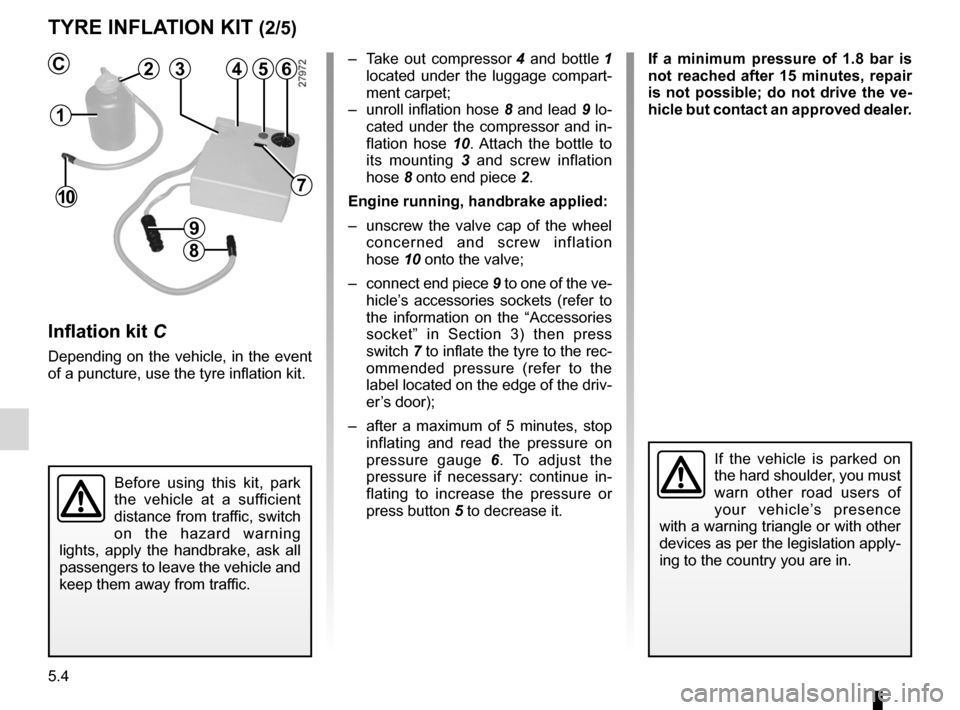
tYre InFLA tIOn KIt (2/5)
Inflation kit C
Depending on the vehicle, in the event
of a puncture, use the tyre inflation kit.
– Take out compressor 4 and bottle 1
located under the luggage compart-
ment carpet;
– unroll inflation hose 8 and lead 9 lo-
cated under the compressor and in-
flation hose 10 . Attach the bottle to
its mounting 3 and screw inflation
hose 8 onto end piece 2.
engine running, handbrake applied:
– unscrew the valve cap of the wheel
concerned and screw inflation
hose 10 onto the valve;
– connect end piece 9 to one of the ve-
hicle’s accessories sockets (refer to
the information on the “Accessories
socket” in Section 3) then press
switch 7 to inflate the tyre to the rec-
ommended pressure (refer to the
label located on the edge of the driv-
er’s door);
– after a maximum of 5 minutes, stop
inflating and read the pressure on
pressure gauge 6 . To adjust the
pressure if necessary: continue in -
flating to increase the pressure or
press button 5 to decrease it. If a minimum pressure of 1.8 bar is
not reached after 15 minutes, repair
is not possible; do not drive the ve-
hicle but contact an approved dealer.
Before using this kit, park
the vehicle at a sufficient
distance from traffic, switch
on the hazard warning
lights, apply the handbrake, ask all
passengers to leave the vehicle and
keep them away from traffic.
1
23456
7
8
9
10
If the vehicle is parked on
the hard shoulder, you must
warn other road users of
your vehicle’s presence
with a warning triangle or with other
devices as per the legislation apply-
ing to the country you are in.
c