2012 RENAULT LAGUNA COUPE seats
[x] Cancel search: seatsPage 42 of 221

ENG_NU_939-3_D91_Renault_1
Jaune NoirNoir texte
cHILd sAfETY : fitting a child seat (2/3)
child seat atta")
1.36
ENG_UD25098_1
Sécurité enfants : installation du siège enfant (X91 - D91 - R\
enault)
ENG_NU_939-3_D91_Renault_1
Jaune NoirNoir texte
cHILd sAfETY : fitting a child seat (2/3)
child seat attached using the IsOfIX
mounting
ü Seat which allows an ISOFIX
child seat to be fitted.
± The rear seats are fitted with
an anchorage point which allows a
forward-facing ISOFIX child seat with
universal approval to be fitted. The an-
chorage points are located in the lug -
gage compartment.
The size of the ISOFIX child seat is in-
dicated by a letter:
– B and B1: for forward-facing seats in
group 1 (9 to 18 kg);
– C: rear-facing seats in group 1 (9 to
18 kg);
– D and E: shell seat or rear-facing
seats in group 0 or 0+ (less than
13 kg);
– F and G: cots in group 0 (less than
10 kg).
child seat attached using the belt
¬Seat which allows a seat with
“Universal” approval to be fitted using
a seat belt;
− Seat which only allows a rear-
facing seat with “Universal” approval
to be attached with a seat belt.
Using a child safety system which is not approved for this vehicle will not
correctly protect the baby or child. They risk serious or even fatal injury.
³ Check the status of the air bag
before fitting a child seat or allowing a
passenger to use the seat.
R I sK O f dE AT H O R
s ERIOU s INJURY: before
fitting a rear-facing child
seat on the front passenger
seat, check that the airbag has been
deactivated (please refer to the in -
formation on “Child safety: front
passenger airbag deactivation/acti -
vation” in Section 1).
Page 43 of 221

ENG_NU_939-3_D91_Renault_1
cHILd sAfETY : fitting a child seat (3/3)
(1) RIsK Of dEAT")
JauneNoirNoir texte
1.37
ENG_UD25098_1
Sécurité enfants : installation du siège enfant (X91 - D91 - R\
enault)
ENG_NU_939-3_D91_Renault_1
cHILd sAfETY : fitting a child seat (3/3)
(1) RIsK Of dEATH OR sERIOUs INJURY: before fitting a rear-facing child seat on the front passenger seat, check
that the airbag has been deactivated (please refer to the information on “Child safety: front passenger airbag deactiva -
tion/activation” in Section 1).
Type of child seat Weight of the child seat sizefront passenger
seat (1) (2) (5) Rear seats
c arrycot fitted across the
vehicle
Group 0 < 10 kg
F - GXX
shell seat/rear-facing seat
Group 0, 0+ and 1 Up to 18 kg
C, D, EUU - IL (3)
forward-facing seat
Group 1 9 to 18 kg
B, B1XU - IUF - IL (4)
Booster seat
Group 2 and 3 15 kg to 36 kg
XU (4)
X = Seat not suitable for fitting child seats.
U = Seat allowing a child seat with “Universal” approval to be atta\
ched by seat belt; check that it can be fitted correctly.
IUf/IL = On equipped vehicles, seat which allows an approved “Universal”/“semi-universal” or “vehicle specific” child seat to be
attached using the ISOFIX system; check that it can be fitted.
(2) Only a rear-facing child seat can be fitted in this seat: raise the seat to the maximum and position it as far back as possible,
tilting the seatback slightly (approximately 25°).
(3) Move the front seat as far forward as possible to install a rear-facing child seat, then move back the seat in front as far as it
will go, although without allowing it to come into contact with the chil\
d seat.
(4) Forward-facing child seat; position the seatback of the child seat in contact with the seatback of the vehicle seat. Adjust the
height of the headrest or remove it if necessary; do not push the seat in front of the child more than halfway back on its run-
ners and do not recline the seatback more than 25°.
(5) Make sure that the child seat or the child’s feet do not prevent the front seat from locking correctly. Refer to the information
on the “Front seat” in Section 1.
The table below summarises the information already shown on the diagram on the previous page, to ensure the regula-
tions in force are respected.
Page 55 of 221

filterparticle filter ..................................................... (current page)
heated seats .......................................................... (current page)
ABS ....................................................................... (current page)
JauneNoirNoir texte
1.49
ENG_UD27730_1
Témoins lumineux (X91 - D91 - Renault)
ENG_NU_939-3_D91_Renault_1
WARNINg LIgHTs (4/4)
A
ðHeated seats operating indi -
cator
This indicates that one of the heated
seats is in operation.
Üparticle filter
Refer to the information on
“Special features of diesel versions” in
Section 2.
The presence and operation of the warning lights dEpENd ON THE EQUIpmENT ANd cOUNTRY.
d riving correction device
warning light
Refer to the information on “Driving cor-
rection devices” in Section 2.
ÄToxic fume filter system
Warning Light
This lights up when the ignition is
switched on and goes out when the
engine is started.
– If it lights up continuously, consult
your approved Dealer as soon as
possible;
– if it flashes, reduce the engine speed
until the light stops flashing. Contact
your approved Dealer as soon as
possible.
R e f e r t o t h e i n f o r m a t i o n o n
“Antipollution, fuel economy and driv -
ing” in Section 2.
Ép reheating warning light
(diesel version)
This should come on when the igni -
tion is switched on. It indicates that the
heater plugs are in operation. This goes
out as soon as the engine starts.
xAnti-lock braking warning
light
This lights up when the ignition is
switched on and goes out after a few
seconds.
If it does not go out after the ignition is
switched on, or lights up when driving,
there is a fault with the ABS. Braking
will then be as normal, without the ABS
system.
Contact an approved Dealer as soon as
possible.
Page 139 of 221

rear bench seat..................................... (up to the end of the DU)
rear seats functions .......................................................... (current page)
3.21
ENG_UD19873_3
Banquette arrière (X91 - D91 - Renault)
ENG_NU_939-3_D91_Renault_3
luggage compartment
To open
Press button 2 and lift the tailgate.
To close
Lower the tailgate using the handles
inside the tailgate to help you.
To put the seatback back in position,
raise it then check that it is locked cor-
rectly.
Rear bench seat
REAR BENch SEAT/luggAgE coMPARTMENT
When refitting the seatback, make sure it is correctly locked in place.
If seat covers are fitted, make sure these do not prevent the seatback
latch from locking in.
Make sure that the seat belts are positioned correctly.
Reposition the headrests.
Rear bench seat
The seatbacks can be folded down in
order to transport large objects.
Pull control 1, the seatback folds down
automatically.
1
In all situations, lower the rear head-
rests (refer to the information on the
“Rear headrests” in Section 1).
2
When moving the rear
bench seat, check that
the bench seat anchor -
age points are clean (they
should be free from grit, cloths or
any other item which may prevent
the bench seat from locking se -
curely).
Page 141 of 221
transporting objectsin the luggage compartment ........... (up to the end of the DU)
towing rings .......................................... (up to the end of the DU)
towing towing equipment ............................ (up to the end of the DU)
towing equipment fitting ............................................... (up to the end of the DU)
towing a caravan .................................. (up to the end of the DU)
roof bars ............................................... (up to the end of the DU)
3.23
ENG_UD29089_6
Transport d’objets : dans le coffre / attelage (X91 - D91 - Renault)
ENG_NU_939-3_D91_Renault_3
Transporting objects:
in the boot
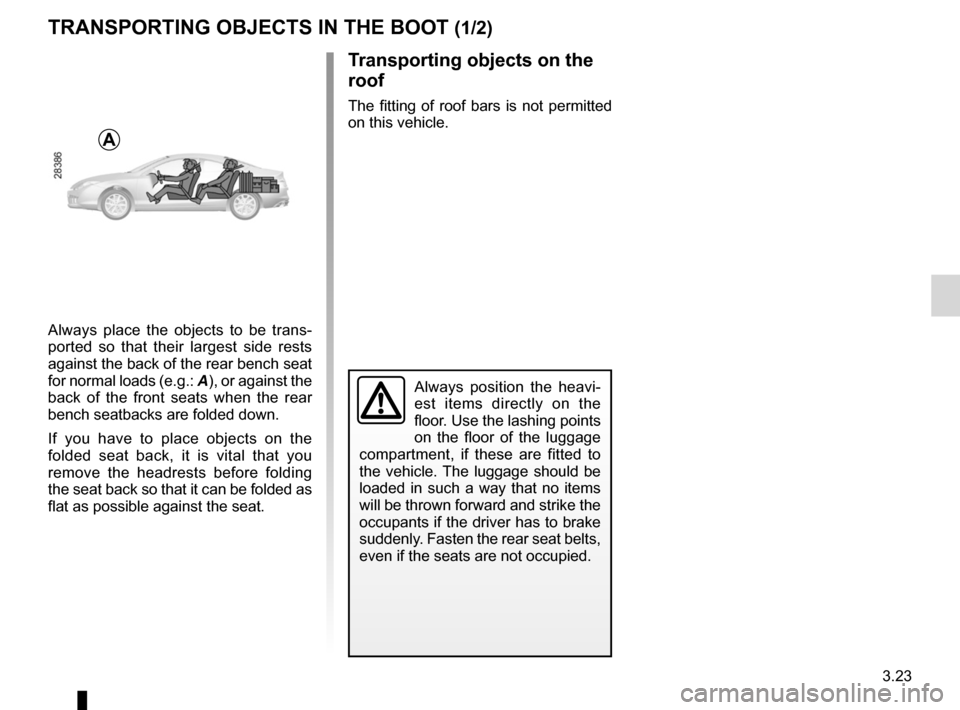
A
Always position the heavi -
est items directly on the
floor. Use the lashing points
on the floor of the luggage
compartment, if these are fitted to
the vehicle. The luggage should be
loaded in such a way that no items
will be thrown forward and strike the
occupants if the driver has to brake
suddenly. Fasten the rear seat belts,
even if the seats are not occupied.
Always place the objects to be trans -
ported so that their largest side rests
against the back of the rear bench seat
for normal loads (e.g.: A), or against the
back of the front seats when the rear
bench seatbacks are folded down.
If you have to place objects on the
folded seat back, it is vital that you
remove the headrests before folding
the seat back so that it can be folded as
flat as possible against the seat.
Transporting objects on the
roof
The fitting of roof bars is not permitted
on this vehicle.
TRANSPoRTINg oBjEcTS IN ThE BooT (1/2)
Page 160 of 221

maintenance:interior trim ...................................... (up to the end of the DU)
interior trim maintenance ................................... (up to the end of the DU)
cleaning: inside the vehicle ............................ (up to the end of the DU)
4.16
ENG_UD22866_8
Entretien des garnitures intérieures (X35 - X45 - X65 - J77 - X81 - J81 - X85 - X91 - B91 - K91 - D91 - X83 - X61 - X77 ph2 - X95 - B95 - D95 - E95 - K95 - J95 - R95 -
ENG_NU_939-3_D91_Renault_4
Jaune NoirNoir texte
Interior trim maintenance
Glass instrument panel(e.g. instrument panel, clock, exterior
temperature display, radio display, etc.)
Use a soft cloth (or cotton wool).
If this does not clean it properly, use a
soft cloth (or cotton wool) slightly mois-
tened with soapy water and then wipe
clean with a soft damp cloth or cotton
wool.
Finally, carefully dry off with a soft dry
cloth.
Cleaning products containing alco -
hol must not be used under any cir-
cumstances.
Seat belts
These must be kept clean.
Use products selected by our Technical
Department (Approved outlets) or
warm, soapy water and a sponge and
wipe with a dry cloth.
Detergents or dyes must not be used
under any circumstances.
InteRIOR tRIM MAIntenAnCe (1/2)
textiles (seats, door trim, etc)
Vacuum-clean the textiles regularly.
Liquid stain
Use soapy water.
Dab lightly (never rub) with a soft cloth,
rinse and remove the excess.
Solid or pasty stain
Carefully remove the excess solid or
pasty material immediately with a
spatula (working from the edges to the
centre to avoid spreading the stain).
Clean as for a liquid stain.
Special instructions for sweets or
chewing gum
Put an ice cube on the stain to solidify
it, then proceed as for a solid stain.
A well-maintained vehicle will last
longer. It is therefore recommended to
maintain the interior of the vehicle regu-
larly.
A stain should always be dealt with
swiftly.
Whatever type of stain is on the trim,
use
cold (or warm) soapy water with
natural soap.
Detergents (washing-up liquid, pow -
dered products, alcohol-based prod-
ucts) should not be used.
Use a soft cloth.
Rinse and soak up the excess.
For further recommendations for
maintaining the interior, and/or for
any unsatisfactory results, please
see an authorised dealer.
Page 182 of 221
5.20
ENG_UD22226_3
Fusibles (X91 - D91 - Renault)
ENG_NU_939-3_D91_Renault_5
FuSeS (2/2)
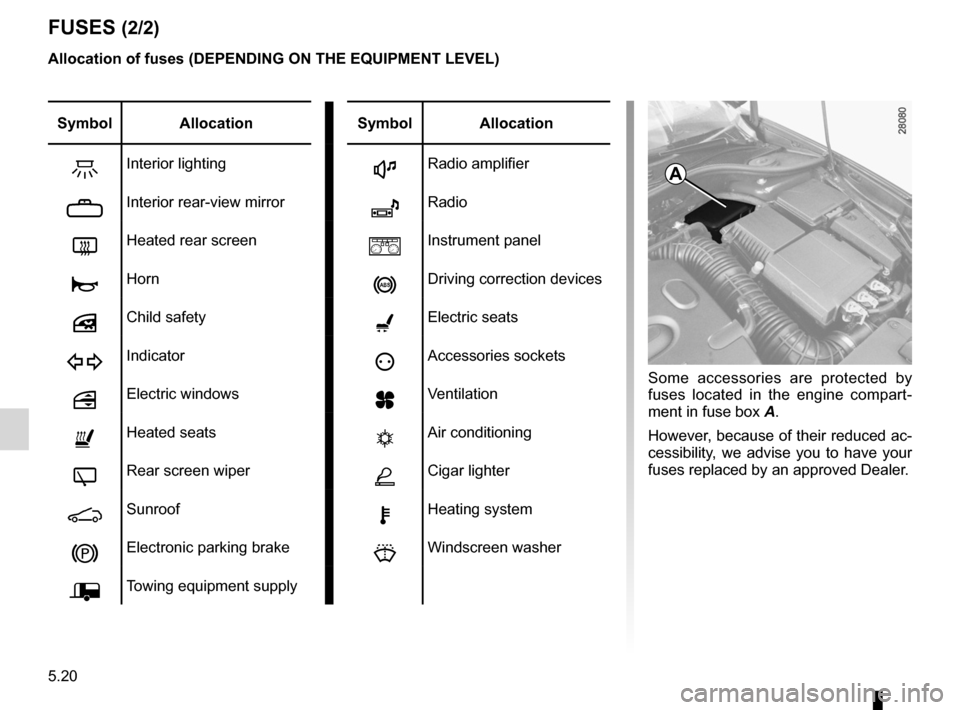
Some accessories are protected by
fuses located in the engine compart -
ment in fuse box A.
However, because of their reduced ac-
cessibility, we advise you to have your
fuses replaced by an approved Dealer.
A
Allocation of fuses (DePenDInG On tHe eQuIPMent LeVeL)
Symbol Allocation SymbolAllocation
ZInterior lightingRadio amplifier
Interior rear-view mirrorîRadio
CHeated rear screenaInstrument panel
ÌHornnDriving correction devices
Child safetyElectric seats
DIndicatorëAccessories sockets
Electric windowsyVentilation
ñHeated seatstAir conditioning
ERear screen wiperÆCigar lighter
[SunroofHeating system
Electronic parking brakeHWindscreen washer
ÝTowing equipment supply
Page 194 of 221

ENG_NU_939-3_D91_Renault_5
OPerA tInG FAuL tS (5/5)
electrical equipment PO")
5.32
ENG_UD28899_2
Anomalies de fonctionnement (X91 - B91 - K91 - D91 - X95 - B95 - D95 - \
K95 - J95 - R95 - X98 - Renault)
ENG_NU_939-3_D91_Renault_5
OPerA tInG FAuL tS (5/5)
electrical equipment POSSIBLe cAuSeSWHAt tO DO
The wipers do not work. Wiper blades stuck.Free the blades before using the wipers.
Faulty electrical circuit. Consult an approved dealer.
Fuse damaged. Replace the fuse, refer to the information
on “Fuses”.
The wiper does not stop. Faulty electrical controls.Consult an approved dealer.
Direction indicators flashing more
quickly. Blown bulb.
See information on “Headlights: changing
the bulbs” or “Rear lights: changing the
bulbs” in section 5.
The direction indicators do not work. Faulty electrical circuit.Consult an approved dealer.
The lights do not come on or go off. Faulty electrical circuit or control.Consult an approved dealer.
Traces of condensation in the lights. Traces of condensation may be a nat-
ural phenomenon caused by varia-
tions in temperature.
In this situation, these traces soon dis-
appear when the lights are switched
on.
The illumination of the seat belt re -
minder warning light does not match
the seat belt status. An object is stuck between the floor
and the seat and is disrupting the op-
eration of the sensor.Remove any objects from underneath the
rear seats.