2012 RENAULT KOLEOS LED
[x] Cancel search: LEDPage 67 of 233

rear view mirrors ................................... (up to the end of the DU)
1.61
ENG_UD7744_2
Rétroviseurs (X45 - H45 - Renault)
ENG_NU_977-2_H45_Ph2_Renault_1
Rear-view mirrors
REAR vIEW MIRRORs
door mirrors
With the engine running, move
button 1:
– position C to adjust the left-hand
door mirror;
– position E to adjust the right-hand
door mirror;
D is the inactive position.
folding door mirrors
With the engine running , move
button 1 to position F: the door mirrors
fold away.
To reset them for driving, return to posi-
tion C, D or E.
heated door mirrors
Mirror de-icing is carried out at the
same time as rear screen de-icing.
The driver ’s door mirror
may have two clearly de -
fined zones. Zone B shows
what can normally be seen
in an ordinary rear-view mirror.
Zone A increases rear side visibility
for greater safety.
The objects in zone A look much
further away than they really are.
1
cdE
f
AB
Interior rear view mirror
Its position can be adjusted.
Rear view mirror with lever 2
For night driving, to avoid being dazzled
by the headlights of the car behind you,
flip the small lever 2 located behind the
rear view mirror.
Rear view mirror without lever 2
The rear view mirror darkens automati-
cally at night if you are being followed
by a vehicle with its lights on.
2
Page 77 of 233

JauneNoirNoir texte
1.71
ENG_UD23493_6
Réservoir carburant (X45 - H45 - Renault)
ENG_NU_977-2_H45_Ph2_Renault_1
v ehicles running on ethanol -based
fuel
It is essential to use unleaded petrol or
fuel containing a maximum of 85% eth-
anol (E85).
In very cold conditions, it may be very
difficult or even impossible to start the
engine. To avoid this problem, use un-
leaded petrol or, on equipped vehicles,
use the heater integrated in the engine:
connect the special end of the exten -
sion piece supplied into the socket in -
tegrated into the radiator grille and the
other end into a 220v socket for at least
6 hours before starting.
Note: you may notice an increase in
fuel consumption with this type of fuel.
Do not mix even small
amounts of petrol (un -
leaded or E85) with diesel.
Do not use ethanol-based
fuel if your vehicle is not compatible
with this fuel.
fUEL TANK (2/3)
filling with fuel
Insert the nozzle fully before beginning
to fill the tank (risk of splashback).
Keep the nozzle in this position
throughout the entire filling operation.
When the pump cuts out automatically
at the end of the filling procedure, a
maximum of two further filling attempts
may be made, as there must be suffi -
cient space in the fuel tank to allow for
expansion.
Make sure that no water enters the fuel
tank during filling. The cap and its sur-
round must remain clean.
petrol versions
Using leaded petrol will damage the
antipollution system and may lead to a
loss of warranty.
To ensure that the fuel tank is not filled
with leaded petrol, the fuel tank filler
neck contains a restrictor fitted with a
foolproof system which only allows
the nozzle for unleaded petrol to be
used (at the pump).persistent smell of
fuel
If you notice a persistent
smell of fuel you should:
– stop the vehicle if traffic condi -
tions allow and switch off the igni -
tion;
– switch on the hazard warning
lights and ask your passengers
to leave the vehicle and to keep
away from traffic;
– contact an authorised dealer.
Page 88 of 233

electronic parking brake ....................... (up to the end of the DU)
driving ................................................... (up to the end of the DU)
2.10
ENG_UD27280_8
Frein de parking assist (X45 - H45 - Renault)
ENG_NU_977-2_H45_Ph2_Renault_2
Jaune NoirNoir texte
Indicator lights 3 and } go out a
few seconds after the engine has been
switched off.
Note: if the driver’s door is opened, in-
dicator lights 3 and
} will light up
again. They will go out when the door
is closed.
w arning: if one of the doors is open
but the parking brake has not been ap-
plied, a bleep sounds and the message
“ Apply parking brake ” is displayed on
the instrument panel.
In this case, the vehicle must be im -
mobilised by pulling then releasing the
switch 2.
The parking brake is released as soon
as the vehicle is driven.
Electronic parking brake
ELECTRONIC PARKING BRAKE (1/4)
Automatic releasing of the
electronic parking brake
The brake will be released as soon as
the vehicle starts and accelerates.
Manual operation
Applying the parking brake
Pull then release switch 2 . The
}
indicator light lights up on the instru -
ment panel accompanied by the mes -
sage “ Parking brake on ” and indicator
light 3.
Releasing the parking brake
With the ignition on and while depress-
ing the brake pedal, press switch 2
until indicator lights 3 on the switch 2
and
} on the instrument panel go
out.
Dynamic braking
In an emergency, under exceptional
circumstances , switch 2 can be pulled
to stop the vehicle. Beyond a threshold,
the
} and © indicator lights
come on. Consult an approved Dealer.
Before leaving the vehicle,
check that the electronic
parking brake is fully ap -
plied.
The
} indicator light lights up
on the instrument panel accompa -
nied by the message “Parking brake
on”.
Automatic operationThe electronic parking brake ensures
automatic vehicle immobilisation when
the engine is stopped by pressing
the engine start/stop button 1.
For certain country-specific model ver-
sions, the automatic brake application
function is not activated. Refer to the in-
formation on “Manual operation”.
To confirm that the electronic parking
brake is applied, the message “Parking
brake on ” and indicator light
}
on the instrument panel and indicator
light 3 on switch 2 light up.
2
1
3
Page 95 of 233

environment .......................................... (up to the end of the DU)
2.17
ENG_UD20974_4
Environnement (X35 - X44 - X45 - H45 - X65 - S65 - X77 - X81 - X85 - X91 - D91 - X76 - X83 - X61 - B65 - C65 - X77 ph2 - X95 - E95 - J95 - R95 - L38 - E33 - X33 - X38
ENG_NU_977-2_H45_Ph2_Renault_2
Environment
ENvIRONMENT
Emissions
Your vehicle has been designed to
emit fewer greenhouse gases (CO2)
while in use, and therefore to consume
less fuel (eg. 140 g/km, equivalent to
5.3 l/100 km for a diesel vehicle).
Our vehicles are also equipped with a
particle filter system including a cata -
lytic converter, an oxygen sensor and
an active carbon filter (the latter pre -
vents vapour from the fuel tank being
released into the open air).
For certain diesel vehicles, this system
also has a particle filter to reduce the
volume of soot particles emitted.
Please make your own
contribution towards
protecting the environment
too
– Worn parts replaced in the course of
routine vehicle maintenance (vehi -
cle battery, oil filter, air filter, batter -
ies, etc.) and oil containers (empty or
filled with used oil) must be disposed
of through specialist organisations. –
At the end of the vehicle’s service
life, it should be sent to approved
centres to ensure that it is recycled.
– In all cases, comply with local legis -
lation.
Recycling
Your vehicle is 85% recyclable and
95% recoverable.
To achieve these objectives, many of
the vehicle components have been de-
signed to enable them to be recycled.
The materials and structures have
been carefully designed to allow these
components to be easily removed and
reprocessed by specialist companies.
In order to preserve raw material re -
sources, this vehicle incorporates nu -
merous parts made from recycled plas-
tics or renewable materials (vegetable
or animal-derived materials such as
cotton or wool).
Your vehicle has been designed with
respect for the
environment in mind for
its entire service life: during production,
use and at the end of its life.
This commitment is illustrated by the
Renault eco² group signature.
Manufacture
Your vehicle has been manufactured at
an industrial site which uses a progress
policy to reduce environmental impacts
on rivers and natural areas (reduc -
tion of water and energy consumption,
visual and noise pollution, atmospheric
emissions and waste water, sorting and
reusing waste).
Page 109 of 233
JauneNoirNoir texte
2.31
ENG_UD27291_6
R gulateur-limiteur de vitesse : fonction limiteur (X45 - H45 - Renault)
ENG_NU_977-2_H45_Ph2_Renault_2
CRUISE CONTROL, SPEED LIMITER: speed limiter function (3/3)
2
5
3
41
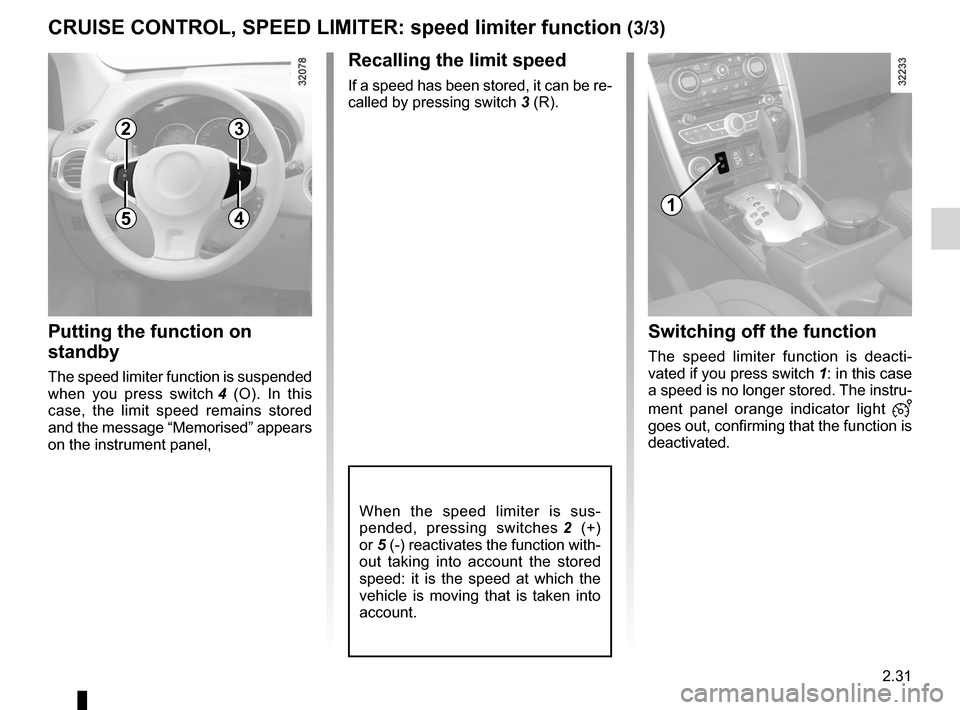
Putting the function on
standby
The speed limiter function is suspended
when you press switch 4 (O). In this
case, the limit speed remains stored
and the message “Memorised ” appears
on the instrument panel,
Recalling the limit speed
If a speed has been stored, it can be re-
called by pressing switch 3 (R).
When the speed limiter is sus -
pended, pressing switches 2 (+)
or 5 (-) reactivates the function with-
out taking into account the stored
speed: it is the speed at which the
vehicle is moving that is taken into
account.
Switching off the function
The speed limiter function is deacti -
vated if you press switch 1: in this case
a speed is no longer stored. The instru-
ment panel orange indicator light
goes out, confirming that the function is
deactivated.
Page 110 of 233
cruise control ........................................ (up to the end of the DU)
cruise control-speed limiter................... (up to the end of the DU)
driving ................................................... (up to the end of the DU)
2.32
ENG_UD23498_5
Régulateur-limiteur de vitesse : fonction régulateur (X45 - H45 - Renault)
ENG_NU_977-2_H45_Ph2_Renault_2
Jaune NoirNoir texte
Cruise control
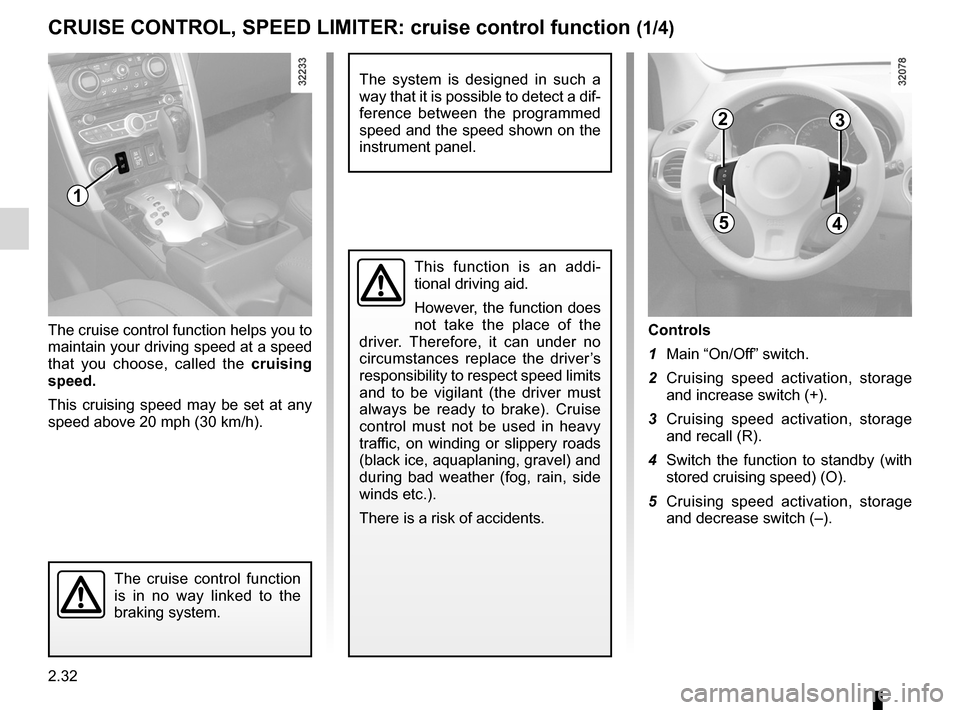
Controls
1 Main “On/Off” switch.
2 Cruising speed activation, storage
and increase switch (+).
3 Cruising speed activation, storage
and recall (R).
4 Switch the function to standby (with
stored cruising speed) (O).
5 Cruising speed activation, storage
and decrease switch (–).
The cruise control function helps you to
maintain your driving speed at a speed
that you choose, called the
cruising
speed.
This cruising speed may be set at any
speed above 20 mph (30 km/h).
The cruise control function
is in no way linked to the
braking system.
This function is an addi -
tional driving aid.
However, the function does
not take the place of the
driver. Therefore, it can under no
circumstances replace the driver’s
responsibility to respect speed limits
and to be vigilant (the driver must
always be ready to brake). Cruise
control must not be used in heavy
traffic, on winding or slippery roads
(black ice, aquaplaning, gravel) and
during bad weather (fog, rain, side
winds etc.).
There is a risk of accidents.
CRUISE CONTROL, SPEED LIMITER: cruise control function (1/4)
1
23
45
The system is designed in such a
way that it is possible to detect a dif-
ference between the programmed
speed and the speed shown on the
instrument panel.
Page 113 of 233

JauneNoirNoir texte
2.35
ENG_UD23498_5
Régulateur-limiteur de vitesse : fonction régulateur (X45 - H45 - Renault)
ENG_NU_977-2_H45_Ph2_Renault_2
CRUISE CONTROL, SPEED LIMITER: cruise control function (4/4)
Putting the function on
standby
The function is suspended when you:
– press switch 4 (O) ;
– depress the brake pedal;
– depress the clutch pedal or shift the
gear lever into neutral on vehicles
with automatic transmissions or con-
tinuously variable transmissions.
In all three cases, the message
“Memorised ” appears on the instrument
panel, followed by the stored speed.
Standby is confirmed when indicator
light
” goes out.
Returning to the cruising speed
If a speed is stored, it can be recalled,
once you are sure that the road condi -
tions are suitable (traffic, road surface,
weather conditions, etc.). With a ve -
hicle speed above 20 mph (30 km/h),
press switch 3 (R).
Note: if the speed previously stored is
much higher than the current speed,
the vehicle will accelerate more rapidly
to reach this threshold.
When the cruise control is sus -
pended, pressing switches 2 (+)
or 5 (-) reactivates the function with-
out taking into account the stored
speed: it is the speed at which the
vehicle is moving that is taken into
account.
Switching off the function
The cruise control function is deacti -
vated if you press switch 1: in this case
a speed is no longer stored. The instru-
ment panel green indicator lights
Î
and
” go out, confirming that the
function is deactivated.
Putting the cruise control
on standby or switching it
off does not cause a rapid
reduction in speed: you
must brake by depressing the brake
pedal.
1
23
45
Page 115 of 233
JauneNoirNoir texte
2.37
ENG_UD27281_8
Aide au parking (X45 - H45 - Renault)
ENG_NU_977-2_H45_Ph2_Renault_2
PARKING DISTANCE CONTROL (2/3)
Automatic activation/deactivation of
rear parking distance control
The system deactivates:
– when the electronic parking brake is
applied;
– when the vehicle speed is above ap-
proximately 7 mph (12 km/h);
– when the vehicle is in neutral or
when the gear lever has been shifted
to N or P for automatic gearboxes.
An impact to the under -
side of the vehicle while
manoeuvring (e.g.: strik -
ing a post, raised kerb or
other street furniture) may result in
damage to the vehicle (e.g.: defor -
mation of an axle).
To avoid any risk of accident, have
your vehicle checked by an ap -
proved Dealer.
If there are obstacles located close to
both the front and rear of the vehicle,
only the closest of the two will be ac -
knowledged and the corresponding
front or rear beep sound will be emit -
ted. If obstacles are detected both to
the front and to the rear of the vehicle
at the same time, and they are both
within 30 centimetres from the vehicle,
the corresponding front and rear beeps
will be emitted alternately.
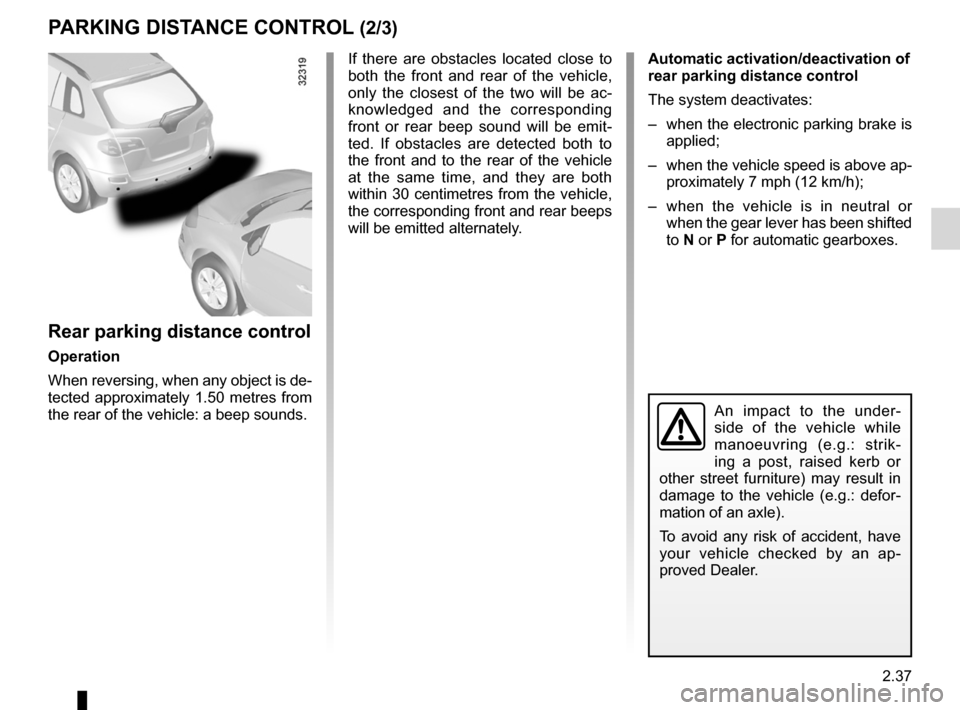
Rear parking distance control
Operation
When reversing, when any object is de-
tected approximately 1.50 metres from
the rear of the vehicle: a beep sounds.