2012 RENAULT KANGOO ZERO EMISSION lock
[x] Cancel search: lockPage 62 of 213

JauneNoirNoir texte
1.57
ENG_UD29120_3
Poste de conduite à gauche (X61 électrique - Renault)
ENG_NU_911-4_F61e_Renault_1
20 Gearstick
21 Remote control/location for radio,
navigation system.
22 Cruise control/speed limiter con -
trols.
23 Bonnet release control.
24 Headlight adjustment control.
25 Additional heating switch.
26 ECO mode switch.
27 Controls for:
– cruise control/speed limiter;
– parking distance;
– activation/deactivation of the
horn.
1 Stalk for:
– direction indicator lights;
– exterior lights;
– front fog lights;
– rear fog lights.
2 – Horn,
– location for driver’s air bag.
3 Instrument panel.
4 Stalk for:
– windscreen wipers;
– windscreen washer;
– trip computer and warning
system.
5 Ignition switch.
6 Central display:
– seat belt reminder warning light;
– airbag deactivation warning
light;
– navigation;
– clock;
– exterior temperature.
7 Centre air vent.
8 Controls for ventilation, heating
and de-icing. 9 Windscreen demister outlet.
10 Location for passenger air bag.
11 Speaker.
12 Side air vent.
13 Side window demister outlet.
14 Glove box.
15 Storage space or accessories
socket.
16 Hazard warning lights switch.
17 Central door locking/unlocking
switch.
18 Cigar lighter/12V socket.
19 Handbrake.
DriviNg POSitiON, leFt-hAND Driver (2/2)
the equipment fitted, described below, DePeNDS ON the verSiON AND cOUNtr Y.
Page 64 of 213

JauneNoirNoir texte
1.59
ENG_UD29121_4
Poste de conduite à droite (X61 électrique - Renault)
ENG_NU_911-4_F61e_Renault_1
DriviNg POSitiON: right-hAND Drive (2/2)
20 Location for radio, navigation
system.
21 Gearstick
22 Cigarette lighter/12V socket.
23 Handbrake.
24 Door electric locking/unlocking
switch.
25 Hazard warning lights switch.
26 Storage space or accessories
socket.
27 Glovebox
28 Bonnet release control.
10 – Horn.
– Location for driver’s air bag.
11 Instrument panel.
12 Ignition switch.
13 Stalk for:
– windscreen wipers;
– windscreen washer;
– trip computer and warning
system.
14 Cruise control/speed limiter con -
trol.
15 Additional heating switch.
16 ECO mode switch.
17 Activation/deactivation control for
the horn.
18 Headlight adjustment control.
19 Cruise control/speed limiter con -
trols.
1 Side window demister outlet.
2 Side air vent.
3 Speaker.
4 Location for passenger air bag.
5 Windscreen demister outlet.
6 Controls for ventilation, heating
and de-icing.
7 Centre air vent.
8 Central display:
– seat belt reminder warning light;
– airbag deactivation warning
light;
– navigation;
– clock;
– exterior temperature.
9 Stalk for:
– direction indicator lights,
– exterior lights;
– front fog lights;
– rear fog lights.
the equipment fitted, described below, DePeNDS ON the verSiON AND cOUNtr
Y.
Page 67 of 213

1.62
ENG_UD26204_4
Témoins lumineux (X61 électrique - Renault)
ENG_NU_911-4_F61e_Renault_1
WArNiNg lightS (3/3)
the presence and operation of the warning lights DePeND ON the eQUiPmeNt AND cOUNtr Y.
el e c t r o t e c h n i c a l s y s t e m
warning light
When the blue warning light comes on,
this indicates that the traction battery
temperature is too low.
When the orange warning light comes
on, this indicates the traction battery or
the engine temperature is too high. Opt
for a calmer driving style.
if either of these warning lights come
on, this may lead to reduced vehicle
performance.
xAnti-lock braking warning
light
This lights up when the ignition is
switched on and goes out after a few
seconds.
If it does not go out after the ignition is
switched on, or lights up when driving,
there is a fault with the ABS. Braking
will then be as normal, without the ABS
system.
Contact an approved Dealer as soon as
possible.
l ow traction battery level
warning light
This comes on when the traction bat -
tery charge level has reached the re -
serve threshold. Please see the infor -
mation on “Displays and indicators” in
Section 1.
e l e c t r o t e c h n i c a l s y s t e m
warning light
If this comes on while driving, it indi -
cates an electrotechnical fault relating
to the “400V” electrical circuit. Please
contact an authorised dealer as soon
as possible.
A
Page 80 of 213

clock ..................................................... (up to the end of the DU)
clock ..................................................... (up to the end of the DU)
external temperature ............................ (up to the end of the DU)
1.75
ENG_UD21606_3
Heure et température extérieure (X61 - F61 - Renault)
ENG_NU_911-4_F61e_Renault_1
Clock and exterior temperature
clOcK AND eXteriOr temPerA tUre
exterior temperature
indicator
As ice formation is related
to climatic exposure, local
air humidity and temperature, the
external temperature alone is not
sufficient to detect ice.
If the electrical supply is cut (battery
disconnected, broken supply wire,
etc.), the clock will lose its time set-
ting. The time must then be set.
A
1
For safety reasons, carry
out any adjustments when
the vehicle is not being
driven.
After two seconds, the hours and min-
utes start flashing.
Press and hold the bottom button to
enter the hour setting mode.
When only the hours flash, press the
top button to scroll through them.
Press and hold the bottom button to
enter the minute setting mode.
When only the minutes flash, press the
top button to scroll through them.
Confirm by pressing and holding the
bottom button on stalk 1.
v ehicles equipped with a navigation
system, radio, etc.
Refer to the equipment instructions for
the special features.
With the ignition on, the time and, de-
pending on the vehicle, exterior tem
-
perature are displayed.
Setting the time
resetting the clock A
(depending on vehicle)
Display the “Clock” page on the instru-
ment panel by pressing one of the but-
tons on stalk 1.
exterior temperature
On equipped vehicles, the exterior tem-
perature is displayed at A . If it is be -
tween -3°C and +3°C, the °c charac -
ters flash (signalling a risk of ice).
Page 85 of 213
see-me-home lighting ............................................ (current page)
lights: main beam headlights ...................................... (current page)
lights-on warning buzzer ........................................ (current page)
1.80
ENG_UD19079_1
Eclairage et signalisation extérieure (X61 - F61 - Renault)
ENG_NU_911-4_F61e_Renault_1
Jaune NoirNoir texte
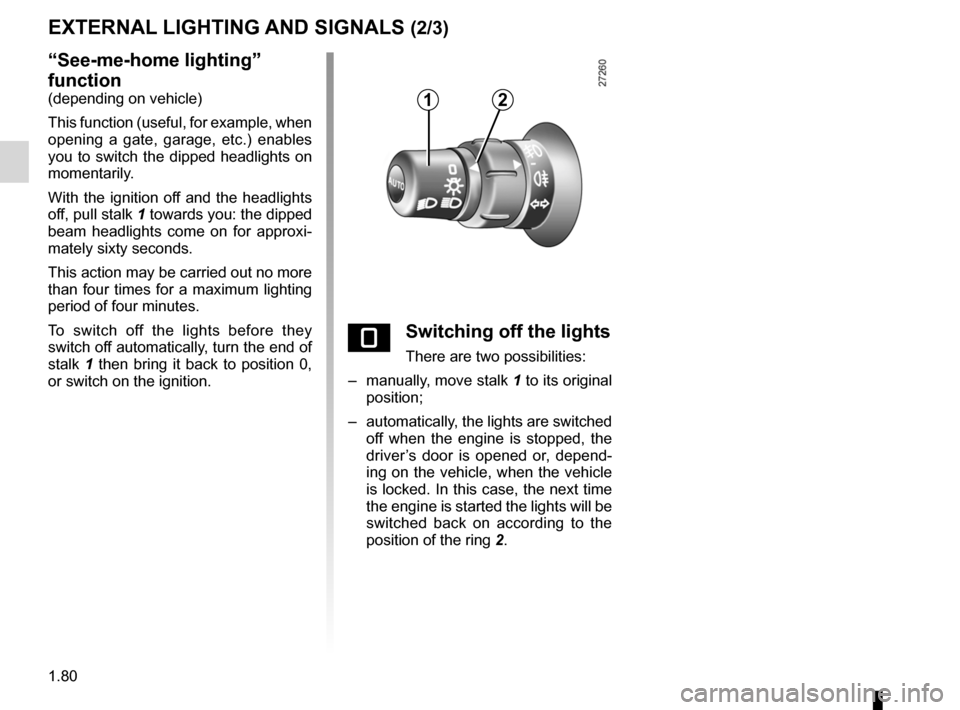
“See-me-home lighting”
function
(depending on vehicle)
This function (useful, for example, when
opening a gate, garage, etc.) enables
you to switch the dipped headlights on
momentarily.
With the ignition off and the headlights
off, pull stalk 1 towards you: the dipped
beam headlights come on for approxi -
mately sixty seconds.
This action may be carried out no more
than four times for a maximum lighting
period of four minutes.
To switch off the lights before they
switch off automatically, turn the end of
stalk 1 then bring it back to position 0,
or switch on the ignition.
eXterNAl lightiNg AND SigNAlS (2/3)
eSwitching off the lights
There are two possibilities:
– manually, move stalk 1 to its original
position;
– automatically, the lights are switched
off when the engine is stopped, the
driver’s door is opened or, depend -
ing on the vehicle, when the vehicle
is locked. In this case, the next time
the engine is started the lights will be
switched back on according to the
position of the ring 2.
12
Page 91 of 213

fuel filler cap ......................................... (up to the end of the DU)
fuel capacity ........................................... (up to the end of the DU)
fuel grade ............................................... (up to the end of the DU)
fuel filling ................................................ (up to the end of the DU)
additional tank capacity ........................ (up to the end of the DU)
additional heating fuel ...........................(up to the end of the DU)
additional heating additional heating fuel tank ............. (up to the end of the DU)
additional tank filling ............................. (up to the end of the DU)
additional heating tank ..........................(up to the end of the DU)
1.86
ENG_UD23011_2
Réservoir chauffage additionnel (X61 électrique - Renault)
ENG_NU_911-4_F61e_Renault_1
Additional heating tank
Useful capacity of fuel tank: 13 litres
approx.
With the vehicle unlocked, to open the
fuel filler flap, place your finger in open -
ing C and pull the flap.
Use the ignition key to open cap B.
ADDitiONAl heAtiNg tANK
Fuel grade
Use a high-grade fuel that complies
with the legislation in force in each
country and which must conform to
the specifications given on the label on
cover A.
Fuel odours and smoke may be present
after a long period without using the ad-
ditional heating.
A
c
B
Fuel filler cap: this is of a
special type.
If you have to replace it,
make sure it is identical
to the original cap. Contact an ap -
proved Dealer.
Never place the cap near a source
of heat or flame.
Do not wash the filler area with a
high-pressure washer.
Fuel filling– Insert the nozzle so that the valve
is open and fully insert the nozzle
before engaging it in order to fill the
tank (risk of splash-back).
– Keep the nozzle in this position
throughout the entire filling opera -
tion.
When the pump cuts out automatically
at the end of the filling procedure, a
maximum of two further filling attempts
may be made so as to leave sufficient
room for expansion.
Persistent smell of
fuel
If you notice a persistent
smell of fuel you should:
– stop the vehicle as soon as traf-
fic conditions allow and switch off
the ignition;
– switch on the hazard warning
lights and ask your passengers
to leave the vehicle and to keep
away from traffic;
– contact an approved Dealer.
Do not operate the addi -
tional heating when the ve-
hicle fuel tank is being filled.
Page 93 of 213

2.2
ENG_UD25284_3
Démarrage (X61 électrique - Renault)
ENG_NU_911-4_F61e_Renault_2
Starting, stopping the engine
“On” position MThe ignition is switched on:
Start position D
Starting the engine
– Move lever 1 to position P only ;
– turn the key to position D and then
release it.
Warning light
Ṑ may flash on the in -
strument panel, along with a beep. As
soon as light
Ṑ stops flashing and
the beep stops, the vehicle is ready to
drive.
Stopping the engine
With the engine running, turn the key
back to the “Stop” position St. Warning
light
Ṑ goes out.
Starting/St OPPing tHE EnginE
Driver’s responsibility
Never leave your vehi -
cle with the key inside and
never leave a child (or a
pet) unsupervised, even for a short
while.
There is a risk that they could start
the engine or operate electrical
equipment (electric windows etc.)
and trap part of their body (neck,
arms, hands, etc.).
Risk of serious injury.
Never switch off the ignition before
the vehicle has come to a complete
stop. Switching off the engine dis -
ables the assistance equipment:
brakes, power-assisted steering,
etc., and the passive safety devices
such as airbagsand pretensioners.
“Stop and steering lock”
position St
To unlock: turn the key and the steering
wheel slightly.
To lock: remove the key and turn the
steering wheel until the steering column
locks.
“accessories” position a
When the ignition is switched off, any
accessories (radio, etc.) will continue to
function.The vehicle can only be started if
the charging cord is unplugged from
the vehicle.
The vehicle can only be started if
the selector lever is at P. Please see
the information on “Gear control” in
Section 2.
1
Page 94 of 213

changing gear ....................................... (up to the end of the DU)
driving ................................................... (up to the end of the DU)
reverse gear selecting .......................................... (up to the end of the DU)
speed control ........................................ (up to the end of the DU)
gear lever .............................................. (up to the end of the DU)
electric vehicle driving .............................................................. (current page)
2.3
ENG_UD26205_3
Commande de vitesse (X61 électrique - Renault)
ENG_NU_911-4_F61e_Renault_2
Gear control
gEar cOntrOl (1/2)
Operates similar to an automatic gear-
box.
Selector lever 1
The display A on instrument panel indi -
cates the gear lever position as 3.
P : Park
r : Reverse
n : Neutral
D : Forward
Operation
Keeping your foot on the brake pedal
and with the selector lever 1 in position
P, turn the ignition.
Start the motor.
To move out of position P, you must de-
press the brake pedal before pressing
unlocking button 2.
With your foot on the brake pedal
(warning light
c in display A goes
out), move the lever out of position P.
Only engage D or r when the vehi -
cle is stopped, with your foot on the
brake and the accelerator pedal re -
leased.
1
Driving
Put lever 1 in position D.
Hill start
For hill starts, especially after a maxi -
mum traction battery charge and for the
first few miles, we recommend using
the handbrake.
While driving, press the accelerator
pedal to achieve the desired speed.
reverse
Put lever 1 in position r.
The reversing lights will come on as
soon as reverse gear is selected (with
the ignition on).
3
2
a
The vehicle can only start if the gear
selector is in position P.
The vehicle can only be started if
the charging cord is unplugged from
the vehicle.