2012 RENAULT CLIO SPORT TOURER tow
[x] Cancel search: towPage 127 of 264

JauneNoirNoir texte
2.33
ENG_UD12577_2
Boîte automatique (X85 - B85 - C85 - S85 - K85 - Renault)
ENG_NU_853-8_BCSK85_Renault_2
AUTOMATIC TRANSMISSION (3/3)
Parking the vehicle
When the vehicle is stopped, move the
lever to position P while keeping your
foot on the brake pedal: the gearbox is
in neutral and the drive wheels are me-
chanically locked by the driveshaft.
Apply the handbrake.
When setting off, if the lever is locked
in position P even though you are de -
pressing the brake pedal, the lever can
be released manually. To do this, unclip
the base of the lever, press recess 7 ,
visible on the gear lever gaiter, and the
unlocking button on the lever.Operating faults
– when driving, if the ‘check gearbox’
message appears on the instrument
panel, it indicates a fault.
Contact your approved Dealer as
soon as possible;
– when driving , if the message “gear-
box overheating” appears on the in-
strument panel, avoid leaving the
lever in position D (or R) where traf-
fic conditions allow: always return to
position N when stationary.
Contact your approved Dealer as
soon as possible;
– If a vehicle with an automatic
gearbox breaks down , refer to the
information on “Towing” in Section 5.
7
For safety reasons, do not
switch off the ignition before
the vehicle has come to a
complete standstill.
An impact to the under -
side of the vehicle while
manoeuvring (e.g.: strik -
ing a post, raised kerb or
other street furniture) may result in
damage to the vehicle (e.g.: defor -
mation of an axle).
To avoid any risk of accident, have
your vehicle checked by an ap -
proved Dealer.
Page 135 of 264

demistingwindscreen ....................................................... (current page)
JauneNoirNoir texte
3.5
ENG_UD19786_3
Chauffage / air conditionné (X85 - B85 - C85 - S85 - K85 - Renault)
ENG_NU_853-8_BCSK85_Renault_3
iThe air flow is shared between
the side window and wind -
screen demisting vents and the pas -
senger footwells.
This is the recommended position for
the best temperature in cold weather.
FThe air flow is directed mainly
towards the footwells.
GThe air flow is directed mainly
towards all the air vents and
the passenger footwells.
This is the recommended position for
the best temperature in hot weather.
ôThe air flow is directed mainly
towards all the air vents.
n
ote: for rapid demisting, use the air
conditioning (depending on the ve -
hicle), position controls A , B and D
on
W and adjust the ventilation
speed C to
y.
Distribution of air in the
passenger compartment
Turn control A to position the pointer
opposite the marked positions.
WAll the air flow is directed to the
demisting vents for the wind -
screen and the side windows.
HeatinG, air COnDitiOninG (2/4)
a
B
CD
Page 137 of 264
JauneNoirNoir texte
3.7
ENG_UD19786_3
Chauffage / air conditionné (X85 - B85 - C85 - S85 - K85 - Renault)
ENG_NU_853-8_BCSK85_Renault_3
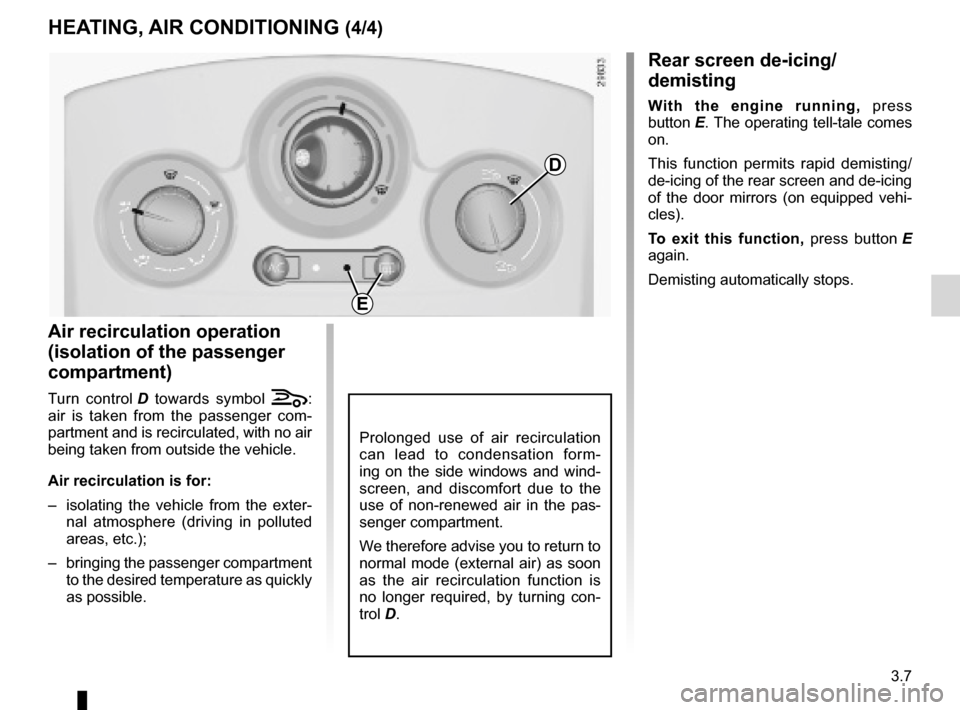
rear screen de-icing/
demisting
With the engine running, press
button E. The operating tell-tale comes
on.
This function permits rapid demisting/
de-icing of the rear screen and de-icing
of the door mirrors (on equipped vehi -
cles).
t o exit this function, press button E
again.
Demisting automatically stops.
air recirculation operation
(isolation of the passenger
compartment)
Turn control D towards symbol á:
air is taken from the passenger com -
partment and is recirculated, with no air
being taken from outside the vehicle.
air recirculation is for:
– isolating the vehicle from the exter -
nal atmosphere (driving in polluted
areas, etc.);
– bringing the passenger compartment
to the desired temperature as quickly
as possible.
HeatinG, air COnDitiOninG (4/4)
Prolonged use of air recirculation
can lead to condensation form -
ing on the side windows and wind -
screen, and discomfort due to the
use of non-renewed air in the pas -
senger compartment.
We therefore advise you to return to
normal mode (external air) as soon
as the air recirculation function is
no longer required, by turning con -
trol D.
D
e
Page 141 of 264
\
ENG_NU_853-8_BCSK85_Renault_3
GThe air flow is directed towards
the dashboard vents an")
JauneNoirNoir texte
3.11
ENG_UD19787_3
Air conditionné automatique (X85 - B85 - C85 - S85 - K85 - Renault)\
ENG_NU_853-8_BCSK85_Renault_3
GThe air flow is directed towards
the dashboard vents and the
footwells.
FThe air flow is directed mainly
towards the footwells.
The manual air distribution option
causes the aUtO (automatic mode)
operating tell-tale light on the dis -
play 5 to go out, but only air distri -
bution is no longer controlled auto -
matically by the system.
Press button 6 to return to auto -
matic mode.
õAll the air flow is directed to the
demisting vents for the wind -
screen and the side windows.
÷The air flow is directed to the
windscreen and side window
demisting vents, and the passenger
footwells.
ôAll the air flow is directed to the
dashboard vents.
Distribution of air in the
passenger compartment
There are five possible combinations
for air distribution, which may be se -
lected by pressing buttons 8 and 10 re-
peatedly. The arrows on display 5 indi-
cate the setting selected:
aUt OMatiC CLiMate COntrOL (4/8)
568
10
Page 146 of 264

air conditioning ..................................... (up to the end of the DU)
heating system ..................................... (up to the end of the DU)
air conditioning ..................................... (up to the end of the DU)
temperature regulation ......................... (up to the end of the DU)
ventilation ............................................. (up to the end of the DU)
heating and air conditioning system ...................... (current page)
3.16
ENG_UD10574_1
Air conditionné : informations et conseils utilisation (X85 - B85 - \
C85 - S85 - K85 - Renault)
ENG_NU_853-8_BCSK85_Renault_3
Air conditioning: information and advice on use
air COnDitiOninG: information and advice on use
Fuel consumption
You will normally notice an increase
in fuel consumption (especially
when driving in town) when the air
conditioning is operating. For vehi -
cles fitted with manual air condition -
ing, switch off the system when it is
not required.
advice for reducing consumption
and therefore helping to preserve
the environment:
Drive with the air vents open and
the windows closed.
If the vehicle has been parked in
the sun, open the doors for a few
moments to let the hot air escape
before starting the engine.
Maintenance
Refer to the Maintenance Service
Booklet for your vehicle for the in -
spection frequency.
Operating faults
As a general rule, contact your ap-
proved dealer in the event of an op-
erating fault.
– r eduction in de-icing, demist -
ing or air conditioning per -
formance. This may be caused
by the passenger compartment
filter cartridge becoming clogged.
– no cold air is being produced.
Check that the controls are set
correctly and that the fuses are
sound. Otherwise, switch off the
system.
Do not open the refriger -
ant fluid circuit. The fluid
may damage eyes or skin.
notes
Presence of water under the ve -
hicle. After prolonged use of the air
conditioning system, it is normal for
water to be present under the vehi-
cle. This is caused by condensation.
Do not add anything to the
vehicle’s ventilation circuit
(for example, to remove
bad odours).
t here is a risk of damage or of
fire.
Page 164 of 264

3.34
ENG_UD12582_2
Cache-bagages (X85 - B85 - C85 - S85 - K85 - Renault)
ENG_NU_853-8_BCSK85_Renault_3
The luggage compartment cover con -
sists of a rigid section A and a folding
section B.
the luggage cover is in the unfolded
position . t
he luggage compartment cover is
removed.
To remove it: with the cover in the folded
position and holding it horizontally:
– pull one side of the luggage compart-
ment cover towards you, pivoting it
slightly;
– then pull the other side of the lug -
gage compartment cover to com -
pletely detach it from its housing.
LUGGaGe COMP artMent COver: utility versions
Do not place any objects,
especially heavy or solid
objects on the luggage
compartment cover. These
may pose a risk to the vehicle occu-
pants if the driver has to brake sud-
denly or if the vehicle is involved in
an accident.
t he luggage compartment cover is
in the folded position .
To fold it:
– lift shelf A slightly and pull it towards
you to remove;
– then fold section B back on itself.
a
B
Page 165 of 264

towing rings .......................................... (up to the end of the DU)
tailgate .................................................. (up to the end of the DU)
3.35
ENG_UD10842_1
Aménagements coffre à bagages (X85 - B85 - C85 - S85 - K85 - Renault)
ENG_NU_853-8_BCSK85_Renault_3
Luggage compartment storage
Locations for anchorage
rings 1
Useful for securing objects transported
in the luggage compartment. See the
information on “Transporting objects in
the luggage compartment”.
Depending on the vehicle, a net for re-
taining luggage on the floor, located
in the storage compartment under the
passenger seat, may be attached to
these hooks.
LUGGaGe COMP artMent stOraGe (1/2)
sport tourer versions
On equipped vehicles, remove the
mobile floor to access the rings (refer to
the information on “mobile floor”).
11
1
Always position objects being trans-
ported so that the heaviest items
are resting against the back of the
rear bench seat.
Page 183 of 264

ENG_NU_853-8_BCSK85_Renault_4
Tyre pressure
TyRE pRESSURE
A
C
D
FE
G
A
B
C
E
E
F
F
When they need to")
4.11
ENG_UD27406_4
Pression de gonflage des pneumatiques (X85 - B85 - C85 - S85 - K85 - Re\
nault)
ENG_NU_853-8_BCSK85_Renault_4
Tyre pressure
TyRE pRESSURE
A
C
D
FE
G
A
B
C
E
E
F
F
When they need to be replaced, only tyres of the same make, size, type
and profile should be used on a single axle.
Tyres fitted to the vehicle should either be identical to those fitted
originally or conform to those recommended by your approved
dealer.
Label A
Open the door to read it.
Tyre pressures should be checked
when the tyres are cold.
If the tyre pressures cannot be checked
when the tyres are cold, increase the
pressures from 0.2 to 0.3 bar (or 3 pSI).
Never deflate a hot tyre.
B : dimension of the tyres fitted to the
vehicle. C: intended driving speed.
D : recommended pressure for optimis-
ing fuel consumption.
NB: driving comfort may be altered. E: front tyre pressure.
F: rear tyre pressure.
G
: tyre pressure for the emergency
spare wheel.
Special note concerning fully laden
vehicles (Maximum Permissible All-Up
Weight) and towing a trailer: the maxi-
mum speed must be limited to 60 mph
(100 kph) and the tyre pressure in -
creased by 0.2 bar.
Please refer to the information on
“Weights” in Section 6.
Tyre safety and use of snow chains:
Refer to the information on “Tyres” in
Section 5 for the servicing conditions
and, depending on the version, the use
of chains.