2012 RENAULT CLIO SPORT TOURER maintenance
[x] Cancel search: maintenancePage 173 of 264

4.1
ENG_UD27582_9
Sommaire 4 (X85 - B85 - C85 - S85 - K85 - Renault)
ENG_NU_853-8_BCSK85_Renault_4
Section 4: Maintenance
Bonnet . . . . . . . . . . . . . . . . . . . . . . . . . . . . . . . . . . . . . . . . . . . . . . . . . . . . . . . . . . . . . . . . . . . . . . . . 4.2
Engine oil level: general information . . . . . . . . . . . . . . . . . . . . . . . . . . . . . . . . . . . . . . . . . . . . . . . . . 4.4
Engine oil level: topping up, filling . . . . . . . . . . . . . . . . . . . . . . . . . . . . . . . . . . . . . . . . . . . . . . . . . . . 4.6
Levels . . . . . . . . . . . . . . . . . . . . . . . . . . . . . . . . . . . . . . . . . . . . . . . . . . . . . . . . . . . . . . . . . . . . . . . . 4.8
engine coolant . . . . . . . . . . . . . . . . . . . . . . . . . . . . . . . . . . . . . . . . . . . . . . . . . . . . . . . . . . . . 4.8
brake fluid . . . . . . . . . . . . . . . . . . . . . . . . . . . . . . . . . . . . . . . . . . . . . . . . . . . . . . . . . . . . . . . . 4.9
windscreen washer/headlight washer reservoirs . . . . . . . . . . . . . . . . . . . . . . . . . . . . . . . . . . 4.10
Filters . . . . . . . . . . . . . . . . . . . . . . . . . . . . . . . . . . . . . . . . . . . . . . . . . . . . . . . . . . . . . . . . . . . . . . . . . 4.10
Tyre pressure. . . . . . . . . . . . . . . . . . . . . . . . . . . . . . . . . . . . \
. . . . . . . . . . . . . . . . . . . . . . . . . . . . . . . 4.11
Battery . . . . . . . . . . . . . . . . . . . . . . . . . . . . . . . . . . . . . . . . . . . . . . . . . . . . . . . . . . . . . . . . . . . . . . . . 4.12
Bodywork maintenance . . . . . . . . . . . . . . . . . . . . . . . . . . . . . . . . . . . . . . . . . . . . . . . . . . . . . . . . . . . 4.13
Interior trim maintenance . . . . . . . . . . . . . . . . . . . . . . . . . . . . . . . . . . . . . . . . . . . . . . . . . . . . . . . . . . 4.15
Page 176 of 264
maintenance:mechanical ...................................... (up to the end of the DU)
engine oil level ...................................... (up to the end of the DU)
engine oil .............................................. (up to the end of the DU)
4.4
ENG_UD22490_3
Niveau huile moteur : généralités (X85 - B85 - C85 - S85 - K85\
- Renault)
ENG_NU_853-8_BCSK85_Renault_4
Jaune NoirNoir texte
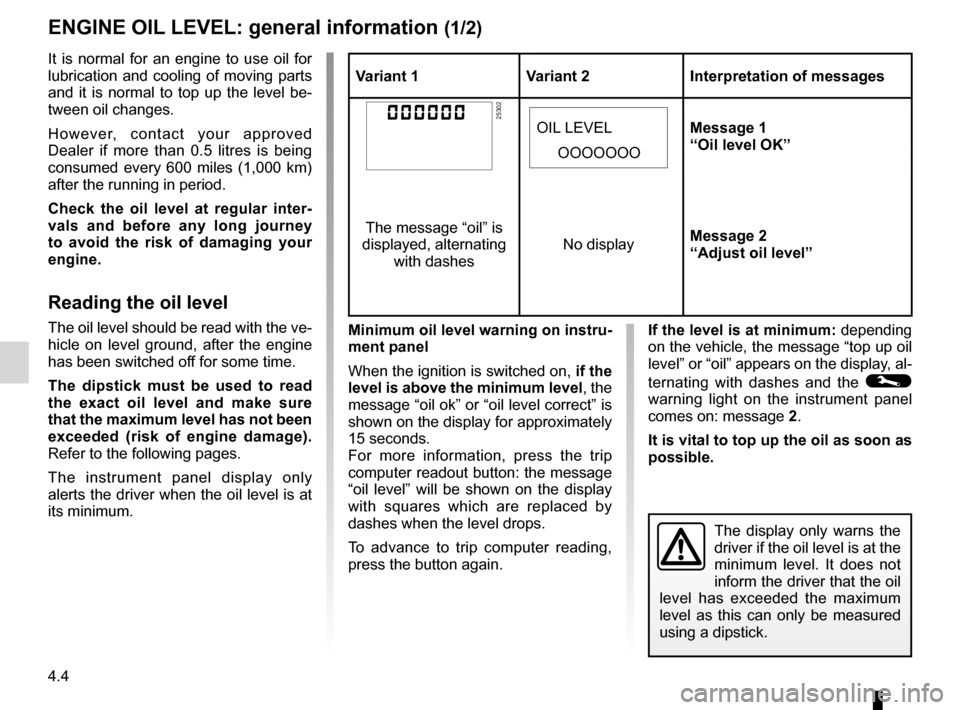
Variant 1 Variant 2Interpretation of messages
25302Message 1
“Oil level OK”
OIL LEVEL
OOOOOOO
The message “oil” is
displayed, alternating with dashes No display
Message 2
“Adjust oil level”
If the level is at minimum: depending
on the vehicle, the message “top up oil
level” or “oil” appears on the display, al-
ternating with dashes and the
©
warning light on the instrument panel
comes on: message 2.
It is vital to top up the oil as soon as
possible.
Engine oil level: general information
The display only warns the
driver if the oil level is at the
minimum level. It does not
inform the driver that the oil
level has exceeded the maximum
level as this can only be measured
using a dipstick.
Minimum oil level warning on instru-
ment panel
When the ignition is switched on, if the
level is above the minimum level, the
message “oil ok” or “oil level correct” is
shown on the display for approximately
15 seconds.
For more information, press the trip
computer readout button: the message
“oil level” will be shown on the display
with squares which are replaced by
dashes when the level drops.
To advance to trip computer reading,
press the button again.
It is normal for an engine to use oil for
lubrication and cooling of moving parts
and it is normal to top up the level be-
tween oil changes.
However, contact your approved
Dealer if more than 0.5 litres is being
consumed every 600 miles (1,000 km)
after the running in period.
Check the oil level at regular inter
-
vals and before any long journey
to avoid the risk of damaging your
engine.
Reading the oil level
The oil level should be read with the ve-
hicle on level ground, after the engine
has been switched off for some time.
The dipstick must be used to read
the exact oil level and make sure
that the maximum level has not been
exceeded (risk of engine damage).
Refer to the following pages.
The instrument panel display only
alerts the driver when the oil level is at
its minimum.
ENGINE OIL LEVEL: general information (1/2)
Page 179 of 264

ENG_NU_853-8_BCSK85_Renault_4
Engine oil grade
Refer to the Maintenance S")
JauneNoirNoir texte
4.7
ENG_UD24922_4
Niveau huile moteur : appoint, remplissage (X85 - B85 - C85 - S85 - K85\
- Renault)
ENG_NU_853-8_BCSK85_Renault_4
Engine oil grade
Refer to the Maintenance Service
Booklet for your vehicle.
ENGINE OIL LEVEL: topping up/filling (2/2)
Never run the engine in an
enclosed space as exhaust
gases are poisonous.
Engine oil change : if you
are changing the oil when
the engine is hot, be careful
not to scald yourself if the
oil overflows.
Filling: take care when
topping up the oil that
no oil drips onto engine
components - risk of fire.
Remember to refit the cap securely
as there is a risk of fire if oil splashes
onto hot engine components.
When working in the engine
compartment, ensure that
the windscreen wiper stalk
is in the park position.
Risk of injury.
The engine may be hot
when carrying out opera -
tions in close proximity. In
addition, the engine cooling
fan can come on at any moment.
Risk of injury.
Oil changeS e r v i c e i n t e r v a l : r e f e r t o t h e
Maintenance Service Booklet for your
vehicle.
Average capacities for oil change
including oil filter
(for information)
1.2 16V engine : 4.0 litres
1.2 TCE engine: 4.15 litres
1.6 16V engine : 4.7 litres
Engine 1.5 dCi : 4.5 litres
Consult your approved dealer at
once if you notice an abnormal or
repeated drop in any of the fluid
levels.
1
2
Page 180 of 264

levels .................................................... (up to the end of the DU)
engine coolant ....................................................... (current page)
tanks and reservoirs coolant ............................................................. (current page)
levels: coolant ............................................................. (current page)
4.8
ENG_UD19908_3
Niveau / Filtres (X85 - B85 - C85 - S85 - K85 - Renault)
ENG_NU_853-8_BCSK85_Renault_4
Jaune NoirNoir texte
Frequency of checking coolant level
Check the coolant level regularly
(very severe damage is likely to be
caused to the engine if it runs out of
coolant).
If the level needs to be topped up, only
use products approved by our Technical
Department which ensure:
– protection against freezing;
– an anti-corrosion protection for the
cooling system.
Levels
engine coolant
Consult your approved dealer at
once if you notice an abnormal or
repeated drop in any of the fluid
levels.
No operations should be
carried out on the cooling
circuit when the engine is
hot.
Risk of burns.
Replacement interval
Refer to the Maintenance Service
Booklet for your vehicle.
Coolant level
With the engine switched off and on
level ground, the level when cold must
be between the MINI and MAXI marks
on reservoir 1.
Top this level up when cold before it
reaches the MINI mark.
LEVELS (1/3)
1
When working in the engine
compartment, ensure that
the windscreen wiper stalk
is in the park position.
Risk of injury.
Page 181 of 264
brake fluid .............................................................. (current page)
levels: brake fluid ........................................................ (current page)
tanks and reservoirs brake fluid ........................................................ (current page)
JauneNoirNoir texte
4.9
ENG_UD19908_3
Niveau / Filtres (X85 - B85 - C85 - S85 - K85 - Renault)
ENG_NU_853-8_BCSK85_Renault_4
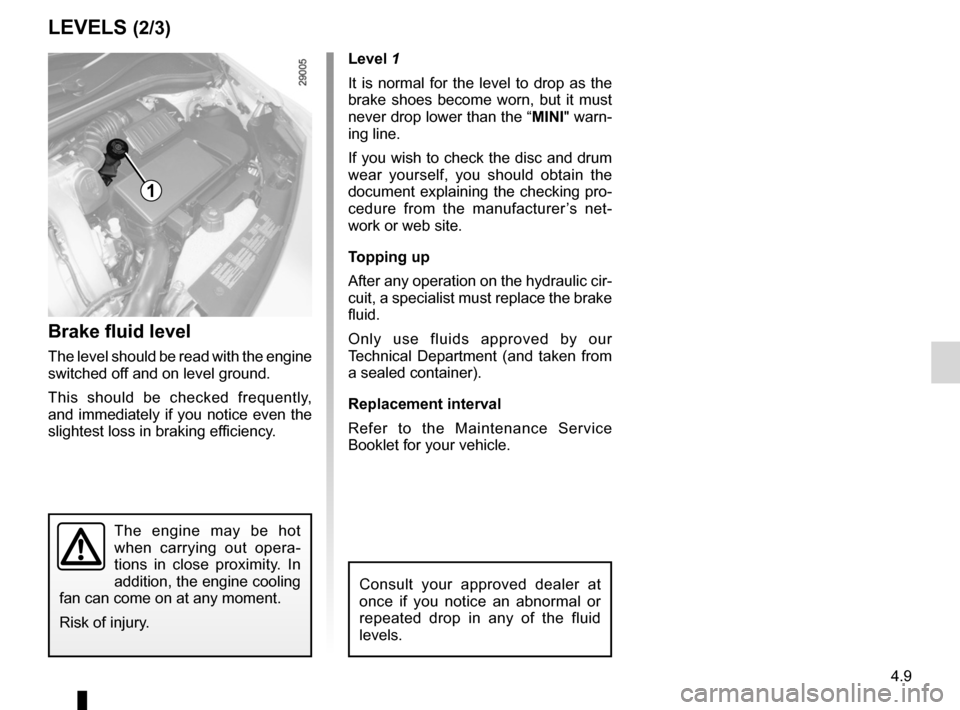
brake fluid
Level 1
It is normal for the level to drop as the
brake shoes become worn, but it must
never drop lower than the “MINI" warn-
ing line.
If you wish to check the disc and drum
wear yourself, you should obtain the
document explaining the checking pro-
cedure from the manufacturer ’s net -
work or web site.
Topping up
After any operation on the hydraulic cir-
cuit, a specialist must replace the brake
fluid.
Only use fluids approved by our
Technical Department (and taken from
a sealed container).
Replacement interval
Refer to the Maintenance Service
Booklet for your vehicle.
Brake fluid level
The level should be read with the engine
switched off and on level ground.
This should be checked frequently,
and immediately if you notice even the
slightest loss in braking efficiency.
LEVELS (2/3)
1
The engine may be hot
when carrying out opera -
tions in close proximity. In
addition, the engine cooling
fan can come on at any moment.
Risk of injury.
Consult your approved dealer at
once if you notice an abnormal or
repeated drop in any of the fluid
levels.
Page 182 of 264

filterair filter ............................................................. (current page)
tanks and reservoirs: windscreen washer .......................................... (current page)
levels: windscreen washer reservoir ........................... (current page)
filter diesel filter ........................................................ (current page)
filter passenger compartment filter .......................... (current page)
4.10
ENG_UD19908_3
Niveau / Filtres (X85 - B85 - C85 - S85 - K85 - Renault)
ENG_NU_853-8_BCSK85_Renault_4
windscreen washer/headlight washer reservoirs
Filters
NOTE
Depending on the vehicle, to find
out the fluid level, use the “dropper-
cap”. To do this, plug hole 2 (in the
cap) and remove the cap.
Filters
The replacement of filter components
(air filter, cabin filter, diesel filter, etc.)
is scheduled in the maintenance opera -
tions for your vehicle.
Replacement intervals for filter el -
ements: refer to the Maintenance
Service Booklet for your vehicle.
Windscreen/headlight washer
reservoir
Topping up
With the engine switched off, open
cap 1 . Fill until you can see the fluid,
then replace the cap.
Liquid
Screen wash product (product with an-
tifreeze in winter).
LEVELS (3/3)/FILTERS
11
2
Jets
Use a needle-type tool to adjust the
angle of the windscreen washer jets.
When working in the engine
compartment, ensure that
the windscreen wiper stalk
is in the park position.
Risk of injury.
The engine may be hot
when carrying out opera -
tions in close proximity. In
addition, the engine cooling
fan can come on at any moment.
Risk of injury.
Page 184 of 264

battery................................................... (up to the end of the DU)
maintenance: mechanical ...................................... (up to the end of the DU)
4.12
ENG_UD19991_3
Batterie (X85 - B85 - C85 - S85 - K85 - Renault)
ENG_NU_853-8_BCSK85_Renault_4
This is located under cover 1 and does
not need to be serviced. Label A
Observe the indications on the battery:
–
2 naked flames and smoking forbid-
den;
– 3 eye protection required;
– 4 keep away from children;
– 5 explosive materials;
– 6 refer to the handbook;
– 7 corrosive materials.
Battery
BATTER y
1
2
Handle the battery with care
as it contains sulphuric acid,
which must not come into
contact with eyes or skin. If
it does, wash the affected area with
plenty of cold water. If necessary,
consult a doctor.
Ensure that naked flames, red hot
objects and sparks do not come into
contact with the battery as there is a
risk of explosion.
The battery is a specific
type , please ensure it is
replaced with the same
type. Consult an approved
dealer.
A234
567
The engine may be hot
when carrying out opera -
tions in close proximity. In
addition, the engine cooling
fan can come on at any moment.
Risk of injury.
Replacing the batteryAs this operation is complex, we advise
you to contact an approved Dealer.
Page 185 of 264

maintenance:bodywork ........................................ (up to the end of the DU)
washing ................................................ (up to the end of the DU)
paintwork maintenance ................................... (up to the end of the DU)
anti-corrosion protection ........................................ (current page)
4.13
ENG_UD26811_2
Entretien de la carrosserie (peinture mate) (X44 - X77 - J77 - X85 - \
B90 - X61 - TEST - X77 ph2 - X95 - B95 - D95 - K95 - J95 - R95 - L90 Ph2 - F90 Ph2 - R90\
Ph2 - X62
ENG_NU_853-8_BCSK85_Renault_4
Bodywork maintenance
BODyWORK MAINTENANCE (1/2)
y ou should
Wash your car frequently, with the
engine off, with cleaning products rec-
ommended by the manufacturer (never
use abrasive products). Rinse thor -
oughly beforehand with a jet:
– spots of tree resin and industrial
grime;
– mud in the wheel arches and under -
neath the body which forms damp
patches;
– bird droppings , which cause a
chemical reaction with the paint that
rapidly discolours paintwork and
may even cause the paint to peel
off;
wash the vehicle immediately to
remove these marks since it is im -
possible to remove them by polish -
ing;
– salt, particularly in the wheel arches
and underneath the body after driv -
ing in areas where the roads have
been gritted.
Remove any plant matter (resin, leaves,
etc.) from the vehicle regularly.
What you should not doDo not degrease or clean mechani -
cal components (e.g. the engine com -
partment), underneath the body, parts
with hinges (e.g. inside the doors) and
painted plastic external fittings (e.g.
bumpers) using high-pressure clean -
ing equipment or by spraying on prod-
ucts not approved by our Technical
Department. Doing this could give rise
to corrosion or operational faults.
Wash the vehicle in bright sunlight or
freezing temperatures.
Do not scrape off mud or dirt without
pre-wetting.
Allow dirt to accumulate on the exterior.
Allow rust to form following minor im -
pacts.
Do not use solvents not approved by
our Technical Department to remove
stains as this could damage the paint-
work.
Do not drive in snow or muddy condi -
tions without washing the vehicle, par-
ticularly under the wheel arches and
body.
A well-maintained vehicle will last
longer. It is therefore recommended to
maintain the exterior of the vehicle reg-
ularly.
Your vehicle has been treated with very
effective anti-corrosion products. It is
nevertheless subject to various outside
influences.
Corrosive agents in the atmosphere
–
atmospheric pollution (built-up and
industrial areas),
– saline atmospheres (near the sea,
particularly in hot weather),
– seasonal and damp weather condi -
tions (e.g. road salt in winter, water
from road cleaners, etc.).
Minor impacts
Abrasive action
Dust and sand in the air, mud, road grit
thrown up by other vehicles, etc.
You should take a number of minor pre-
cautions in order to safeguard your ve-
hicle against such risks.