2012 RENAULT CLIO SPORT TOURER engine
[x] Cancel search: enginePage 17 of 264
child safety............................................................. (current page)
children .................................................................. (current page)
JauneNoirNoir texte
1.11
ENG_UD12573_2
Carte Renault en mode mains libres : utilisation (X85 - B85 - C85 - S85\
- K85 - Renault)
ENG_NU_853-8_BCSK85_Renault_1
If you wish to check that the doors are
locked after locking with the RENAULT
card or buttons on the handles, you
have approximately three seconds to
try the door handles without unlocking
them.
After this delay, the hands-free mode
is activated once again and any move-
ment of the handle will unlock the doors.
If a door or the tailgate is open or not
properly shut, or if a card is in the
reader, the doors or tailgate lock then
quickly unlock and the hazard warning
lights and indicator lights do not flash.Locking the vehicle
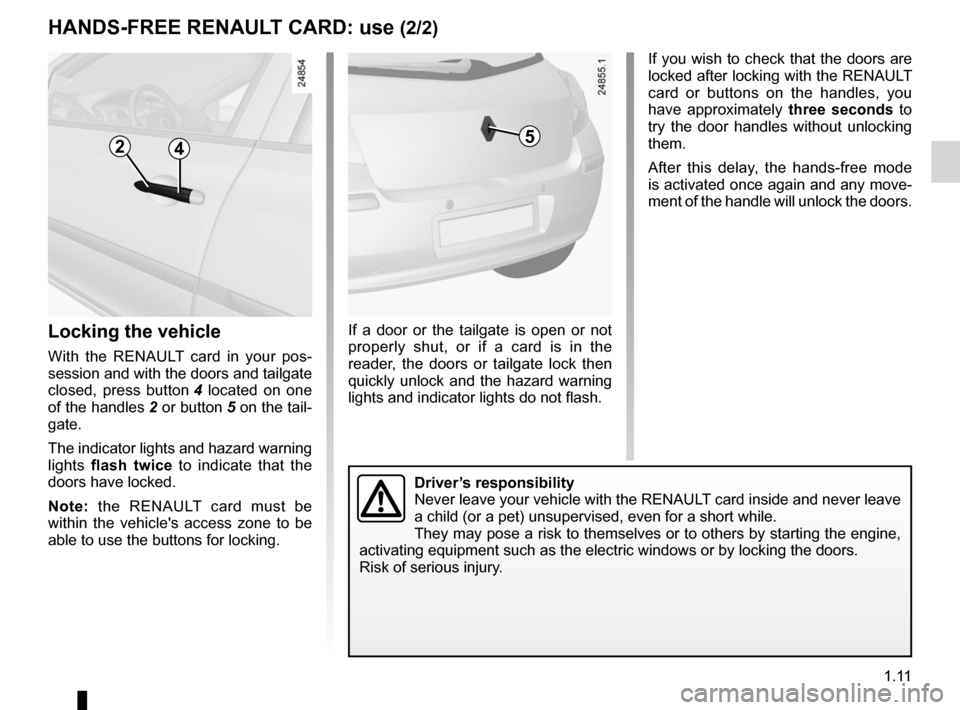
With the RENAULT card in your pos -
session and with the doors and tailgate
closed, press button 4 located on one
of the handles 2 or button 5 on the tail-
gate.
The indicator lights and hazard warning
lights flash twice to indicate that the
doors have locked.
Note: the RENAULT card must be
within the vehicle's access zone to be
able to use the buttons for locking.
HANDS-FREE RENAULT CARD: use (2/2)
245
Driver’s responsibility
Never leave your vehicle with the RENAULT card inside and never leave
a child (or a pet) unsupervised, even for a short while.
They may pose a risk to themselves or to others by starting the engine,
activating equipment such as the electric windows or by locking the door\
s.
Risk of serious injury.
Page 20 of 264

ENG_NU_853-8_BCSK85_Renault_1
Child safety
Vehicles fitted with switch 3
Press switch 3 to inhibit")
1.14
ENG_UD22281_3
Ouverture et fermeture des portes (X85 - B85 - C85 - S85 - K85 - Renaul\
t)
ENG_NU_853-8_BCSK85_Renault_1
Child safety
Vehicles fitted with switch 3
Press switch 3 to inhibit operation of
the rear electric windows and opening
of the rear doors from the inside. The
indicator light in the switch lights up.
Other cases
Lower lever 4 and check from the inside
that the doors are securely locked, to
prevent the rear doors being opened
from the inside.
OPENING AND CLOSING THE DOORS (2/2)
3
4
Safety of rear occupants
The driver can authorise
operation of the rear doors
and, depending on the ve -
hicle, the electric windows by press-
ing switch 3; the integrated indicator
light goes out.
Depending on the vehicle, in the
event of a fault:
– a beep sounds;
– a message is displayed on the in-
strument panel;
– the integrated indicator does not
light up.
If the battery has been discon -
nected, press switch 3 on the side
with the symbol to lock the rear
doors.
Driver’s responsibility when parking or stopping the vehicle
Never leave an animal, child or adult who is not self-sufficient alone on
your vehicle, even for a short time.
They may pose a risk to themselves or to others by starting the engine,
activating equipment such as the electric windows or by locking the door\
s.
Also, in hot and/or sunny weather, please remember that the temperature inside
the passenger compartment increases very quickly.
RISK OF DEATH OR SERIOUS INJURY.
Page 24 of 264
central door locking .............................. (up to the end of the DU)
doors/tailgate ........................................ (up to the end of the DU)
locking the doors .................................. (up to the end of the DU)
RENAULT ANTI-INTRUDER DEVICE (RAID) .......(current page)
closing the doors ................................................... (current page)
1.18
ENG_UD19716_2
Condamnation automatique des ouvrants en roulage (X85 - B85 - C85 - S85\
- K85 - Renault)
ENG_NU_853-8_BCSK85_Renault_1
Operating principle
After the vehicle is started, the system
automatically locks the doors once your
speed reaches approximately 5 mph
(7 km/h).
The door can be unlocked:
– by pressing the door unlocking
button 1.
– when stationary, by opening a front
door.
Note: if a door is opened, it will auto-
matically lock again when the vehicle
reaches a speed of 5 mph (7 km/h).
Operating faults
If you find an operating fault (no auto -
matic locking, the indicator light incor -
porated in button 1 does not light up
when trying to lock the doors and tail -
gate, etc.), firstly check that the doors
and tailgate are properly closed. If they
are closed correctly, contact an ap -
proved Dealer.
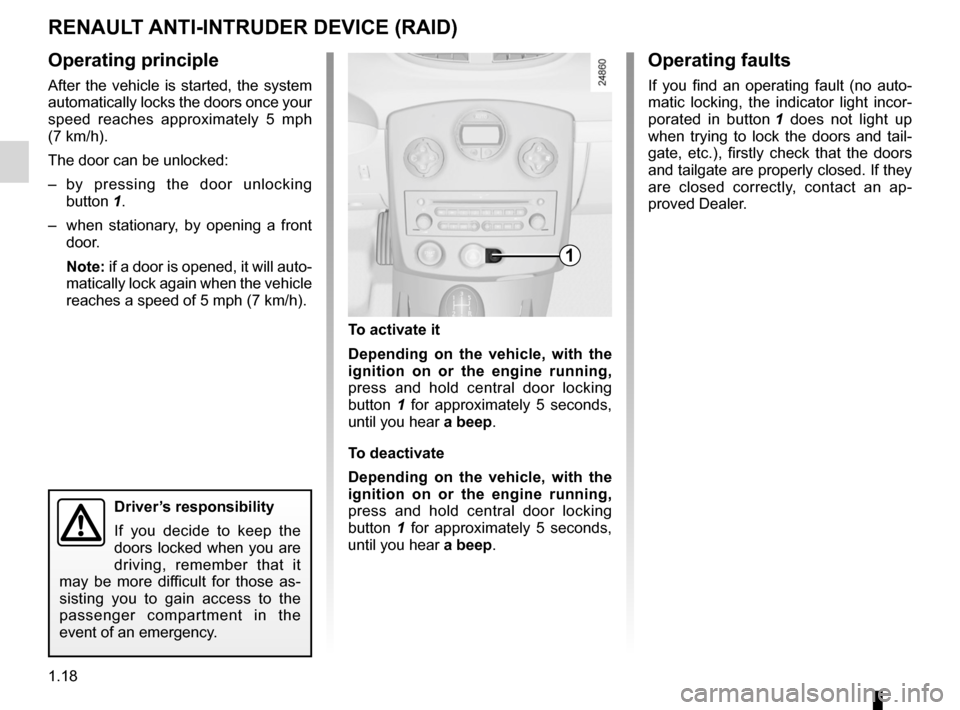
To activate it
Depending on the vehicle, with the
ignition on or the engine running,
press and hold central door locking
button 1 for approximately 5 seconds,
until you hear a beep.
To deactivate
Depending on the vehicle, with the
ignition on or the engine running,
press and hold central door locking
button 1 for approximately 5 seconds,
until you hear a beep.
Automatic locking when driving
RENAULT ANTI-INTRUDER DEVICE (RAID)
1
Driver’s responsibility
If you decide to keep the
doors locked when you are
driving, remember that it
may be more difficult for those as -
sisting you to gain access to the
passenger compartment in the
event of an emergency.
Page 25 of 264
engine immobiliser................................(up to the end of the DU)
engine immobiliser................................ (up to the end of the DU)
1.19
ENG_UD10518_1
Système antidémarrage (X85 - B85 - C85 - S85 - K85 - Renault)
ENG_NU_853-8_BCSK85_Renault_1
Engine immobiliser
Operating fault warning light
If the warning light continues to flash or
stays lit up permanently following an at-
tempt to start the engine, this indicates
a fault in the system.
In this case, use the second key or card
(supplied with the vehicle). If the fault
is still present, contact an approved
Dealer, as they are the only personnel
qualified to repair the engine immobi -
liser system.
If there is interference and/or the hands -
free RENAULT card is not recognised,
move the card or insert it fully into the
card reader.
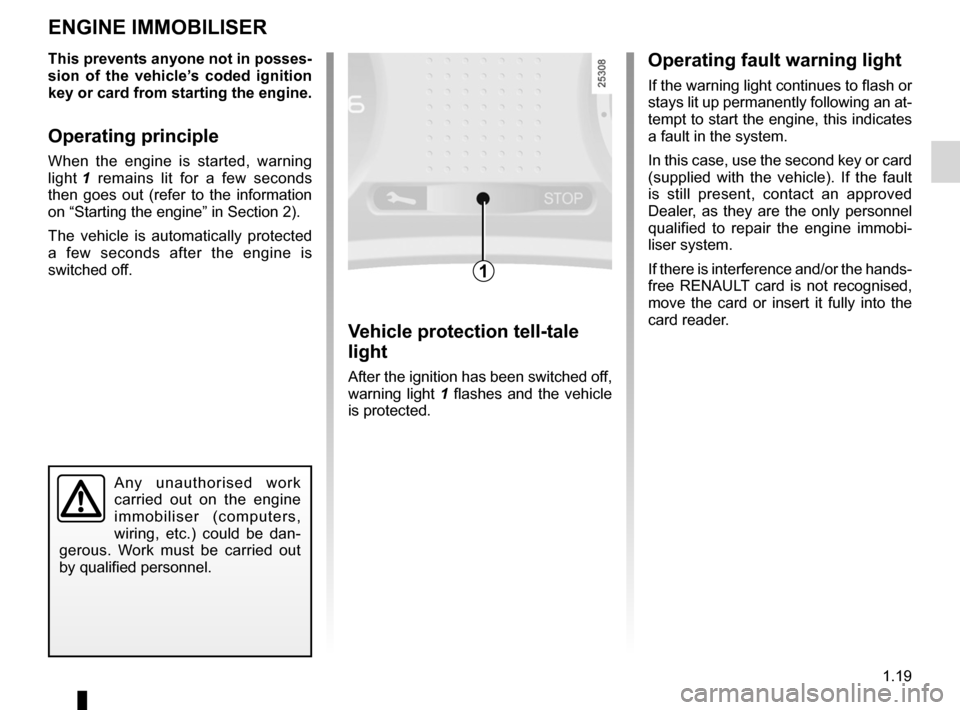
Vehicle protection tell-tale
light
After the ignition has been switched off,
warning light 1 flashes and the vehicle
is protected.
This prevents anyone not in posses-
sion of the vehicle’s coded ignition
key or card from starting the engine.
Operating principle
When the engine is started, warning
light
1 remains lit for a few seconds
then goes out (refer to the information
on “Starting the engine” in Section 2).
The vehicle is automatically protected
a few seconds after the engine is
switched off.
ENGINE IMMOBILISER
1
Any unauthorised work
carried out on the engine
immobiliser (computers,
wiring, etc.) could be dan -
gerous. Work must be carried out
by qualified personnel.
Page 30 of 264
steering wheeladjustment ...................................... (up to the end of the DU)
power-assisted steering ......................................... (current page)
variable power-assisted steering ........................... (current page)
1.24
ENG_UD10536_1
Volant de direction (X85 - B85 - C85 - S85 - K85 - Renault)
ENG_NU_853-8_BCSK85_Renault_1
Power Assisted Steering
Never drive with an inadequately
charged battery.
Variable power assisted
steering
The variable power assisted steering
system is equipped with an electronic
control system which alters the level of
assistance to suit the vehicle speed.
Steering is made easier during parking
manoeuvres (for added comfort) whilst
the force needed to steer increases
progressively as the speed rises (for
enhanced safety at high speeds).
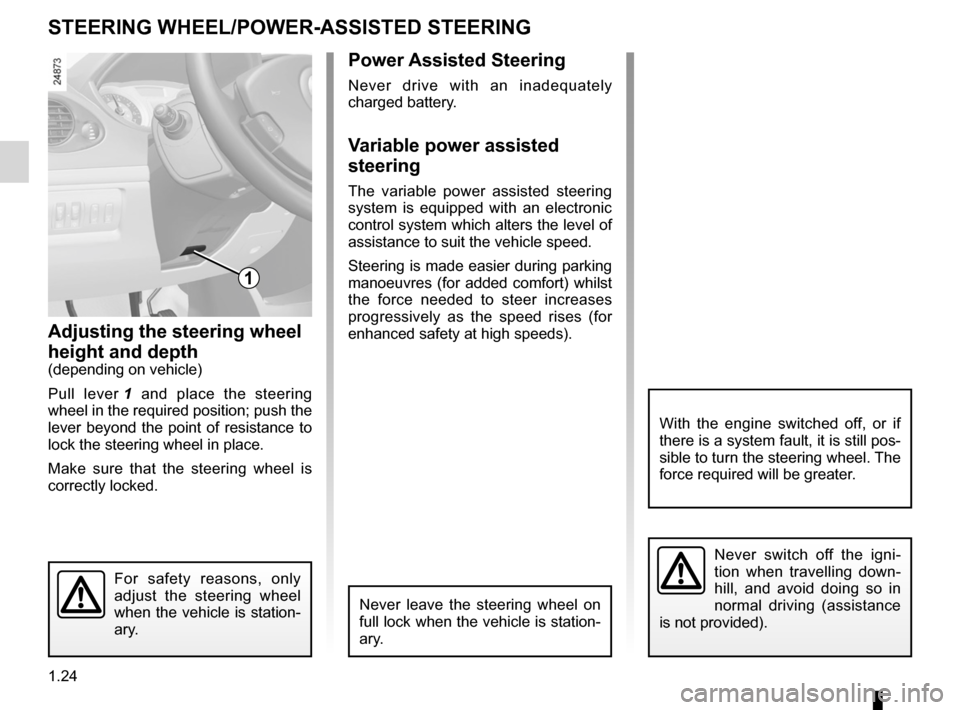
Adjusting the steering wheel
height and depth
(depending on vehicle)
Pull lever 1 and place the steering
wheel in the required position; push the
lever beyond the point of resistance to
lock the steering wheel in place.
Make sure that the steering wheel is
correctly locked.
Steering wheel/Power-assisted steering
Never leave the steering wheel on
full lock when the vehicle is station-
ary.
For safety reasons, only
adjust the steering wheel
when the vehicle is station-
ary.
STEERING WHEEL/POWER-ASSISTED STEERING
1
Never switch off the igni -
tion when travelling down -
hill, and avoid doing so in
normal driving (assistance
is not provided).
With the engine switched off, or if
there is a system fault, it is still pos-
sible to turn the steering wheel. The
force required will be greater.
Page 37 of 264

ENG_NU_853-8_BCSK85_Renault_1
METHODS OF RESTRAINT IN ADDITION TO THE")
JauneNoirNoir texte
1.31
ENG_UD19771_3
Dispositifs complémentaires à la ceinture avant (X85 - B85 - C85 \
- S85 - K85 - Renault)
ENG_NU_853-8_BCSK85_Renault_1
METHODS OF RESTRAINT IN ADDITION TO THE FRONT SEAT BELTS (3/4)
Operating faults
Warning light 4 å will light up on
the instrument panel when the ignition
is turned on and then go out after a few
seconds.
If it does not light up when the ignition
is switched on, or comes on when the
engine is running, there is a fault in the
system.
Contact your approved Dealer as soon
as possible. Your protection will be re-
duced until this fault is rectified.
4
Operation
This system is only operational when
the ignition is switched on.
In a severe frontal impact, the air bags
inflate rapidly, cushioning the impact
of the driver’s head and chest against
the steering wheel and of the front pas-
senger against the dashboard. The air
bags then deflate immediately so that
the passengers are not in any way hin-
dered from leaving the vehicle.
Page 42 of 264
child safety............................................ (up to the end of the DU)
child restraint/seat ................................ (up to the end of the DU)
child restraint/seat ................................ (up to the end of the DU)
child restraint/seat ................................ (up to the end of the DU)
child seats ............................................. (up to the end of the DU)
transporting children ............................. (up to the end of the DU)
children ................................................. (up to the end of the DU)
1.36
ENG_UD18356_1
Sécurité enfants : généralités (X45 - H45 - L38 - X38 - \
X32 - Renault)
ENG_NU_853-8_BCSK85_Renault_1
Jaune NoirNoir texte
Child safety: General information
CHILD SAFETY : General information (1/2)
Carrying children
Children, and adults, must be correctly
seated and strapped in for all journeys.
The children being carried in your vehi-
cle are your responsibility.
A child is not a miniature adult. Children
are at risk of specific injuries as their
muscles and bones have not yet fin -
ished growing. The seat belt alone
would not provide suitable protection.
Use an approved child seat and ensure
you use it correctly.
A collision at 30 mph (50
km/h) is the same as fall -
ing a distance of 10 metres.
Transporting a child without
a restraint is the equivalent of allow -
ing him or her to play on a fourth -
floor balcony without railings.
Never travel with a child held in your
arms. In the event of an accident,
you will not be able to keep hold of
the child, even if you yourself are
wearing a seat belt.
If your vehicle has been involved in
a road accident, replace the child
seat and have the seat belts and
ISOFIX anchorage points checked.
To prevent the doors being
opened, use the “Child
safety” device (refer to the
information on “Opening
and closing the doors” in Section 1).
D r i v e r ’s r e s p o n s i b i l i t y
when parking or stopping
the vehicle
Never leave an animal,
child or adult who is not self-suffi -
cient alone on your vehicle, even for
a short time.
They may pose a risk to themselves
or to others by starting the engine,
activating equipment such as the
electric windows or by locking the
doors.
Also, in hot and/or sunny weather,
please remember that the tempera-
ture inside the passenger compart-
ment increases very quickly.
RISK OF DEATH OR SERIOUS
INJURY.
Page 59 of 264

ENG_NU_853-8_BCSK85_Renault_1
DRIVING POSITION: LEFT-HAND DRIVE (2/2)
1 Side a")
JauneNoirNoir texte
1.53
ENG_UD19781_2
Poste de conduite direction à gauche (X85 - B85 - C85 - S85 - K85 - \
Renault)
ENG_NU_853-8_BCSK85_Renault_1
DRIVING POSITION: LEFT-HAND DRIVE (2/2)
1 Side air vent.
2 Stalk for:
– direction indicator lights;
– exterior lights;
– front fog lights;
– rear fog lights.
3 Instrument panel.
4 Driver ’s Airbag location, horn,
cruise control/speed limiter con -
trols.
5 – Radio remote control.
– Hands-free telephone inte -
grated control.
6 Stalk for:
– windscreen and rear screen
wash/wipe;
– trip computer and warning
system information readout.
7 Ignition switch (vehicle with key).
8 Centre air vents. 9 Warning lights for:
– driver’s seat belt warning light;
– deactivating the front passenger
airbag.
10 Display (depending on the vehicle)
of time, temperature, radio infor -
mation, navigation system infor -
mation, etc.
11 Heating or air conditioning con -
trols.
12 Passenger Airbag location.
13 Side air vent.
14 Glove box.
15 Location for radio, navigation
system, etc.
16 Central door locking switch.
17 RENAULT card reader (vehicle
with RENAULT card).
18 Hazard warning lights switch.
19 Gear lever.
20 Cruise control and speed limiter
control.
21 Cigar lighter.
22 Handbrake.
23 Location for a cup holder, ashtray,
etc.
24 Engine start or stop control (vehi -
cle with RENAULT card).
25 Parking distance control switch.
26 Fuse box.
27 Steering column height adjustment
control.
28 Controls for:
– traction control and ESP;
– headlight beam height remote
adjustment;
– instrument panel lighting rheo -
stat.
29 Bonnet release.
The equipment fitted, described below, DEPENDS ON THE VERSION AND COUNTRY.